Izayoi no Fortuna (十六夜のフォルトゥーナ) Review
Rain Falls, Hearts Ache, Where Sorrows Dwell, Gojou Village
Looking at the intro or whatever of Izayoi no Fortuna, you won’t spot any obvious highlight. But successful people always tell us that when there’s no highlight, you should go find one yourself…
Case in point: in the game’s planning credits, we see a familiar name: Satoshi Yaginuma
Who the hell is that? Right—the guy from fripSide who plays piano while shaking his ass, the one in MVs and lives who always looks like he’s desperately holding in a piss.
Times really have changed. Even musicians are getting into Galgame planning now. According to a detailed expose of the Galgame production pipeline I read on Douban, the planner determines the basic plot and outline, while the scenario writer follows that outline to write the script.
So the plot of this game was dreamed up by Satoshi Yaginuma… Out of sheer curiosity about what kind of story a musician would cook up, I played this game…
Of course, I still don’t know if he was in the planning for those fripSide MVs…

The game is called “十六夜のフォルトゥーナ.” “十六夜” refers to the day after Japan’s mid-autumn “十五夜”—the night of the full moon—and “フォルトゥーナ” is Fortuna, the Greek goddess of fate.
Plainly put, you could call this game “Fate of the Sixteenth Night” or “Fate of the Full Moon.” To fit the theme, the game’s day counter uses lunar phase icons—full moon, half moon, etc. Whether Japan’s version is just a knockoff of the Chinese lunar calendar, I don’t know, but it gives off a thick classical vibe. Also worth noting: the entire OP, ED, and even BGM are handled by fripSide. First time I’ve seen fripSide do BGM for a Galgame. The overall music style is… weird. Classical with a hint of melancholy, and a slightly haunting, empty feel to it. Looking at the plot, it fits pretty well—clearly deliberate to match the story beats.
There are four romanceable characters: the nun “Lucia” 露西亚, the protagonist’s cousin Kujou Otome, and the twin sisters Shigure and Konagi. Story-wise, each route is largely independent, though they connect a bit.
The story kicks off with the protagonist, Kujou Kaoru, near death from thirst after a long journey to Gojou-cho, saved by the nun Lucia. He’s accompanied by his cousin and fiancée, Kujou Otome. The siblings decide to stay in town a while—the guy camps by the beach, Otome stays at Lucia’s church. Soon, the protagonist spots a girl sitting in the treetops who calls herself Konagi. This Konagi can be seen by the protagonist, by Otome, and by Lucia—but not by the tearful girl praying in the church who calls herself Shigure, who looks so much like Konagi that the protagonist initially mistakes her for the same person. Later he learns that Konagi is actually dead, and Shigure is her twin sister, drowning in grief over just having lost her.

Now the protagonist’s backstory drops: he’s from the Kujou family, whose members more or less all have some kind of power—ancestral bloodline stuff. Lucia, as a nun, has powers too. That’s why only the protagonist, his sister, and Lucia can see Konagi’s ghost, while Konagi’s own sister Shigure cannot. With Konagi’s help, the protagonist and company eventually coax Shigure out of her mourning. Finally, the protagonist risks letting Konagi’s spirit possess him so the sisters can meet one more time, fully pulling the little sister out of her gloom, and telling her that Konagi will always be by her side.
Is the story over? Not even close…
Now begins the daily life between the protagonist, Otome, Lucia, Konagi, and Shigure. Otome clings to him every day, calling herself his fiancée; Konagi chats with him often; Lucia, as a nun, patrols the town every night because evil spirits exist there. At the very north, atop the high mountain, lies Gojou Castle, abandoned since ancient times, overrun with evil spirits. Lucia’s job each night is to destroy the spirits that appear in town using a cross and holy water.
Here the game’s mysteries start piling up.
Konagi has been a ghost since she first appeared, but she can’t remember how she died. Lucia patrols every night to destroy evil spirits, and those spirits come from the mountain’s Gojou Castle—why is that abandoned place full of them? The protagonist once saw a vision of the future—Otome and Lucia in danger—but he couldn’t see what kind of danger.
These mysteries get resolved in the routes, but not in the first two playthroughs. You have to finish Konagi’s and Shigure’s routes first to unlock Otome’s and Lucia’s routes.
Konagi/Shigure => Otome => Lucia
That’s roughly the unlock order.
I’d say Konagi’s and Shigure’s routes are a bit of a bait-and-switch. They have the least connection to the main plot—just the protagonist in daily life, Konagi and Shigure realizing they both have feelings for him, Shigure confessing, and the protagonist deciding whether to accept. If he accepts, Shigure becomes his girlfriend, and eventually Konagi’s spirit ascends and vanishes. Later, the daughter born to the protagonist and Shigure looks exactly like Konagi reincarnated.

If he refuses, the protagonist tells Shigure that he actually likes Konagi in her ghost form. The two try dating, but eventually find that human-ghost relationships are genuinely difficult. Then his cousin Otome offers a method: at the cost of sacrificing the protagonist’s lifespan, separate his soul from his body. Normally he can control his body, but when he needs to touch Konagi, he uses his soul…
The protagonist accepts. Though he can touch Konagi, he soon discovers that she can’t remain in this world for long—ghosts eventually have to move on. So Otome, throwing caution to the wind, fetches the doll Konagi gave to Shigure and anchors Konagi’s spirit to it. From then on, the half-spectral protagonist and the doll-bound Konagi become a couple, deciding to wander the world together and leaving the town.
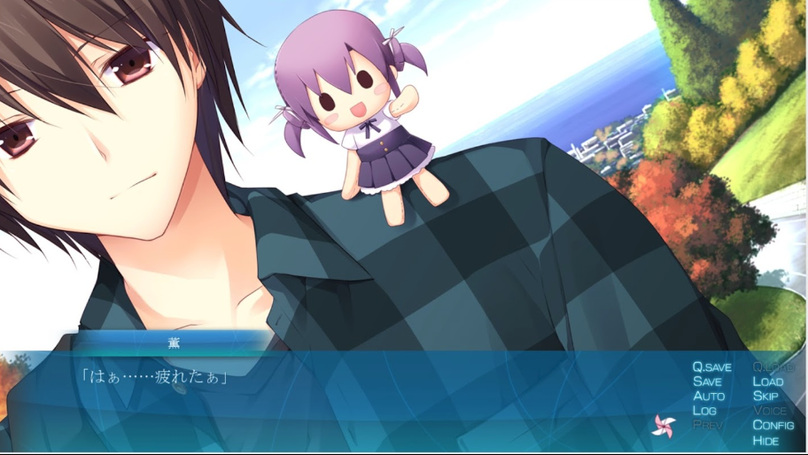
As I said before, Shigure and Konagi’s routes have absolutely nothing to do with solving the main mystery. The real story starts in Otome’s route.
Otome’s route cuts in abruptly—more daily life, then the protagonist realizes he doesn’t mind Otome being his fiancée, she confesses, he’s about to accept, and then suddenly they’re attacked by an evil spirit.
The protagonist blacks out, Otome is abducted, and visions of Gojou Village’s past flood his mind.
Turns out the Kujou family originally lived near Gojou Village. Once, the family had fallen so low only two siblings remained: a brother, Kujou Shinnosuke, and his sister, Kujou Yui. They lived relying on each other. The brother didn’t want to abandon his sister and take a wife; the sister didn’t want to leave her brother and marry out (you know why…). One day, while hunting in the mountains, the brother found a young girl—no name, no past, utterly innocent and carefree. He couldn’t leave her, so he brought her home, and he and Yui named her Kaguya (かぐや). Kaguya quickly settled into their little family; the siblings raised her like a daughter. Then one day, the village suffered a drought—no rain for ages. The brother had to fetch water from another village, gather food from elsewhere too, often gone all day.

Kaguya found it odd and asked:
“Why do you leave in the morning and come back at night?” “Because our village is in a drought. We have to go to the next village for water and food.” “Why is there a drought?” “Maybe the dragon god in the sky is slacking off and won’t make it rain…” “That’s not a thing!” “?????”
After that, the Kujou siblings noticed Kaguya often staring at the sky for no reason. One day, after staring for ages, she told them:
“It’s going to rain.”
Sure enough, clouds gathered and it poured.
The siblings realized then: Kaguya was no ordinary human. Another time, Kujou Yui got hurt, and Kaguya touched the wound—it healed completely…
Word spread that the Kujou siblings had taken in a divine girl. People came from all over seeking healing, and she never refused.
One day, a man claiming to be a merchant came for treatment. Shinnosuke found him suspicious and, after careful observation, realized he was a bandit. He told Kaguya to stop healing him, but she refused. In the end, Shinnosuke relented, let the bandit be healed, and sent him on his way.
Then one day, the wealthy Gojou family of neighboring Gojou Village invited Shinnosuke to bring Kaguya to treat someone.
At the Gojou mansion’s great hall, the Gojou steward insisted that Kaguya was a shrine maiden—and that if she could heal, she could surely curse too. They wanted to imprison her.
Reading between the lines, this was probably the bandit getting revenge.
The Kujou siblings refused, of course. As guards moved to seize Kaguya, Kujou Yui rushed forward and was cut down by a guard’s blade, collapsing in a pool of blood. Shinnosuke, mad with rage, drew his sword and cut down two guards, then held his sister, sobbing uncontrollably.
Kaguya, having witnessed it all, was in despair and agony. Before more guards arrived, she used the last of her power to pour her ability into Yui’s body, reviving her, and teleported the siblings out of the Gojou hall.
When the siblings woke, they saw Kaguya using her magic to slaughter everyone—guards cleaved in two by her spells…
“We’ll always be family… You two run… Leave this to me.”
Those were her last words before she sent the siblings fleeing Gojou Castle. Then, at midnight on the sixteenth night, under the full moon, wings sprouted from her body. She flew into the sky and unleashed her final power: a bolt of lightning destroyed Gojou Castle entirely and cursed the land. Since then, the place has been forever abandoned and swarming with evil spirits.
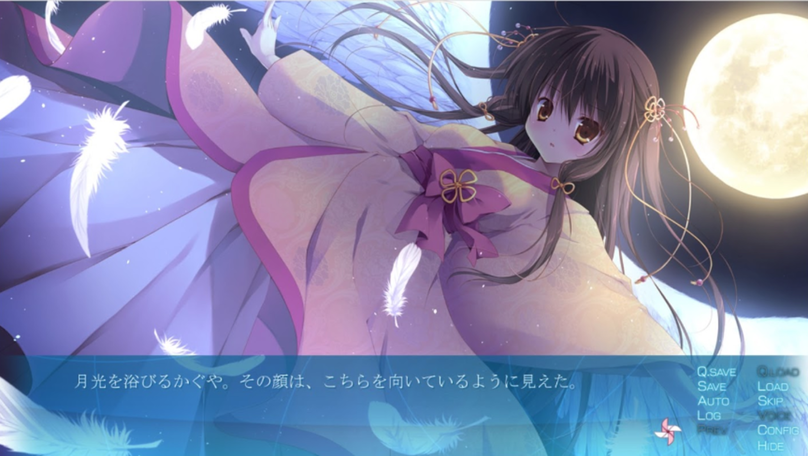
The siblings who escaped Gojou Village chose to flee far away, never to return. Later they married and continued the bloodline. Because Kujou Yui carried Kaguya’s power, the Kujou descendants all have some degree of supernatural ability.
Judging by what we learn later in Lucia’s route, Kaguya’s true identity is probably an angel.
At the end of Otome’s route, the protagonist learns his ancestors’ history, deduces that Otome has been trapped by evil spirits in the abandoned Gojou Castle in Gojou-cho, and heads there with Lucia to fight the spirits. When things look grim, Kaguya’s spirit appears to help the siblings and voluntarily lifts the curse on Gojou Castle:
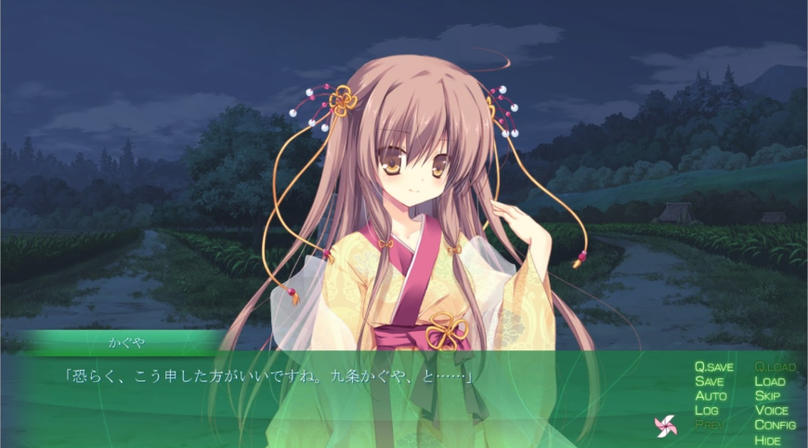
“I intended to curse this place forever… but I never expected the Kujou descendants would come back here…”
By then she calls herself Kujou Kaguya, having become part of the Kujou family. She passes her power to Otome, who uses it to purge the evil spirits from Gojou Castle. The town returns to peace, the protagonist marries his fiancée Kujou Otome, and we get a Happy End.
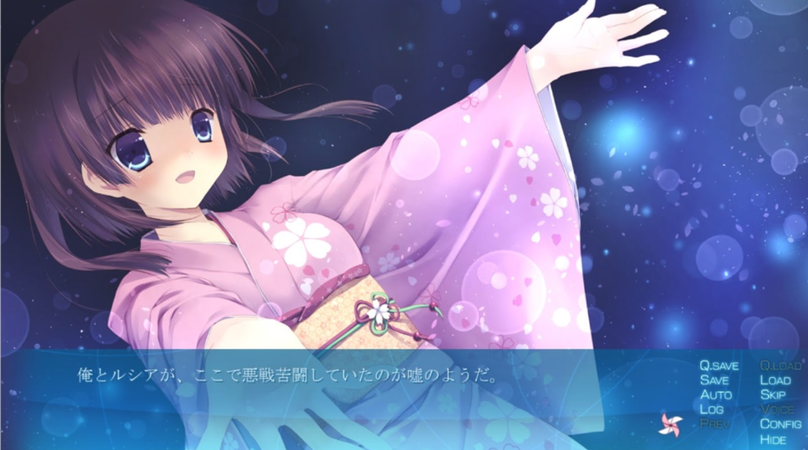
Honestly, Otome’s route basically resolves all the game’s mysteries, and the flashback content has a real Chinese Liaozhai feel to it—which explains why the BGM has that classical flavor.
But some mysteries remain: the vision the protagonist had of Lucia and Otome in mortal danger—what was that about? And how did Konagi die? For those, you need Lucia’s route.
Lucia’s route actually diverges even more from the previous ones, yet it’s still connected.
As the story progresses, Lucia has a dream: her father killed by a crazed girl who calls herself Noel—yes, that Noel—and claims to be Lucia’s sister. Lucia had always been told by her mother that her father died in a car accident. When she finally asks her mother, the truth comes out.
Lucia does have an older sister named Noel. From birth, Noel seemed abnormal. Though the family was with the church, Noel drew demonic and satanic symbols from a young age and refused to accept the church’s teachings.
Then one day, she killed her defenseless father… and declared herself an angel of God.
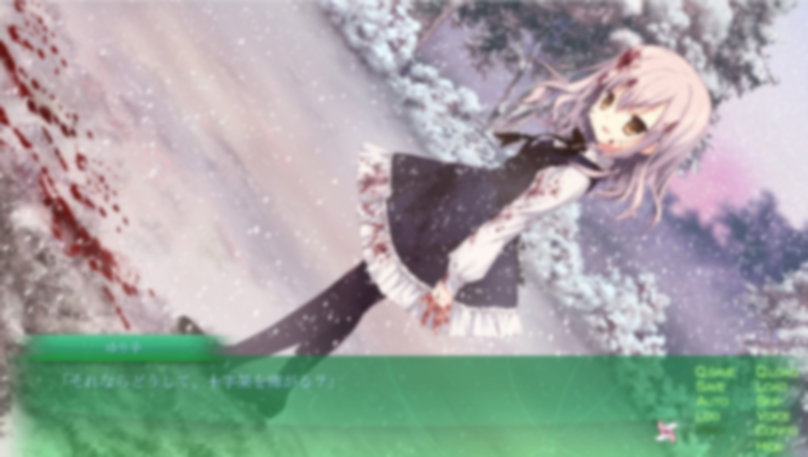
Her mother used a cross on her daughter and found she was afraid of crosses and holy water—meaning she’d been possessed by an evil spirit or demon since birth.
Afterward, her mother never told Lucia she had a sister, and hypnotized Lucia into believing her father died in a car accident.
After killing her father, Noel fled into the mountains. In fact, she didn’t die all those years—she was taken in by many people but kept running. Her mind had been taken over by the demon, and her ultimate goal was to kill her sister and mother. She called it revenge.
So Noel secretly returned to Gojou-cho, attacking children by the roadside, even killing them. Konagi died at her hands (though it’s not stated outright).
Finally, Noel reaches the church. She stabs her mother first, then confronts Lucia.
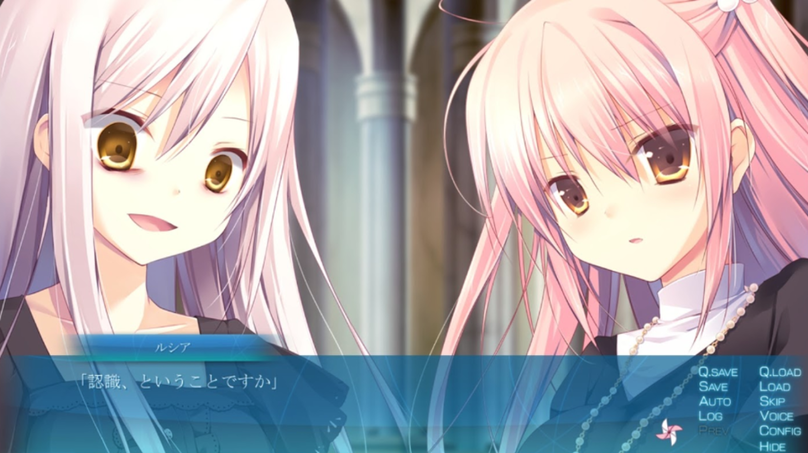
This is the future the protagonist saw: Noel walking step by step toward Lucia and Otome, intending to kill them both…
At the critical moment, the protagonist encourages the timid Lucia. She steels her faith in God, borrows some of the angelic power within Otome, and defeats the demon-possessed Noel. With that, the whole matter of Gojou Castle’s evil spirits and Konagi’s killer is resolved.
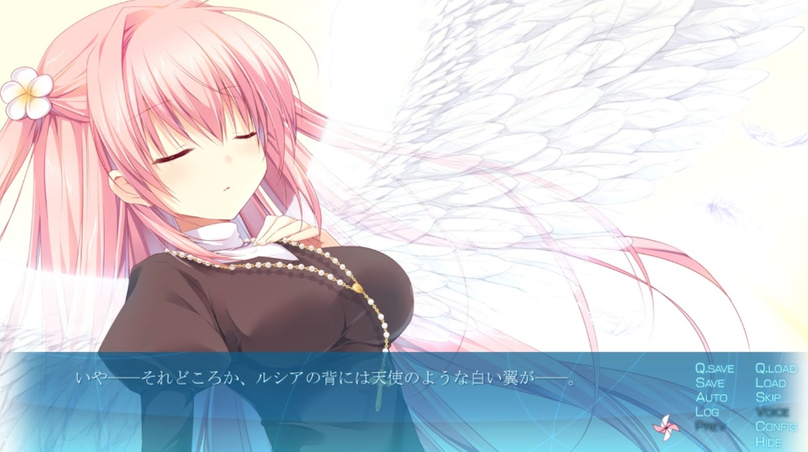
Though it’s not stated outright, Noel’s possession is connected to the curse on Gojou Castle.
Defeated, Noel fades away. The protagonist, having encouraged Lucia, becomes her guardian. The two attend Noel’s funeral together, and the story ends.

Honestly, Lucia’s route isn’t as outstanding as Otome’s, yet it’s the one that closes the game… a bit odd… but not bad per se.
The art style skews young, but the quality is decent. The BGM—well, I’ve said enough, it fits the theme. As for voice acting: Lucia is Kaori Mizuhashi doing her mature sister voice; Konagi is the long-awaited Mai Gotou! Shigure is the class rep from Clover Days, and Kujou Otome is Miyu Kashiwagi—who’s that? The perverted loli from The Sheep’s Library…
The voice work is on point, the art isn’t bad, the music is good, and the plot isn’t a landmine. Does that mean this is a flawless Galgame?
あり得ないだろう
The biggest problem with this game is—the daily life segments are way too long…
I’ve distilled the main plot, but between main story beats, the game stuffs in massive amounts of daily-life scenes. How long? Just for Shigure to properly join the story, you’ll be skipping for 10 minutes; the common route alone is another 10 minutes of skipping… It’s not that the daily life puts you to sleep—honestly, thanks to the excellent voice work, the daily scenes are quite fun—but building suspense for so long without resolving it makes you restless. Especially since the protagonist’s future vision shows Otome and Lucia in danger from the very beginning, yet the payoff is saved for last. Who even remembers that foreshadowing by then?
The game system also shows some thought. It uses something like 11eyes’ multi-perspective system, periodically unlocking other characters’ viewpoints. You can watch them or not, but watching always gives you more story.
This system is called ATS. When a multi-perspective scene triggers, you get a prompt, and the map screen shows whose perspective you can choose:
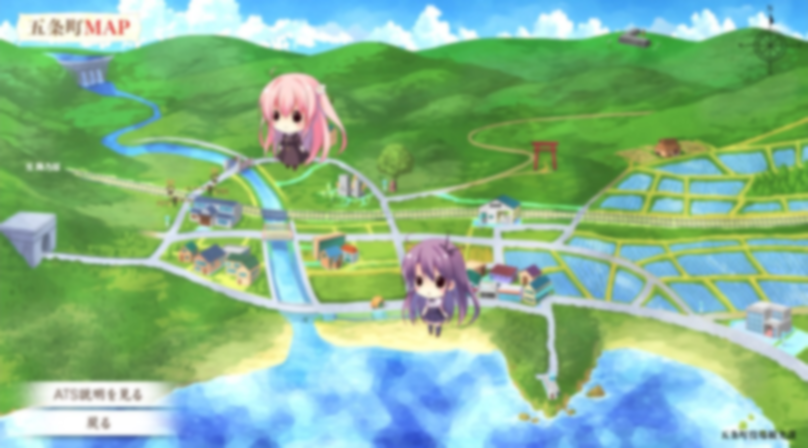
So what’s the verdict on Izayoi no Fortuna? I’d say the main plot is good, the music is good, the art isn’t bad, and the voice actors worked hard. The only catch is you might spend a huge amount of time on daily-life scenes that aren’t boring but have nothing to do with the main plot… And if you skip them, you’ll accidentally miss a ton of ATS scene choices—even more of a loss…
Speaking of which, I’m reminded of the planning credit: Satoshi Yaginuma. Honestly, Izayoi no Fortuna was a pleasant surprise for me. If the story really was led by Yaginuma, then he’s genuinely got some skill—after all, stuffing in all that daily life probably isn’t the planner’s fault.
If a Galgame leaves you with an impression, then Izayoi no Fortuna’s impression for me is steeped in Qingming Festival vibes. The BGM is retro, haunting, and slightly melancholy; Kujou Otome’s kimono adds a classical touch too.
A drizzling rain falls on Qingming days, The traveler’s heart breaks on the way. Asked where the evil spirits are found, The passerby points afar to Gojou Village.
That’s about the… gist of it…
Comments are hosted on the Chinese main site. This mirror is read-only.