Wakasama no Zasuru Sekai (和香様の座する世界) Review
The World Where Waka-sama Dwells
No idea how many years ago, there was a novel-based anime called Humanity Has Declined (人類は衰退しました). The premise: humanity has declined for unknown reasons, the world is overrun by “fairies,” and the female protagonist, a human, observes and interacts with them. Your standard anecdotal setup.
I never read the original, so I can only talk about the anime, and honestly the anime was pretty good. After watching it I was left with three impressions: fun, sci-fi, and what-the-hell-did-I-just-watch. That last one sticks with you the most. You always get the sense the show is “hinting” at or “allegorizing” something, but you can never find the exact parallel, so it’s hard to pin down the author’s stance or viewpoint, what the story is trying to say, blah blah blah. But that’s exactly the appeal of Humanity Has Declined—if it stated its position too clearly, it’d feel like force-feeding you opinions, and it’d be harder to provoke thought. That half-hidden, “still holding the pipa behind the curtain” feeling is just right.
And what’s worth noting: the author of Humanity Has Declined is Tanaka Romeo.
This was the first and only time I’d encountered his work. I had no interest in what he wrote afterward and didn’t follow him much. Then a while back, a game called Waka-sama no Zasu Sekai (和香様の座する世界) came out, and I saw that familiar name in the script credits again: Tanaka Romeo.
And it reminded me of Humanity Has Declined.
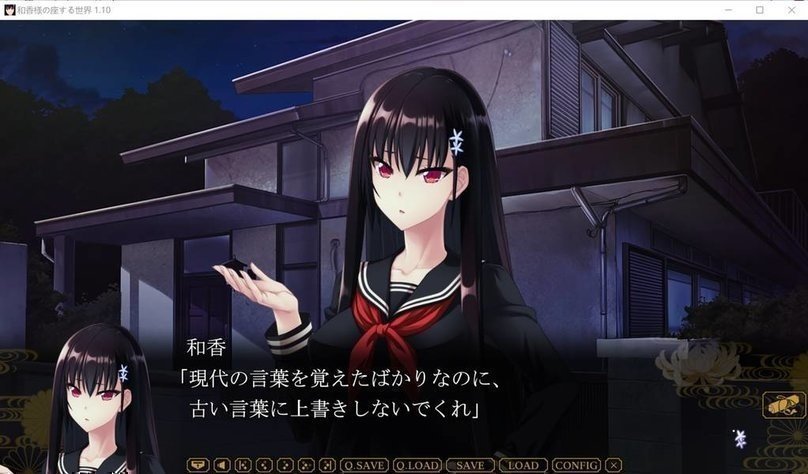
Waka-sama no Zasu Sekai—「和香大人坐镇的世界」or maybe「和香大人降临的世界」if you want to be loose about it—doesn’t really have a clear main plot. It’s fundamentally a parody game, riffing on Japan’s creation myths, and most of what follows is secondary creation built on Japanese folklore and legends. Think A Chinese Odyssey or Wu Kong Zhuan… story-wise it’s not rigorous, it’s more about comedy.
The heroine is of course “Waka,” and the protagonist is a broke-ass loser who inherited his grandfather’s shrine. When he’s at rock bottom, dropped out of school, he accidentally unseals the “Waka-sama” locked inside the shrine, and so begins his fun-filled life among gods and demons.
“Fun-filled” is right, because it really is fun. The story looks packed with monsters and spirits, but it’s mostly snark and comedy. Treat it as a semi-fantasy gag story in the vein of Gintama and it holds up fine. That said, even though it’s mostly parody, the game still describes a lot of things, and those things are buried in the various “small stories” throughout. By the way, this game is actually a “one-way street,” except there are tons of choices, with “marks” hidden in many of them—you need to collect marks to unlock the true route and keep the story going, otherwise you hit a Bad End. So there’s some game-y flavor after all.
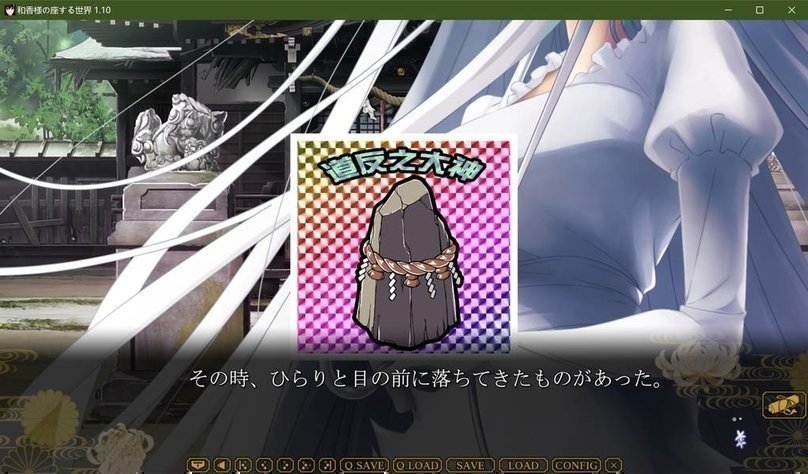
I honestly don’t know how to describe the plot, so let’s just go by the game’s structure: prologue, Shuten-douji chapter, Yamata no Orochi (?) chapter, and the chapter where the scriptwriter loses control and Amaterasu has a catfight (?)…
The prologue introduces the cast. The heroine Waka is actually a Japanese “kunitsu-gami,” a earthbound deity opposed to the “amatsukami,” the heavenly ones. After waking up, Waka mentions she once fought the amatsukami, bringing along her little sister Ruruha—and apparently the two of them lost.
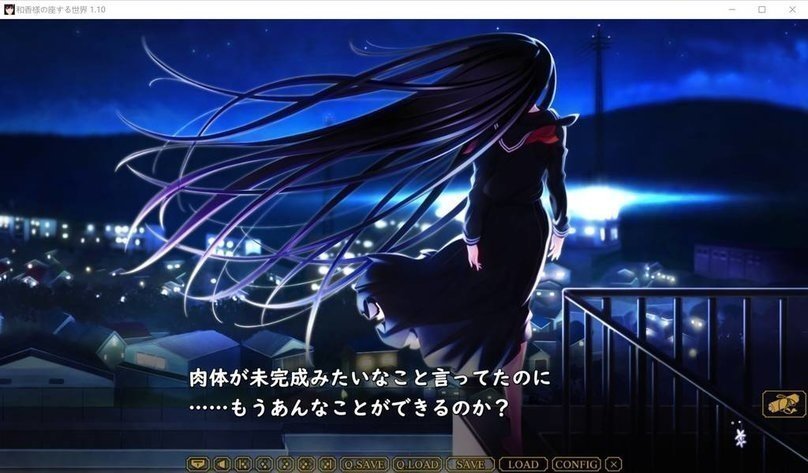
The game explains the concept of the “Yomi road” from the start. China has something similar, but in Japanese myth the Yomi road is tied to Izanagi and Izanami, and Izanagi and Izanami also fucked day and night to create all the random islands of Japan.
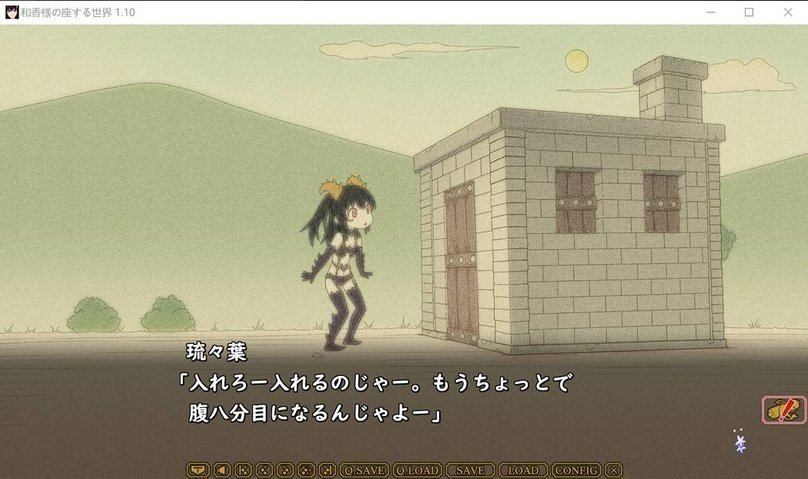
Most of the prologue is given to the little sister Ruruha, and it’s mainly watching the protagonist bicker with a sheltered female demon—about the level of reading a manga, and honestly pretty entertaining.
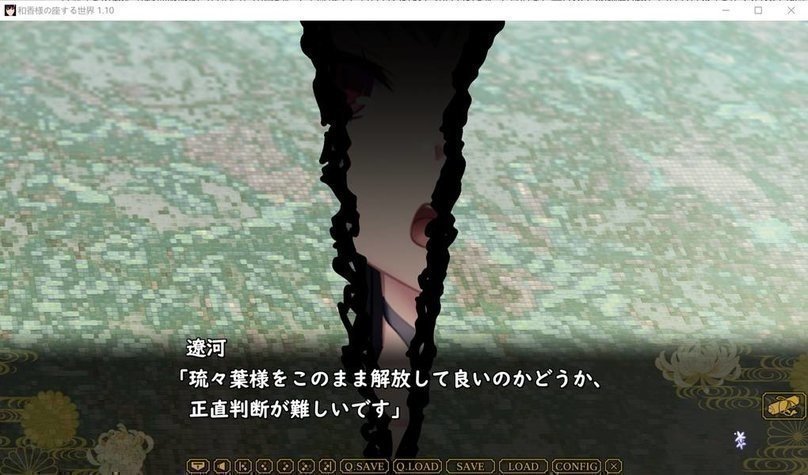
Chapter two is the Hyakki Yagyou Shuten-douji chapter: a bunch of oni sneak into the human world to steal sake, and just as they’re about to get cut down by Doujigiri, the protagonist leads two demons in and KOs them easy. And after the Shuten-douji chapter… my comprehension of the game’s Japanese mythology just started going downhill.
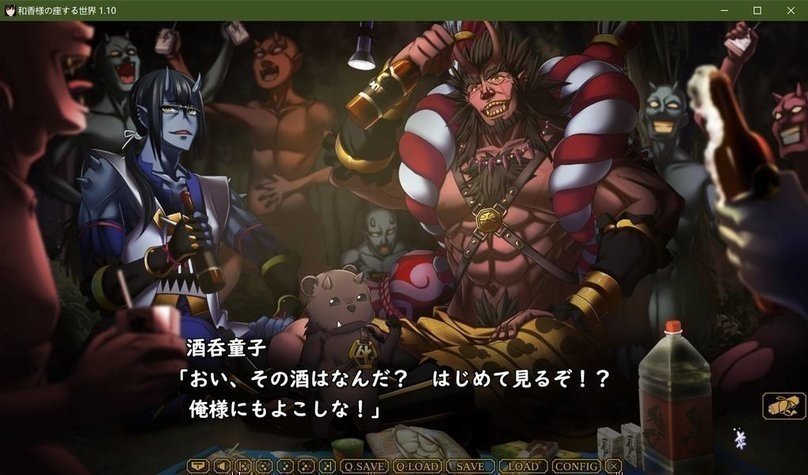
Ah, not that I couldn’t understand—it’s just that it was boring as shit. Or rather, I’m not Japanese, so I just can’t wrap my head around the logic of Japanese myth.
The game uses little vignettes and “re-enactments” to recreate various legends from Japanese myth, and the dumbest part is definitely Izanagi and Izanami fucking and the children they birth becoming the islands of Japan. And then Izanagi coming back from the Yomi road, washing his eye and—what the fuck—washing out Amaterasu… washing his nose and washing out another god…
There’s more familiar Japanese myth content later, more vignettes including the slaying of Yamata no Orochi, the nine-tailed fox and the killing stone. These elements we’ve all heard of to some degree. Even if you don’t know where they come from… you’ve at least seen Naruto, right?
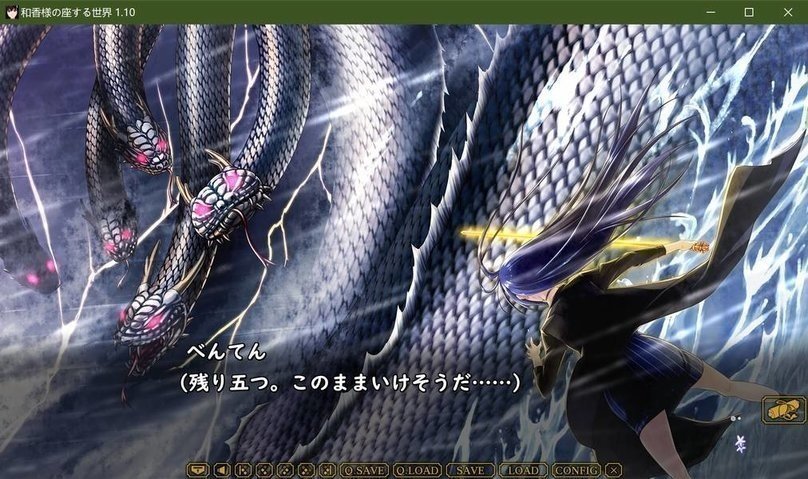
Oh right, plenty of weird shit barges in later too, including “The Three Little Pigs.”
The game eventually wants to take the “vignettes” all the way to the birth of the Japanese emperor. But our protagonist’s identity is unclear, so the script goes off the rails—it even has the protagonist “give birth to himself”… and then that self gives birth to his own wife… and the self and the wife keep giving birth… until the emperor is born. I was staring at my screen like a question-mark-emoji.
Naturally the game ends with the kunitsu-gami vs. amatsukami showdown, but nothing really comes of it and it wraps up hastily. A lot of people want a sequel. I’d say this game probably isn’t getting one. From the start I could follow the story, and the Shuten-douji Hyakki Yagyou chapter was still tolerable. The killing stone and nine-tailed fox stuff is roughly connected to the Su Daji legend, so that’s about fine too. But after that, I feel like my capacity ran out… especially the final “I give birth to myself” move, which just left me confused. Maybe the scriptwriter didn’t know how to wrap it up either and just rushed the ending.
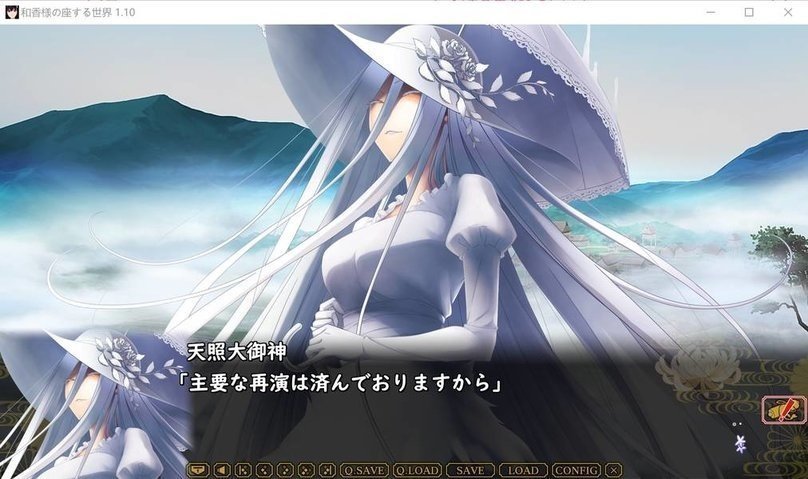
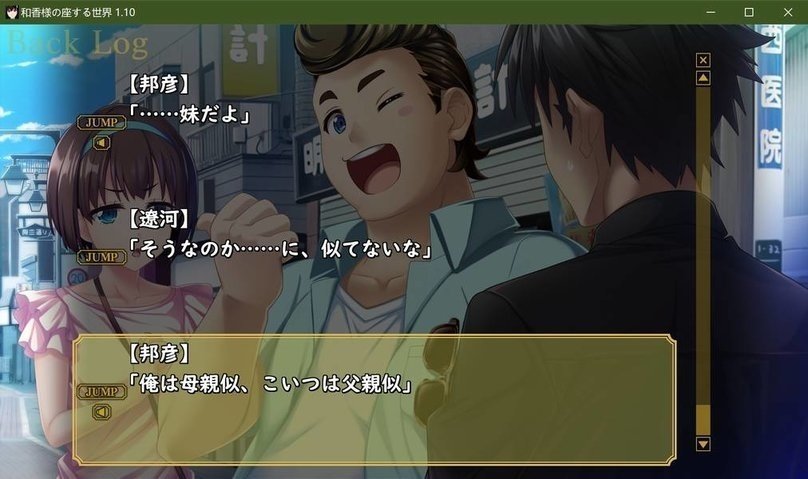
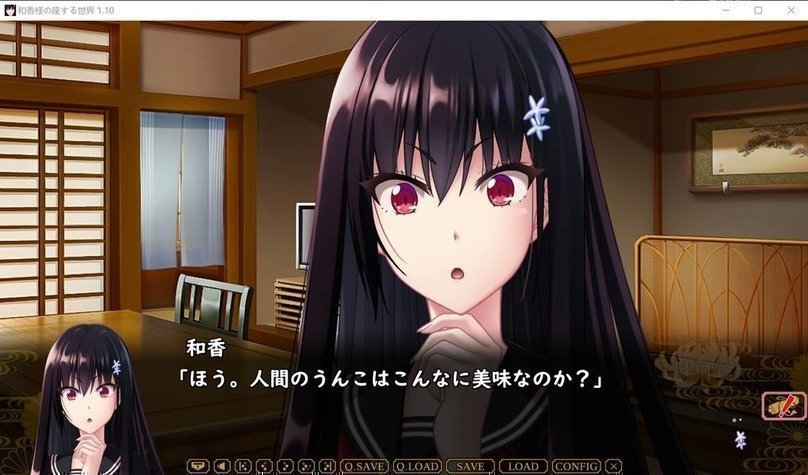
The visuals are okay—they match that slightly dark “god descends” vibe. And the character work is better than the “story” itself. You see the gods look at humans and call them all “hito-gusa”—people like grass, lives as cheap as weeds. And according to the heroine, ancient gods ate people. That stopped in modern society because “modern cooking is too delicious,” apparently. Which is hilarious.
Every character has their own flavor, and the personalities are well-drawn and mature. Voice cast is star-studded: Waka is voiced by Namikawa? No—Ikue? Wait, it’s Hitomi Nabatame. The second heroine, Ono Ryoko. The villain (?) parasol woman is Kitamori Minami. The rest of the cast aren’t slouches either—the commitment to character work is absolutely there.
As for the system, let’s just say it’s “got character.” Like I said, the game is a “one-way street” (even if there are multiple endings at the end, it feels like one line), but it forces you to pick other options by hiding a bunch of “marks.” The biggest effect is that the game feels torn apart, because you don’t know which mark you’re missing that caused the Bad End, so you end up going back to a guide. It doesn’t let players just binge the whole thing—seems like a lot of trouble for nothing.
The hardest part to evaluate is the story, same as how hard it was for me to evaluate Humanity Has Declined. I keep feeling like this game is “trying to say something”… but I look closely and can’t see what. Since Tanaka Romeo wrote both, I can only chalk it up to his personal style. Still, in the latter half, watching that absurdly mangled mythology, I started to get what the script was going for.
Early on, when Chinese characters came to Japan, the Japanese used “かみ” (kami) to refer to the dead. Eventually that “かみ” got the Chinese character for “god” (神), and that’s how it’s stayed.
Which is to say: in Japanese eyes, their “gods” are not the same concept as Chinese “gods.” Our gods are supreme, and theirs, besides being supreme, are more a description of souls after death.
That’s why Japan has “eight million gods”—you can find a “god” in pretty much any random object. That “god” isn’t really God. At most it’s a spirit. Take Izanagi from the Japanese creation myth: he created so many gods, most of which aren’t really “gods,” and the ones who slay demons are ordinary people. Maybe in Japanese myth, “god” isn’t so high and mighty—it’s practically a dime a dozen.
So what Waka-sama no Zasu Sekai expresses is the idea that “gods go crazy too.” A former kunitsu-gami comes to modern times and looks no different from an ordinary woman, and Ruruha, the man-eating demon, ends up living in modern society like a total dumbass…
Japanese worship of gods goes way back, but from my own experience visiting Japan, I think a lot of Japanese people don’t care whether they’re praying to “Buddhism” or “Shinto”—they just bow to whatever god is in front of them. Every village has a torii gate, all scattered around, gods everywhere.
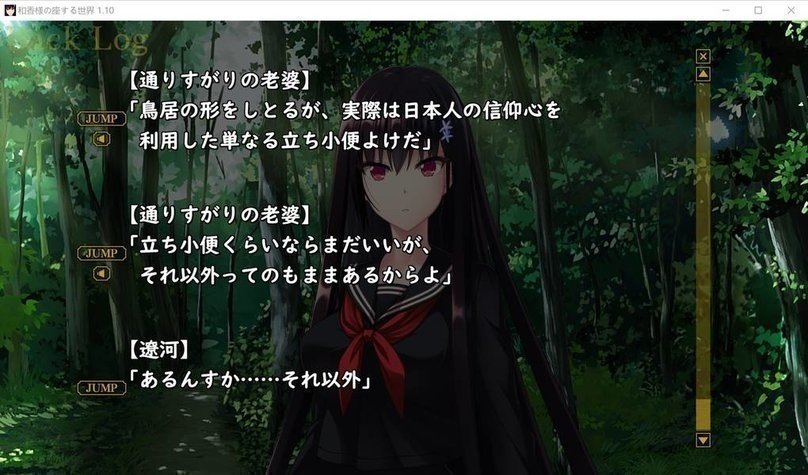
“In Japan, torii gates are like the people who mindlessly worship gods—they’re everywhere, like public urination.”
That’s a line from an old lady in the game, and it probably sums up some of what the script is thinking.
“Gods ain’t all that. Sometimes you write a game and let the gods screw around with you for a while—it’s fun, right?”
Comments are hosted on the Chinese main site. This mirror is read-only.