Tamayura Mirai (タマユラミライ) Review
タマユラミライ
その昔、深野市には、外つ国から来た魔法使いが住んでいたという もちろん、それを本気にするものは少ない。 けど、もし旅人がこの地を訪れたなら、きっと平地にはない異郷の香りを嗅ぐことだろう。 ここは、かつてヒトとヒトならざる者が共に暮らしたと伝わる幽玄の地。 四方を山に囲まれ、独自の自然観をはぐくんできた深野の町には どこか、そんなこともあるかもしれないと信じたくなる霊気が漂っている。
They say that long, long ago, a witch from a foreign land lived in Fukano City. Of course, hardly anyone takes that rumor seriously. But any traveler who visits will surely catch a whiff of something foreign, different from the usual. This is a legendary place of mystery, where humans and all sorts of non-human beings live together. In this small town of Fukano, surrounded by mountains on all sides and nurturing its own unique natural scenery, a faint spiritual presence drifts about, and there exist things that may or may not be there—yet you can’t help but believe in them…
Advertisement
This passage isn’t something I wrote — it’s from the game Tamayura Mirai (タマユラミライ). If you’ve played it, the words will be burned into your memory, because the game repeats them at least 20 times. If you haven’t played it and plan to, then once you’re done you’ll probably be able to recite it from memory just like I can…
Before I get into Tamanura Mirai (タマユラミライ), let’s talk about something else first — something game-related, of course. I know none of you want to read those intros that have nothing to do with the game, so I’ll skip them.
Actually, you might not know this, but I’m not just a Rukuru fanboy — I’m also a Touta fanboy.
I first noticed 籐太 while playing various titles that get labeled “moegé” (moe-focused fluff). I remember when I was playing Kujira-ojisan and Sano-ba Witch, there were always moments where the writing unexpectedly felt like top-tier quality. It’s like going from a painfully cringe New Year’s gala skit to something that suddenly hits. That abrupt shift naturally made those scenes stick in my mind. So I started digging through the game scripts, and that’s when I noticed the name 籐太.
The biggest surprise 籐太 gave me was probably Floral Flowlove (フローラル・フローラブ) — he planned the whole thing and steered the entire scenario, and that story genuinely stuck with me. Some of the finer details don’t hold up, sure, but the core of it shines bright enough.
After that, Touta went on to work on Yuzusoft’s Senren * Banka. It’s not explicitly stated what parts he handled, but you can kind of see it: starting with this one, Yuzusoft actually got a bit better on the story side, and personally I’d say the parts Touta was responsible for played a part in that.
After that I think I saw that Touta had done an interview with some anime magazine from mainland China that I’d never heard of, and after that I stopped hearing anything about him — seemed like he’d gone off to write light novels. Then a while back I found out he’d run off to DMM to handle planning and scenario for a new game, and that new game is this very Tamayura Mirai.
Based on what I know of Touta, his writing sits above most “moege hacks” and a notch below Rukuru when it comes to sheer storytelling ability. There’s always a core to a Touta story — what people call “the message,” the thing the work wants to say. That message tends to be upbeat: basically, be kind, and take a moment to appreciate how good life is. Stuff like that easily devolves into slogan-shouting, sure. But Touta, like most “famous scenario writers,” instead lays the brutal stuff out right in front of you — just so you understand what makes the good parts worth treasuring.
And Tōta is smart about this too. If he wants to write something brutal into the story, he won’t make the protagonist pay the price—most of the time he’ll have a side character, or rather a “non-routeable NPC,” bear it. However miserable it gets, those fat otaku nerds already gripping their dicks and scrambling for the heroine’s porn CGs aren’t about to call Tōta a “heartwarming” killer—after all, the game’s heroines haven’t lost a single piece of meat…
Compared to Touta, Niijima Yū is just too blunt, too dumb.
So going in, I had pretty high expectations for Tama Yura Mirai (タマユラミライ). I was hoping 籐太 would give me something more thought-provoking. After finishing it, all I can do is sigh—the game’s quality is solid, sure, but it still falls a fair bit short of what I’d been expecting…
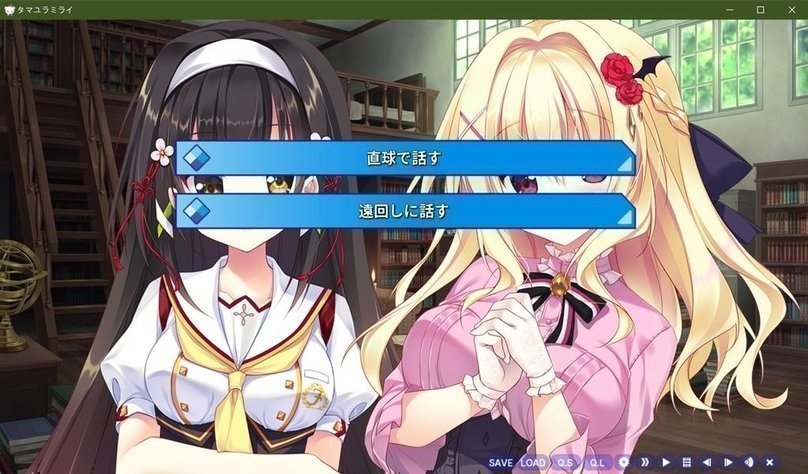
Sure, it’s still a decent story, all things considered.
《タマユラミライ》 could be written in Chinese as “玉響未来”, but I think the たま and ゆら in it should be translated separately — the former can be “soul”, the latter “swaying”. Because writing たまゆら as 玉響 leans more toward the meaning of “a single instant”, which doesn’t line up with the game at all…
At least I don’t think it matches, because this game is full of ghosts and youkai.
The protagonist is set as a magician in Fukano City, a very small village. The whole point of a magician existing there is to use their magic for “harmonizing”—mediating all sorts of quarrels and friction in the village, whether between youkai and youkai, person and person, or person and youkai. More like a mediator than anything else.
Honestly, I really want to roast this “magus” for being way too pitiful—basically just a shaman whose whole job is breaking up fights. But after digging into the game’s setting a bit, I found there’s actually a reason behind this “magus” business.
游戏里提到是“深野市”,里面存在着人类与妖魔一同生活的情景,而实际上这个县在日本是有原型的,那就是“遠野市”,而且关于那个地方的灵异鬼怪传说,还有一本书,名为《遠野物語》,里面介绍了关于遠野市存在的各种奇闻异谈。
Maybe that’s also why the game is set in Tōno, written here as “Fukano City, where humans and yōkai live together” — and the protagonist ends up working as a mediator between the yōkai and the humans.
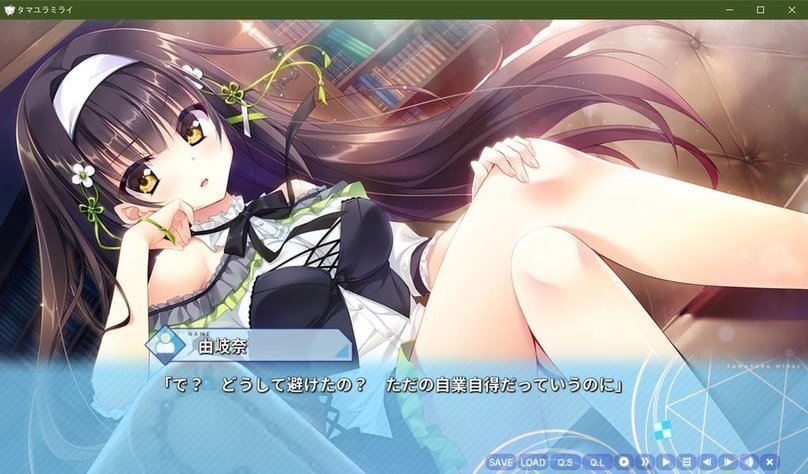
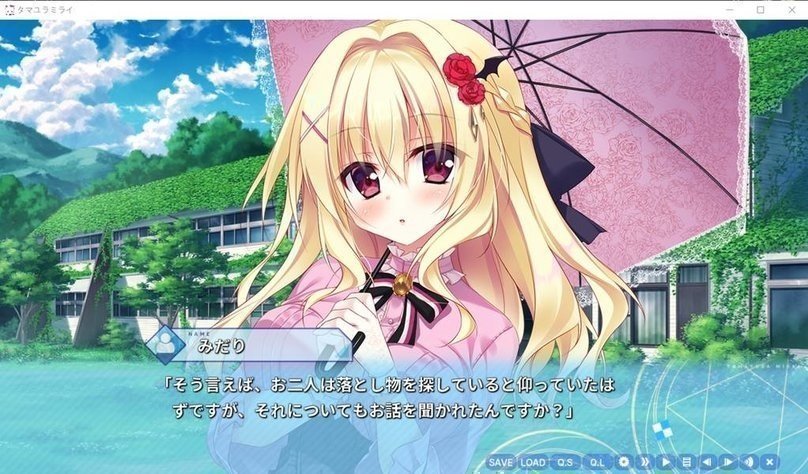
The first chapter of the game is basically a tour of Fukano City, introducing a few heroines as they show up: Kokomi Shiromi, the protagonist’s “older sister” who has the body of a loli; Suishouishi, a Western succubus the protagonist takes in after she stumbles into the place by accident; Hanako, a cat youkai who constantly haunts the girls’ bathroom at school; and Yukina, a mysterious girl who just arrived here and claims she can see supernatural things, along with her best friend Makina.
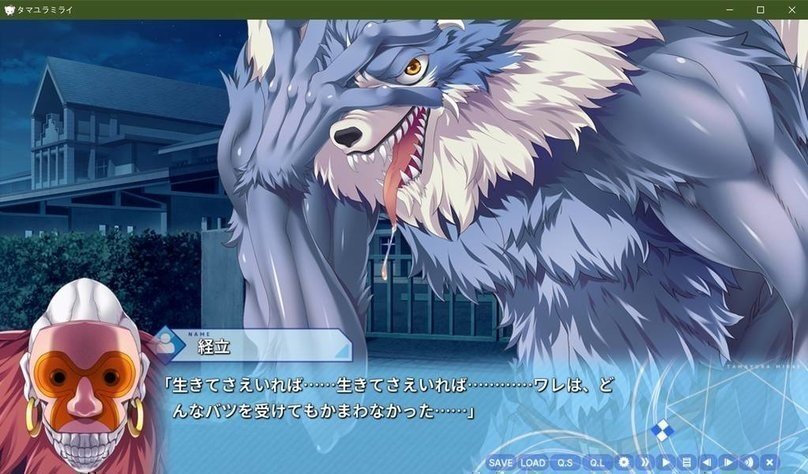
After that, the protagonist gets caught up in some trouble in the city and learns there’s friction between the werewolves and the baboon yokai around here, and in the end he steps in to mediate and restore the peace.
Chapter 2 of the game is basically another story about the protagonist mediating a dispute between youkai, though this time it’s a lion-looking god up in the mountains who wants to hook up with another deity and sends a love letter, only to accidentally offend some other gods along the way, and the protagonist ends up stepping in to sort it out. It also emphasizes that this “Fukano City” has an “Ukonotori Shrine” that’s supposedly super effective for love, and tells the legend of this “Ukonotori.”
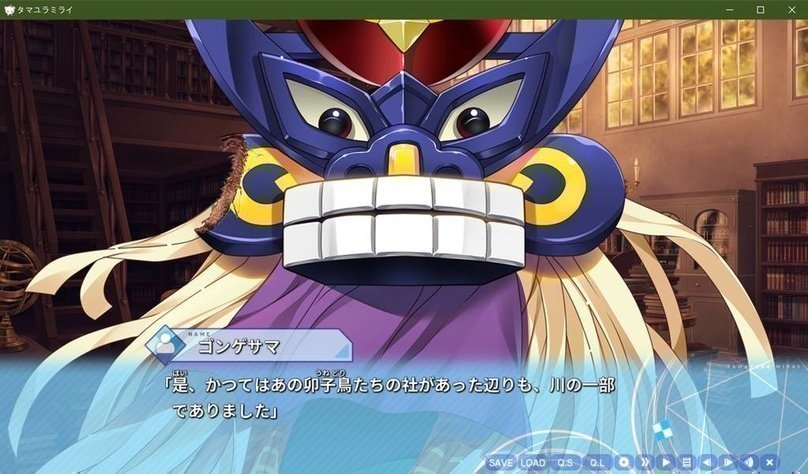
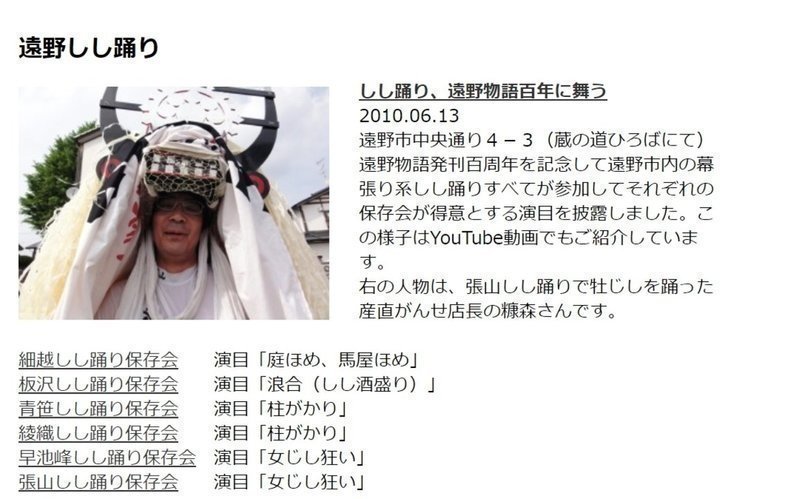
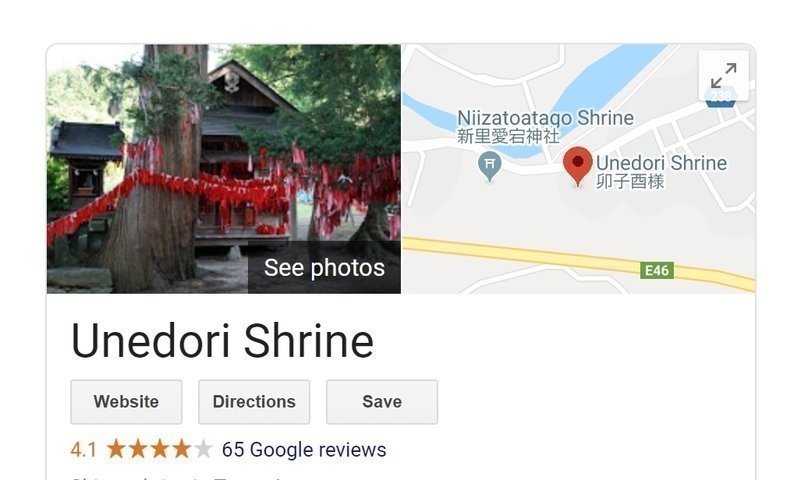
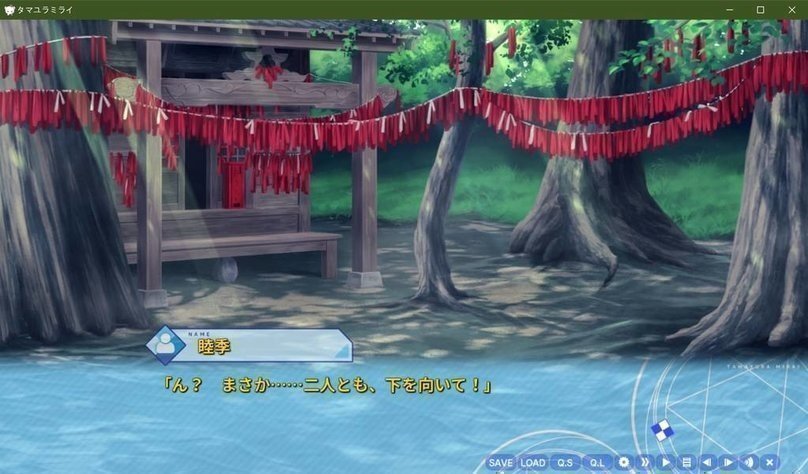
Here I have to bring something up: this “Uzura Shrine” (卯子鳥神社) actually exists in Tōno, the city the story is modeled on, and it’s a fairly well-known shrine where you can pray for good matches. The only thing is, there’s no real-life basis for the “uzura bird” itself. In the game, these birds always show up in pairs, each with only one wing, and legend has it that every uzura bird, in past lives and this one, is a pair of lovers transformed.
What came to mind?
This is literally the 比翼鳥 (jian) from the Classic of Mountains and Seas~ The legendary “in heaven we’ll be birds flying side by side, on earth we’ll be branches intertwined” bird is exactly this, and the setup matches the Shan Hai Jing to a T — looks like the scenario writer just lifted it straight without any tweaking.
Sure, the first two chapters have a lot going on, packed with Neta and references to Tōno Monogatari, but honestly none of it has much to do with the main story. If you really want to force a connection, it’s that these two incidents drop a few worldbuilding hints:
Humans can’t see youkai, unless you’re a magician or yourself a non-human.
厕所里的猫妖花子、小伯白,还有由岐奈的闺蜜蒔奈,似乎都无法被其他人看到。
Yukina has extremely strong psychic abilities and can see supernatural beings, so as a human she’s able to see the other heroines.
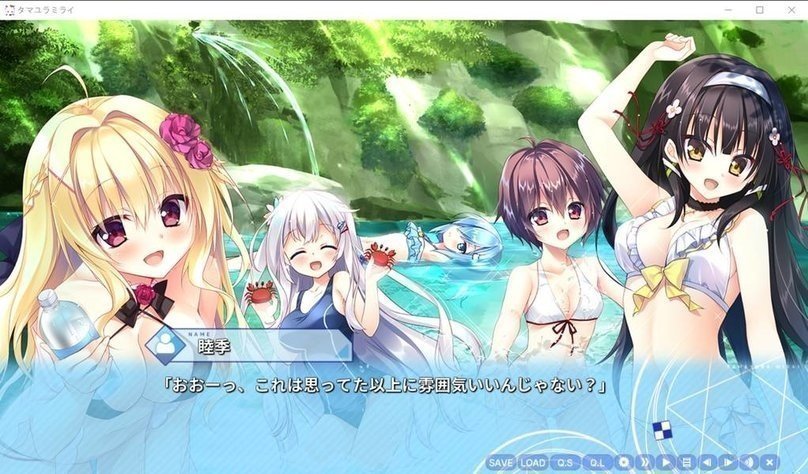
After the two chapters ended, chapter 3 turned out to be a “swimsuit episode” out of nowhere. Sure, other eroge have pulled this trick before, but for a game that “looks like it actually wants to tell a serious story,” seeing it go there was still a bit surprising. Naturally, in the swimsuit episode you can pick whichever heroine catches your interest, and once you do, you’re locked onto her route — this is also the only “meaningful choice” in the entire game.
After the swimsuit episode wraps up, the protagonist asks Yukina to put her absurd spiritual power to use and become his apprentice in magic here in “Fukano City”—to learn the craft under him. He also takes her to meet the big-shot spirits of “Fukano City”, and with their blessing she’s handed a legendary-grade staff. And with that, Yukina officially becomes the protagonist’s disciple and a trainee magician—and the game’s branching point is already staring you in the face.
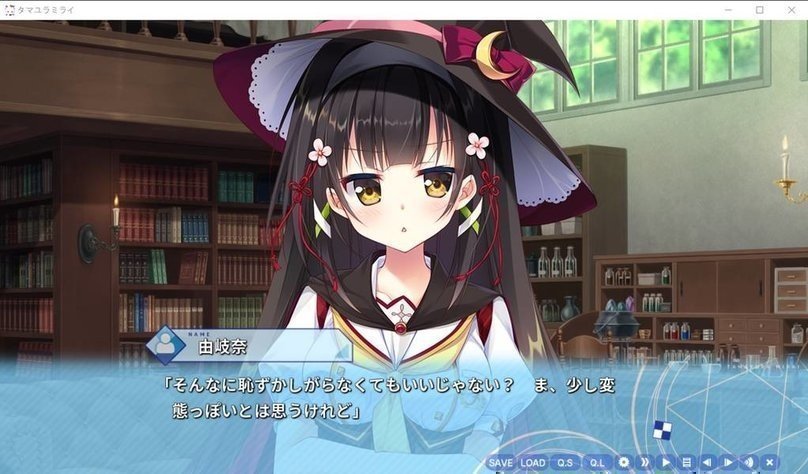
This game has four character routes: Yukina, the succubus Suishou-seki, the cat youkai Hanako, and Kohaku-haku, who only unlocks last. The routes that actually matter here are Yukina’s and Kohaku-haku’s. Suishou-seki’s and Hanako’s barely touch the main plot at all — they feel more like concessions to sell a couple extra character designs. Still, I’ll go through them quickly anyway.
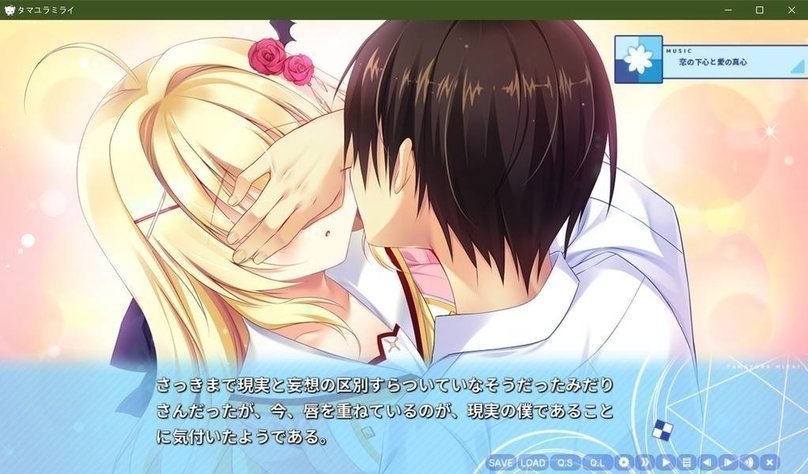
Suishouseki is a succubus from another land, with succubus blood running through her veins. As the name suggests, the succubus clan makes its living by charming others, screwing them, and draining their “vitality.” Yet Suishouseki, a succubus, has “androphobia” — so she’s seen as a disgrace to her kind and gets exiled. She ends up in Fukano City, where the protagonist takes her in.
The succubus clan carries an extremely alluring, sexy bloodline, so Suishouseki always ends up unconsciously seducing everyone around her — the protagonist included. But a succubus can only have sex with people; she can’t actually fall for them. For a succubus, “doing it” is just a means of eating and surviving. If she does fall in love and wants to marry and become partners with someone, the succubus will drain her partner dry (dead serious), which causes a whole lot of trouble.
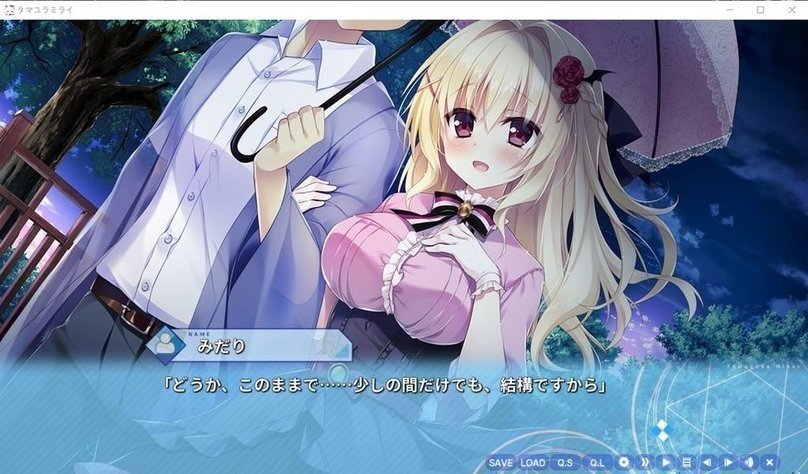
But as you’d expect, Suishouseki falls for the protagonist. That breaks a taboo of the succubus clan — though neither of them thinks it’s a big deal, and they even figure out that if they kiss a lot during sex, he won’t get drained dry (what?). Still, Suishouseki wants her family to accept the marriage, and not see her as a traitor to the clan.
So after a bunch of pointless agonizing, Suishouishi and the protagonist decide to use the special power of the god in Fukano City to send a letter back to her hometown—a letter with a video attachment, no less—introducing the protagonist to her family, spelling out her feelings, and making clear that she’s genuinely in love with him. As a succubus she’s not supposed to fall for a single person, but she really can’t help it, and she just hopes her family will forgive her.
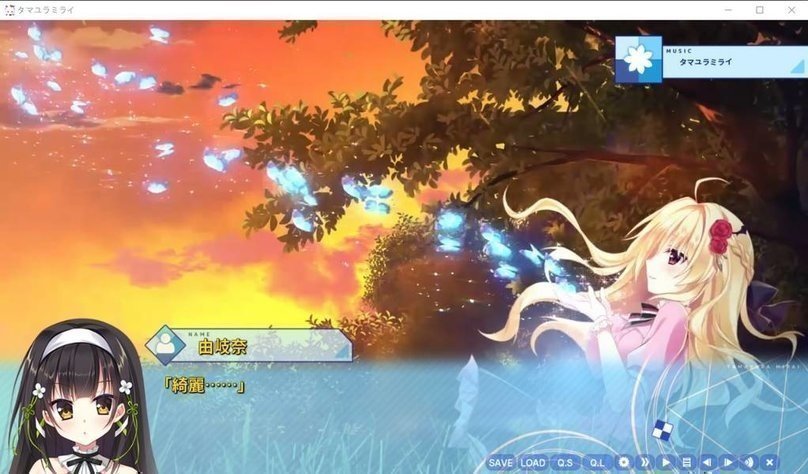
Naturally, it ends on a Happy End. The family accepts Suishouseki’s feelings, and even comes to visit her — and her boyfriend, too…
No telling if the protagonist is gonna get completely drained, though.
Hua Zi the cat yokai’s route, meanwhile, is even more pure. As a yokai, Hua Zi suddenly takes an intense interest in “love.”
And the target of that “romance”? Why, our protagonist of course!
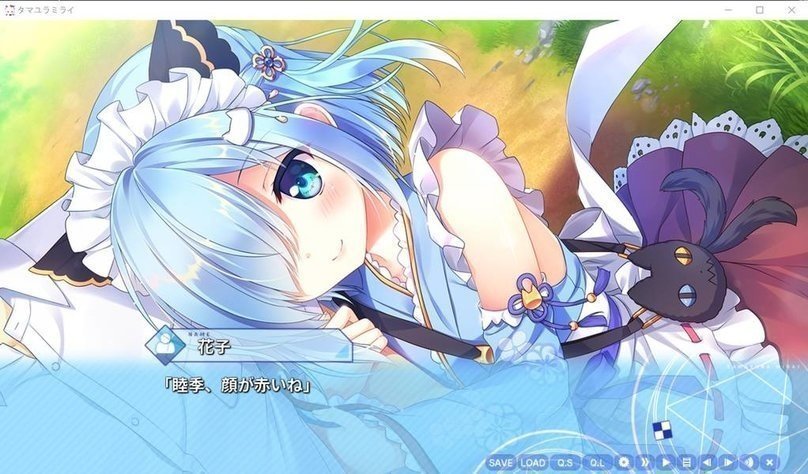
So Hanako launches all sorts of love offensives, pressing the attack on the protagonist. He manages to hold out at first, but eventually he just can’t take Hanako’s relentless pestering anymore and his resistance crumbles.
After a certain “date” (or something close enough), Hanako confesses to the protagonist. He’s confused—why is Hanako always so dead-set on getting him to explain “what love is” to her (no ambiguity intended!)? Hanako sincerely lays out what’s in her heart: as a youkai, she was curious about “romance” at first, and as that curiosity grew, she realized she’d fallen for him without noticing. So she just followed her feelings and confessed. In the end, the protagonist is moved by her sincerity and agrees to try dating for a while.
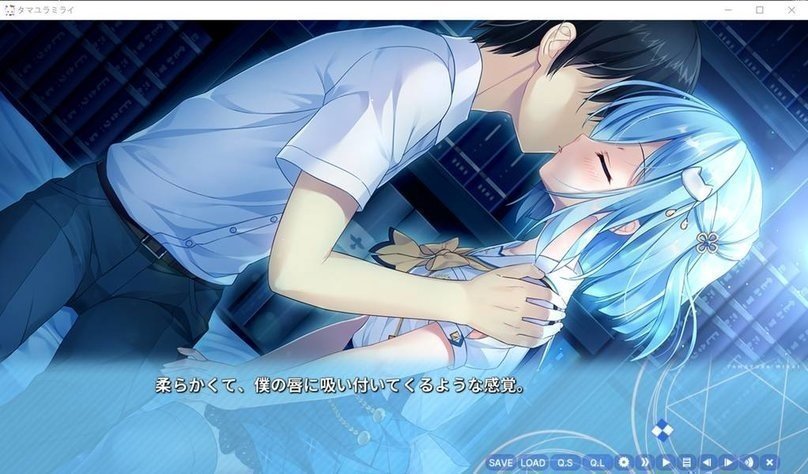
Of course, this game isn’t just about college kids dating — once you agree to go out, it’s obviously heading all the way to the end. Like, they start banging on day three of the relationship… and then the more they bang, the better it gets, the more hooked they get, until what started as “trying out dating” turns into a real couple’s relationship.
Honestly the game could’ve just ended here and it would’ve been fine—the route feels like it’s peaked. But as a standalone route, wrapping up like this obviously won’t do. That’s when the cat-spirit clan people show up looking for Hanako, saying she left the cat-spirit tribe and afterward the tribe fell into infighting, so they want Lady Hanako to come back and settle things. Hanako says she’s having a great time doing the lovey-dovey fuckfest thing in the human world and doesn’t want to go back. The cat-spirit clan folks also discover that Hanako’s powers have actually weakened from all the romance, which pisses them off—they figure the protagonist must have bewitched her into this state.
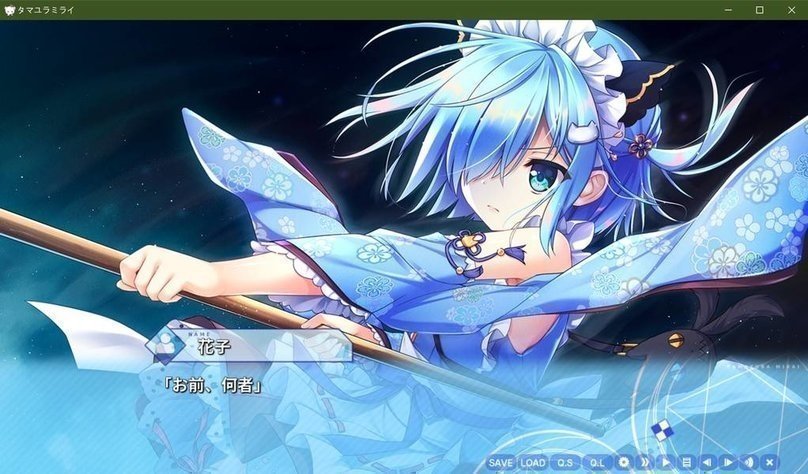
In the end, after a bit of scrapping and trash talk, the whole thing blows over, and Hanako goes right back to flirting with the protagonist like nothing happened.
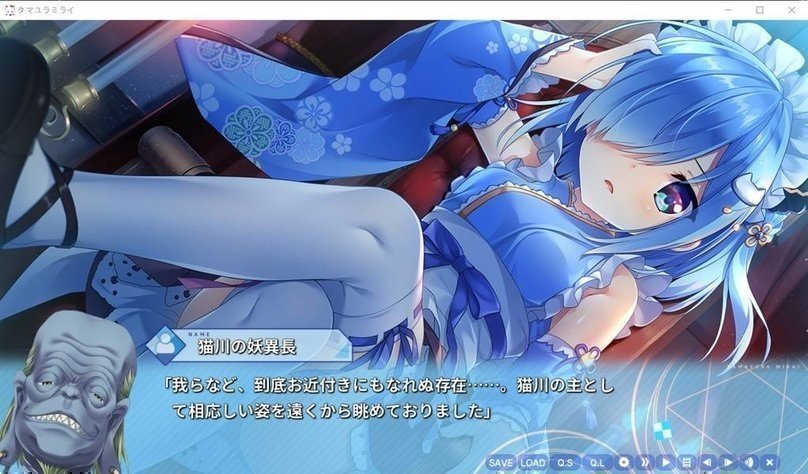
Setting aside the succubus crystal stone and Hanako’s route, the remaining routes are heavily tied into the main story—including Yukina’s and Kohaku’s.
Let’s start with Yukina. She agrees to become the protagonist’s apprentice, and as an apprentice, she naturally has to start learning magic. While she’s learning, the protagonist notices that Yukina must have some past she can’t talk about. He’s actually already noticed something else too: the girl named Makina, who’s always glued to Yukina’s side, is actually a ghost that nobody else can see. But when it comes to where that ghost came from, Makina always gives a vague answer.
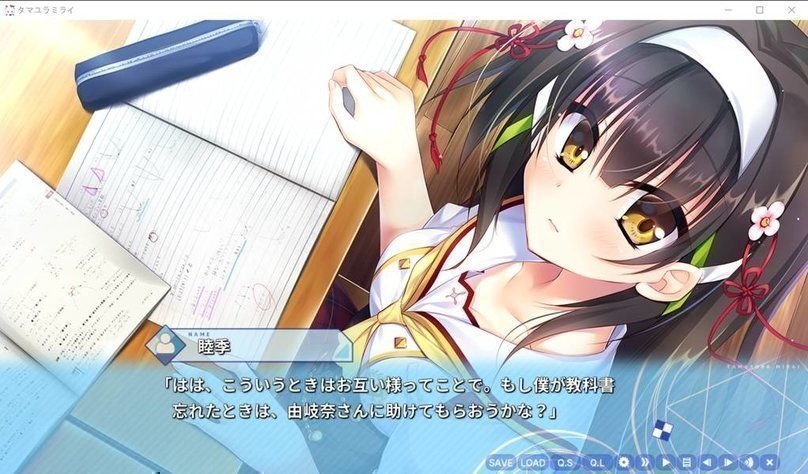
After a series of coincidences and some extremely melodramatic plot turns, the protagonist and Yukina end up a couple, and they do the deed too. After that, he starts seeing some of Yukina’s memories — probably because of bodily fluid exchange, I guess (dead serious).
And Yukina has two lines that stick with you the most: “I came here looking for something I lost.” “I have no right to fall in love.”
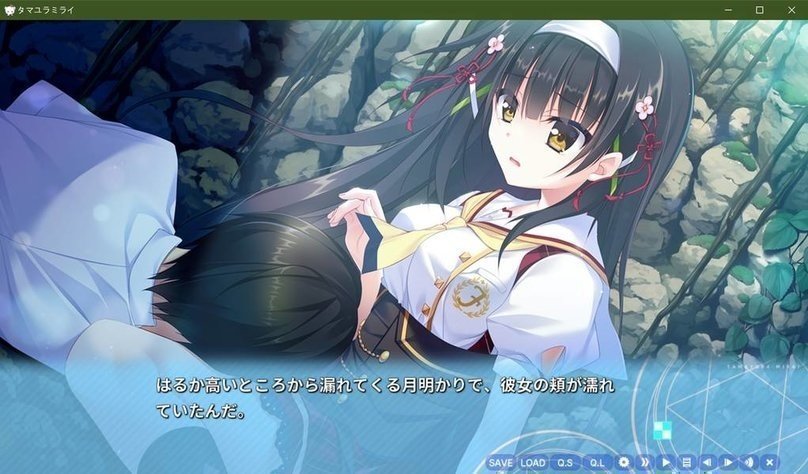
(I have to roast myself here — I literally can’t remember much of this route’s plot. Probably because I read way too many of those Yamauba legends in the middle and somehow forgot the actual game’s story. Dunno, maybe I’ve been jerking off too much. I’ll just flip through my screenshots and tweets and try to bullshit my way through it. If anyone ever asks me to write something proper, I’ll give it a serious reread.)
And Makina, who’s always stuck to Yukina’s side, is actually a living sacrifice from one of the mountain tribes. When famine hit, that tribe’s families ate anything and everything—and in the end they ate people too, picking someone to serve as the sacrifice so everyone could share the meal. Makina was one of them. Later, because that cannibal tribe ate so much human flesh, some of them started going mad, and eventually some turned into crazed “Yamanba.” Naturally, that monster eats people too.
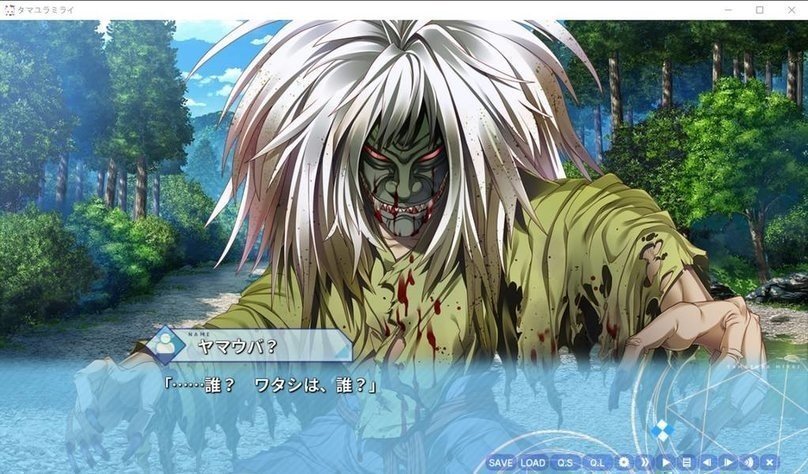
Yukina had eyes that could “see supernatural phenomena” ever since she was a kid, and she carried something like a good-luck charm called Otsukisama (seems it had something to do with her parents, too). She ended up running into this Yamanba in the mountains by accident, and in the process lost the charm. Just as the Yamanba was about to eat her, she thought fast and cut a deal with it—“How about you eat me once I’m grown up?"—and the Yamanba actually agreed. Then, while she was running away, she somehow ended up taking a girl named Makina with her. Truth is, Makina was already dead by then, offered up as a sacrifice. What Yukina brought along was her wandering spirit.
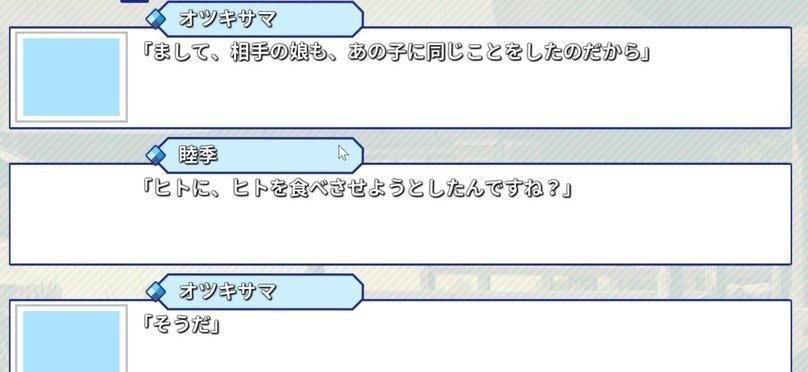
The lost オツキサマ was exactly the “lost thing” Yukina had been searching for.
Yukina treats the Mana she saved as a sister. Yukina’s charm may be gone, but thanks to the “kotodama” she still enjoys its protective effect: since she’d be devoured once she “comes of age,” the guardian deity intervened and stopped her growth—she never got her period. And Yukina, of all people, concludes that no period means she never came of age, that even after having sex she can’t get pregnant, can’t bear children, and therefore has forfeited her right to love.
Me: ??????
Feminists: ??????
LGBT crowd: ??????
Of course, later on, after the protagonist started protecting her, Yukina got her period again — which is to say, she’d come of age! Time to fuck!
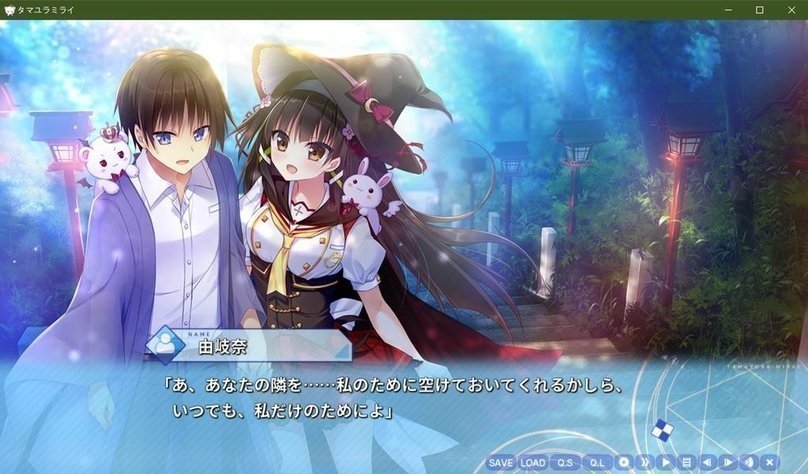
And Makina is actually a ghost herself—she was a sacrifice once, and she’s eaten previous sacrifices too, so there’s a “Yamanba” inside her as well. Anyway, after a whole pile of convoluted bullshit, Makina awakens and turns herself into the Yamanba from back then.
“You’re getting your period already, so you’re grown up now. Time for me to settle the score with you, kid.”
Anyway, the whole thing ends in a big noisy brawl: Makina gets brought to heel, Yukina fights with her own powers too and turns into a halfway decent mage, and then she and the protagonist squeeze in a little lovey-dovey moment before it’s all over.
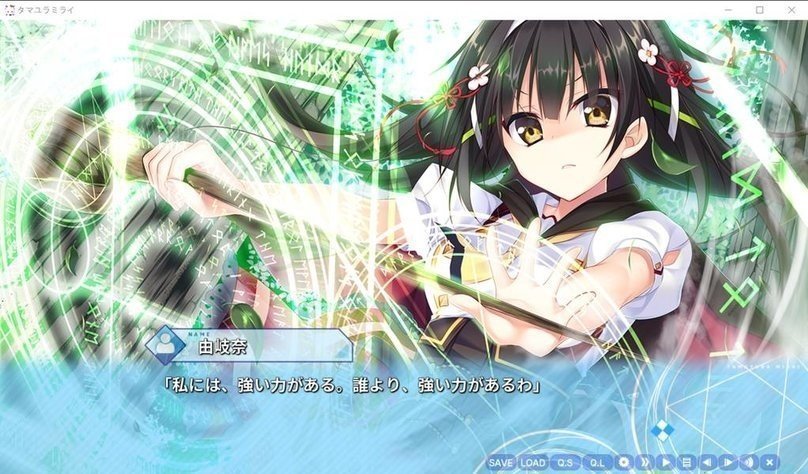
And what this route is mainly getting at is that “Makina has something to do with the Yamanba,” and this Yamanba is also tied to Makina’s family and to “eating people” in some way. The important part, of course, is the deal Yukina made with the Yamanba as a child: she used a doll called Otsukisama, which housed her parents’ souls, to trade for Makina’s existence. That’s why the game keeps saying from the very start that Yukina is searching for something she lost—except it wasn’t really lost. She traded it away herself, she just forgot due to her amnesia. And of course, the most important thing this route wants to say is:
“The Kobai of today is a ghost — she actually died back in the Showa era.”
And Oguro Shiro’s younger sister, Oguro Aka, is actually still alive — only Yukina saw her as an old woman already, but the weird part is that the protagonist still sees her as a young girl.
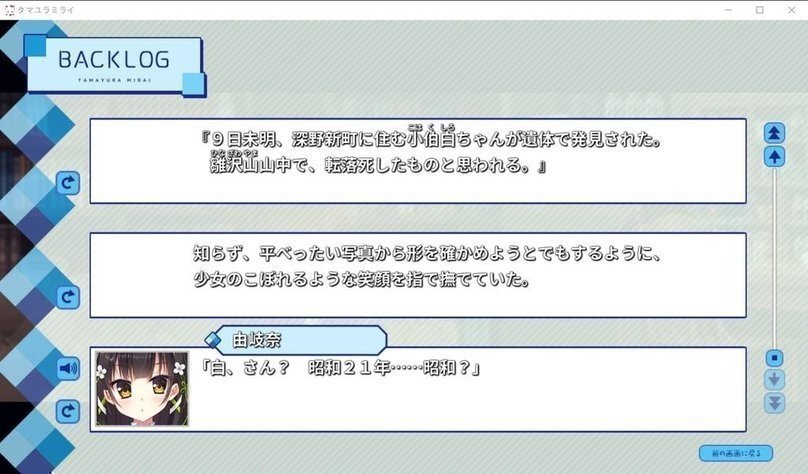
I think for the main story, this is where the bulk of this route’s content lies. And that “Yamanba”—honestly—the version in Tōno Monogatari is way more interesting than what’s in this game, and the Wikipedia article is even more insane. I recommend reading more of that; it left me in awe.
Yamanba is generally thought of as an old hag who appears deep in the mountains and forests of Japan. It’s a ghost story, but plenty of people claim they’ve seen the real thing — so who exactly are these real people supposed to be? Some say it’s just an old woman who ran off into the mountains and went feral, some say she’s Kintarou’s mother, and the most insane take of all is that these “yamanba were white people of Western lineage.” There are even Japanese scholars who’ve done research on it, claiming that the yamanba in Japanese paintings — white-faced, blonde — are obviously of Western blood! And some say the “oni” of Japanese legend are Western blood too… after all, fossils of people suspected to be of Western lineage really have been found in Japan itself. God knows how they got over there.
Of course, every time Japanese mystery legends come up, someone in Japan will say it was the descendants of Xu Fu, the guy Qin Shi Huang sent over back in the day. God, this Xu Fu is just way too convenient to pull out…
Anyway, the arguments about Yamanba were way more entertaining than the game’s actual route. I got so absorbed in those that I honestly can’t remember anything specific from Yukina’s route or the flashback scenes between her and Yamanba. All I remember is that Yukina’s good friend Makina was actually Yamanba in disguise, and showed up years later to settle the score with Yukina… and honestly, that’s enough.
Once you’ve cleared the routes for the other three heroines, the final route, Kohaku Shiraha (小伯白), opens up for you. And you’ll also notice that after unlocking Kohaku’s route, she disappears from the game’s title screen.
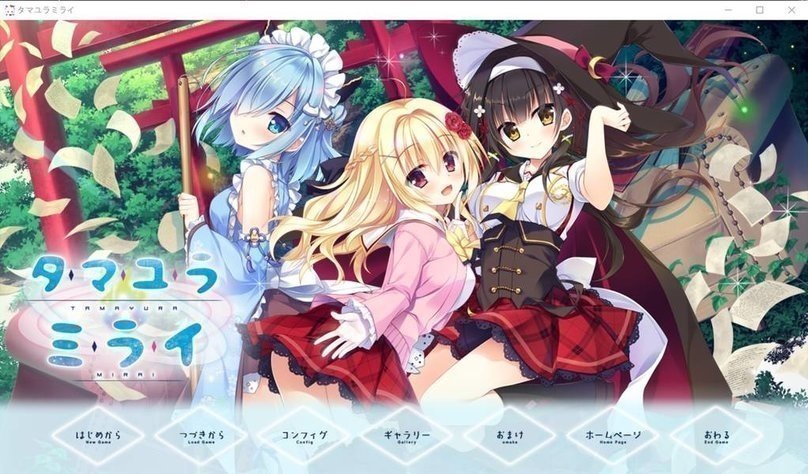
At first, Kohaku’s route unfolds in a pretty unremarkable way too — love confession, then boom, boom, boom. But it ramps into the real meat fast, and that’s when the flashbacks kick in, here we go.
Turns out Kohaku had a little sister, Kohaku the Red—half-sisters, same father. And the protagonist is a relative of Kohaku’s family who lived at her house as a kid. Kohaku’s stepmother treated her like garbage and deliberately kept the red Kohaku away from her, but even so, things between Kohaku, the protagonist, and the red Kohaku stayed pretty decent. Then one day Kohaku fell to her death in the forest. The protagonist was devastated. He wanders the mountains and woods every day, praying that this forest steeped in the occult might hold some way to bring her back.
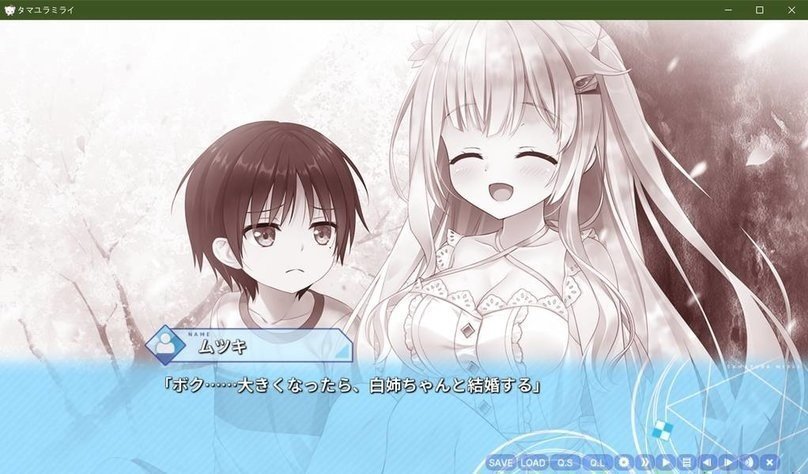
In the end, in order to bring Kohaku back to life, the protagonist begins studying magic and becomes a magician. While helping the youkai of Fukano City get along in harmony, he searches for a way to revive Kohaku. And though Kohaku is already dead, the protagonist’s obsessive longing for her turns her into an omaku (an omaku is basically the kind of “vengeful spirit”-like existence described in Tōno Monogatari), and she cannot move on for a long time. As the protagonist’s skills as a magician improve, he actually becomes able to see Kohaku’s soul, which strengthens his resolve to keep researching and bring her back to life.
But bringing a soul back isn’t that simple. Ten years passed, then another ten, then another ten. Who knows how long it’s been now — the protagonist has grown old, while Kohaku’s soul is still young. And they still haven’t found a way to revive her. Then he gets diagnosed with cancer, and the doctor tells him he has three months left.
Three months. Not nearly enough time to bring Kohaku back. But then someone came to the protagonist.
“The demon can do anything at all, you know. Make a contract with me!”
This is a demon called Pheles. The protagonist found her inside a box at his uncle Shiro’s house — no telling how long she’d been sealed in there. He broke the seal, and ever since she’s been trying to get him to sign a contract with her, but he won’t budge. After all, a contract with a demon means selling your soul.
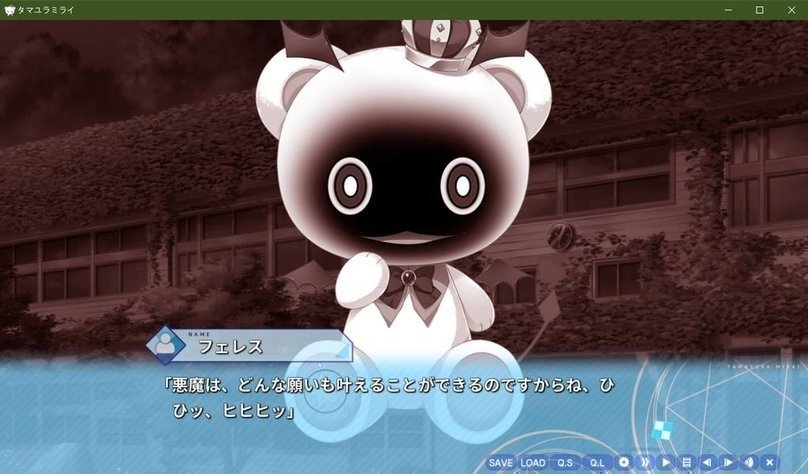
But there were only three months left. The demon laid out the terms: sign the contract, and the protagonist gets eternal life, forever young, free to research as long as he likes.
In the end, the protagonist gives in and makes a contract with the demon, gaining a young body and the condition of never aging. He won’t grow old, and since Konohakushi is a ghost, she won’t either. It seems the two of them now have all the time in the world to keep up their research.
But even after all that research, the protagonist has already confessed and is dating Koshirakashi Shiro, who’s a ghost—and as a magician, no less—yet he’s still got no real lead on a way to bring her back. He’s even thinking about trying some doll-related stuff, like what Yukina and that Makina were doing, but he has no idea how to go about it either.
But by this point, Kohaku’s half-sister, Kohaku the Red, was already on the verge of giving out.
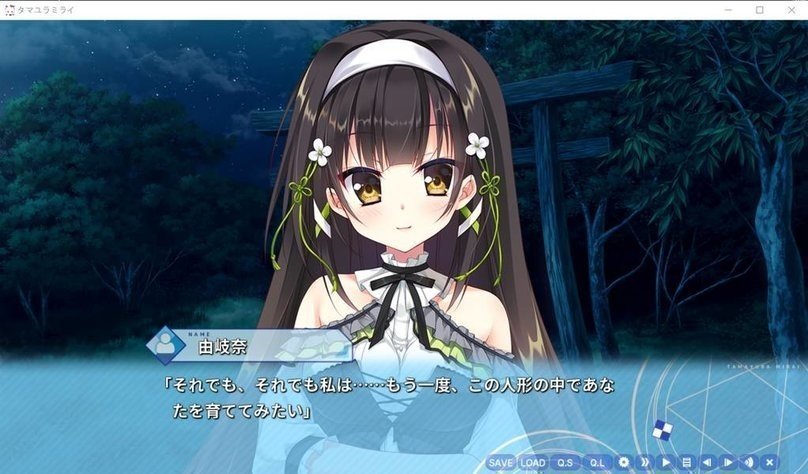
When she was little, Kohakuren actually had a bit of a thing for the protagonist too. Losing her sister hit her hard as well. She wanted to comfort him, but he just wouldn’t let go of her sister — and there was nothing she could say. She couldn’t get her own feelings across to him either, so she just let the years go by.
Later, Kohaku became a music teacher at a school in Fukano City, and after that she retired and stayed at home. She’s over eighty now. The protagonist, though, has stayed young and never aged. She knows he paid a price for that, but she never says anything about it.
Someone once confessed to Kohaku before, but she turned them down — she still can’t let go of her sister, and even less of the protagonist.
Interestingly, from the protagonist’s perspective, this Fukano City has barely changed at all. In his eyes, Kohak ko is still the same as she was in high school, like some kind of illusion—even though to everyone else she already looks like an old woman.
Komohaku stayed single like that for the rest of her life, until she grew old and frail. In the end, it was extreme old age that did it — a sudden heart attack, and she was on the verge of dying.
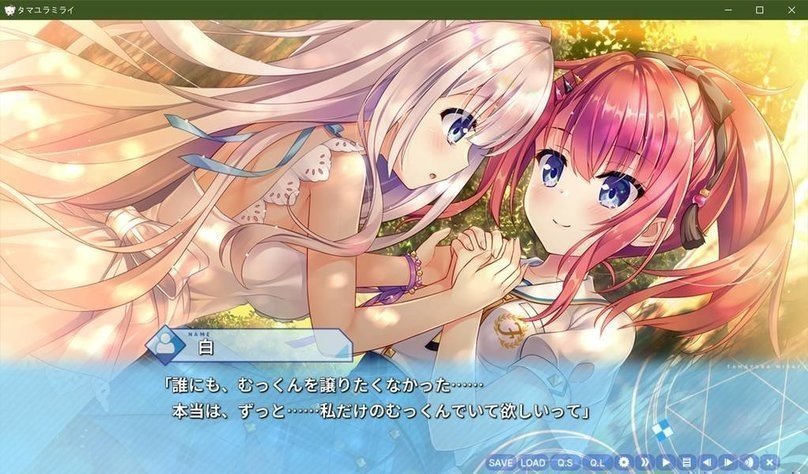
Kohaku Shiro and the protagonist run into the forest to find the god and beg for the elixir of life to save her. The god is eventually moved, hands over the medicine, and Kohaku Aka’s life is saved. During her day trip to death’s door, Kohaku Aka finally sees her older sister, the ghost Kohaku Shiro. After all those years, the two sisters finally get to talk.
Kohaku White said she was sorry to Kohaku Red—that because of her, Kohaku Red had lived her whole life so unhappily. Unable to confess her feelings to the protagonist, trapped in this little mountain village, growing old alone. Kohaku Red just laughed instead, and said her life had actually been happy, because she had felt it: “My sister was always by my side, watching over me, even though I couldn’t see her.” Personally, I think it would’ve been fine for Kohaku Red to pass away peacefully right there—but the game just had to bring her back to life…
Naturally, problems showed up afterward too. The protagonist’s “attachment” to Kohaku Shiro had diminished (because he’d already gotten his happiness with her, even if she was just a ghost), and at the same time Kohaku Kurenai’s “attachment” to Kohaku Shiro had also faded (because they’d met and talked), and even Kohaku Shiro’s own “attachment” to the mortal world was shrinking (because she felt there was nothing left to cling to). As an omaku ghost who exists on the mortal world’s “attachment,” Kohaku Shiro’s presence began to thin out, and she even showed signs of fading away.
The protagonist was getting a bit anxious, and right then the demon Pheles showed up again, laying out a deal: use Otsukisama—some thing that came up in Yukina’s route and that I still don’t have the faintest idea what it actually is. All I know is it seems to be a doll. He could let Kohaku’s soul lodge inside that doll and give it life. But the protagonist mulled it over and didn’t want to do it. For one, the thing belongs to Yukina. And two, even if Kohaku came back to life as a doll… what would even be the point?
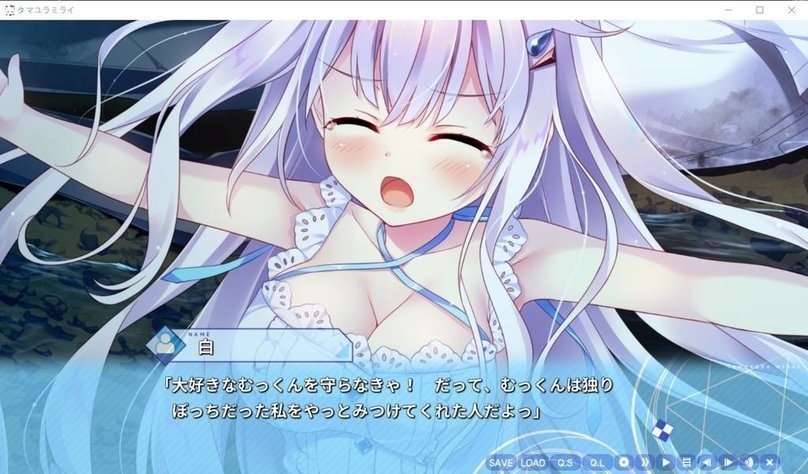
The protagonist starts to wonder — what has he been living for all this time? To bring Kohaku back? To turn her into one of the living dead? Honestly, he himself is only alive thanks to the power of the demon’s contract; he’s basically a walking corpse too. Meanwhile Kohaku’s soul just keeps wandering here, unable to reincarnate or find release. Is that really okay?
As the protagonist keeps mulling it over, he decides all this hassle isn’t worth it and wants to give up.
At this point, the demon Feles, who had formed a contract with the protagonist, sensed it — she started to feel that he was about to break their pact, and she got a little angry. If the contract between the protagonist and Feles were severed, she could no longer keep existing. It was only by taking his soul that she was able to do any of this.
And the protagonist isn’t Feres’s first contractor. There was one before him—another person who signed a contract with Feres, gained an undying body, wandered through countless eras of history, invented and created all sorts of things, and even pushed human civilization forward (the motherfucker literally invented paper money for the Song dynasty). Eventually this contractor drifted east to Shinno City on that little island in the East and settled down there. But in the end, for some reason… he decided he no longer wanted eternal life. He violated the contract on his own, sealed Feres inside a box, and lost his own immortality in the process, turning to ash.
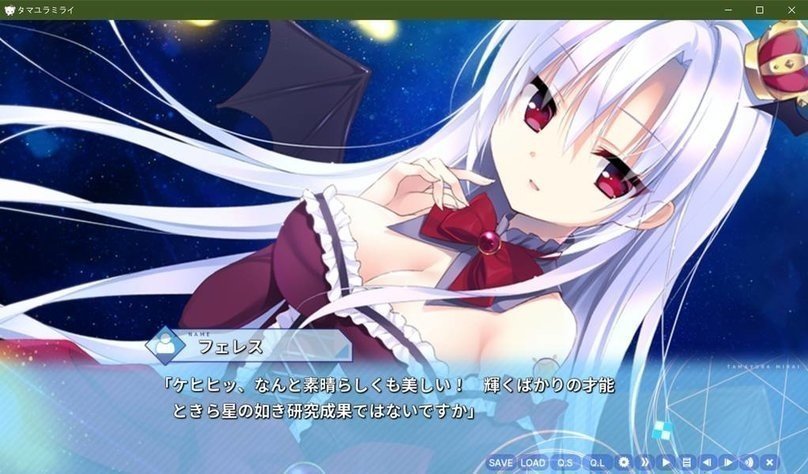
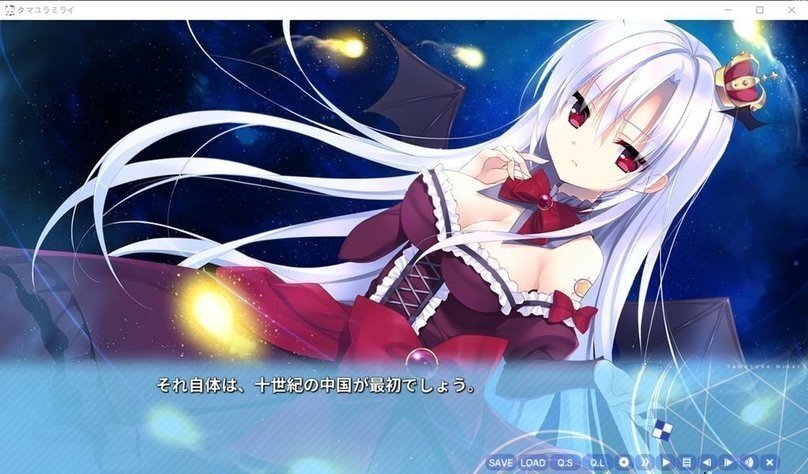
Just like the previous contractor, the protagonist does the same thing—he pulls out the box. Feres notices and gets furious. She’s been betrayed again. She’d thought this guy wouldn’t pull the same dirty trick as his predecessor, but nope, it’s the exact same story. Enraged, Feres attacks him on her own—and that’s exactly what he was counting on…
The demon attacked its master first, so it was the demon who broke the contract. The demon has to be punished, and Feres begs the protagonist for forgiveness — but before he can even open his mouth, Yukina shows up, having watched the whole thing and knowing exactly what led to what.
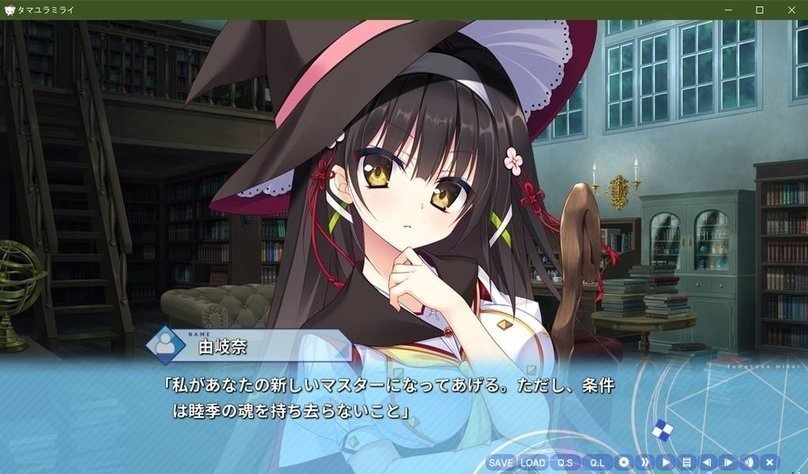
“I’ll be the new contractor, but on one condition—you give his soul back to him.”
In the end, Yukina became the new contractor, and Phelles had a new master too. And the protagonist handed the role of Fukano City’s newest mage over to Yukina, choosing to leave himself.
So where does our protagonist head to? To find Kohaku’s soul, of course. The two of them sit down on the hill and say their final words to each other.
The protagonist stops fixating on bringing Kohaku back. He wants to let her go—and to let himself go too. Since he’s already broken off his contract with Felis, he doesn’t have much time left to live anyway.
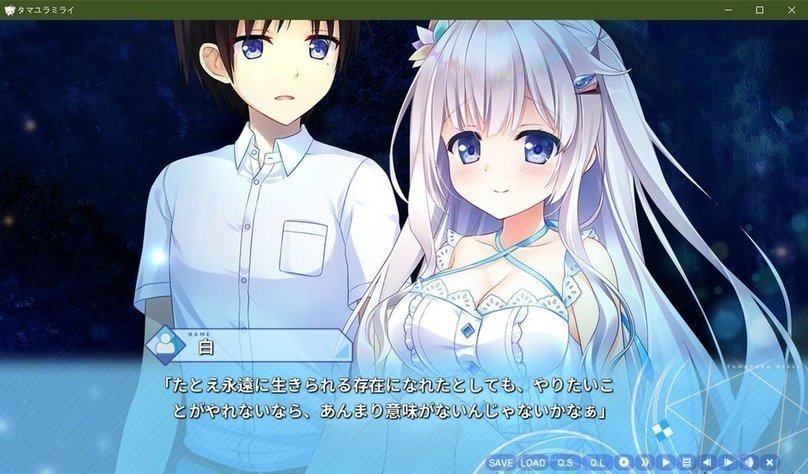
The two of them confess their love once again. Kohaku does say that the protagonist shouldn’t ascend to heaven along with her, but he replies: “Don’t forget—I was supposed to have died of cancer a long time ago.”
The protagonist tells Kohaku (小伯白) that the two of them should have died and gone to heaven long ago — but fate had other plans, and they ended up living this long. Now it’s time to put everything back the way it was always meant to be.
“They say there are ubume birds at Ubume Shrine, and they always fly in pairs. Birds that fly in pairs were lovers bound together in a previous life and in this one too.”
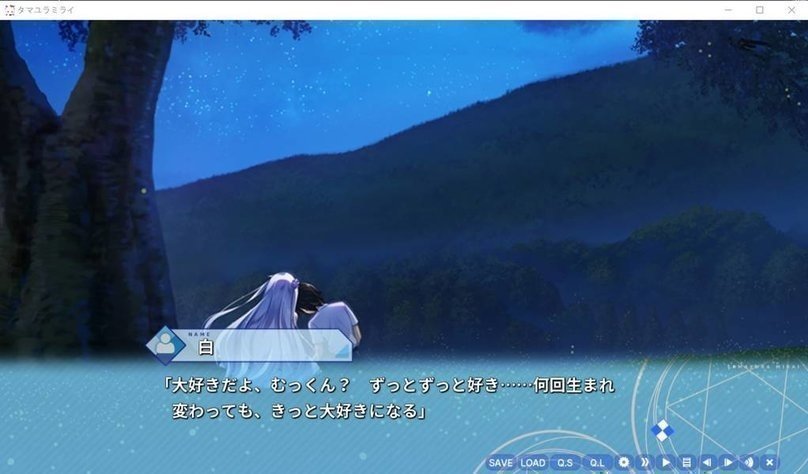
“If our bond really is that unbreakable, then let’s meet again in the next life!”
In the end, the protagonist and Koshaku-shira turn into uzura birds on the hillside, fly off wing to wing, and vanish from this world.
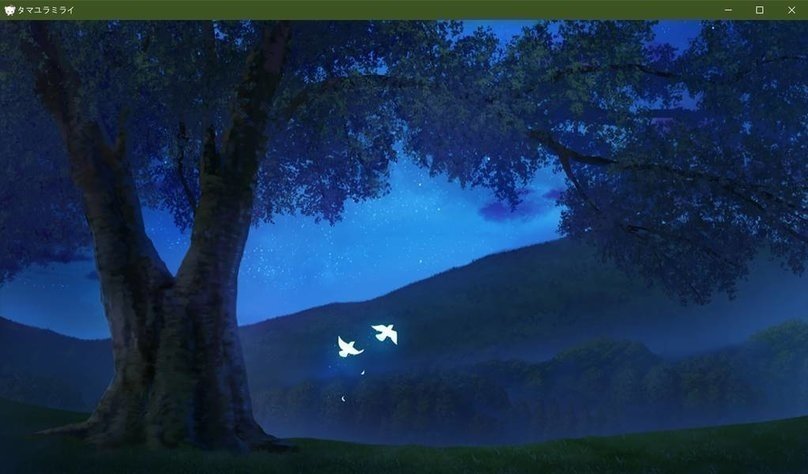
Yukina became the new witch and took over the protagonist’s work in this Fukano City. She told Kousaka Beni that Kousaka Shiro and the protagonist had already passed away, and Beni accepted it without complaint. All things considered, that’s probably the best outcome.
The protagonist tells Yukina, “He and Kohaku ascended to heaven, and they’ll be reincarnated into this world again soon.”
Yukina could only stare up at the sky, watching the bi-winged birds (the ubōshi-bird) fly past overhead, hoping to meet the protagonist and Kohaku-shiroba again.
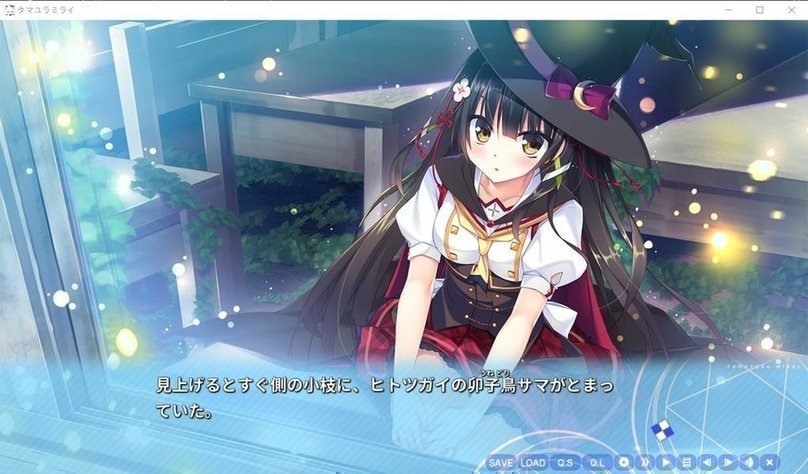
And somewhere in the world, a pair of babies had just been born—one with black hair, one with white.
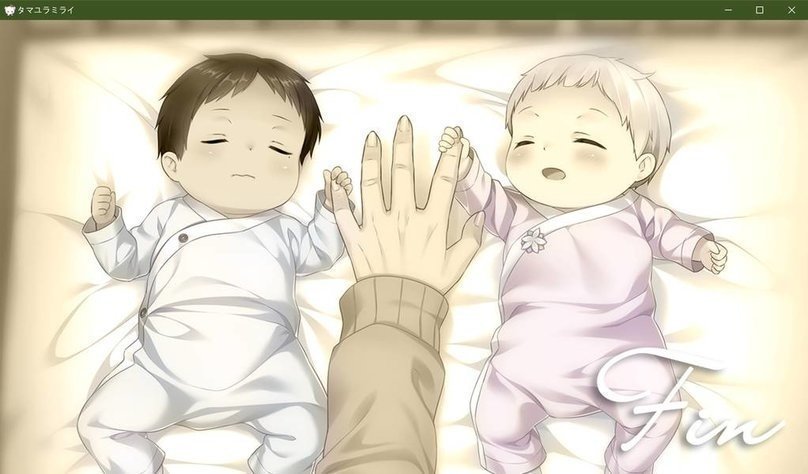
Wait, does this mean the lovers from their past life are gonna be twins—a brother and sister—in their next life?
Anyway, that’s the game wrapped up.
So how do I even rate this game?
First, let’s talk about the game’s backdrop, which is completely modeled after Tōno Monogatari, a certain Japanese book of folklore and spirits. The setting is pinned to a place called Fukano City, which is really just Tōno City in Japan. To build a better atmosphere on that front, the game doesn’t hesitate to pad things out heavily, cramming in a bunch of spirit and monster stories that have little to do with the main plot…
But no connection really means no connection, man.
Is the first and second chapter’s story about some werewolf and baboon—plus that god who looks kinda like a lion—falling in love even remotely connected to the main plot?
The main story of this game is:
The guy’s crush dies. He can’t accept it, so he decides to become a magician and bring her back—even if it means signing a contract with a demon and selling his soul. In the end he finds out the whole ordeal was for nothing, and all he can do is give it all up together with the ghost of the girl he loved, quietly choosing to ascend and be reincarnated, hoping they’ll be lovers again in the next life.
Is it connected to some legend from Tono City? Not really — this whole pile of lore exists for no other reason than to make the game feel more mysterious.
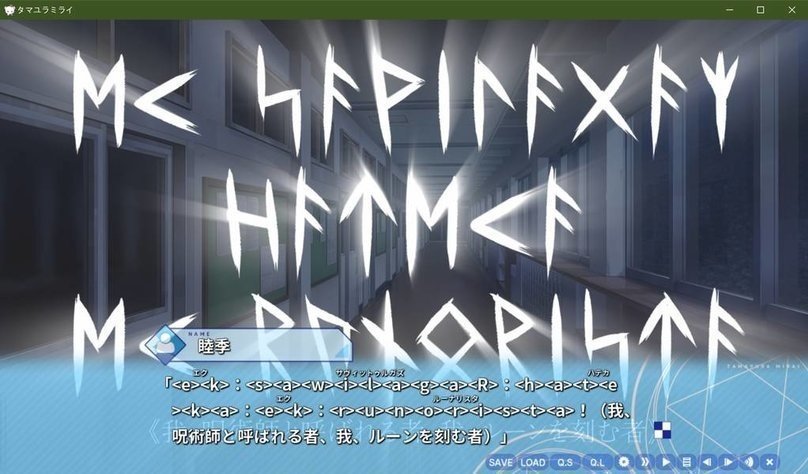
And to add a sense of mystery to the game’s magic users, this game even invented a whole magical script. It’s really just a deformed version of the alphabet — draw up a letter chart and you can decipher it. The incantations for casting spells got the same detailed treatment too, though pasting them out loud is pretty goofy, a lot like Kagura from Gintama speaking Chinese… XXXX aru.
Oh right, this “Aru” also needs the “ah” dragged out — like “aaaaaa-ru.” So dumb.
游戏有四条个人线,其中小伯白的路线是主线。其他的路线——如果说由岐奈讲清楚了那个重要的オツキサマ——其余几条更像是「凑数的」,单纯为了卖角色,在「深野市」这个环境下各自捏了一个独立故事。
Of course, saying all this doesn’t mean I think the game is bad. It’s just that a lot of it feels forced. Honestly, from where I’m standing, “it should have been better.”
- For one, the Great Demon Feres doesn’t come off as evil enough. As a “demon’s temptation” she doesn’t really make you feel what the protagonist feels — she’s more like a cute mascot.
- For another, a lot of the individual routes could’ve been linked together. You could’ve tied the cat youkai and the succubus into Kohaku’s story too — that would’ve been worthy of that True End. But nope, it didn’t happen.
- What I hate most is that the game uses katakana for so many key terms — オツキサマ, オマク, ヤマオバ. Would it kill them to write these in kanji? I don’t know if Japanese people find it annoying, but as a Chinese reader it really grated on me…
Beyond that, everything else in this game is a plus.
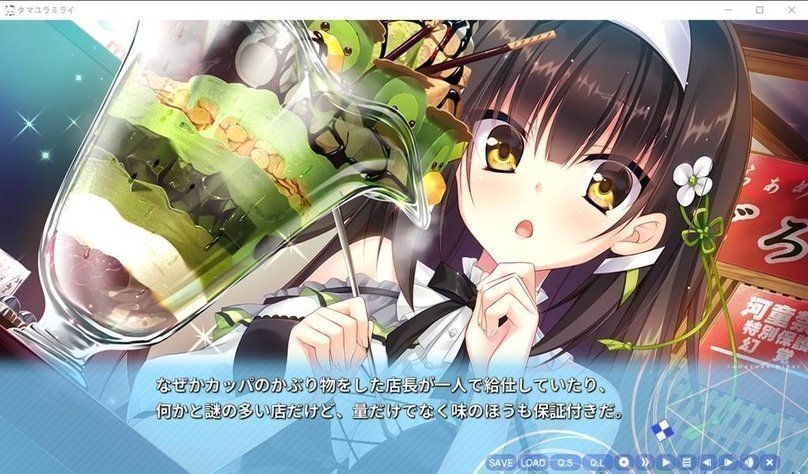
I don’t really need to say much about the art style — both artists have plenty of fans, I’d imagine. The soundtrack isn’t exactly packed with tracks, but what’s there sets the mood just right. Most importantly, the game is stuffed with enough NETA to get you curious about “Tōno City” and its legends. There’s a free edition of the Tōno Monogatari online — worth a read if you’re interested.
As for the game’s voice acting, I wasn’t too happy with the main heroine’s voice at first — it sounded awful, like someone named “Yuika,” but I got used to it and honestly it’s fine. What really got on my nerves instead was Kohaku’s CV, Mai Kadowaki…
A lot of people say her voice is 萌え, but listening to it gives me the creeps all over — where exactly is the moe in that…
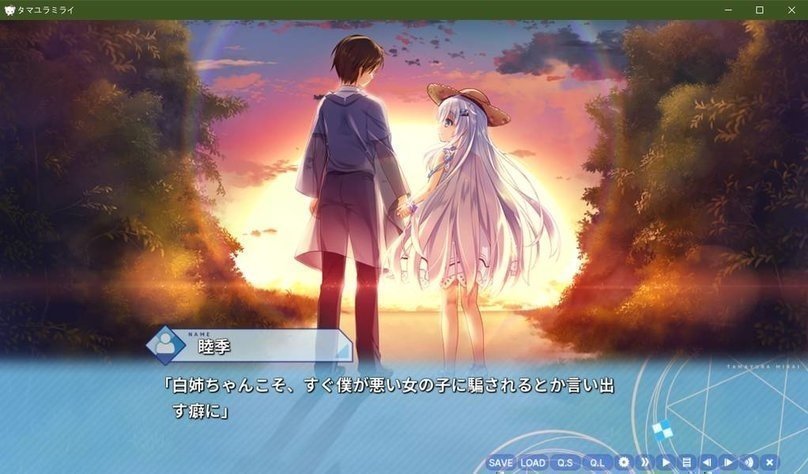
By the way, Hanako’s CV is Kyōka — absolutely goated. I mean, I said her singing is goated. I’ll do a separate write-up on her sometime.
Last up, the scenario: Touta.
No question about it, the story Touita wrote this time is a step up from last time—and like last time, it’s loaded with some serious chicken-soup platitudes. The improvement just wasn’t as big as I’d hoped.
A fair number of spots in the story still fall short of what I’d expect from Lulu, whose stuff I actually like. The “Great Demon” character in particular is way too one-note, and the finer details lean so hard into the “supernatural atmosphere” that they drift away from what the character fundamentally is. Setting should serve the main plot, not just get trotted out to look cool.
And like the passage at the very start of this article, the game keeps repeating that same passage over and over, trying to create the atmosphere of a “high-brow literary work” that “bridges past and future” and feels “operatic” — but overused like this… it still feels a bit off, like Ko Wen-je’s catchphrase: “kinda weird.”
But setting all that aside, the writing itself holds up pretty well, and the big thing is that “the foreshadowing was planted nicely and paid off properly.”
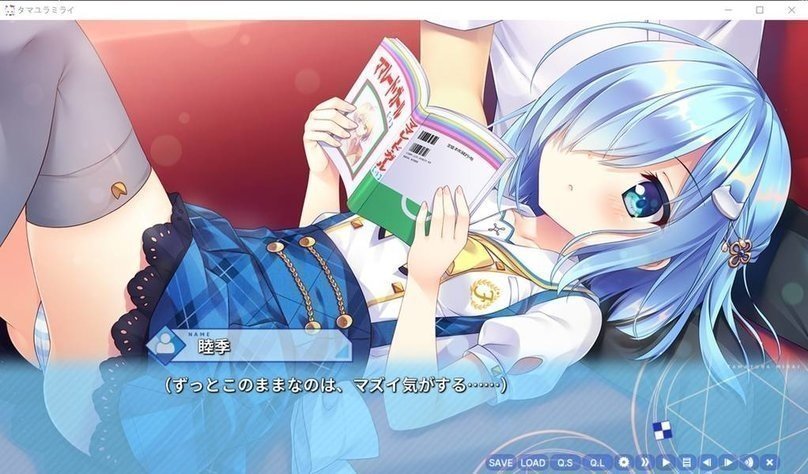
The game front-loads a bunch of fake-outs. For one, it’s easy to miss that a lot of the heroines aren’t actually human. The protagonist can see them because he’s a mage, and Yukina can see them because she’s a natural-born medium—the people around them actually can’t. The twist that Kohaku Konaki is a ghost gets seeded all over the place too, especially the bit where the other students at school can’t see her. When the reveal finally lands, it still manages to catch you a little off guard.
And the game emphasizes “Ukonotori” right from the very start, and it also ends on “Ukonotori” — so I guess you could call that bookending.
Tōta’s writing is very much a “rough start, strong finish” kind of deal — at first you might find it a slog, but it keeps getting better as it goes, and this game is no exception. What starts as a simple ghost story eventually turns into a discussion of the meaning of life and death. You could call it a decent bit of deliberate under-promising and over-delivering.
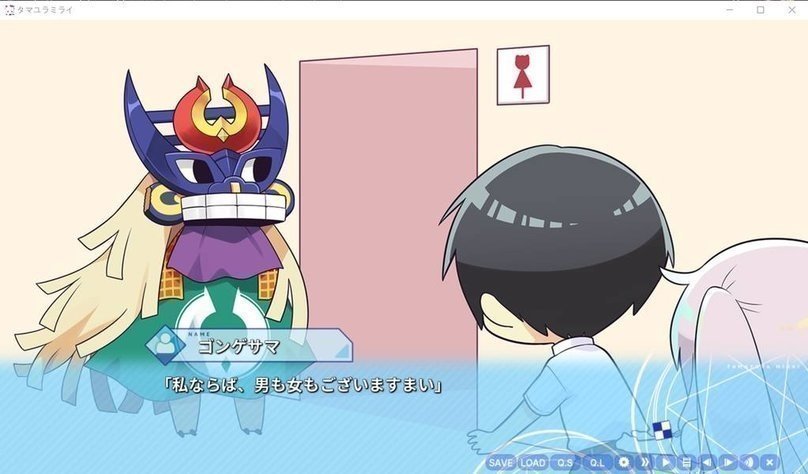
The game’s real payoff comes later, with the contract between you and the Great Demon: would you sell your own soul in exchange for immortality?
And the first-generation contractor and the protagonist both give the same answer: an eternity is worth less than a life well lived.
So what if you live longer? So what if you chase immortality? So what if you bring back the dead? None of it beats finding yourself, 自分らしく生きている — following your own heart, living one hell of a life.
Maybe this is the lesson 籐太 went to such lengths to tell us after all.
It’s just that the name Tama Yura Mirai still sounds way too lame…
Comments are hosted on the Chinese main site. This mirror is read-only.