Hands-on: Sennheiser IE 80
Sennheiser IE 80
Back when I bought my first pair of balanced-armature IEMs, the UE TF10, I had this weird sense of superiority.
Because everywhere online said BAs were the new tech, wiping the floor with dynamic drivers in every way — superior resolution, badass multi-driver setups, vocals so poisonous it hurt, etc., etc.
Looking back now, BAs aren’t all that. Not that those strengths are bad, I’m just saying that when I listen to music with BAs, something always feels missing. Sure, the Focal (Phonak) female vocals were poisonous, sure the ER4P’s treble was transparent, sure the UE900 had strong instrumental expression — but it never quite had that flavor.
A while back I was eating with a friend. The restaurant had a small stage, and a resident singer was up there performing “Love Like a Tide.” After that song, I think I understood what BAs lack.
What’s missing is that sense of atmosphere, like sitting in a tiny bar and feeling the music reverberate through the space. BAs are too cold and clinical — that’s when the dynamic driver needs to step up.
The Sennheiser IE 80 is probably a pretty good dynamic.
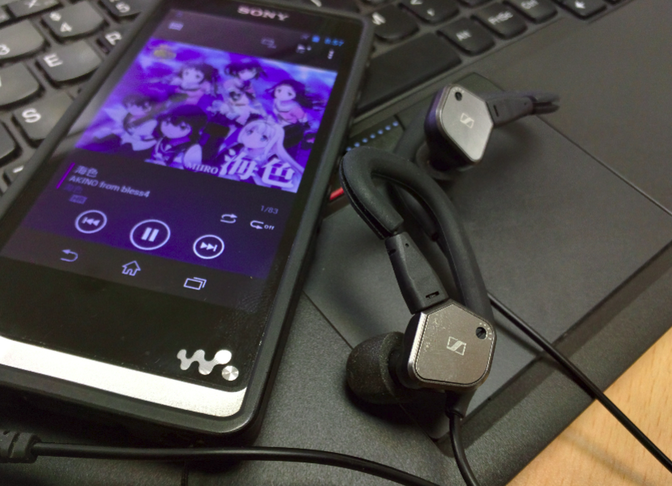
The IE80’s packaging is actually a bit cheap — utterly insignificant next to the UE900’s. Simple eartips: silicone ones, bi-flange ones, and something that looks like a Comply tip but doesn’t fit as well. Luckily I had a Comply tip in the right size, which saved me from the awkward situation of silicone tips leaking sound for no apparent reason.
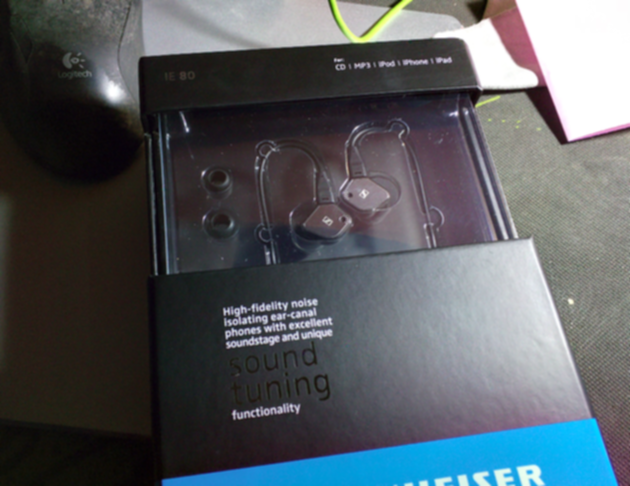
What’s interesting here is the IE80’s shape. I’d seen it before, actually — it’s the HAVI B3 Pro 1 I mentioned earlier. That thing is basically a shape-clone of the IE80; the polygon isn’t quite identical, but most of it is exactly the same.
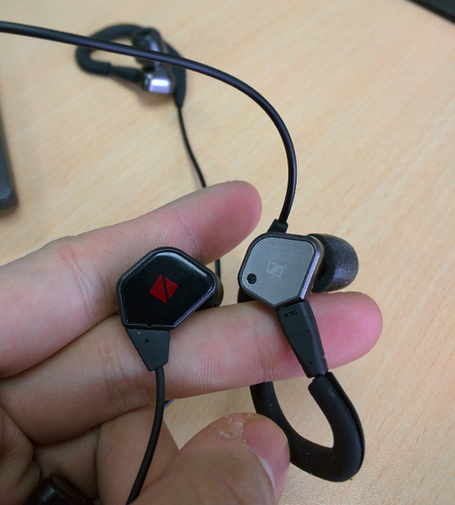
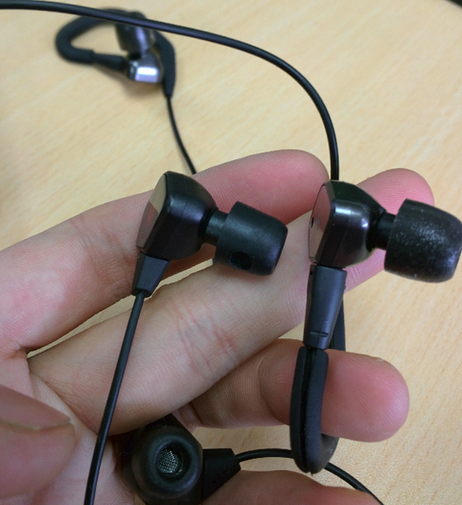
Of course, there’s one IE80 feature that can’t be cloned: the bass adjustment dial on the earpiece itself. The box includes a tuning tool you can use to turn the dial and adjust the bass amount. After testing for half a day, I found 2–3 is a good spot. Too low and the earphone loses its character; too high and you might as well go buy Beats.
Enough nitpicking — time for listening impressions. My sources are mostly the Sony D100 and ZX1. The two have different styles, but when it comes to presenting the IE80, they arrive at the same place by different roads.
So what does the IE80 sound like? Simply put, it uses a dynamic driver to achieve BA-like resolution.
What does that mean? It’s as if the IE80’s tuning is yelling at all those BA earphones: “Look, I can render the details you want too, damn it.” So through the IE80 you can hear almost every detail in the music — some you’d barely notice on BAs. For example, in the second verse of Asphodelus, the OP of Aiyoku no Eustia, there’s a short piano passage where the position shifts. I’d listened to it so many times and never noticed, yet on the IE80 it’s blatantly obvious.
That’s not necessarily a good thing. Some people online call the IE80 a classical set, precisely because its instrumental presentation is so prominent that it drowns out the vocals.
As I said, dynamics have no advantage over BAs in resolution — they can only compensate by exaggerating certain details so the listener notices they exist. But details are still details; making them too obvious just lets them steal the show. The result: instruments are over-prominent, vocals end up on par with them, and you feel like you can’t make out what the singer is singing while the accompaniment keeps grabbing your ears…
That’s where the “classical set” label comes from.
But actually the IE80 isn’t bad at vocals — provided you find vocals that “aren’t easily drowned out.” That requires two things: the arrangement’s instruments aren’t noisy, and the vocals aren’t too diffuse and have punch.
For example, I tried the IE80 with SUM41. You can guess the result: the singer’s voice has no power to begin with, and against the big beat it just disappears. Another example is the Hyouka ED2: Satomi Satou’s voice is too low and diffuse, so in the duet with Ai Kayano you basically can’t hear Satou anymore — it sounds like Kayano is singing solo…
It’s also about the arrangement. Many people say Fish Leong is the queen of sibilance. Actually, to me Zhou Hui’s voice is similar, but her recordings are a bit worse and don’t deliberately push the vocals forward, so the sibilance isn’t as obvious.
All that rambling, and what I actually want to say is:
Is the IE80 a classical set? No — it’s just that its character suits classical accompaniment well. But if you pick suitable music, it does pop just fine too.
And it’s not just that — you can even listen to hip-hop with no problem. Here I have to mention MC Hotdog — or Hot Dog; more people probably know him as 哈狗帮. MC Hotdog’s tracks are hip-hop rap, but the arrangements are unexpectedly well-suited to the IE80: the accompaniment and vocals are well separated, Hotdog’s voice is full of texture and never gets drowned, and it complements the rhythm. Most importantly, the IE80’s bass is great.
The IE80’s bass quality is scary good — something BAs simply can’t do. That’s the dynamic driver’s last dignity.
Another recommendation is fripside. I’d say fripside could rescue a whole pile of earphones with dull treble, all because Nanjou’s voice is so penetrating it never gets buried in the instruments. If your mids and highs have even a bit of feel, Ms. Nanjou will bring it out to the fullest.
Worth mentioning: the IE80 is an extremely sensitive earphone. What does that mean? It’s also a hiss detector.
The Walkman ZX1’s noise floor control is odd — sometimes it’s loud, sometimes you can barely hear it. Some say it’s capacitor-related, but who knows? One day I plugged the IE80 into the ZX1 and heard not just hiss but something close to a faint whine.
Then I plugged it into the D100 — still hiss.
PHA-2 amp into the desktop — still hiss.
PHA-2 amp into the laptop — hiss gone.
I dug out my old iPod Classic — no hiss either.
In short, the IE80’s sensitivity is too high. If you buy it and find that a bunch of your so-called high-end gear produces strange noises, well… that’s not really strange.
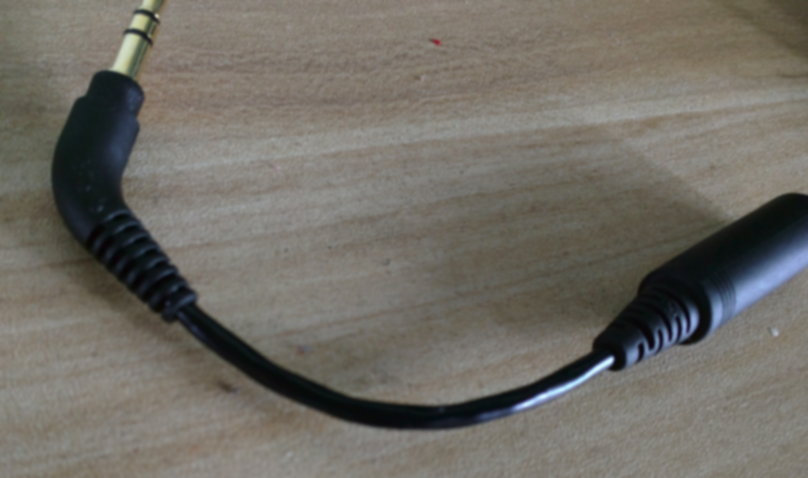
There is a fix for the hiss. I cleverly dug out the 4S impedance adapter that came with the ER4P, plugged it in, and the hiss vanished completely with no major change in sound. Well, actually there was — it felt a bit underpowered, so I added an amp and it went back to normal.
All in all, the IE80 is an earphone worth studying and savoring. When I first got it, I thought it was just boom-boom-boom bass. Later I found that with different songs and different sources it behaves in all sorts of different ways, and quite a few of those surprised me. After listening to BAs for so long, I’ve realized dynamics are the sound that warms my heart most. Ending my earphone-buying career with the IE80 isn’t bad at all.
Comments are hosted on the Chinese main site. This mirror is read-only.