Hanasaki Work Spring! (花咲ワークスプリング!) Review
The All-You-Can-Eat Buffet of Visual Novels
While I was playing Yuzusoft’s Sanoba Witch, I was already aware of HanaSaki Work Spring!, the new release from SAGA PLANETS. Turns out I’ve somehow played two games from this studio already — Hatsuyuki Sakura and Kisaragi Gold Star. The former was pretty good, the latter was a total trap. And it’s worth noting that Hatsuyuki Sakura was good partly thanks to the music and the way the story was arranged; Kisaragi Gold Star is closer to the studio’s actual average.
So I hesitated for a moment about whether to play this game that reeked of moege from a mile away — maybe 30 seconds of hesitation — then I saw Sawasawa Sawa in the CV list and jumped right in…

The game isn’t short, but no single route is all that long either. The overall plot is fun, but it’s also scattered. HanaSaki Work Spring! has a structure very similar to Kisaragi Gold Star: establish a main story first, then list out the heroine routes as side branches that barely connect to the main line, and once you’ve cleared the side routes, an After route opens up unlocking two supporting characters, and once you’ve cleared those two, the True End unlocks so you can finally see the real ending.
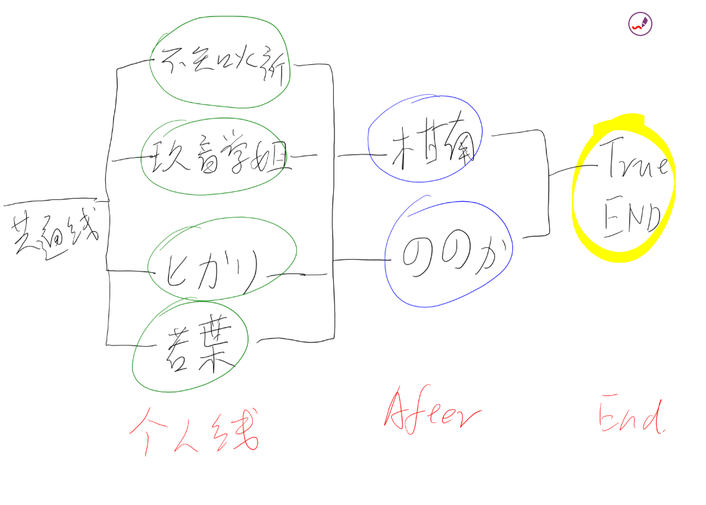
This way of structuring a story is genuinely weird. In the game’s overall arrangement, the common route and the True End are directly connected head-to-tail, but in between the player is forced through all these side routes, and only after the After routes does the real ending get dropped on you. It’s easy to come away feeling the story is in fragments.
When you sort it out, the story the game actually wants to tell is dead simple:
HanaSaki Work Spring! — the title refers to the protagonist himself, since the protagonist is named Hanasaki Yuma. “Work Spring” refers to laboring away in the late-spring season the game is set in, and since the male lead is defined as a lazy bum, you can read the title simply as: the story of this lazy bum starting to work hard in spring.
The protagonist starts out sleeping under a cherry tree, then meets all sorts of people at school — childhood friend Kuramori Wakaba, the underclassman who confesses to him, Kotobuki Hikari, the mysterious girl at school, Shiranui Inori, and the senpai who drags him into the Ghost Club, Kuon Ayano. The Ghost Club is the thing the common route spends the most time on. The senpai’s explanation: it’s a club for people who, like ghosts, cling to something they’ve lost or are about to lose and can’t move on. In plain terms, it’s the club for lazy people. The protagonist is a lazy bum, the senpai is a lazy bum, they hit it off instantly and become members, and to avert the crisis of the club being disbanded, the protagonist drags in his whole circle of friends. Every day is spent chatting and goofing off in the club room, and so on and so forth…
Then one day the protagonist discovers that club member Shiranui Inori is the younger sister of Shiranui Asuka, the kid who was the ringleader of his childhood play group. The protagonist idolized him. Asuka used to take the protagonist every day to hide in an old house in the forest he called the “secret base,” and together they founded the “Help-With-Anything Squad” to help people. Later, Asuka secretly took a job to save up money to buy presents for the squad members, and one day at work there was a fire. He died helping fight it.
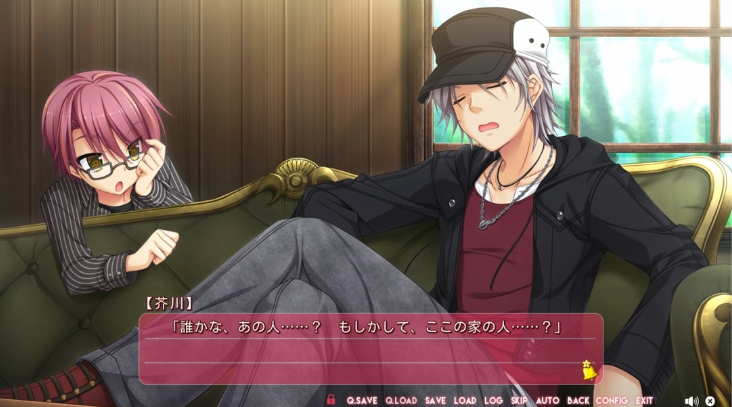
The protagonist has always believed Asuka’s death was his fault. He’d given Asuka a badge, Asuka was thrilled with it, and that day during the fire Asuka could have gotten out — but he came out, realized he’d left the badge in the flames, and turned back, which meant he never came out again. The protagonist blames himself endlessly, mourns Asuka, and believes his own descent into laziness is tied to losing his best friend. So he blames himself more and more, and withdraws from other people more and more.
“Shiranui Asuka was your friend, but he’s dead. You can’t live in his shadow forever. Shouldn’t you open your eyes and look at the new friends in front of you?”
Then, after a good talking-to from his bro and the Ghost Club members, the protagonist finally gets over it, lets go of his guilt toward Asuka, and honestly embraces his new life.
That’s the True End. The plot summary is stupidly simple… and yet the game chops it into two pieces, one in the common route and one at the very end. Viewed back-to-back it’s fine, but played with a gap in between, it just feels baffling and cheap.
I recall most SAGA PLANETS games follow this pattern — main story torn off and stuck at the end, with a pile of side routes up front. Hatsuyuki Sakura made it work because its side routes are fragments of one complete story: the Osakai Aya route is a prequel, and the other routes each tell a piece of the whole, which assembles into a single complete plot. In Kisaragi Gold Star the individual routes had nothing to do with the main line, or barely grazed it — each one just rambled — and the final main story even pulled out a setting on a completely different level from everything before, going full grotesque.
So how are the individual routes in HanaSaki Work Spring!? Put simply: most of them still ramble — but the rambling’s pretty good.
Personally I liked Kuramori Wakaba’s route best, then Kotobuki Hikari, then the senpai. Kuramori Wakaba’s route doesn’t touch the main line at all — it’s just a sweet romance story, with banter and character building that both land. Wakaba’s bold, open personality and the protagonist’s lazy, whiny one both come across perfectly, and it’s a joy to play. The late reveal that Wakaba is a rich girl who just wants an ordinary life is basically filler and can be ignored — it’s short anyway, and the whole thing is a comedy. The same pattern shows up in Kotobuki Hikari’s route: same fun, same charm, and again at the end it pulls out that Hikari’s hearing is bad so she’s always been insecure and easily swayed — also basically filler. Even so, I’ll say it: don’t expect main-story plot in the individual routes. They can’t be bothered to write the main story there, and that’s not this studio’s strength. As far as I’m concerned, if they can take the banter to its absolute peak, that’s enough — being fun matters more than anything.
The senpai Kuon Ayano’s route starts edging toward the main line, but doesn’t quite get there. The first 80% is confession and flirting, and then it tells you Ayano is about the same age as her teacher — looks around 25 — and keeps repeating grades at school forever. The reason: she once joined Shiranui Asuka’s “Help-With-Anything” squad, got a doll from Asuka, and came out of her shell. After Asuka died she couldn’t let go, didn’t want to grow up or graduate. In the end, after the protagonist’s efforts, the senpai accepts the truth too.
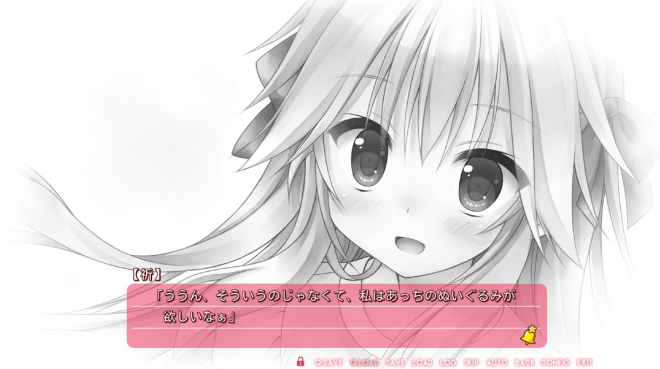
Shiranui Inori’s route is even easier to follow. Inori and Asuka were close as kids, but then Asuka was always out of the house playing with the “Help-With-Anything Squad” and grew distant from his little sister. She grew jealous of the squad, convinced they’d stolen her brother. Then the Shiranui family decided to move abroad, the brother wanted to stay, the sister insisted on going, they fought and fell out, and by the time she came back to Japan all she got was news of his death. Same clinging to Asuka, same release from it thanks to the protagonist, same walk toward a new life.
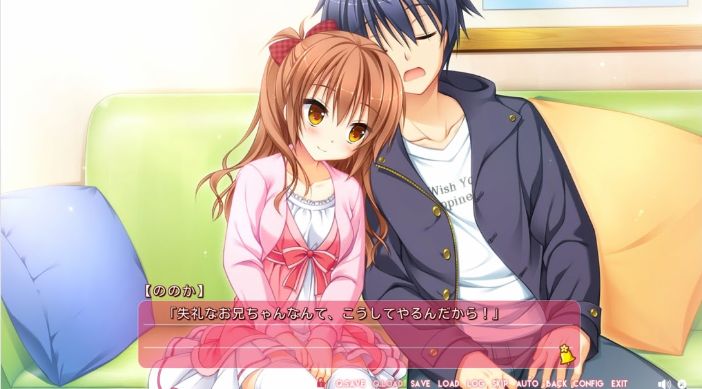
The After routes for the maid Kozami Kannan and Hanasaki Nonoka are even more casual. The former is the protagonist somehow ending up with her for no reason; the latter has been a brocon pining for the protagonist since childhood, confesses, and then crosses the sibling line — a fine demonstration of what “freebie content” actually means.
So how is the game, really? I’d say the strengths and weaknesses are both pretty obvious. The weakness is that the plot is too weak. The only main story is about encouraging people to step out of the shadows of the past, welcome a bright future, let go of old attachments, and cherish the people in front of you. Shame the boring route locks scatter it to pieces. But the strengths are prominent too: the daily banter, the animated CG presentation, and the BGM are all pluses, and the voice acting really stands out. Whether it’s Kiritani Hana… no, Sawasawa Sawa, or Tono Soyogi, they all nail their characters. Hanasaki Nonoka especially — the CV is listed as Tsukamoto Rita, but one listen and you know it’s the imouto goddess Gotou Mai. Gotou Mai voicing a little sister again after all these years, I absolutely could not hold it together. The art is business as usual — some spots aren’t polished, but the eyes and facial features are as distinctive as ever.
HanaSaki Work Spring! has a crossover with Yuzusoft’s Sanoba Witch, and Sendai Eri appears in both, wearing a scarf in each. But in my view HanaSaki Work Spring! is more fun than Sanoba Witch. Yuzusoft’s game has a more complex, deeper plot, but it falls far short of being good. Better to learn from SAGA PLANETS and beef up the daily life and comedy — it’s lower pressure to play and easier to enjoy.
If you think of visual novels as eating, some plot-driven works are like going to a ramen shop for top-grade ramen: one whole bowl arrives and you seriously savor everything from the broth to the noodles. HanaSaki Work Spring! is a buffet — all sorts of dishes and flavors, you take what you need. Sure, this hodgepodge feast has no coherence and it’s hard to taste the chef’s full course structure and flavor, but… it always satisfies all kinds of cravings, and it doesn’t taste half bad.
Comments are hosted on the Chinese main site. This mirror is read-only.