Grisaia no Rakuen (灰色的乐园) Review
Crossing the Labyrinth, Racing Toward Eden
The Fruit of Grisaia has sequels — two of them, actually. One is The Labyrinth of Grisaia, and the other is the finale, The Eden of Grisaia.
The Fruit of Grisaia already got a TV anime adaptation, and since the Labyrinth and Eden anime are both airing on the 12th of this month, skip this if you’re worried about spoilers.
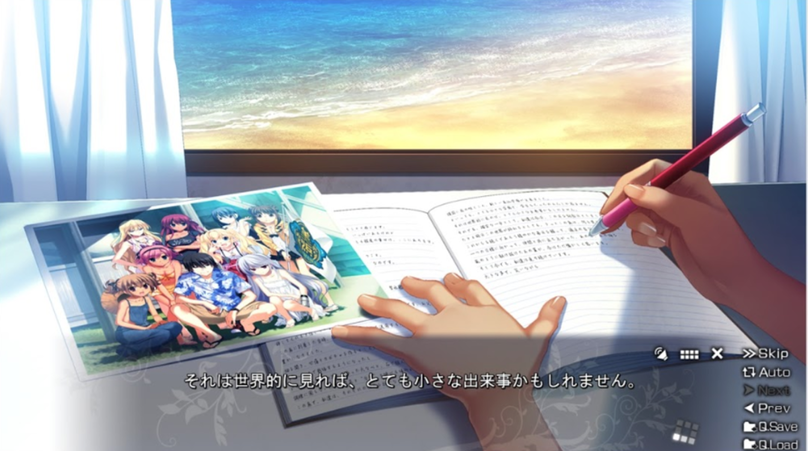
Honestly, looking back at The Fruit of Grisaia after all this time, I don’t think its plotting is all that clever. The common route drags on, and the individual routes have barely any foreshadowing — they just unfold through flashbacks. If the flashback stories weren’t genuinely good, and if the psychological detail weren’t so thorough, it’d be easy to nod off.
The Labyrinth of Grisaia (グリザイアの迷宮) is technically a fan disc for The Fruit of Grisaia. But it includes a chapter called “The Cocoon of Caprice” that covers the protagonist Kazami Yuuji’s past — meaning that chapter is the real Labyrinth, and everything else is mostly bonus short scripts.
“The Cocoon of Caprice” starts with Yuuji’s childhood. His family was a misery. His father was a small-time merchant with zero ambition; after going bankrupt he spent every day drinking and screaming at his family. Then Kazami Kazuki was born and gave him hope, because she was an eight-year-old genius with a 180 IQ, good at everything, and especially good at painting — her work sold for astronomical prices. Yuuji’s father latched onto her like a lifeline, greedily making her paint and sell, even shipping her off for further training. Yuuji, Kazuki’s little brother, was ignored entirely. His father barely acknowledged his existence, and when he did, it was to call him a burden. Then one day — the day of the basketball club training camp, when the van flipped in the wilderness in The Fruit of Grisaia — Kazuki was confirmed dead. It destroyed Yuuji’s father. The money was gone, everything was finished. He went back to drinking and beat Yuuji and his mother every day. Yuuji’s mother couldn’t take it and ran with him, but his father found them anyway, forced them to hand over what little cash they had, and whenever he was in a bad mood he’d rape Yuuji’s mother while Yuuji watched her suffer. Yuuji couldn’t stand it anymore. He decided to kill him.
“If this worthless man just didn’t exist… everything would be fine.”
Yuuji grabbed the beer bottle his father had left half-empty and smashed it into the back of his head. The bottle shattered, and his father collapsed in a pool of blood. His mother was barely lucid. She gave Yuuji the last of their money and told him to run first, she’d follow. Yuuji believed her — naive kid — but after running a while something felt wrong, so he turned back. He found his mother hanged, a suicide note saying she’d killed her husband.
Just like that, Yuuji was an orphan. A friend of his father’s took him in — a man named Kirihara. Except this guy was a terrorist leader, and also a fag, and also a fag who got off on little boys, and worse, a degenerate fag with a crossdressing fetish for young boys. He’d dress Yuuji up in girls’ clothes and play with him. He really liked Yuuji. By then Yuuji’s mind was already broken; as long as someone fed him and gave him a place to sleep, he didn’t care about anything else.
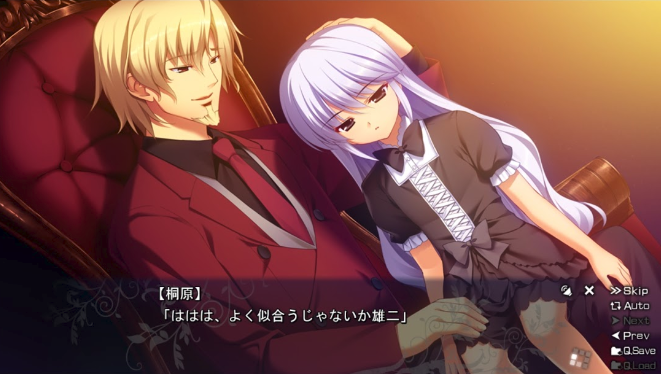
Kirihara eventually sent Yuuji to his terrorist training camp for children, where they injected him with a drug they’d developed as part of the “super soldier” program — build the ultimate killer on the battlefield. Yuuji spent years there, graduated successfully, and started traveling the world dressed as a little girl, killing people.
Worth mentioning here: Yuuji was a coward. He didn’t want to kill, didn’t dare to. But Kirihara would inject him with psych drugs that turned him bloodthirsty, and in that frenzy he’d kill — driving a ballpoint pen through a target’s jaw up into the brainstem, destroying the brain in the process. Extremely brutal stuff.
Yuuji’s activities caught the attention of another organization, which took contracts and set out to snipe Kirihara. He escaped, but they captured the killer — Yuuji — who was still a child at the time. An inspector named JB and her friend Kusakabe Makina noticed the boy. Makina liked Yuuji and pitied him, and decided to adopt him.
At first Yuuji was hard to tame. Years of drugs had left him without a mind and without any idea how to survive. Makina became his adoptive mother, took him to her home in the forest, lived with him day by day, and slowly restored him to something like a normal person.
This stretch paints Kusakabe Makina vividly. The one word for her is “freewheeling” — like a female warrior from some ancient tale. And she really was a soldier, the squad’s sniper. Makina taught Yuuji everything she knew, and built him into another version of herself.
Without the psych drugs, Yuuji couldn’t kill. He kept remembering killing his father, killing all sorts of people, and the fear ate at him.
“Sometimes we pull the trigger not to kill, but to protect our comrades.”
Makina’s words got into his head, and he found temporary relief, climbed out of the shadow. Later, years of sniper work ruptured a capillary in her right eye; the blood clot pressed on her brain and her vision deteriorated. She started sending Yuuji to do the assassin work in her place, and sent him to a US Navy training camp to serve. There he met a bunch of new friends and had a genuinely fun stretch of life.
Once he’d recovered, Yuuji formally took over Makina’s work — until one day JB called to tell him Makina had collapsed. Only then did he learn the clot had become permanent, inoperable, terminal. Holding her hand, Yuuji felt the pain; Makina just smiled. Smiling, she closed her eyes.
It took Yuuji a full week to climb out of losing his adoptive mother. Makina’s friend JB took over as his guardian, and Yuuji carried on her unfinished work while also attending school and living “the ordinary life of an ordinary student.” That’s where The Fruit of Grisaia begins.
At the very end of The Labyrinth of Grisaia, Yuuji gets a job: snipe a target. When he sees the target, his vision goes black. The man in front of him is none other than Kirihara — the man who once took him in and turned him into a terrorist. Kirihara smiles into Yuuji’s scope and mouths:
“Little Kazami Yuuji, I’m back.”
Yuuji immediately breaks. He can’t kill. The shot fails. The Labyrinth ends there, and next comes The Eden of Grisaia.
Eden also has three main script parts, with the rest being odds and ends. The important one is “The Seed of Blanc Aile,” which picks up from Labyrinth.
“The Seed of Blanc Aile” opens with the heroines at the school dorm learning that Kazami Yuuji has been arrested on suspicion of attacking an embassy. It’s on the news — the attacker matches Yuuji at 65%, and the name is given as カザミユージ. Yuuji is labeled the prime war criminal, imprisoned, and slated for handover to the government for trial.
Yuuji’s inspector JB is dismissed, and the school is to be shut down. The heroines want to help Yuuji but have no idea how. Komine Sachi tells the others she found another room in Yuuji’s house, containing things from the past he’d described, plus some things that shouldn’t see the light of day.
They go look, and find the walls covered in Yuuji’s anguished confession.
“I’ve killed people…”
“I’ve killed all kinds of people, lost all kinds of things.”
“I just wanted a place where I could die.”
“Makina took me in and saved me, so surely I’m allowed to die now?”
“I saved five girls at school, so surely I’m allowed to die now?”
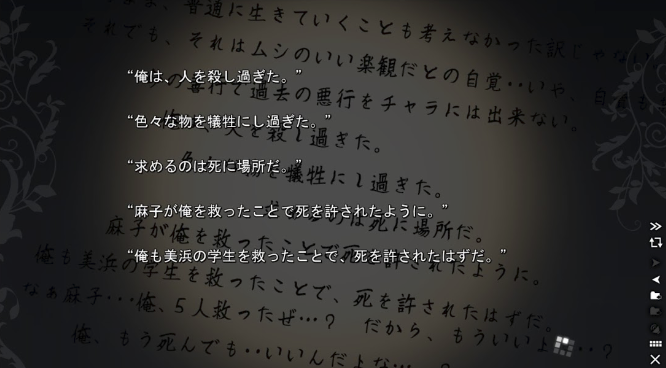
“Sometimes I’d see Yuuji awake in the middle of the night, just crouching in this room without a sound.” Suou Amane’s words hit everyone — the dorm girls finally realize that the expressionless Kazami Yuuji had been carrying this much pain all along. They resolve to save him.

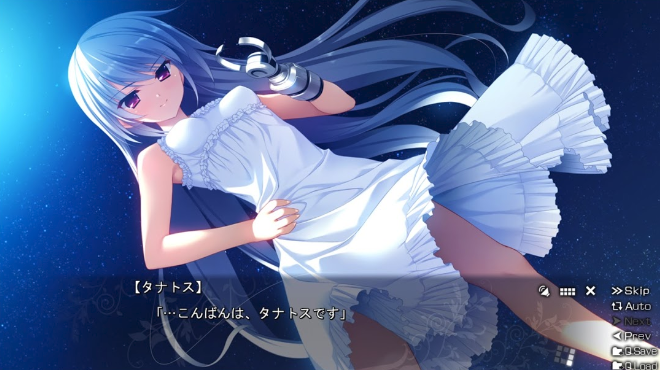
But saving Yuuji isn’t simple. A figure calling herself “Thanatos” contacts the girls by phone, claiming she has a way to save him and asking for their cooperation. They follow her instructions to a spot near where Yuuji is held and start preparing. With Thanatos’s help they buy guns, scout escape routes, ready weapons, and gather funds.
So who is Thanatos? She’s Kazami Kazuki — the girl confirmed dead in The Fruit of Grisaia. That night, after sending Suou Amane off, Kazuki was caught by the surviving cannibals, but they didn’t do anything to her; they started infighting and killing each other. Some who ate human flesh regained their sanity, couldn’t accept what they’d done, and attacked the others; some went mad. One by one they died. The last survivor, the teacher, died of liver failure from poisoning after eating human flesh. Kazuki was rescued by people who arrived afterward, but instead of being handed to the government, her genius-level intellect got her taken by the organization to serve as “the Professor” in developing the Thanatos AI project. The Thanatos contacting the girls is an AI modeled on Kazami Kazuki’s brain, so it has her personality, her intelligence, even her voice. The real Kazami Kazuki is still imprisoned in the lab.
Thanatos works busily, using the net and every resource to infiltrate, laying plans for JB, the girls, Kazami Yuuji, and Yuuji’s comrades from his US military service. Everything converges on the day the organization transports Yuuji — the girls strike and take him back.
Kirihara’s crew isn’t idle either. Kirihara’s plan this time is to seize the Thanatos AI. His super-soldier program has paid off; he’s even made a clone with perfect combat capability. All he needs is the ultimate AI and the plan is complete. He also hears that Thanatos is Kazami Kazuki, and that Kazami Yuuji is Kazuki’s beloved little brother — plus he’s a fag who’s into Kazami Yuuji — so he also plans to hijack the transport on that day.
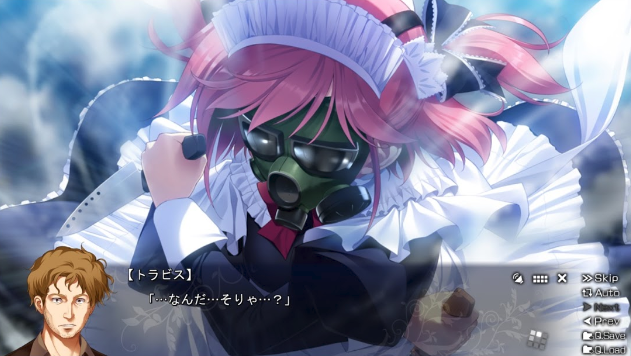
So the great battle finally arrives. Kirihara strikes first and takes Yuuji; the girls strike again and snatch him back from under Kirihara’s nose. Komine Sachi, the top fighter, wipes out three special forces soldiers single-handedly; Inokuma Yumiko blows out the convoy’s engine block with a long-range sniper rifle. Amane takes over, and the crew launches into a car chase. The organization throws armed helicopters at them; the group flees into the forest and runs a guerrilla loop, and finally — with help from Yuuji’s comrades, who’ve received Thanatos’s instructions — they get Amane’s group onto a submarine at sea.
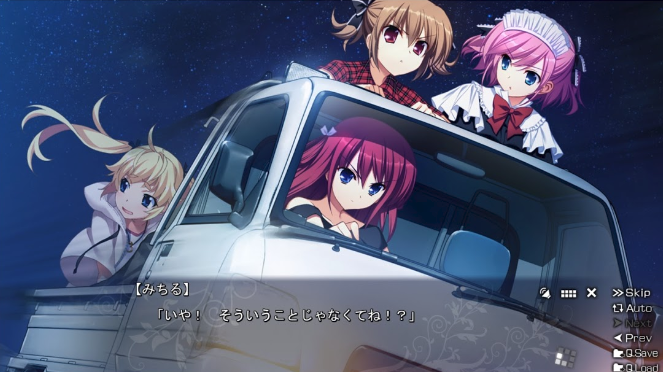
Meanwhile JB follows Thanatos’s orders to the organization’s core, rescues the imprisoned Kazami Kazuki, and brings her to the submarine too. Yuuji, after all these years, meets his sister Kazami Kazuki again.
It’s not over. Kirihara is still eyeing Yuuji, and Yuuji — confidence restored — decides to go on the offensive and settle it. He sneaks onto Kirihara’s ship, cutting down everyone in his path until he reaches Kirihara. But the one who appears isn’t the old fag — it’s someone who looks exactly like Yuuji.
This is Kirihara’s finished super-soldier: a clone built from Kazami Yuuji, an ultimate killing machine made nearly invincible through drugs, with the same-sounding name — カザミユージ. So the embassy attack at the start was him, not Yuuji.
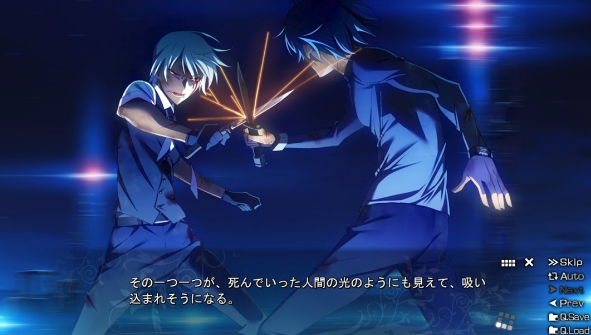
The two begin the final fight. Here you can choose whether to use that drug again. Obviously pick “no” — otherwise what was this whole arc for?
After a hard fight, Yuuji beats his own clone and reaches Kirihara. Kirihara is still the same old fag, another hard fight, and Kirihara dies — Yuuji badly wounded. But then Yuuji realizes the Kirihara who died wasn’t the real one. The real Kirihara has withered away, controlling clone proxies from afar through a brain link. Kirihara explains his plan — to become the god of a new world. (Tacky or what?) He invites Yuuji to join him.
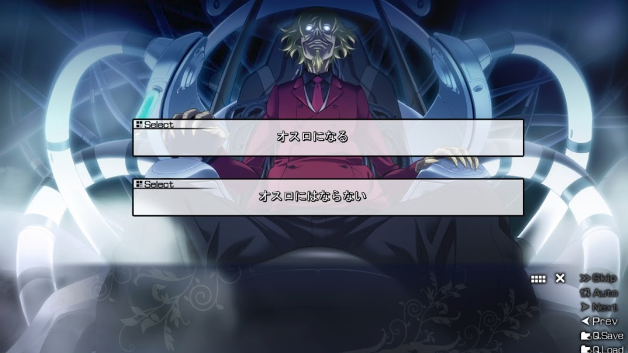
So choose “refuse,” cut down Kirihara’s real body and his machine, the ship explodes, Yuuji is blown clear, survives, and takes the heroines to the little private island Kusakabe Makina bought with her life savings — and they live happily ever after.
Looking at both the past arc (Labyrinth) and the finale (Eden) as a whole, I can only say these two games aren’t on the same level story-wise at all. Labyrinth keeps the oppressive weight of The Fruit of Grisaia in its depiction of the past, and holds to the same meticulous-to-the-point-of-rambling pacing. The military service stretch in the middle is absurdly long, though I figure the anime will cut it.
Eden, though, doesn’t feel like the same series anymore — same characters, sure, but it plays like an American blockbuster. The high-tech rescue at the start, the endless explosions during it, the barrage of combat set pieces, the American-style snark in the middle of firefights, the final boss transformation — sometimes I felt like I was watching Pacific Rim or Spider-Man or Batman rather than playing a sequel to the scientifically rigorous The Fruit of Grisaia. Sure, the Hollywood plotting is fun, and the game is made with obvious care — it doesn’t skimp on effects and CGs when it counts — but crammed into the Grisaia series it still feels a bit off.
Even so, apart from the overlong preparation phase at the start, Eden’s final operation is genuinely exciting. It’s weird, but who cares — the real story was already told in The Fruit of Grisaia, and the protagonist’s past we wanted is answered in The Labyrinth of Grisaia. So what’s left for The Eden of Grisaia is to give us a Happy End where we cross the “Labyrinth,” pick the “Fruit,” and arrive at “Eden.”
Is a Happy End bad? Kazami Yuuji has been through enough. It’s time to let him live out his days in peace.
Comments are hosted on the Chinese main site. This mirror is read-only.