Hana no No ni Saku Utakata no (花の野に咲くうたかたの) Review
Like Hard Liquor, Tastes Like Plain Tea
The reason I paid attention to Hana no Aruji (花の野に咲くうたかたの) is first, because of the scenario writer Kirizuki, and second, because of the coloring style.
桐月 wrote Tasogare no Sinsemilla (黄昏のシンセミア — the forbidden medicine at dusk, or dusk’s weed, call it whatever you like), and the game’s coloring style reminds me of [Clover Day’s] 1. Same artist as dusk’s weed, sure, but the coloring is way better than the old work — the girls are cuter and fresher.
Honestly, I didn’t even want to play this one at first. I never played Tasogare no Sinsemilla either—people just hype it up to the heavens, and I figured a writer who’d produced at least one readable work couldn’t be all that bad. Then I took one look at the art style, fell in love with it, and played the thing.
If I had to sum up this game in one sentence, it’s like a cup of gongfu tea carefully brewed by a soft-spoken girl — mild in flavor, nothing like the instant jolt of coffee or hard liquor, but it won’t leave you feeling bad, and if you sip it slowly you’ll find something uniquely its own.
I genuinely have no idea how to translate the title Hanano Nobe ni Saku Utakata no. The first part means flowers blooming in the field, but I have no clue what that last bit is supposed to be. Maybe, like Tasogare no Sinsemilla, it’s some kind of word that points at something or other. Doesn’t stop you from playing the game, though. Before I get into the story, I need to run over and sing the praises of everything in this game that isn’t the story. The system, for instance.
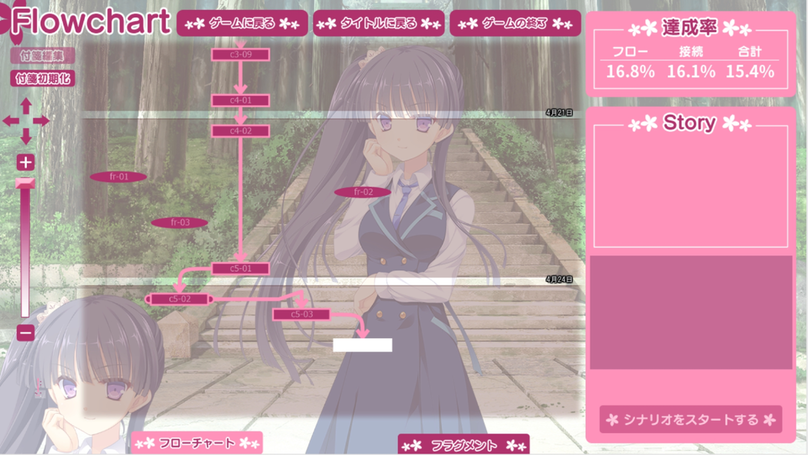
First off, the game has 100% touchscreen support—you can even bring up the menu by swiping your finger across the screen, just like the Start menu in Win8. At the same time, the game marks the most direct choices right on the routes, so you can see at a glance which route you’re on and what side stories have unlocked nearby; the right side also gives you a quick preview of each side story’s summary, background, and cast. Last time I saw a system close to this was the perspective system in 11eyes, and Hana no No ni Saku Utakata no takes the player experience to the extreme. The game supports HiDPI, the window can be stretched freely, and it automatically adjusts the scaling and whether to show the little portraits based on the window—every detail that could be considered has been considered.
They really went this far — you can tell the game accounted for a lot of situations during production. Even for the demo version, they had the CVs record a little send-off for the player in character at the end: things like what story developments the full version might have, thanks for downloading and trying the demo, and if there’s anything you don’t like, please email us. All in all, it felt like a genuinely warm show of goodwill.
The music fits the game’s style well. I don’t know the details, but it really does have that “serene,” “quiet,” “peaceful” vibe. The OP and both EDs are solid too.
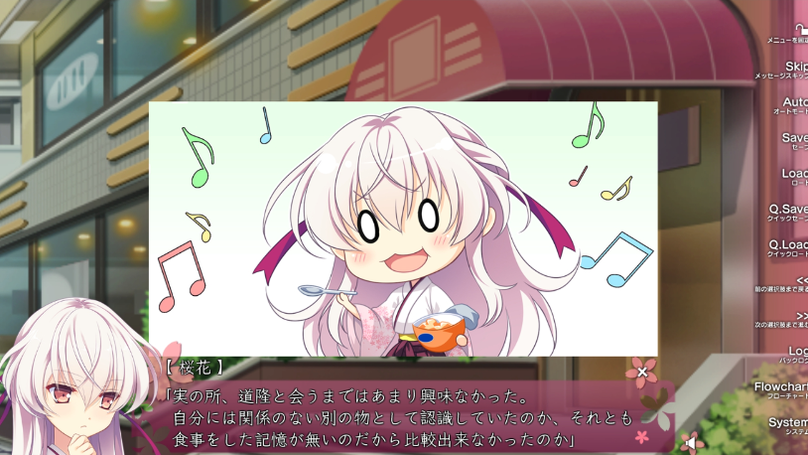
Also, the SD CGs in this game have their own thing going on, though they’re a bit far off from the main art style…
Anyway, enough of the other stuff — time to talk about the story…
There are five romanceable characters: the student council president Kasasagi Shizuku, the ghost girl of Sakura-sou, Ouka, the childhood friend Inoue Rena, the underclassman Yakushi Ryoko, and the cousin Fujimiya Shione. But the way the routes are laid out is, uh… very much a crime against humanity.
First you need to clear either Inoue Reina or Yakushi Ryoko’s route to unlock Kasasagi Shizuku’s route. After finishing all three of those routes, your cousin Fujimiya Shion’s route unlocks. Clear Fujimiya Shion, and then Sakuraka’s route opens up. Once Sakuraka’s route ends, the True End route begins — start the branching game again from the main menu to actually finish the whole thing.
Sure, there are five romanceable heroines, and the route locks look like one nested inside another, but… aside from the True End Sakura route, the other routes barely have anything to do with the main plot. Some of them have literally zero connection.
The game’s prologue lays out the premise: the protagonist moves into his grandfather’s old house, Sakura-sou. Nobody’s lived there for years — supposedly because it’s haunted. First day there, he runs into the ghost. A female ghost. A big-breasted female ghost named Ouka (桜花). Then his cousin shows up looking for him, and at school he runs into his childhood friend, a kouhai, and the student council president, and the daily routine begins.
Then all sorts of incidents start happening around school — the teacher’s chalk box mysteriously goes missing, stray cats inexplicably pile up at the shrine on the hill, that kind of thing. The protagonist stumbles onto and gets dragged into each one, and eventually he heads back to Sakura-so to ask Sakura’s opinion. Sakura then does her best famous-detective impression, lays out a whole chain of reasoning, and cracks the case…
Honestly, this section moves at a pretty leisurely pace. I mean, a lost chalk box and a stray cat aren’t exactly big deals. If I had to name something it reminds me of, it’d be Hyouka… more or less.
Same detective flavor, same detective doing a lap and finding out it was all little things close to home.
At the end of the prologue, the protagonist suddenly reveals that he was in a car accident as a kid. It was bad. He was supposed to die, but they pulled him through — only for him to wake up blind, unable to see a thing. Then one day he realizes he can see again. Except the world he sees is all wrong: some of it is black and white, and there are these weird colors mixed in. He can even tell how people are feeling from those colors. It’s basically an esper power, but he can’t control any of it. Honestly, just having his sight back is enough to be grateful for.
The ghost girl haunting Sakura-sou, Ouka, calls herself a spirit and says she’s the place’s jibaku-rei — a bound spirit that can’t leave the building, or she gets yanked back like a forced teleport. Ouka doesn’t know where she came from or how long she’s been drifting around here either. Plenty of people can see her, and she’s not out to hurt anyone. She loves reading, so she comes off as surprisingly sharp at deduction.
Oh, okay — so it’s not Gosick, but it’s definitely close: a brilliant girl locked away in a house, helping people on the outside solve cases and whatnot.
Next come the individual routes. Each route corresponds to one school event and its resolution, and none of them are long at all — once the event is resolved you can just push forward, and when you’re done, it’s ED time…
Yakushi Ryoko’s event is the part-time-job thief incident—stuff goes missing from the staff at her workplace… and it has absolutely nothing to do with the main plot.
The Inoue Rena incident is about Rena’s father wanting to buy Sakurasou and selling off stuff on his own. Rena’s family seems loaded. By the way, her family seems to be connected to the car accident the protagonist was in as a kid. The incident gets resolved in the end, and if this route has even the slightest bit to do with the main story, it’s the one short flashback of the accident.
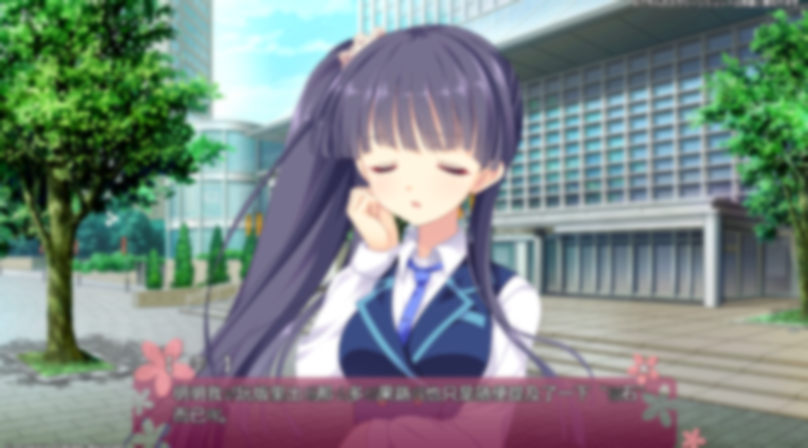
Shizuku Kasasagi’s route, the student council president’s, is even more casual. She hears about the seven school mysteries and about someone running around the school at night, so she drags the protagonist along to investigate. They poke around and find absolutely nothing. Eventually the protagonist asks why she’s so obsessed, and she says that as a kid she saw a mirror — a mirror that could talk — and she talked to it, and then the mirror disappeared. Her interest in all these ghost stories comes from thinking they might be connected to that mirror, and she wants to see it again. This route drops the key main-route clue, “a mirror with a spirit,” and then… nothing else.
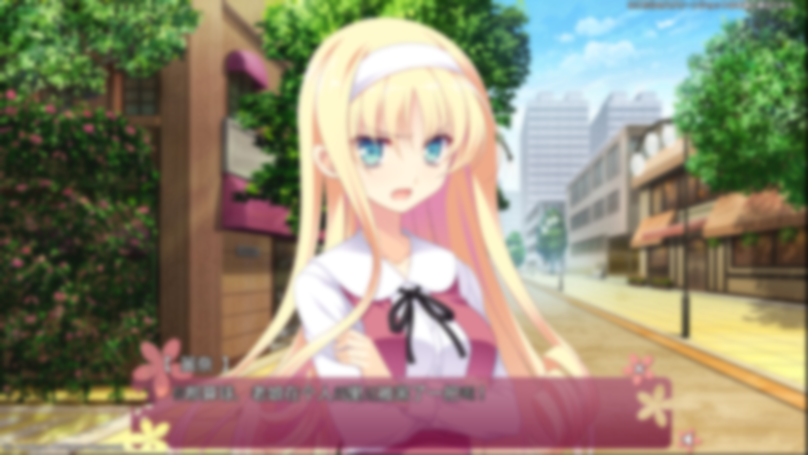
表妹藤宮汐音线有点贴近主线,但是又不太一样。某日男主的同班同学在公园和小混混打架,据说是保护妹妹还是什么,然后那群混混里手里拿着一个黑色的片状石头,男主最后也搅和到这个事件里了,经过一番乱斗,带着汐音逃离了混混的包围,顺便抢走了那块石头,汐音的手则被那个石片不小心划伤了。接着当晚半夜汐音仿佛变了一个人一样,夜袭男主要和他啪啪啪,样子非常妖媚。男主没把持住,后来经过桜花的分析,和对山上神社的拜访询问。得知那块石头应该是“镜石”的一部分,“镜石”是相传有灵性的石头,一面平如镜,可以映出人影。“镜石”的功能是可以存储倒影的一切内容,甚至包括面对它吐露心声的人的内心,并且可以将人曾经感受到的情感一股脑爆发出来。汐音被“镜石”划伤后,自己长达十多年对表哥,也就是男主的暗恋被全部一晚上爆发出来,所以就妖媚的把男主推了……然后正是这个事情捅破了窗户纸,男主说自己其实也是喜欢汐音的,然后俩人成为情侣,没了。这条线对于主线已经很有关系了,虽然不大,就是“镜石”的存在和作用。
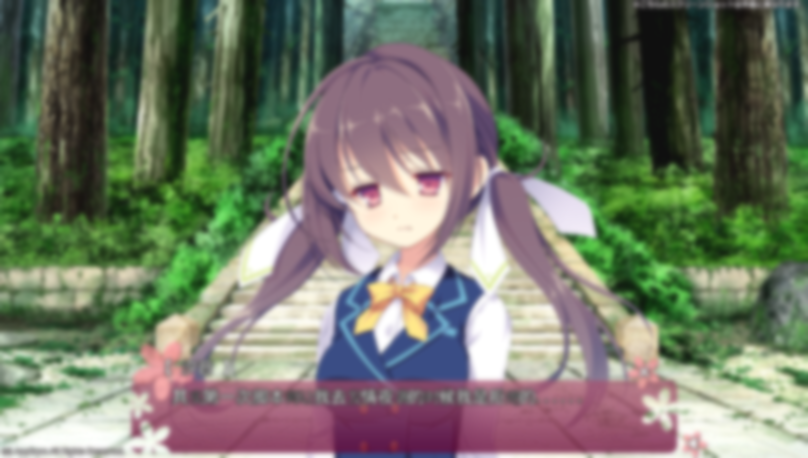
None of the individual routes are all that long, but a fair number of them are straight-up weird. By the time you’ve finished everyone’s route, your confusion has only grown. “What the hell is this game even trying to say?” It starts out like a detective story, then turns into some kind of ghost story, nobody ever questions that Ouka exists, and everyone’s just chilling. What’s even stranger is that the OP goes hard, like some big drama is about to kick off, a holy-shit twist Around the Corner — but the actual content is painfully tame. Just taking the routes for Shizuku Kasasagi, Reina Inoue, and Ryoko Yakushi on their own, they feel like filler handed out for free. And on top of that, they’re the keys you need to unlock the story lock. It’s like the writer knew these routes had nothing to do with the main plot, so the only way to force you through them was with this kind of gating.
Once every route is cleared, the protagonist arrives at the Sakura route, and from here the story starts moving fast. First, him and Sakura falling for each other is still pretty mild—they just suddenly fall in love, then he confesses, and they’re a couple. Next, the protagonist notices his vision starting to get weird; like I mentioned earlier, he keeps seeing inexplicable black-and-white and colors. After he starts dating Sakura, the two of them begin investigating the “Kagamiishi” incident and learn that the Kagamiishi was originally a stone enshrined at the area’s old shrine, but the old shrine was lost in the war. Maybe the ruins of the old shrine can be found on the mountain behind the house.
Ouka and the protagonist head to the back hill, and he finds that in his field of vision the hill is just a pitch-black void—nothing there at all.
The protagonist is scared, so he drags Ouka and his male classmate along to explore and figure out what to do about all this darkness. But once that classmate reaches the back hill, the blanket of black just vanishes — it feels exactly like playing War 3 when the fog of war suddenly gets lifted.
And then the protagonist finds it weird. Sakura is weird about it too. They go back and start mulling it over, and eventually Sakura finally remembers something. She opens up some hidden attic in Sakurasou and shows it to the protagonist. He looks inside, and it’s still dark.
Ouka asks the protagonist about the car accident from his childhood, and finally everything clicks into place.
Turns out the guy got badly hurt in a car accident as a kid — he should have gone blind, and in fact he still is blind. And the car that hit him may have been hauling mountain rocks; during the crash, fragments of the “mirror stone” got driven into his body. The surgery saved his life, but the “mirror stone” has already become part of him.
The “Kagamiishi” can map another person’s mind and field of view, and transmit that person’s mind and vision to the protagonist. So through the power of the Kagamiishi, the protagonist gains sight — though it’s somewhat monochrome, with some strange colors mixed in. Those colors really do reflect what’s in the other person’s heart.
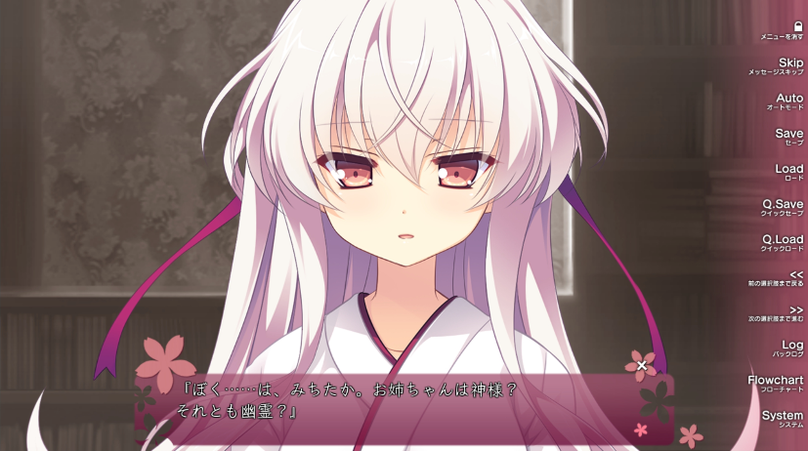
The reason the war fog over the back hill is invisible is that none of the people the protagonist has come into contact with have ever been there. Nobody has any memories of that place, so to the protagonist it just looks black. The same goes for the secret attic in Sakura-sou. Ouka isn’t human, so she isn’t affected by this, which also means she can’t help the protagonist.
And Ouka’s very existence gets recalled through the “Kagamiishi” that the protagonist awakens to. The site of Sakura-so is a shrine that originally stood on the old battlefield, dedicated to the “Kagamiishi.” Ouka isn’t a ghost — more precisely, she’s a god.
Ouka realized that staying with the protagonist wouldn’t work. His eyesight depends on human memory and the way humans map the world onto it—and she isn’t human, so all she does is drain more of his stamina. Keep going like this and he’ll be dead sooner or later. So she decides to disappear. The protagonist then gives her one last passionate speech and pulls the Ouka who wanted to leave back to him. Then he activates the power of the “Kagamiishi” and materializes Ouka’s body, which had originally been a soul (sorry, there’s way too much pseudoscientific nonsense in there, I can’t be bothered to write it all out). Ouka, now with a body, takes the protagonist and the two of them walk off into a Happy End.
When the game later reveals the truth about the “Kagamiishi” and the protagonist’s ability, it’s hard not to think of another game called Chaos;Head.
All you need is for everyone around you to acknowledge that an object exists—once there’s consensus, the object is real. You could rewrite the brains of everyone nearby with your brainwaves, or you could use the “Mirror Stone” inside the protagonist.
In the end, the protagonist busts out some serious cheat-tier power and succeeds in becoming the one who wields the power of the “Kagamiishi” — he’s blind, sure, but he’s already surpassed the gods. Fortunately he keeps himself in check: he only did it to save his little sister, and there’s no shared enemy to worry about, so it doesn’t come off as too absurd.
Back when I first got hooked on novels, the one that dragged me in was a horror novel. Not for any other reason—horror has a ton of mystery in it, enough to keep me reading, whereas all that romance-and-sakura stuff put me to sleep halfway through.
For a lot of kids these days getting into Japanese visual novels, that holds true too. But I’m old now, so when it comes to familiar plot beats, I end up seeing things a bit differently from everyone else.
在剧情描写上,太多人一门心思扑在所谓的“大反转”上,反而把故事本身丢到一边。这也是为什么,在冻幔游这三个圈子里,越来越多作品设定搞得花里胡哨、哗众取宠,剧情却烂得像一坨狗屎。这不能怪制作组——这些“狗屎”是观众和玩家自己挑的,你们爱看,做的人自然就投其所好。我不是说追求超展开有什么错,只是说,你不能为了“超展开”而“超展开”,把剧情和故事本身扔了。谁都爱看掉头和虐心桥段,但主角随随便便死一死再复活,并不会让作品自动变成神作。
For Hana no Uta, this holds true even in the OP and prologue—it throws out a pile of setup to hook you, and the OP in particular looks like it’s about to be some hot-blooded hypefest, but then the common route turns out to be this mild. Mild as it is, though, each story is short enough that it reads like a little short story with its own flavor, and paired with the gorgeous art and cozy music, it’s a laid-back, easygoing experience—like sipping afternoon tea while an old timer slowly tells you a tale.
The main route of Hana no Uta (花の野に咲くうたかたの) deals with the protagonist’s ability and the past of the Sakura-sou goddess Akira. It doesn’t drag things out much—the problem gets solved in one go, and everyone’s happy afterward. No twists and turns, sure, but honestly it’s almost too grounded in reality.
I skimmed some reviews of Hana no Uta (花の野に咲くうたかたの) and they’re pretty polarizing. A lot of people think the story is too plain and ordinary, and doesn’t live up to its energetic OP — nobody dies, the protagonist doesn’t save the world, and the heroines don’t even have dark backstories, so they can’t get invested. The other camp thinks the length is just right, the narration is fairly grounded and laid-back, and even with a slow rollout it’s enough to make the characters feel vividly alive.
For me, Hana no Uta (花の野に咲くうたかたの) is of the latter kind — I at least played through it nice and easy, and I didn’t dislike it.
“Do you like Hana no No ni Saku Utakata no?” “Not sure.” “Then do you hate it?” “Nope.” “So that means you like it.”
Borrowing the confession line that gets used all the time in galge, I’d say Hana no Uta is still a pretty good game. The setup makes it feel like a bottle of hard liquor, but what you actually taste is the fragrance of clear tea.
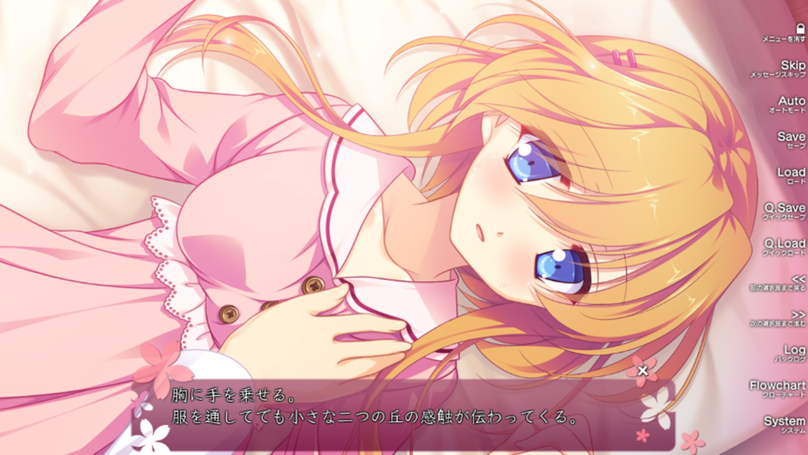
On a side note, Hana no Uta ni Saku Utakata no even has Mai Gotou in it — that’s Ryouko-chan, and man, what a treat.
Comments are hosted on the Chinese main site. This mirror is read-only.