Harenochi Kitto Nanohana Biyori (晴のちきっと菜の花びより) Review
Sunny, Then Sure to Be Onion-Flavored Melodrama Weather
The keyboard critics on Quora once debated a question:
Is a galgame literature?
The question is itself a problem. Asking whether a game is literature is like asking whether “humans” are “perverts.” Sure, there are humans who can’t get through a day without licking something, and there are also normal people like me who have zero interest in that stuff.
A galgame is still a game. Games have plots, and most non-nukige galgames lean heavily on theirs. There may be some “literary” elements in there, but on the strength of those elements alone you can’t begin to put it on the same level as literature.
So as a game genre that carries “literary elements,” plenty of galgames try to break new ground in their plots. These days, if you don’t have foreshadowing and a shocking twist, people will call you boring. Which has led many to believe that only “suffering,” “dying,” “flying off the rails” and the like deserve to be called a god-tier scenario, while anything focused on the everyday gets sneered at.
On this point I’m fond of the 2007 Chinese college entrance exam essay prompt: unexpected, yet inevitable.
What it means is that no matter how your plot unfolds, no matter how high it flies or how wild the ideas get, as long as you can justify it and give people that “unexpected yet inevitable” feeling, your story is a success. Even slice-of-life, if written vividly and every character’s personality also lands as “unexpected yet inevitable,” is a success too. At the very least the story keeps you in suspense, is easy to follow, and doesn’t feel too far-fetched.
Put more bluntly: write it however you want, but at minimum it has to be logical. That’s the baseline.
Without logic, the whole story looks nonsensical — exactly like Haru nochi Kitto Nanohana Biyori (晴のちきっと菜の花びより).
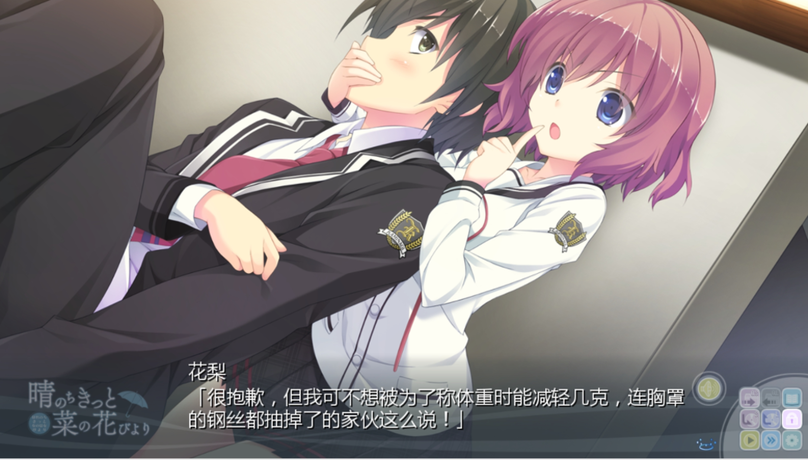
The Chinese fan translation rendered 晴のちきっと菜の花びより as 晴霁之后定是菜花盛开的好天气. Nothing wrong with the name — hell, I don’t know how I’d translate the Japanese either. It contains the names of the male and female leads, so if you force a meaning-based localization it always feels like something’s missing, since it betrays what the original title meant. Same as when someone translated Hatsuyuki Sakura (はつゆきさくら) as 初雪樱花…
I don’t know how to describe the story of Haru nochi Kitto Nanohana Biyori, because I can’t understand its logic — at least not the fine-grained logic. But I’ll run through it anyway; interpret it yourselves.
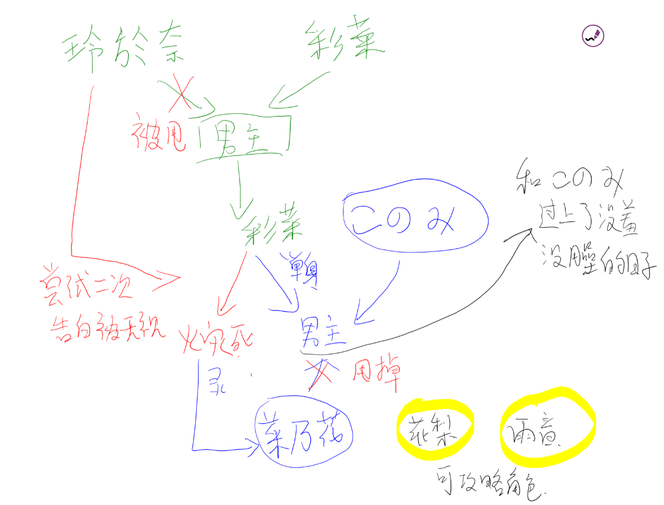
It starts as a love triangle. Reona and Ayana both like the protagonist, they get jealous and snipe at each other, and in the end he picks Ayana and dumps Reona.
Soon after he gets together with Ayana, the two get caught in a fire and Ayana dies in it. The protagonist, shattered, loses his grip on reality. Ayana’s little sister Konomi, trying to comfort him, impersonates Ayana — meaning she just cut her hair short and mimicked Ayana’s speaking voice.
Sister-deprived and out of his mind, the protagonist sees a girl with similar hair throw herself at him, assumes Ayana is back, and without hesitation pins her down and fucks her, taking Konomi’s virginity. Then he suddenly realizes something’s off: he’s been screwing the wrong person, not his girlfriend but his girlfriend’s sister. He lets out a shriek — ah, his mind breaks. He’s hospitalized and comes down with amnesia. Konomi, nothing daunted, decides that to get him back on his feet she’ll use his memory loss to overwrite her sister’s feelings onto herself, flirting with him and throwing herself at him every day, and colluding with everyone around him to never mention Ayana and make him forget. So at the start of the game, the protagonist knows nothing about Ayana, only Konomi, and thinks Konomi is into him while he himself isn’t sure whether he likes her.
So is Ayana, who died in the fire, really dead? Of course not. She was actually helped by a god and revived in a loli body, just to see the protagonist again. Her revived name is Nanoka. Soon Nanoka meets the protagonist and lives with him, and soon after the protagonist discovers Konomi is hiding something from him and Nanoka is hiding something too. Then he runs into Reona again, Reona confesses to him, and the plot kicks into gear: the protagonist discovers Nanoka’s secret and learns that Nanoka is Ayana.
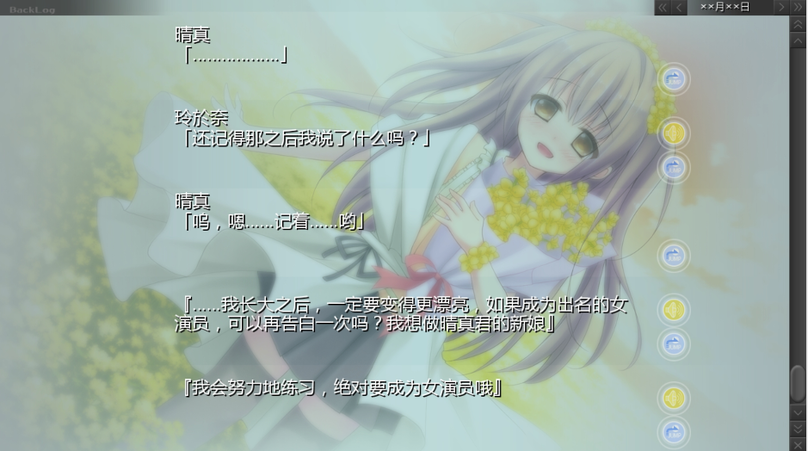
Faced with this shocking truth, faced with his revived lover, the two reunite and shed tears of joy. Ayana tells him her body is only borrowed and won’t last long, and asks him to think carefully about his feelings.
Faced with Reona’s confession, faced with his past lover’s crisis, faced with the flags of two other romanceable characters, the protagonist resolutely…
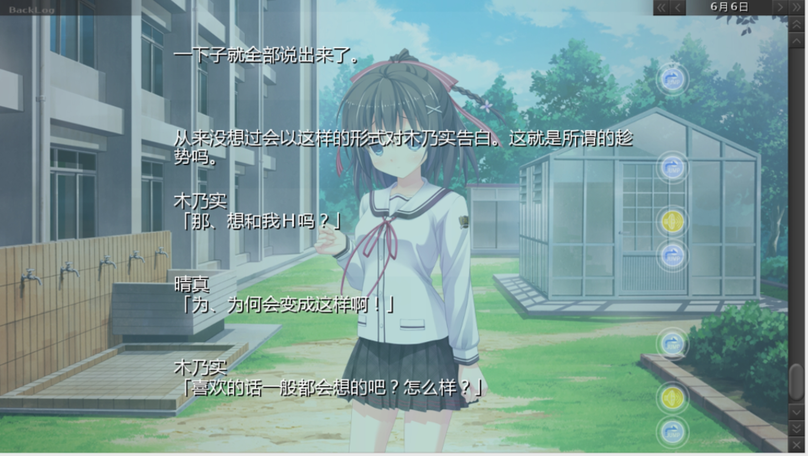
…chooses his lover’s little sister.
In the end his lover’s soul departs, and the protagonist and his lover’s sister become a new couple, heading into the True End.
Ah yes, I said True End. You can actually choose to pursue Nanoka and two other side characters. As for Reona? Nope, no route for her. Despite her several solo CGs, despite her sizable screen time, she still gets no route, and in other people’s routes she’s still all ワクワク about the protagonist’s feelings. I truly admire that generosity of spirit…
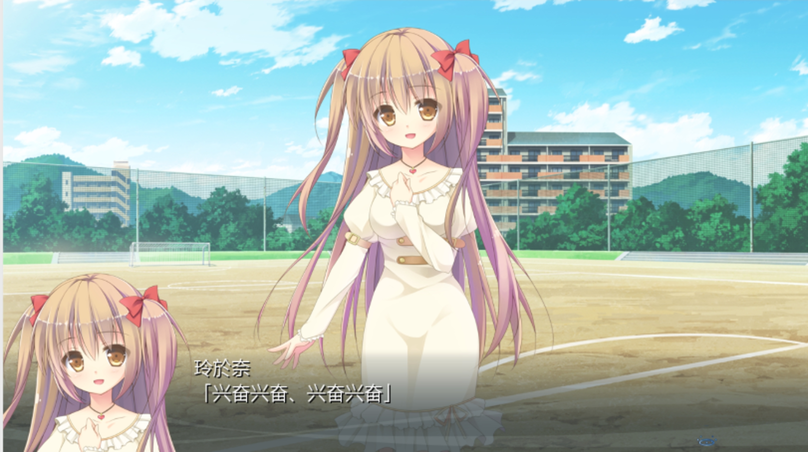
That’s roughly the plot. What I can’t understand on the whole is the existence of Reona as a character. From the start she’s meant to exist as a supporting heroine: a dopey, innocent girl who loves the protagonist with a one-sided fervor. Both of her confessions, and her inner determination to keep trying for his sake, are genuinely moving. And yet throughout the entire story, Ayana gives her the cold shoulder, the protagonist friendzones her, everyone else ignores her, even local thugs show up to gang-rape her, and in the end you’re told there’s no route for her — and when someone steals the person she loves, she still has to offer her blessing…
Even more absurd: the protagonist can pursue two side characters with no main route, but not Reona…

Are you sure this plot isn’t some kind of revenge on society?
Beyond Reona, the game has way too many problems in the details, mostly in how the characters are written. Konomi starts the game as a textbook throw-herself-at-him girl, pulling out every trick to seduce the protagonist — “want to take a bath together? want to see my panties?” — and then all of a sudden she turns prim and even timid. Combining it with later plot you learn she was faking, but the dialogue doesn’t convey that at all; all you get is a jarring switch.
The same problem shows up with Nanoka. Nanoka = Ayana is the game’s mystery, and it should build suspense so the player can unravel it at the end. But this writer is terrified you won’t notice it’s a mystery, terrified you won’t think too hard about Nanoka, so he wedges in loads of boneheaded muttering between lines of dialogue.
“He’ll find out my true identity sooner or later…” “I can’t accept his feelings for me, mustn’t accept them…”
It feels like watching Detective Conan when suddenly someone draws a circle around a character’s face and tells you, “Pay attention to this one, there’s a surprise.”
Surprise, my ass. That’s a spoiler.
This kind of official spoiler fills every corner of the game, so by the end anyone can tell Nanoka = Ayana. And then the plot suddenly turns dead serious and starts manufacturing suspense — “Who on earth is Nanoka?” — and the protagonist starts idiotically searching for the answer.
You rush to spoil the entire common route, then act like you don’t know. Do you think players are stupid?
Nanoka’s characterization is weird too. The game sets her up as someone who “only came back to see the protagonist once; she’s already dead and doesn’t want to interfere with his life.”
So at first Nanoka turns down all the protagonist’s invitations. When he finds out she’s living in a cave and invites her to his house, she refuses without hesitation.
Then comes the highlight. When the protagonist walks out of the cave and gives up on inviting her, Nanoka pops out and says:
“Actually I really wanted to go to your house, I was lying before, come on~ come take me with you~”
What the hell kind of logic is that? Slapping her own face?
Then after the protagonist brings Nanoka home, she starts guilt-tripping herself:
“Why did I accept his invitation, when I should have just kept avoiding him.”
Lady, you didn’t accept his invitation — you came out and demanded one.
And then there’s Ayana’s death. The protagonist enters the fire together with Ayana, so why does she suddenly stand up and tell him to go on ahead? Why not leave together?
And the two of them spend ages on a tearful deathbed farewell right in front of the fire — with that much time they could’ve run out ages ago, no?
For these questions I genuinely want a scientific explanation.
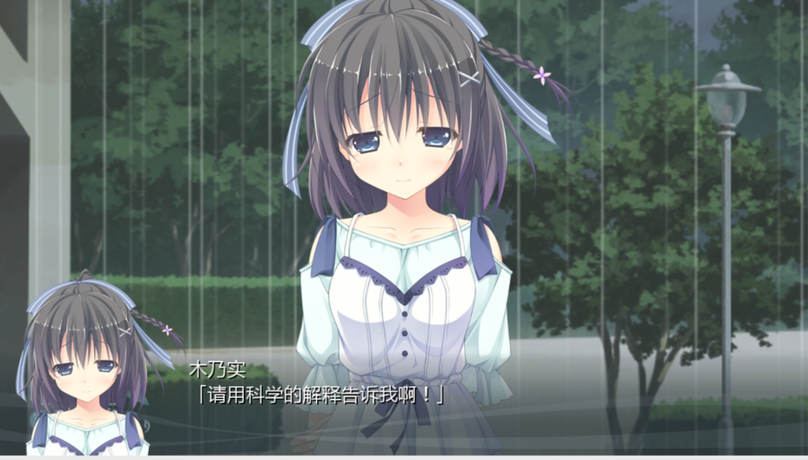
Another point is that the game’s definition of dirty talk is extremely murky. Basically you’ll see a girl be prim and proper one second, then talk at length about panties and sex the next without a trace of shame. One moment a soft girl, the next a tomboy. No wonder Ono Ryouko and Kadowaki Mai sound so stiff voicing the two characters.
Voice actors need to understand their characters’ personalities. I can guarantee that whether it’s Ayana, Nanoka, or Konomi, the script writes their personalities a complete mess. The VAs can’t latch onto the character traits, so they just wing it, which further strips the characters of any color.
The premise — “a past heroine dies, comes back for the protagonist, and they resume their relationship” — is actually a great setup. But the writer, in a fit of madness, made Nanoka a Normal End and Nanoka’s sister Konomi the True End.
As I said before: the girlfriend dies early, comes back to life, and the protagonist dumps her for her little sister.
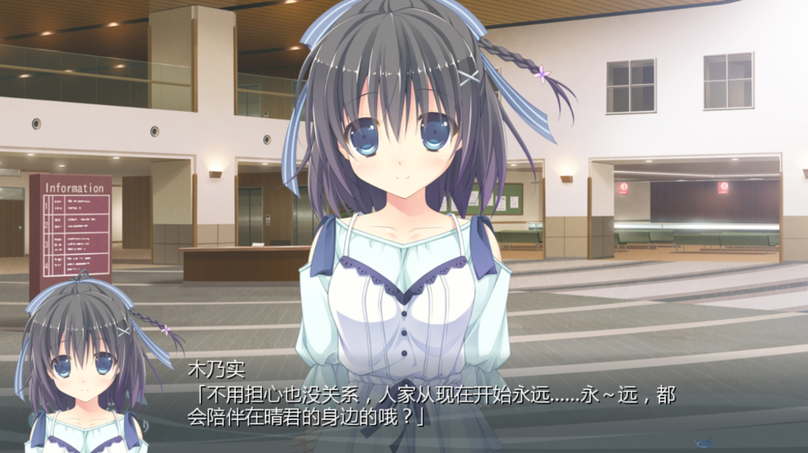
Melodrama cranked to the absolute max.
The writer seems pleased with this turn of events and forces tears in all sorts of places — drenching a girl in the rain, making a girl live in a cave, making a girl cut off her beloved long hair — but because the storytelling and execution are so goofy, there’s no tear-jerking to be found. It’s laughable and nonsensical. All I see is someone with elementary-school-level logic jerking off to his own ideas; I don’t see an actual story.
As I said before: you can take your plot anywhere, but you have to make the player feel that your twist is “unexpected, yet inevitable.” This game clearly doesn’t manage that, and it’s not even close.
That said, Haru nochi Kitto Nanohana Biyori does have its merits — the OST, the CGs — but beyond that: a melodramatic ending, bizarre logic, a moronic plot, all paired with forced tear-jerking. The whole game is like a basin of onion-flavored melodrama splashed right in your face. Whether the onion has enough punch to make you cry, I don’t know, but the nausea is definitely real.
Comments are hosted on the Chinese main site. This mirror is read-only.