Clover Heart's Review
Clover Heart’s is an old 2003 game. As one of Alcot’s early works, it got a commemorative sequel ten years later in Clover Days.
Looking at it now, Clover Heart’s has a surprising number of strong points for a 2003 visual novel — some of it even ahead of its time.
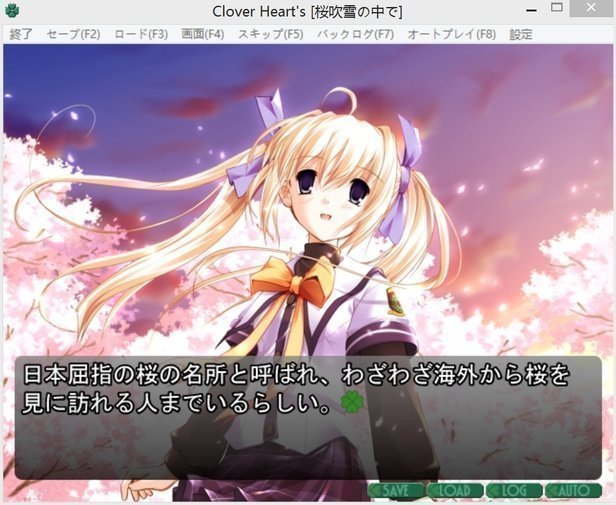
The heroines of Clover Heart’s are twin sisters, and the twist is that the protagonist isn’t one person either — he’s one half of a pair of twin brothers. The story splits into two perspectives, following the brothers Nagumo Shirato and Nagumo Itsuki.
The romance routes are fairly clean: the twin sisters Rea and Riori end up with Shirato and Itsuki respectively, pairing twins with twins. Safe and convenient, as far as setups go.
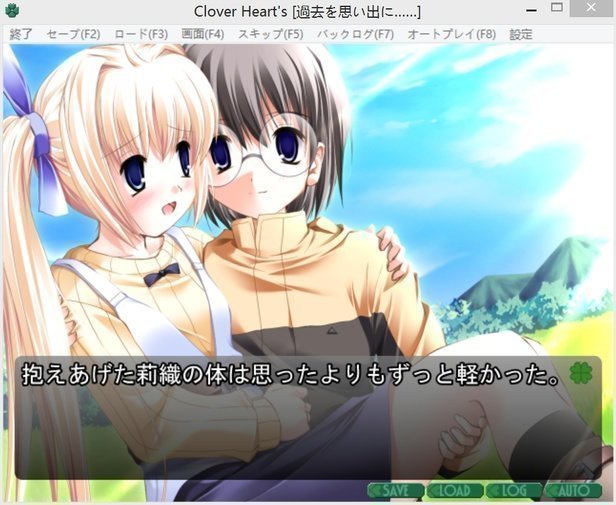
Because of the dual perspectives, the story runs on two main tracks. First, Shirato’s route with Rea. This one’s the orthodox one: a bunch of Russian twin sisters show up at the protagonist’s house claiming to be the daughters of his father’s friend, and for various reasons they start living together.
From the first meeting, Rea takes a serious interest in Shirato and clings to him constantly — and eventually they become a couple. What follows is pretty much what you’d expect: confessions, sweetness, sex. Midway through Rea’s route, though, a childhood friend named Chimari barges in claiming she made a marriage promise with the protagonist as a kid, and then it’s bickering and catfighting between Chimari and Rea — adversarial, but played for comedy. In the end the protagonist picks Rea and they get together.
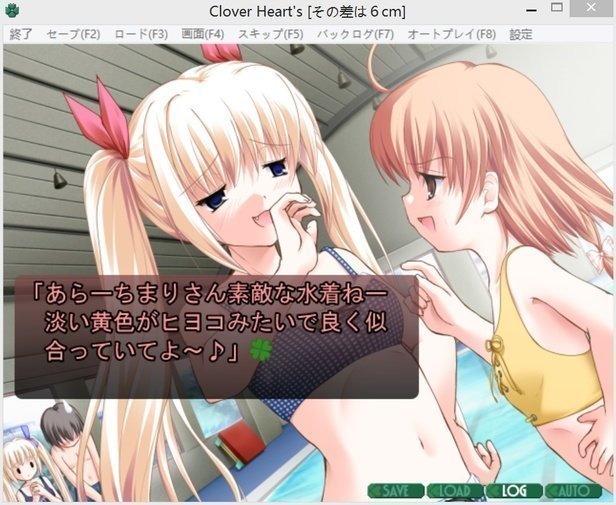
Honestly, Shirato and Rea’s route doesn’t have much turbulence. Even Chimari’s arrival doesn’t really shake things between Rea and Shirato. I didn’t check the walkthrough carefully, but I don’t think Chimari even has a route. She shows up too abruptly — just pops out of nowhere — and by then the protagonist is already dating Rea, so stealing him away wouldn’t mean much anyway.
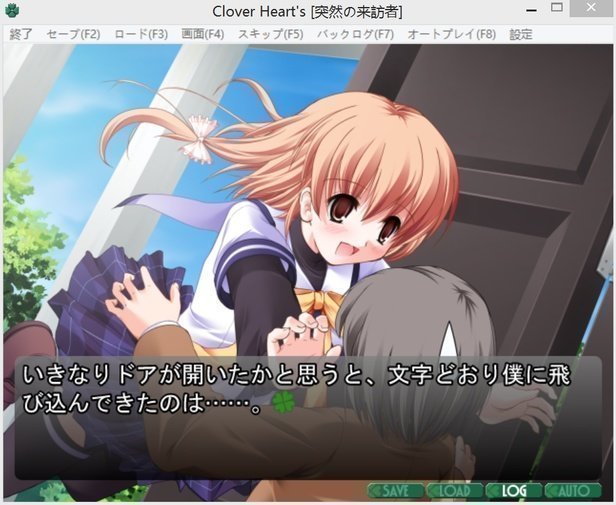
That said, Shirato’s route does have its highlights: plenty of interesting “activities”… I mean, activities between a couple.
Shirato is a soft, gentle sort of guy, while Rea is aggressive and a bit of a little demon, so you constantly see her bullying him — ambushing her boyfriend with an erection during the day, forcing him into women’s clothes, demanding he push her around for no reason, all kinds of dress-up play. And Shirato, that closet pervert, is no slouch either: even while being pushed around by his girlfriend he still manages the occasional fantasy, like imagining Rea getting molested by a chikan…
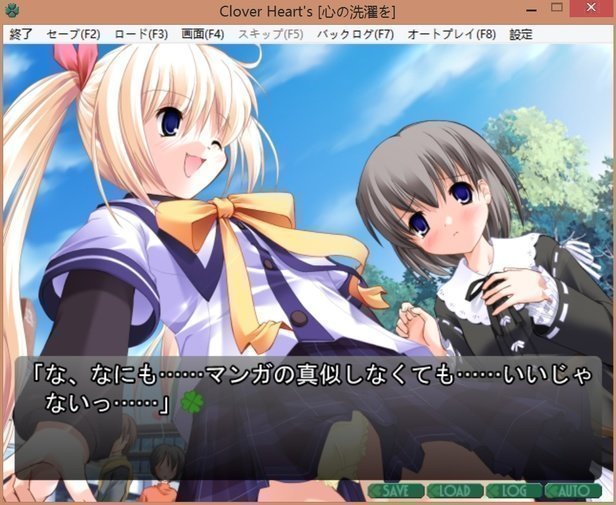
I don’t know if these elements were too spicy for 2003, but they hold up fine today. So on that front, Clover Heart’s was genuinely ahead of the curve.
The other route belongs to the other brother, Itsuki, and Riori. Itsuki’s route opens with a shocker — it starts with fucking.
With who? His senpai.
Quick note on the Nagumo brothers’ relationship: they don’t get along, stuck in a cold war. Shirato is mild-mannered; Itsuki, the older brother, is rebellious and stays out all night doing god knows what. At the end of Shirato’s route, he explains why the brothers don’t get along.
The two brothers and their mother were once trapped in a fire. At the moment the house was collapsing or whatever it was (I couldn’t quite follow), Shirato pulled his brother out, saving Itsuki and himself, and abandoned their mother, who couldn’t be moved.
So Itsuki has always believed Shirato killed their mother, while Shirato believes that if he hadn’t saved his brother, both mother and brother would have died. That’s what sparked the feud and the cold war.
If Itsuki is out carousing every night instead of coming home, where is he? The opening of Itsuki’s route explains: his story with his senpai Madoka.
Madoka has a younger brother who was always good to her, and who liked her too. As he got older, his feelings stopped being brotherly and became romantic. Every day he begged his sister to go out with him — soft approaches failing, he got forceful. When Madoka’s parents went away for a month, the brother planned to rape her; she dodged him, he ambushed her, and just as he was about to succeed in a back alley, Itsuki, wandering outside, stepped in and saved her. Madoka was grateful and asked Itsuki to protect her during the month her parents were away — she called it a “contract.”
Itsuki agreed. But then Madoka continued:
“For a contract, there needs to be payment…”
The payment was Madoka’s body. Itsuki didn’t refuse, so they became fuckbuddies. Itsuki wasn’t clear on whether he liked her; he just didn’t mind her throwing herself at him.
That’s how Itsuki’s route opens. Its whole span is wider than Shirato’s — from before the Russian twins arrive in Japan to the end of Shirato’s route — and it runs parallel to Shirato’s, so through Itsuki’s perspective you see some of what’s happening on Shirato’s side.
Itsuki starts out living the life: out carousing, protecting Madoka, and occasionally screwing her to blow off steam. Madoka makes him lunches every day, and Itsuki eats them without much warmth.
“It’s like he’s being kept by his senpai.” That’s how their classmate Asuka Rin described Itsuki and Madoka’s relationship.
Madoka is popular at school, and a lot of students don’t get why she’s so close to Itsuki, but Itsuki is too much of a delinquent for anyone to say anything.
The turning point is when the Russian twins move in. Riori values family deeply, so she figures that since they live together, they’re family, and she can’t stand Itsuki skipping dinner to go out carousing. Setting aside everything else, at least eating together with the family should be a given.
Stubborn Riori forcibly drags Itsuki back for dinner, and keeps insisting even when he curses and hits her.
Itsuki can’t win against Riori and just does as told — and over time he finds he likes the family life. He also develops some strange feelings for Riori, who’s always looking after him.
His weekly protection-and-sex arrangement with Madoka continues, and Madoka’s brother keeps harassing her, with Itsuki continuing to protect her. Then one day Madoka calls him out to a hotel for sex, and Itsuki feels revulsion — he even thinks it’s not good to keep taking her body like this.
The scene is subtle: Madoka starts actively teasing Itsuki, and it’s pretty clear by then that she’s not using her body as payment — she’s doing it because she likes him.
Itsuki is caught between Riori, who cares for him, and Madoka, who needs protecting, with no idea what to do.
“Is this really okay?” Asuka Rin asks him one day.
Itsuki thinks it over and decides he should be clear with Madoka — he doesn’t want a physical relationship with her anymore.
Madoka notices how close Riori and Itsuki have gotten and wants to confess, to tell him she likes him. But before she can, Itsuki beats her to it: no more physical relationship.
“I’ll keep protecting you, but let’s not do that anymore.”
“What? You’re tired of me?” Madoka doesn’t understand, thinks she’s been dumped, and cries.
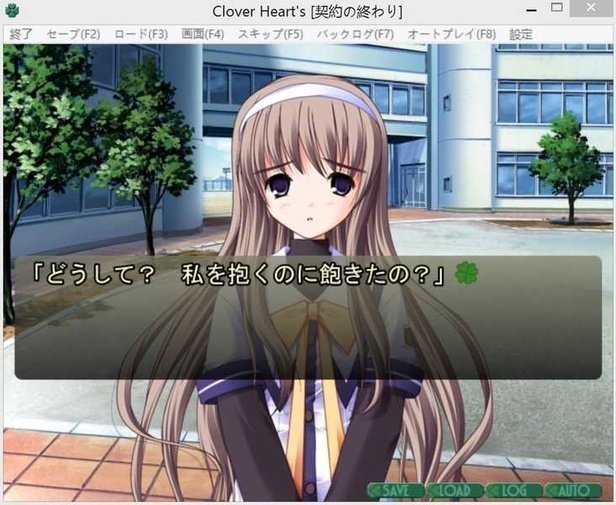
What follows is the usual love-triangle resolution: Itsuki ends his “contract” with Madoka, and with his help she starts to move on, talks to her brother directly, firmly rejects his romantic advances, and the brother gives up on his sister.
Actually you can pick Madoka’s route here, but it’s pretty much… a consolation prize. Lots of sex, but the brother keeps hating Itsuki, so it doesn’t really count as a good ending.
After that, the story goes back to the same thing as Shirato’s route: lovey-dovey stuff and sex. Only Riori is more reserved and Itsuki more forceful — the opposite of Shirato and Rea, so it’s like a different set of personality traits.
You’d think the twin brothers hooking up with the twin sisters is the end of the game?
Wrong! The game has a background story that’s genuinely unsettling once you think it through.
At the end of Itsuki’s route, the game’s hidden overarching plot is revealed. A few points:
Rea and Riori are Russian twin sisters, and both their parents are scientists working in Russia.
The father of Nagumo Itsuki and Nagumo Shirato is a Japanese diplomat, and this diplomat was close with Rea and Riori’s parents.
Rea and Riori’s parents were murdered by some unknown organization, reportedly because they’d researched some kind of high-tech metal (probably).
After their parents were killed, Rea and Riori were secretly brought to Japan from Russia by the protagonist’s father — the Japanese diplomat.
The brothers’ household has only a butler, Robert, and a maid, and neither of them seems ordinary.
Riori claims her parents were hunted by some unknown organization like the mafia.
So at the end of Itsuki’s route, a mysterious organization attacks the protagonist’s house in Japan, apparently targeting the Rea twins.
And then…
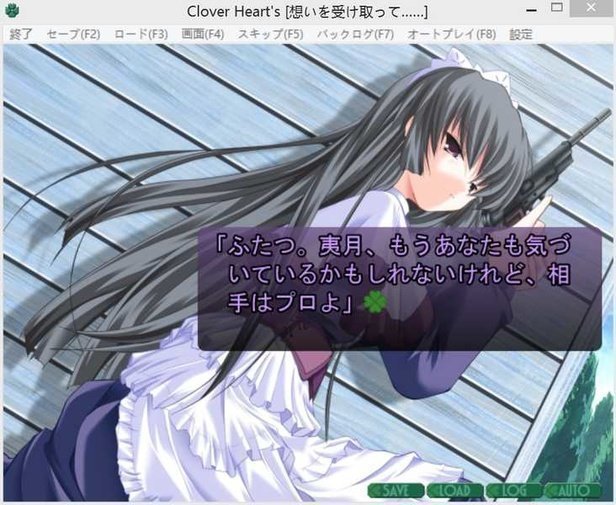
The maid turns into a special agent!
After some scuffling, the attacking Russian mafia (let’s call them that) prove too professional and too numerous, and they capture Riori. Without wasting words they ask her what the password is. Riori says she doesn’t know, stalls for time, and the maid seizes the chance to get the sisters and brothers out.
So what’s the password?
Turns out Riori likes to play a certain tune, and tells Itsuki it was what her mother taught her before she died. The maid later explains that the notes of that tune, written down, are the password to the research data Riori’s parents left behind.
By this point my brain was fully rattled — this isn’t a spy drama?!
Why would Rea and Riori’s parents, Russian scientists, be so close to a Japanese diplomat? They were spies, weren’t they?
It wasn’t the mafia that killed their parents — it was Russian state agents, right? High-tech research about to be stolen, of course they’d be silenced.
And the ones attacking Rea and Riori were agents too, right? Otherwise why so pro? The password they wanted was research secrets, wasn’t it?
Robert the butler and the maid are agents too, right? Otherwise how are they so combat-capable, and able to call in reinforcements?
And the kicker: none of this development is illogical — you can find foreshadowing and hints from earlier in the game, and the spy stuff is only hinted at, not spelled out. Much better than those chuuni forced-flexing reveals. You can overthink it or not think about it at all — it completely escapes the curse of “whenever Japanese writers do political plots it gets goofy.”
On that point alone, Clover Heart’s story is already way more interesting than Clover Days. The former is this mysterious; the latter is just a classic, orthodox childhood-friend tale. Maybe they were worried about scaring the otaku, so the British twin sisters in Clover Days got that badass development dropped.
A lot of descriptions say Clover Day’s and Clover Heart’s have nothing to do with each other. Wrong…
First, they share characters:
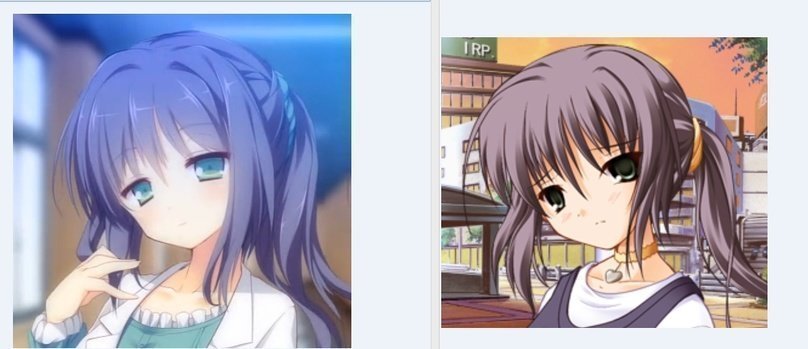
Asuka Rin and Nishidera-sensei are the same characters — one stayed at school, one’s still teaching there.
Second, there are remade characters:
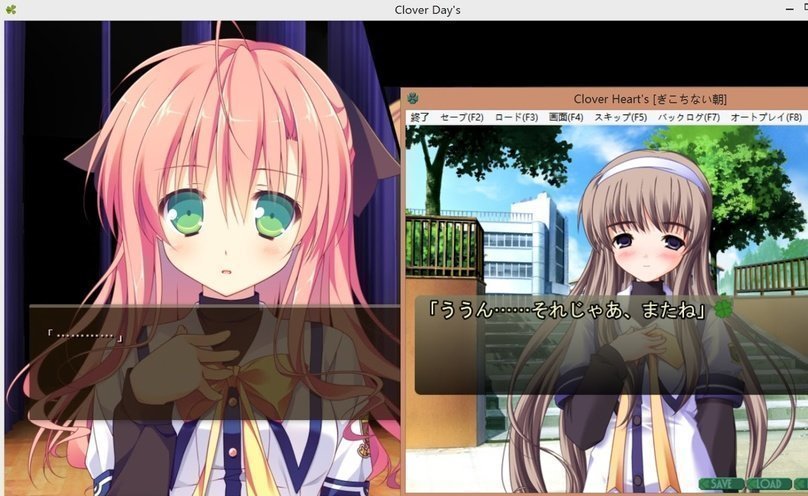
Maybe Madoka’s fate in Clover Heart’s was too tragic, so in Clover Day’s her traits and appearance got remade as a new character, with a full personal route this time.
So how should you view Clover Heart’s?
I’d say, given its era, it’s genuinely above Clover Day’s. Beyond the deeper story arrangement, the protagonist is a bit more serious than Clover Day’s protagonist — loses some of the fun, admittedly — but the story is also steadier, with less screwing around, which was one of the hallmarks of visual novels back then. Rea’s route emphasizes the sweetness of love, Riori’s the bitterness, each with its own merits, and the personalities don’t repeat much.
Beyond the story overall, Clover Heart’s structure is tightly tied to its theme: each route is split into four chapters, corresponding to the four leaves of a clover, and each chapter has a new OP. Even so, those OPs are awfully bare-bones — probably Alcot had no money back then…
The game has lots of choices, and even if you pick wrong you get little unlockables. There are collectibles, meaning you need to try most of the options to reach true 100%, which is rare these days — it shows visual novels were still in their exploratory phase, with the developers still treating it as a game rather than a visual novel.
Ten years later, Clover Day’s as the commemorative work inherits a lot of Clover Heart’s presentation — including OP2 (minus OP3 and OP4), the in-game character monologues (basically the diaries from Clover Heart’s), the background and setting, and even the OP storyboard are consistent with the old game, and they even got the original singer back to re-record the old OP. There’s a real sense of homage in there.
You might think Clover Heart’s art is a bit rough, or the OP singer’s a bit off-key, but that was ten years ago. Who’d have thought Yushi Nimura’s art would evolve this much in ten years? Who’d have thought Marie’s singing would improve this much in ten years?
Maybe time pushes people forward — that’s what this is about.
Playing Clover Heart’s after Clover Day’s, you can’t help but taste the passage of time.
Comments are hosted on the Chinese main site. This mirror is read-only.