Sousaku Kanojo no Ren'ai Koushiki (創作彼女の恋愛公式) Review
Sakuhin Kanojo no Ren'ai Koushiki
Back at the start of 2021, while I was playing visual novels, I couldn’t help but sigh:
“Everything coming out early this year is so mid. Guess only the big second-half releases can save this year’s reputation.”
So I waited for the second half, and at last the legendary “big release” showed up:
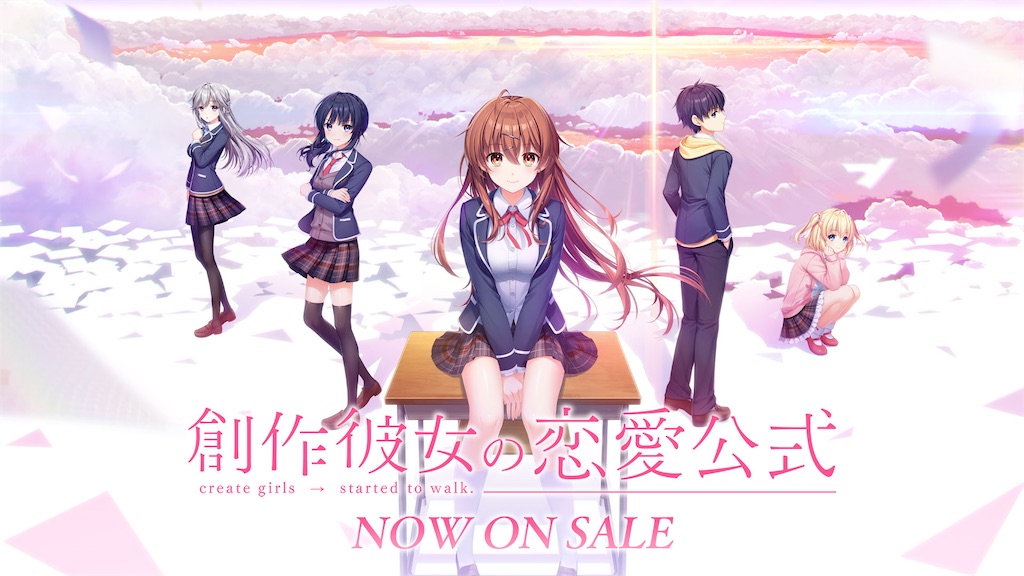
Sakuhin Kanojo no Ren’ai Koushiki (創作彼女の恋愛公式)
When this one was announced it was stacked with buffs: the artist behind “G-Senjou,” Nii Shuu’s go-to producer, a Campus scenario writer who supposedly understands love better than anyone and who’d kept Light alive for a whole year off a pile of small titles, plus the best support resources Akabesoft2 had to offer. Everything about it made this game the closer that had to finish the year off.
Then the trial version dropped. Honestly, the trial had its affected and janky bits, but overall I thought it had real merit. The big one: the secondary heroine, Kiriha, genuinely stood out. Earlier in the year I’d been snarking that she was a painter who’d also done debug work on the game, and then in the second half she turns around and becomes a heroine who spends the whole route PUA-ing the protagonist, and she’s the one who brings the story’s highlight moments.
So I was looking forward to release. End of the year came, the full version arrived. When I saw the walkthrough mention a story lock, something felt off. Add the OP title they revealed later, “Kiseki nante, iranai” (“I don’t need miracles”), and I had a bad feeling.
“Don’t tell me this game is about to pull some shit again.”
Unfortunately, my hunch was right. Again.
Let’s start with what the story’s actually about.
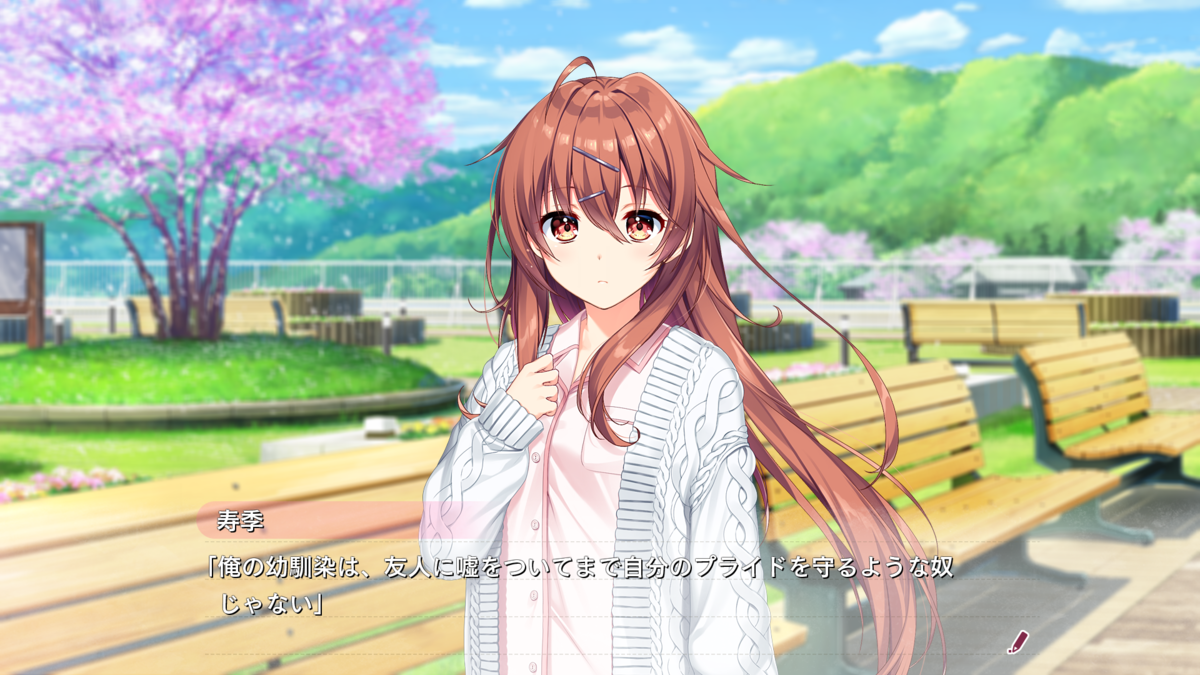
Our protagonist is a guy with real talent for writing. He started writing novels as a kid and got a bit of a name for himself. Back then there was a girl named Ousakura, and the two of them were always hanging out talking about how to write stories and novels, and they called each other “rival.”
Man, you cultured types are insane. When I was in elementary school I was still borrowing game cartridges off people, and our protagonist is already writing novels. You could call him the Han Han of the 11 wards.
Then the protagonist decides he’s feeling his first love stirring, gets all fired up, and confesses to Ousakura. She doesn’t answer. She just up and leaves without a word. Rejection, presumably. So he loses love but gains a career, his writing takes off and he gets some fame. Before long, though, he hits a creative block and feels like he can never write a story that moves anyone again. The Japanese call this a “suranpu.” I stared at the word for ages with no idea what it meant. Looked it up. It’s “slump.” I’d always thought slump just meant a stock market crash. Didn’t know the Japanese use it for “hitting a low point.”
So our protagonist, to find new creative inspiration and shake off his slump, enrolls at a Japanese art school devoted to “creators” — basically a vocational school, in plain words. It’s got all sorts of creator-focused stuff in there, including a “light novel” course, of all things.
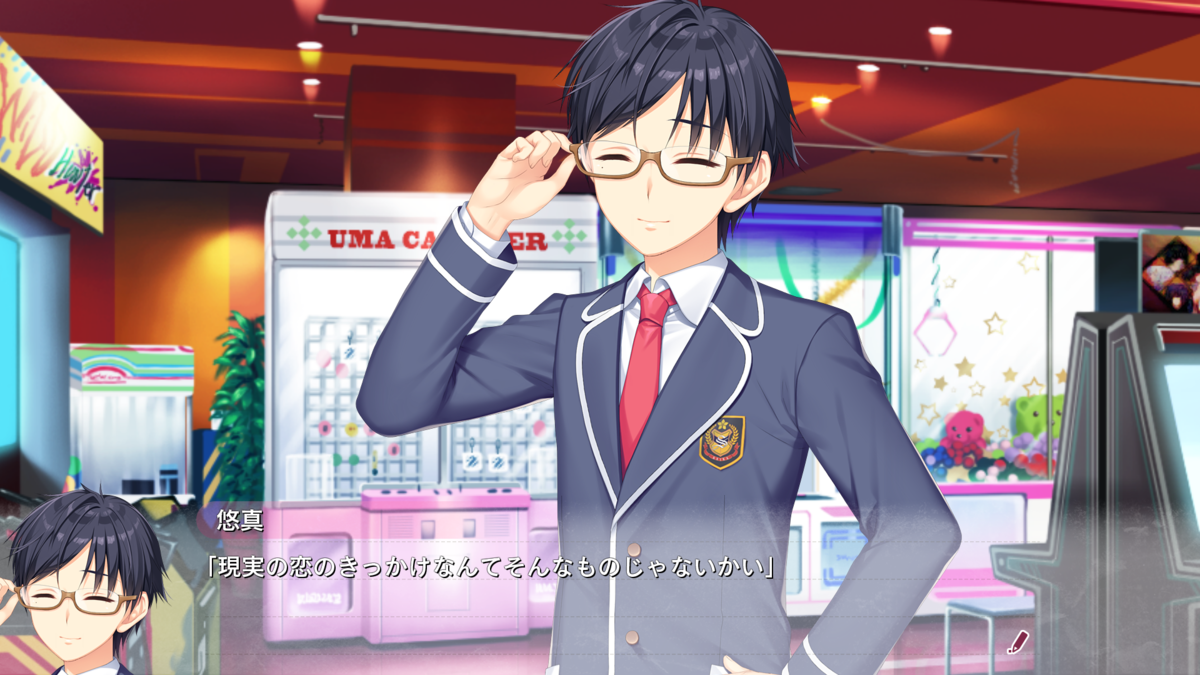
At this school, our protagonist, of all people, runs into that childhood Ousakura. By now she’s a moderately famous author who writes love stories, and her stories have one hallmark: she loves dropping the knife.
Ousakura hears that the protagonist is washed up now, in a slump, can’t get boiling anymore, so she starts thinking about how to fire him back up. Every day she talks with him about how to write novels — how to write love, how to drop the knife, that kind of thing. But inside, the protagonist just wants to write toilet-paper-tier premises: isekai, other worlds, harems. Anyway, they eventually land a gig helping a company owned by a friend of the school’s higher-ups develop a new visual novel. The planning, voice cast, and art for this new VN are all picked from the school. The protagonist and Ousakura work on it as scenario writers.
All fine. But then Ousakura suddenly announces she’s going abroad to study, and pulls another vanishing act. The protagonist figures he’ll at least see her off, so he walks her to the station, and just as she’s about to leave, she suddenly plants a kiss on him, turns, and runs. He never sees her again, and she cuts off contact.
He figures, whatever, she’s going abroad. Maybe the kiss before leaving meant she likes him but couldn’t say it. Then not long after, he finds Ousakura in a local hospital. So she never went abroad at all — she’s a patient there.
What’s she got? They ask, and it turns out to be the big one: ALS. The disease from the worldwide ice bucket challenge and Stephen Hawking. A terminal illness. Once it sets in it doesn’t stop, and you die fast.
That’s when Ousakura admits it. She’d noticed something was off as a kid, and later it got out of hand — she can’t even hold a fountain pen anymore. She didn’t want to cause the protagonist trouble or leave him a bad impression before she died, so she said she was going abroad and planned to quietly wait to die in the hospital.
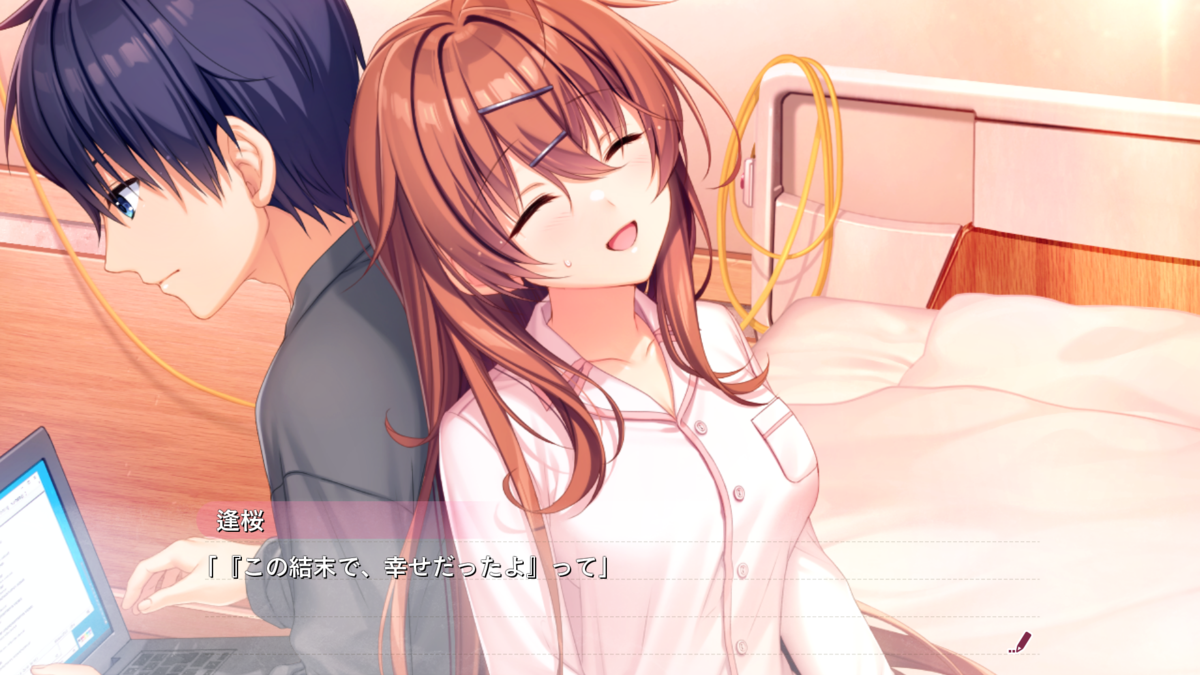
The protagonist obviously can’t just watch her die, but there’s not much else he can do. He just visits her every day and chats about whatever. Ousakura says she still hasn’t finished that school VN project story, and decides to finish it before she kicks the bucket. The protagonist encourages her to write. She writes and writes until she’s in the late stages of ALS and can’t hold a pen, so she dictates and the protagonist writes it down. The game gets finished, Ousakura croaks, the game ships, and the protagonist and Ousakura’s happy pals all reminisce about her having ascended. Game over.
So that’s the main plot: a girl who loves writing stories gets ALS, and before she dies she creates one visual novel for an industry already heading into the sunset, then passes away.
I know there’s a lot to mock in this main story, but before I get to that, let’s talk about the other heroines’ routes.
Besides Ousakura, there are three more: Tsukimizaka Kiriha, Elina, and Yumemi. The common route is mostly the protagonist talking with them at school or in daily life, everyone joining the VN project the school took on and working together. After Ousakura kisses the protagonist and leaves, whoever he calls first determines whose route you enter, and after that the stories are basically independent and have nothing to do with Ousakura…
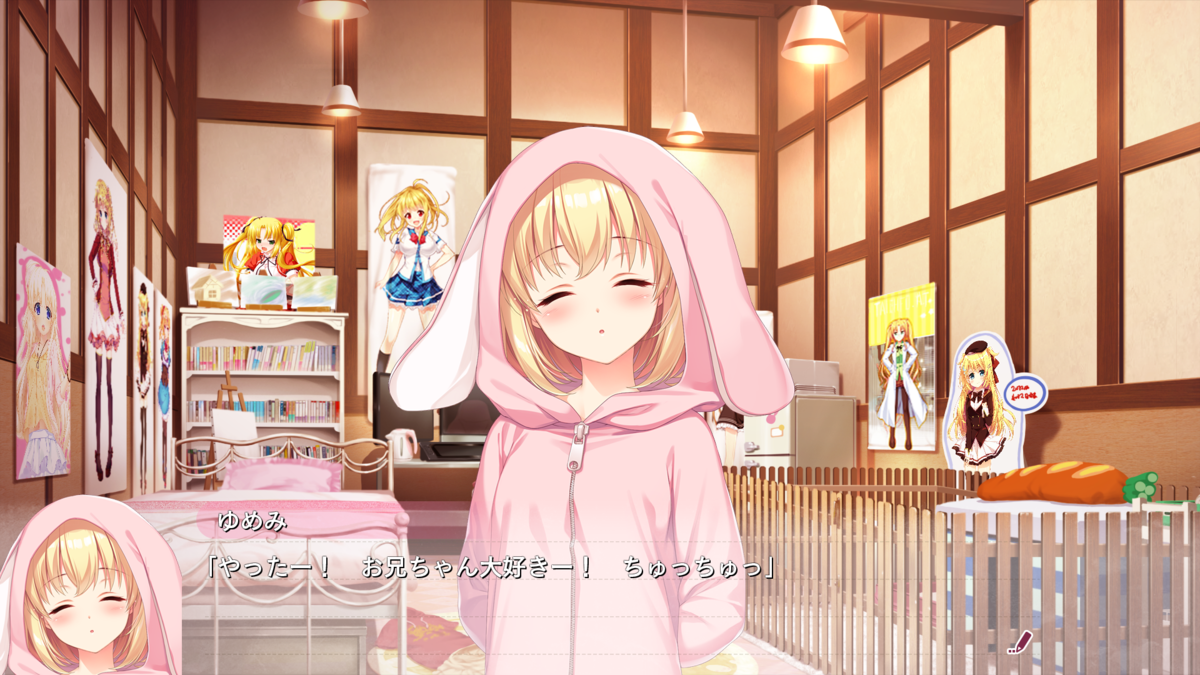
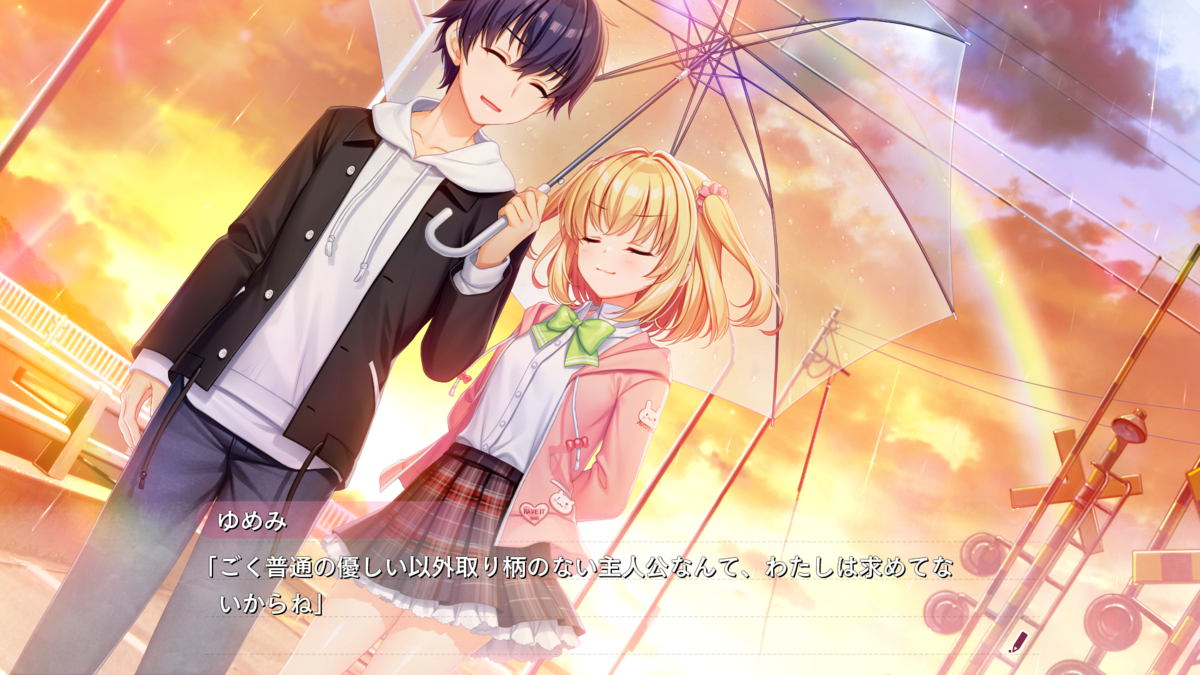
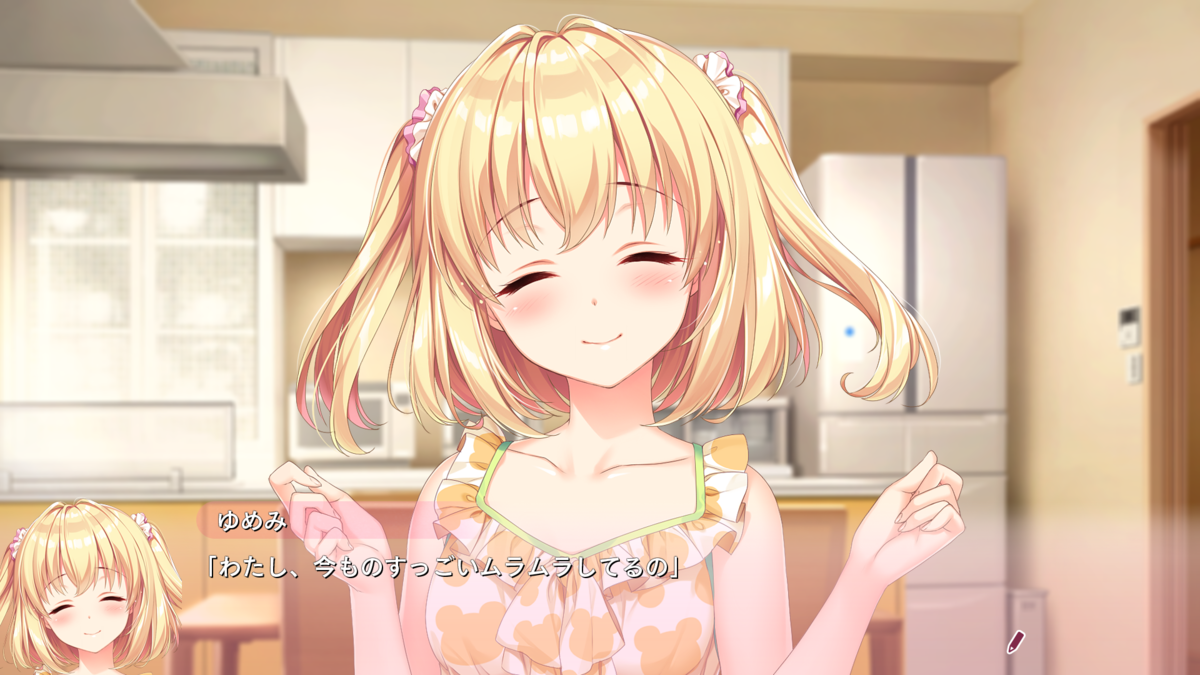
Yumemi is the protagonist’s cousin, lives with him, and claims to be an artist who draws blonde pretty-girl characters. She takes commissions and does conventions to make money, and has crippling social anxiety. One day she hits a creative block and can’t figure out how to draw a man’s dick, so she calls the protagonist over and makes him strip so she can look at his dick. He complies. Thanks to this dick-sharing relationship, they quickly get together. Later the protagonist discovers that while his horny cousin is a decent artist, she doesn’t really like drawing. She just uses art to escape life because she hates socializing. So the protagonist uses his dick to let her feel the benefits of being a normie, and she finds her confidence in drawing, drawing more lewd art so the protagonist will like her, and the two become a complementary sibling couple.
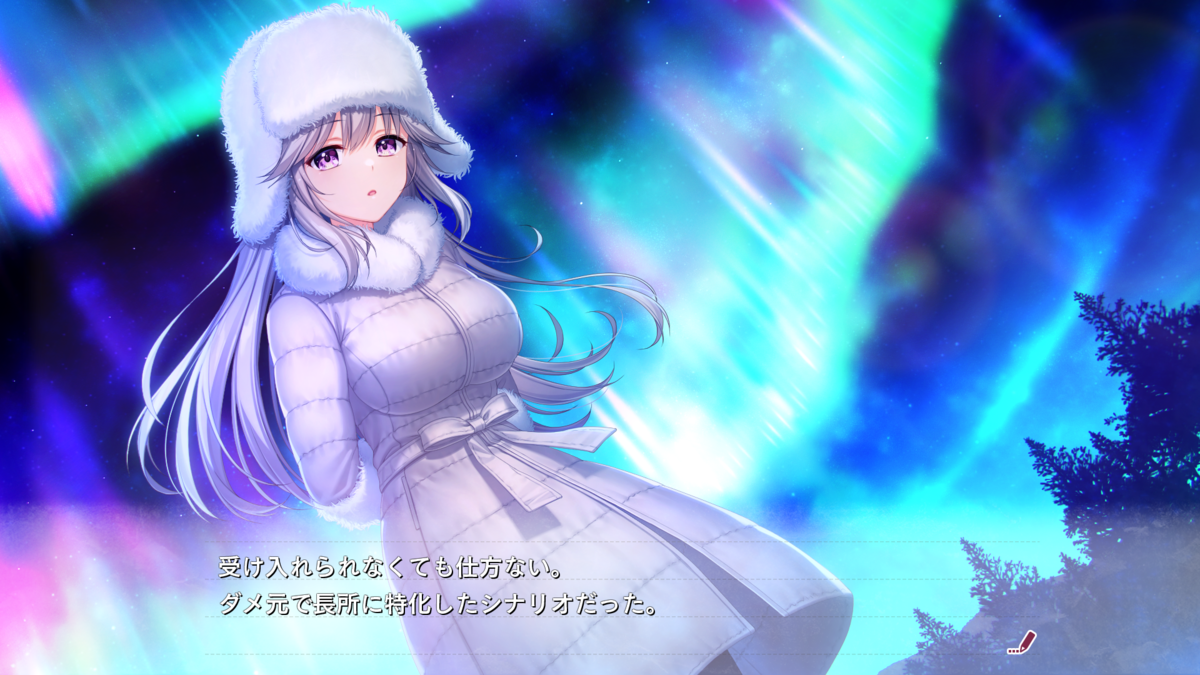
Elina’s route is even more absurd. After barely meeting a few times, she suddenly launches a love attack on the protagonist, and he can’t fend it off so he agrees. Elina’s true identity is the main scenario writer of an eroge the protagonist used to love, one that “changed his outlook on life.” Roughly the feeling of a modern ACG fan meeting a busty girl who says she’s Maeda Jun. Elina says she’s a creative genius, that she can write insanely good stories off the cuff, and that she’s troubled by it — being this good is just so boring. This humblebragging sends our protagonist straight into emo mode, and their relationship gets awkward: one of them quietly flexing, the other quietly taking crits. Eventually Elina’s older sister steps in and their relationship improves. Though I have no idea why Elina suddenly stops flexing. My guess is the scenario writer wanted to write something like “the inferiority complex between genius and ordinary people” but couldn’t pull it off, so the protagonists just fuck a bit and it ends.
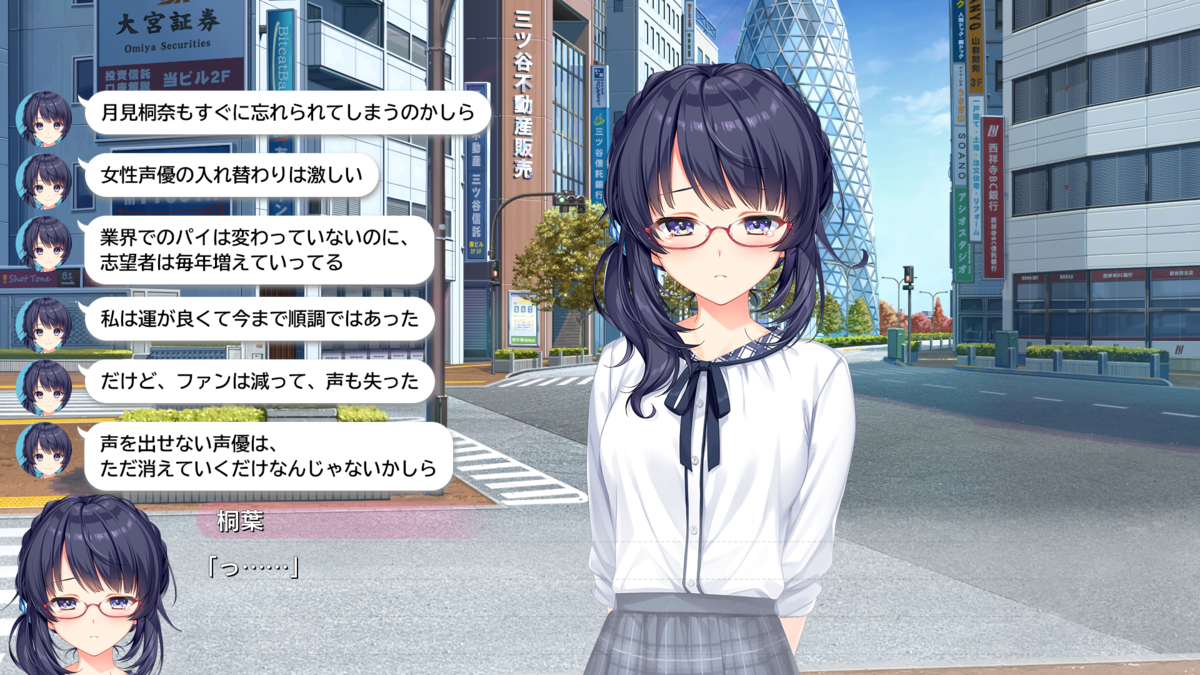
Tsukimizaka Kiriha’s route is a bit more normal. Her true identity is a young female voice actress, and the protagonist happens to be a fan of hers, so he recognizes her quickly at school. Kiriha then straightforwardly asks the protagonist whether he wants to be her boyfriend. This blows the protagonist’s mind — the feeling of Ogura Yui, Minase Inori, or Ishihara Kaori suddenly confessing to me. He agrees without a second thought, but soon realizes his girlfriend is off. They’re a couple but they don’t really kiss, don’t really fuck; it doesn’t feel like a couple at all. Finally Kiriha confesses: she has some lover roles coming up to voice, and she’s using the protagonist to practice and find the feel. He’s just a tool.
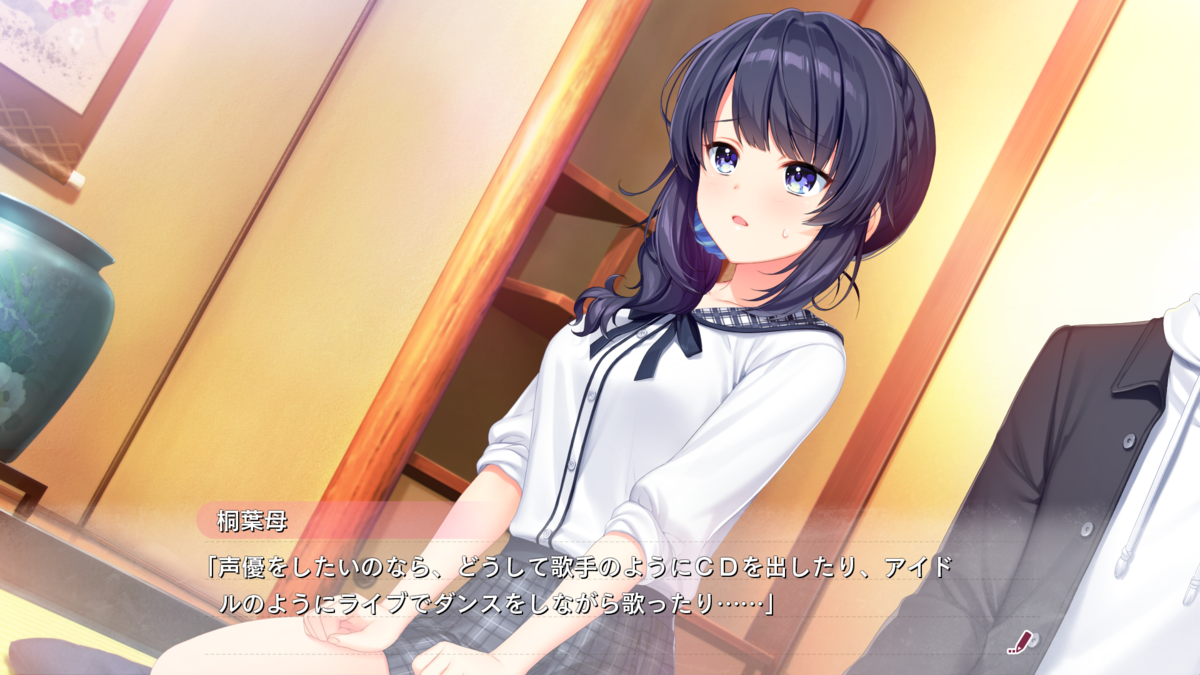
So the protagonist, being a total idiot, ends his second relationship (the first was the confession to Ousakura). They still see each other a lot afterward, but it’s always awkward. Later Kiriha quietly decides this protagonist isn’t bad as a backup, has potential to be upgraded to boyfriend, and starts spending more and more time with him. Then Kiriha comes to the protagonist again, asking him to keep playing her boyfriend and come home with her to meet her parents. The reason is simple: her parents don’t really support her voice acting career and want her to come home and inherit the family hot spring inn. Kiriha clearly doesn’t want to be an inn proprietress, so she fought with her parents and went to the city to do voice work on her own. This time she wants to go home and show her parents how well she’s doing — she’s got a boyfriend, her career’s taking off. Her parents had only agreed to let her do voice work until graduation, and now she wants to keep going.
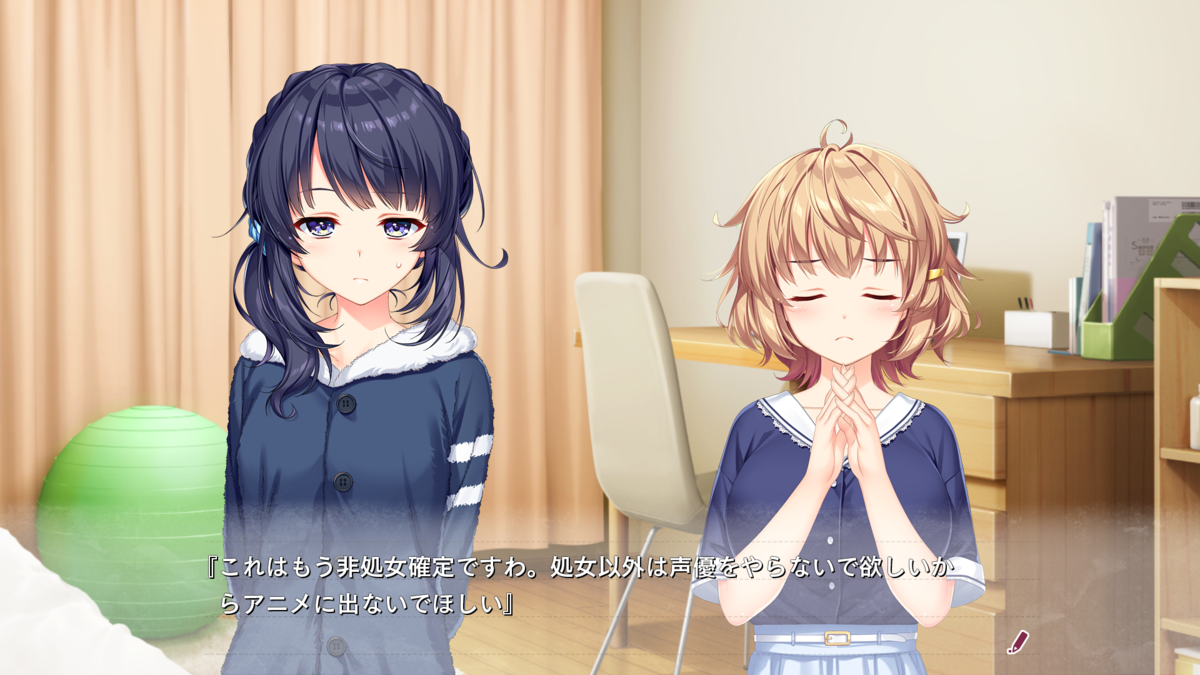
But before the confrontation even gets going, her parents shut her down. Kiriha thought her parents didn’t understand the voice acting industry and were just resisting it out of ignorance. Turns out they understand it very, very well. Kiriha’s father points out flatly that voice acting is a young person’s game. You’re doing well now, but plenty of younger girls will do even better, and you’ll soon lose your edge to them and stop getting work. Voice acting is temporary; being an inn proprietress and running a real business is forever…
Just when I was thinking Kiriha’s father was goddamn right, the protagonist opens his mouth about “dreams” and “hope” and “struggle” and all that, and just bulldozes the old man with sheer rhetoric until he believes the bullshit. Maybe the protagonist is such a smooth talker that the old father thinks his daughter’s marrying some insanely capable politician. The old man says fine, let Kiriha chase her dream, and if she really can’t make it someday, she can come home — the chairman’s seat of the real business will always be kept for her.
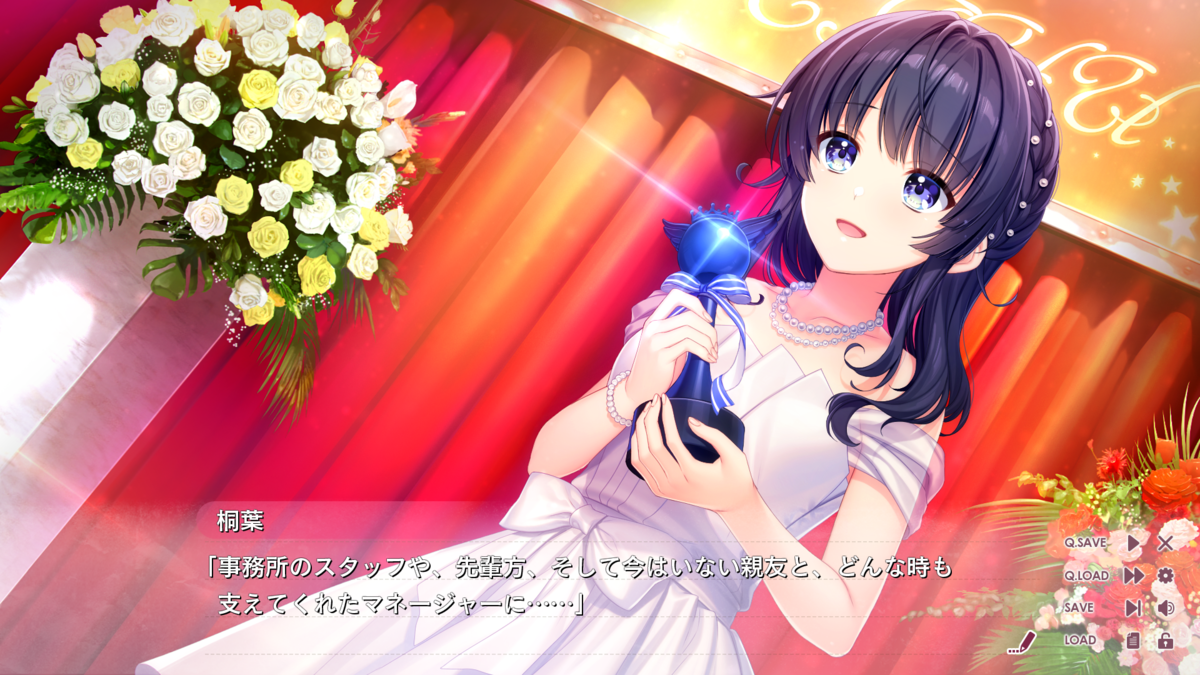
With her parents’ support, Kiriha quickly submits to the protagonist’s verbal technique, and the two become a real couple. After that, Kiriha’s voice acting career goes exactly as her father predicted: she’s now an old voice actress with no competitiveness against the flood of newcomers, and she has to work twice as hard just to hold her position. It gets so hard she loses her voice for a while, and in the end it’s the protagonist’s company that pulls her out of it. She achieves her life’s worth and wins a voice acting award.
My feelings on Sakuhin Kanojo no Ren’ai Koushiki are complicated.
First, the “hard specs” are great. Hazuki’s art shows visible improvement over “G-Senjou” back in the day. The music has no real highlights but it’s at least competent, on par with the Akabesoft average. The voice cast is good — personally I like Kiriha voiced by Wang-san; she’s genuinely one of the better characters in recent years.
As for the story, plenty of people are going to trash it. Most can’t accept the heroine’s sudden death from ALS — the common route looks fine, then in her route she suddenly has a terminal illness and is dying, with zero warning, a sudden knife to the gut. Players find it sickening.
I don’t agree with that. The heroine’s health problems are hinted at all over the place:
- The game’s OP is “I don’t need miracles,” which means it’s definitely a tragic ending
- The heroine often says she’s seen through life and death — that’s practically writing “I’m going to die” on the wall
- The heroine says she gets tired easily — also a hint
Generally, when a visual novel heroine says she’s “made peace with life and death,” that proves she has a high chance of having a terminal illness.
If there’s anything unreasonable about Ousakura’s death, it’s the scenario writer’s ignorance of ALS. Like all those “terminal illness games” I’ve complained about before, our heroine Ousakura in the late stages of ALS is still articulate, tireless, and more energetic than me. You can’t tell at all she’s dying. The scenario writer clearly never looked into what ALS actually does to you. And this stuff isn’t even hard to find in Japan — even in chaotic old China, you can find plenty of detailed info on Quora. Not doing the research and just making shit up is the scenario writer being irresponsible.
Setting aside the ALS tag, the game’s biggest problem is that the scenario falls into obvious “self-moved” territory. The scenario seems to want to elevate the profession of “creator.” Every main character in the game has a role — some are voice actresses, some artists, some light novel writers, some eroge writers — but the scenario writer, Kudou Keisuke, insists on lumping them all under “Creator” (kurieetaa), constantly throwing out “as a creator” this and that. As a creator, you must devote yourself body and soul to your work — meaning, to create something that moves people, you’d give your life for it.
This romantic creative spirit is basically nowhere to be found in commercialized Japan. Lots of people praise Japan’s “artisan spirit,” but they don’t realize that where there are “artisans,” there are high costs. If you’re such an artisan, then don’t make money. In the end it’s all using “artisan” to raise your commercial value. It’s all business.
It’s not that no one has ever given their life for a perfect work — but they’re rare, and they mostly exist in high art: music, painting, some stage performances. Saying someone would give their life to create a “light novel toilet paper” or a “visual novel” is completely unimaginable. Those fanatical “creators” probably don’t even recognize these lewd commercial products as “artistic creation.”
Through this game I can kind of understand: the scenario writer, Kudou Keisuke, writes eroge himself, and he thinks what he creates is “art,” not “porn-adjacent AV products,” so he buried his private agenda in this work — the idea that voicing anime games, drawing hardcore fetish art, making light novels and visual novels stuffed with ero content is also a form of artistic expression. And he created a bunch of characters who sacrifice themselves for this “art.” Of course, this creative passion isn’t impossible to express — every trade has its master. Japan’s “Zenra Kantoku” celebrates exactly this kind of creator. But Sakuhin Kanojo no Ren’ai Koushiki clearly can’t pull it off. ACG, increasingly pandering to otaku, is itself a commercial product. The scenario doesn’t want to depict creators’ perseverance and struggle to survive in the commercial tide; what it depicts is a kind of white-lotus stubbornness and self-righteousness that’s hard to resonate with players. All that’s left is affectation.
The scenario naively thinks that making the heroine suffer for her creative work will make players feel pity and empathy. The scenario has Kiriha lose her voice for voice acting, has Yumemi feel ashamed for drawing lewd art, has Elina suffer for writing nukige scenarios, and even, to milk tears from otaku, has Ousakura lose her life for writing stories. These characters, while suffering, still don’t give up their pursuit of creating commercialized porn products. How noble!
Noble my ass. The “sacrifice for art” trope in visual novels isn’t unwritten — last year’s Meikyuu did it. But that was about stage plays, about performance, about high art, not an adult product that keeps piling lewd CGs onto preorder bonuses to sell more copies.
Plainly: some excellent visual novels may have flashes of “art,” but at bottom this is still a lowbrow adult product. Don’t take yourself too seriously.
This game’s commercial article will appear in Erciyuan Kuangre issue 153: shop link
Comments are hosted on the Chinese main site. This mirror is read-only.