Hands-on: Pixel 6 Pro
Still Worth It? Pixel 6 Pro 256GB Hands-On Impressions
I decided to switch to the Pixel 6 Pro a long time ago, because the Pixel 4 XL was just too slow.
But this phone somehow sold way better than expected. Normally you’d get a Nexus/Pixel within the first week, but this one was out of stock forever. In the end, a guy who runs a proxy-buying service, “Watermelon Daigou,” generously helped me out, barely charging me any fee, and I got the Pixel 6 Pro 256GB white version at retail price.
It’s been a while since I got it, so let me talk about how it feels. I’ll skip the generic stuff and get straight to the real points.
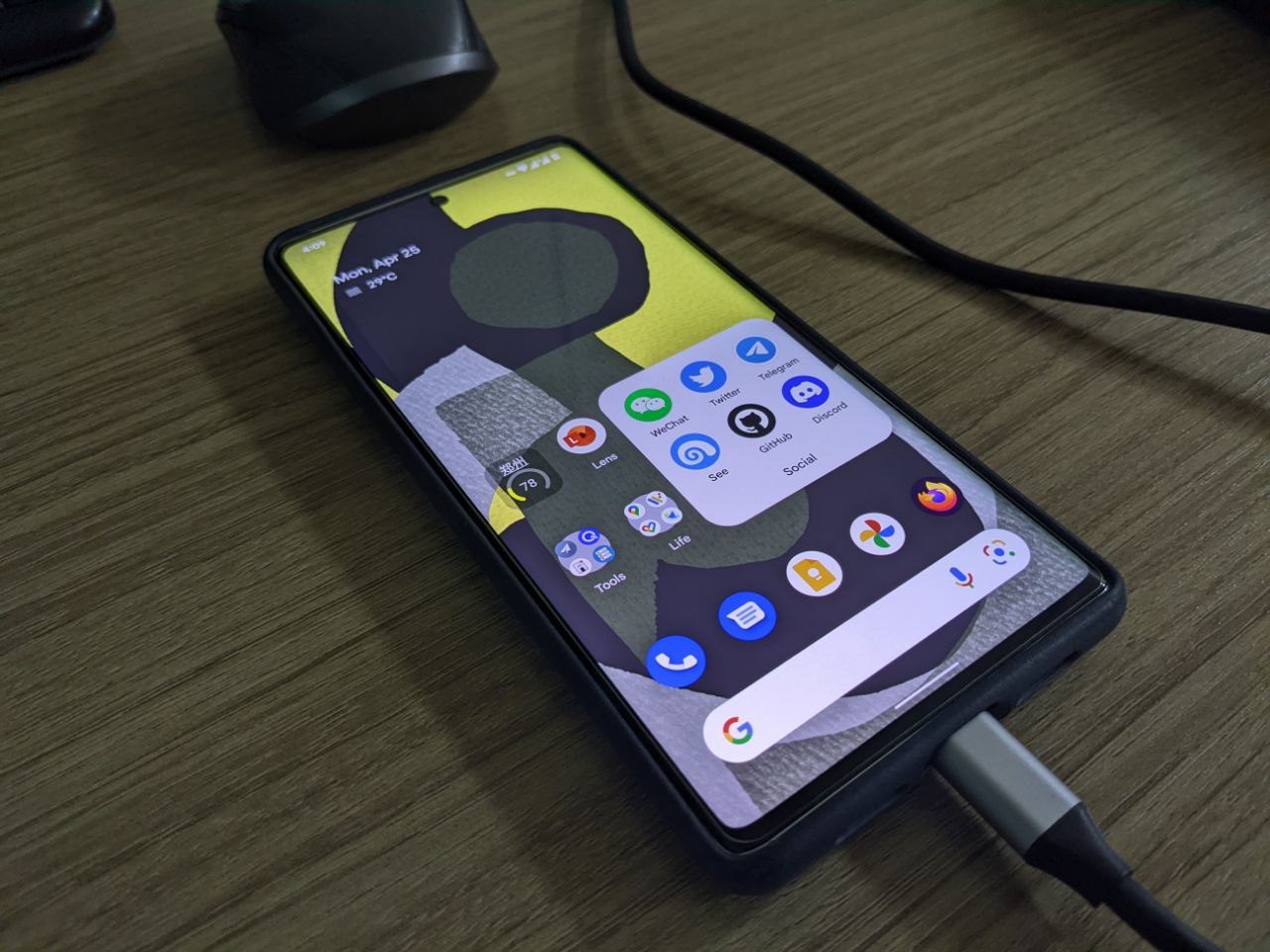
Tensor SoC: Performance is enough, but still disappointing
This time Google’s own phone uses its self-developed Tensor chip. Compared to the Snapdragon 888 fire-breathing dragon, this chip actually packs two X1 big cores, which sounds pretty badass. But according to benchmarks from overseas reviewers, it’s roughly at the 870 level. That was expected, honestly—having 870-level performance is enough…
But once I actually started using it, I found that in some ways it doesn’t even reach the 855. Honor of Kings on max settings stutters because it overheats and drops frames, while the Pixel 4 XL stayed smooth the whole time. I had to lower some effects to get it playable. As for Genshin Impact, forget it—max settings are impossible, it stutters constantly, and only dropping to medium makes it acceptable. And the Pixel 4 XL could run Genshin on medium just fine.
Thinking about it, the peak performance is impressive, but it overheats quickly, then throttles, then goes limp. If you don’t play games, Tensor won’t give you a stuttery experience—it’s good enough. But this is supposed to be a flagship SoC. I haven’t used the Snapdragon 888, so I don’t know which one is worse.
Screen: Great colors, smooth refresh, LTPO is useless
These days, unless you’re buying from some trashy knockoff brand, screens are all decent. The Pixel 6 Pro is no exception. The curved punch-hole screen actually feels pretty good, and the refresh rate is 120Hz—basically the same level as the screen OnePlus 9 bragged about. The so-called LTPO, variable refresh rate—personally, it feels like “variable nothing.” At least from what I can see, it just switches between 60 and 120, no other values. Even when playing a video, there’s no other change. I can’t tell what’s variable about it. But I later heard that the refresh rate Android reports isn’t the real one, and it might actually be adjusting in the background.
Either way, real or not, I don’t think it’s a problem. It is what it is.
Battery: Explosive endurance
The Pixel 6 Pro has a 5000 mAh battery, and I have to say the endurance is explosive. I can get up to 5 hours of screen-on time—unimaginable for the Pixel series. Whether scrolling or gaming, a big battery is just better. After using this, I even think future phones should all have 5000 mAh batteries, otherwise endurance is a problem.
Camera: Stills are average, video is garbage
I rarely take photos, and the Pixel 6 Pro’s camera didn’t bring any big surprises. Many of the selling points, like Magic Eraser, are software features—extract the app and the Pixel 4 XL can do it too. For video, it supports 4K 60 FPS, which is worth praising. But after recording for a bit, the phone overheats and the video drops frames—it gets so hot that even switching back to 1080P 60 FPS isn’t stable. If you ask me, you’re better off with a cooling clip; otherwise this thing is useless for video. The stabilization is good, but it just can’t last.
Experience: Extremely smooth, but not because of the CPU
The Pixel 6 Pro’s system feels extremely smooth—switching and launching are fast. But I quickly realized the smoothness isn’t because the CPU is powerful, but because the phone has 12GB of RAM. As everyone knows, the Pixel series has always been stingy with RAM. I don’t know what Google was smoking this time, but they actually gave it 12GB, and the experience took off. I can even run Genshin Impact and Honor of Kings in split-screen and switch between them without either getting killed. 12GB of RAM is more than most computers have. The difference is extremely noticeable. I now think that if you’re buying an Android phone, you must get 8GB of RAM or more, otherwise the experience just won’t be good.
Other: Fingerprint is fine, charging is not, no bugs encountered
The Pixel 6 Pro has an under-display fingerprint sensor. Many people complain about the low recognition rate, but I think it’s fine. Maybe I haven’t used Chinese phones, or maybe the system had already been updated several times by the time I got it. What’s worth complaining about is that the Pixel 6 Pro’s wireless charging is really garbage. If the phone overheats, it won’t charge—but the phone generates heat while wirelessly charging, creating a vicious cycle. The solution is either to switch to wired charging or use a wireless charging stand with a fan… no wonder the Pixel Stand 2 has a built-in fan. The charging wattage isn’t high, but it’s enough.
I haven’t encountered a single system bug. Maybe I’m a good kid, or maybe I’m just lucky. By the way, the Pixel 6 Pro can use almost all features without root. Google actually grew a conscience and stopped requiring SIM certification to enable Google Now.
Network: 4G works perfectly, 5G probably hopeless
Not much to say about 4G; let’s talk about 5G. The Pixel 6 Pro uses a Samsung modem. Currently, the way to unlock 5G for overseas phones in China is to find a phone with the same CPU and modem, root it, and write the 5G config file to enable it. That’s how the Pixel 5’s 5G was cracked too. Unfortunately, no phone in China uses this Samsung modem from the Pixel 6 Pro. Vivo once had a phone with an Exynos chip—that might be the only hope—but that phone doesn’t seem to have much custom ROM support. Of course, 5G isn’t hopeless; it just depends on future developments.
Accessories: Screen protector and case
Many people don’t like curved screens. Honestly, I don’t either. The reason I don’t like them is that they’re hard to put screen protectors on. But the Pixel 6 Pro actually has really cheap curved UV screen protectors on Taobao. Maybe manufacturing has improved over the years—this UV protector works pretty well. The oleophobic coating feels a bit weird, but it’s very clear, and the cost is extremely low. Highly recommended.
For cases, I recommend Dbrand and Bellroy’s leather. It’s a shame Nomad stopped making them. Leather wears through easily from friction, but that’s the charm of leather, I guess.
Impressions: Is it necessary?
Honestly, I used to think the reason I used a Nexus/Pixel was the clean system and fast updates. But lately, while Android updates are fast, each one brings more bugs and problems. As for Chinese phones, their systems have lots of ads, but once you strip the ads away, their performance still runs faster than the Pixel 6 Pro’s baffling CPU. And the Pixel’s stock Google Assistant is somehow worse than Xiao Ai—it often makes dumb mistakes even when setting an alarm by voice. I don’t know if it’s still necessary to spend that much money on something like the Pixel 6 Pro.
Especially since after buying the Pixel 6 Pro, I chose to upgrade my Pixel 4 XL to 12GB of RAM on Taobao and replace the battery. Suddenly the phone’s smoothness is no different from the Pixel 6 Pro—it’s even smoother in games. The only downsides are slightly worse battery life and the fact that it doesn’t overheat when charging.
Thinking about it, buying a Pixel 4 XL and upgrading the RAM gives you an experience almost identical to the Pixel 6 Pro, sometimes even better—as long as you don’t mind that big forehead…
Is the new Nexus/Pixel necessary? Is it worth it?
I’m lost in thought.
Comments are hosted on the Chinese main site. This mirror is read-only.