Hands-on: GPD Pocket 3
Irreplaceable Junk: GPD Pocket 3
I actually got this thing back in December, having joined the whole pre-order process, and later got kicked out of the Discord group by GPD’s marketing guy “Old Zhu” (real name Zhu Kaihui, overseas ID: Kendyzhu).
I was so pissed off at the time I thought about making a video to fire back, because this asshole is just that repulsive, and he’s even cultivated some asshole lackeys. But after half a year of learning about other manufacturers (AYN, AYA, Anbernic) and seeing the state of the whole industry, I figure Zhu Kaihui might not even be the biggest asshole out there. Thought about it and let it go. So here I’ll just briefly go over the pros and cons of this product, plus my personal views on GPD, including some thoughts and advice on the so-called “Win handheld” market as a whole.
Around September 2021, GPD revealed design sketches of the next Pocket series product, the Pocket 3. Along with their constipation-like “leaks,” the product’s appearance became clearer and clearer — basically an enhanced GPD Micro PC with better performance, a bigger screen, a new manufacturing process, and a rotating screen.
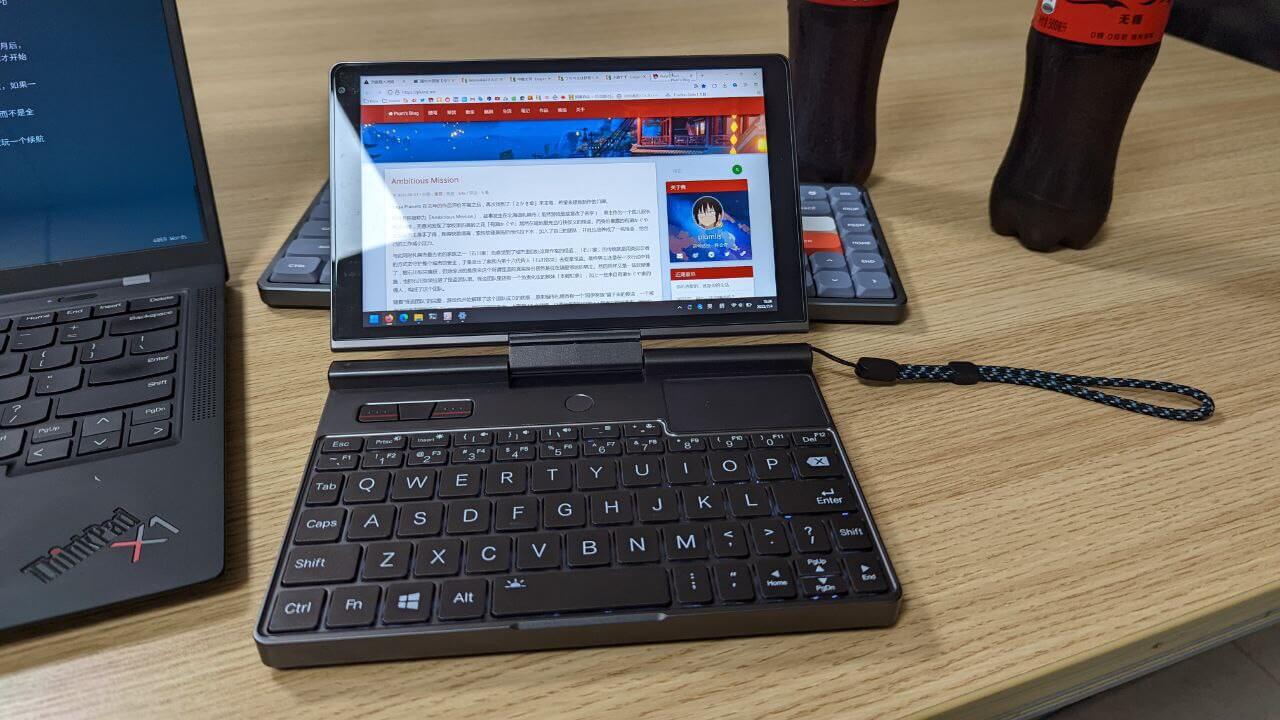
Strictly speaking I’m fairly satisfied with this product, but it also raises a lot of questions, because GPD’s past products always had a few standout problems:
- Shitty build quality on launch units
- No oleophobic coating on the screen
- Overly aggressive power draw making battery life absolute garbage; I wish there were software for dynamic adjustment instead of having to reboot into the BIOS every time
I kept asking whether these had improved while in the pre-order group. I got replies, but I don’t think they were straight answers:
- “Relax, the build quality is fine!”
- “I think the screen has an oleophobic coating.” (said by someone who got a test unit)
- “You can just go into the BIOS and lock the TDP to 5W, want battery life, easy” “Rebooting isn’t that hard!”
And as more insider leaks came out, I discovered a few even more bizarre design choices:
- The initial Pocket 3 had no gravity sensor, meaning after flipping the machine you’d have to manually set landscape or portrait.
- The screen’s color gamut was initially stated by the official as 89% P3, but according to NotebookCheck’s unit, it was only 75% sRGB, and P3 was just 50%.
- After flipping the screen, the machine has no buttons at all — so in the officially hyped “tablet mode” you can’t adjust volume, and you can’t even power it on or off, making this mode basically pointless.
The biggest complaint was the first point: no gravity sensor on a 2021 machine, completely unacceptable. It caused a huge uproar in the pre-order group, with many users unhappy, but GPD’s operations guy “Old Zhu” (Zhu Kaihui) branded them “competitor spies” and kicked them. GPD was very hardline, saying what’s wrong with no gravity sensor, setting screen rotation yourself isn’t that hard? Whoever said his design was bad got labeled and kicked.
As for the color gamut issue, Zhu Kaihui didn’t give a straight answer either, just saying: anyway, the supplier told me this gamut, P3 89%, as for why NotebookCheck tested that result, I don’t know. And Zhu Kaihui said something even more classic: “Does anyone really want to do color work on this thing? Surely not, surely not, surely not?”
Meanwhile, many so-called video UP hosts in China got the GPD Pocket 3 too, and their reviews were basically the knockoff kind with no meaningful content. Especially one so-called “middle schooler” review, which said something in the video that completely broke me:
“I eyeball this GPD Pocket 3 screen at 100% sRGB color gamut.”

Good grief, first time I’ve seen anyone test color gamut with the naked eye.
When you ask these people who got the machine two questions — “How’s the screen color gamut, does the screen have an oleophobic coating?” — the replies are usually:
“I don’t have a colorimeter, I don’t know. I think the colors look great.”
“I think the screen has an oleophobic coating.”
And many people discovered another design flaw of the so-called GPD Pocket 3 through Linus Tech’s unboxing video:
The hinge is prone to being crooked.
If you watch more unboxings, you’ll find almost none of the hinges are straight — either tilted left or tilted right. And the hinge feels like it has no “locking” design, meaning when you lift the screen it’s easy to rotate the hinge, giving a very flimsy feeling.
GPD’s response: “The hinge is awesome, it’s stable, there’s no problem.” And all of GPD’s videos brag about how great the performance is, and also about the “multi-module” and “HDMI Input” features — more on that later.
But there was good news too: along with the GPD Pocket 3’s overseas crowdfunding, the lack of a gravity sensor got complained about by foreigners, who also expressed dissatisfaction with no TF card slot and no LTE. So GPD reacted quickly:
Immediately announced that the retail GPD Pocket 3 would have a built-in gravity sensor, and that TF card and LTE modules would come later.
After all this bullshit, I lowered my expectations for the so-called GPD Pocket 3 a bit, roughly like this:
- Screen probably has no oleophobic coating
- Hinge probably crooked
- Performance is fine, and very aggressive — aggressive enough that the battery dies
- No dynamic TDP adjustment software; GPD can’t develop software
- Color gamut probably 75% sRGB; I consoled myself that it’s the same screen as the “Xiaomi Pad 4,” which I used back then, and at least it doesn’t blind you
The machine was said to “ship next month” from September, but dragged all the way to December before I got it. After all, the high-end i7 1195 version’s price, considering the performance, really isn’t bad.
But once I got the machine, I found it had more problems than I imagined.
First thing after getting it, I tested the screen’s oleophobic coating… wipe it with water and you can even see grid marks left on the glass panel.
Sure enough, none.
Then I installed the system, pulled out the Spyder 5, and ran a color gamut test…
Sure enough, 75% sRGB.
The only difference was that my unit’s screen hinge was actually centered, not crooked — everyone else who got the machine wasn’t so lucky.
During use I found new problems:
- The retail version cut the Caps Lock indicator light from the engineering version — you can’t even tell if you’re in uppercase or lowercase
- Holding the machine precisely covers the speakers on both sides, so you can’t hear anything
- Plug in headphones and you’ll find the jack is on the right side, which just ruins your grip comfort
- The machine has a lanyard hole, but it’s just a hole punched in a plastic component, not secure at all — could easily snap off
- The four rubber feet on shipped units aren’t level; you have to take them off and carefully re-tighten them yourself
- My hinge isn’t crooked, but it’s too loose — lifting the screen flips it over, no locking design
- The official said during promotion it could run at 45W, but later it was limited to 25W. Some say the machine’s power supply design has issues and can’t handle that, some say the official was afraid of hurting their handheld sales — either way, what was bragged about in promotion couldn’t be delivered
- When charging, only reaches 45W PD fast charge when powered off; when on, only 15W slow charge
- The bundled charger claims 45W but can’t reach that; the official later said you can contact customer service to replace it with a new 65W charger


After using it a few days, I found others in the group had various problems too, most commonly the “halo” phenomenon on the screen. I personally suspect it’s related to the backlight, but GPD never responded beyond saying “send it back for a replacement.”
Later, more than half a year after this defect appeared, GPD only admitted on the overseas Reddit site that the “Halo” problem was caused by Intel’s motherboard missing two soldered resistors for connecting the tablet screen, and that overseas units could get repairs.
https://www.reddit.com/r/GPDPocket/comments/udogi6/about_pocket3_screen_halo/
Funny thing is, no response domestically. Of course, if you have a problem in China, they’ll tell you to send it back and quietly fix it, but they’ll never publicly admit a design flaw.
So I made some adjustments and mods to the machine to make it “good enough.”
First, screen protector. The only one on Taobao with “curved edges” and “real glass” is probably from a shop with GPD official backing. The film is glass, but still no oleophobic coating — you can buy an oleophobic coating kit on Taobao and apply it yourself. One application only lasts half a month, but better than nothing.
https://item.taobao.com/item.htm?spm=a1z09.2.0.0.71ec2e8dwk1jjM&id=669126105386&_u=4mqntnd575
GPD’s official reason for not providing a tempered glass protector is worry about affecting the lid closing, but actually applying one doesn’t affect it at all.
Since the Caps Lock indicator is gone, you can download a small utility to display it:

The left side simulates a three-button mouse, but the middle-button scroll doesn’t work well by default and needs a small utility to enhance:
https://github.com/ykon/w10wheel.net/releases
For the touch area you can buy a protector film to improve the sliding feel:
The touchpad isn’t clickable, and the factory touchpad feels terrible, but GPD later released firmware updates that fixed this:
https://www.gpd.hk/gpdpocket3firmware
It ships with Win10, upgradeable to Win11. Default battery life is poor; I later went into the BIOS and lowered the memory frequency and locked TDP to 7W, which basically meets daily use. Battery capacity is 38Wh, and at about 10W default power draw, you can still get 3 hours playing Galgame.
Many people praise GPD’s after-sales service, but actually GPD uses this “unlimited returns” after-sales to make up for build quality shortcomings, at the cost of huge amounts of your time.
The keyboard, as a handheld input, is much better than the P2 Max, and the cooling fan temperature isn’t high either.
Later GPD released the TF card module; I bought one and it feels okay installed:

As for the LTE module, I figure it’s hopeless… and those HDMI Input modules, I advise you not to get your hopes up. Search it and you’ll find it’s actually just a camera input signal — a far cry from the HDMI Input you imagine.
All in all, the GPD Pocket 3 has obvious pros and cons:
Pros:
- Strong performance, highly configurable
- Strong expandability
- Convenient handheld operation — one hand on touchpad, one on mouse buttons, quite nice
- Portable, smaller than the P2 Max, supports rotating screen and stylus (though I never used it)
- Battery life after tweaking is passable, at least longer than past devices
Cons:
- In 2021, still using a 75% sRGB screen (probably the Xiaomi Pad 4 panel)
- Shitty build quality, but unlimited returns after-sales — provided you have lots of time
- Screen has no oleophobic coating
- Hinge design has problems, no limiter, can’t hold position, wobbles all the time
- All-metal design, too heavy
- Speaker grille and headphone jack positions are just idiotic
- The rotating screen is completely impractical
- Thunderbolt 3 port compatibility is terrible
Final thoughts on the GPD Pocket 3: this machine satisfies some of my ideas about playing Galgame, with decent battery life, pretty good performance, and a somewhat nice handheld feel. But the color gamut has always been my biggest dissatisfaction — mind you, the Chuwi Minibook is 100% sRGB. Considering the Steam Deck’s gamut is even worse, I feel slightly better.
This machine has way too many design flaws; I even suspect the designer never used this machine himself. Plus the various asshole after-sales and marketing behaviors of GPD’s Zhu Kaihui make me loathe this machine even more. But I have no choice — at this size, with a full keyboard, high performance, big screen, and big battery, the GPD Pocket 3 might be the only option. (Don’t mention the One-Netbook one to me, that thing is garbage.)
As the title says: this is an irreplaceable piece of electronic junk.
Finally, a few points I know about GPD, AYA, and other manufacturers, in whatever order they come to mind:
- GPD places great importance on overseas markets; foreign opinions are always prioritized
- GPD’s “Old Zhu” (Zhu Kaihui / Kendy Zhu) seems utterly lacking in character, but he’s not stupid at all — all the “Sorry” for foreigners and all the cursing at Chinese users is precisely because they value overseas markets
- GPD’s biggest product design strength is performance release; the weakness is that aside from performance release, the details are no good — but compared to competitors whose “performance release” isn’t even good, GPD sometimes has merit
- GPD’s product design has a strong “science-engineer” mindset. For example, the recently designed GPD Win Max 2 is completely “I’ll give you everything you want, no consideration of feel or portability” — clearly something only an engineer could come up with. In that sense, it does have its user base
- GPD’s screens will never have an oleophobic coating, will never be factory-calibrated, will always source leftover panels from wherever — they just don’t care
- GPD’s prices are always relatively the cheapest, at the cost of shitty build quality on launch units
- GPD’s marketing always steals other people’s videos; they’ve been cursed out by quite a few foreigners on YouTube for this, which shows how low they really are
- Aya’s current CEO often trashes One-Netbook and AYN, but basically never trashes GPD directly — maybe he was a GPD user, or knows GPD’s boss
- Aya’s current “surprise pre-order” thing is basically illegal fundraising
- When the Aya Neo Air was announced, CEO Uncle Weiba said “this machine will ship at the latest, at the very latest, at the very very latest by the end of August.” Then a month later he said “if things go smoothly, it’ll ship by the end of August,” and released a shipping schedule showing that “if things go smoothly,” assembly wouldn’t even start until mid-to-late August. Personally I don’t believe he can assemble, test, and ship within a few days
- Aya’s Uncle Weiba makes all kinds of basic mistakes in every livestream — either late, or rambling, or editing the PPT live. If a CEO can’t even run a livestream properly, it’s hard to believe he can run a product properly
- Ayn’s Loki series is the same kind of thing as Aya’s, but the difference is their pre-order deposit is only 100 RMB instead of the full payment
- I personally am very pessimistic about the idea of “playing AAA games on a handheld.” Why spend that much money to play a game at the lowest resolution and lowest settings on a handheld with only an hour and a half of battery life?
- Recently after joining a bunch of so-called “Chinese handheld groups” I realized… there are this many idiots in our country…
Last last thing, my view on GPD as a company:
First, GPD has decent engineer design thinking. What they make may be “rough” and not “pretty,” but to some extent it’s genuinely “usable” — they won’t make flashy-but-useless stuff. And GPD is good at embracing (or “exploiting”) the open-source community, always giving machines to Linux distro communities to develop various custom systems. That’s a merit, a bit of geek spirit.

But GPD’s biggest problem is marketing: always overhyping, black-and-white thinking, and treating domestic and overseas customers completely differently — truly disgusting. Of course, the root cause of this is one person: their “Old Zhu” Zhu Kaihui. Including the well-known GPD statement about “being good at playing pirated games” — that came from this Zhu Kaihui too. I don’t know what his actual position is; on Lingke you can see his title is actually “Sweeping Monk,” no proper title. I guess if he weren’t a lifelong buddy of the boss, it’d be hard to get such treatment.
Facing the current Aya and Ayn, GPD still has a big advantage. But if they don’t fire that asshole Zhu Kaihui, then GPD at best is nothing more than a small knockoff factory with a very small vision. I still have some affection for GPD, but seeing a good hand played this low by this asshole, I’d rather it just go bankrupt sooner.

Finally, a nice photo of Zhu Kaihui. Hope he leads GPD to bankruptcy soon.
Comments are hosted on the Chinese main site. This mirror is read-only.