Zanghua Anhei Taohuayuan (葬花·暗黑桃花源) Review
Burial Flowers: Maybe the Right Direction for Chinese Games
I actually downloaded this game a long time ago, and I honestly don’t remember why. I just saw someone upload it on Nyan.
I had no idea who made it, where it came from, or when it released. Then I downloaded it and, like most of the visual novels gathering dust on my hard drive, never touched it again.
Not out of burnout—just a total lack of interest. I’d say I’ve played quite a few so-called “Chinese text adventure” games, and most of them left me disappointed. It’s like China’s music industry: full of copycats with nothing of their own.
What made me finally play this one was when the game’s producer posted a “blind date / fishing expedition” on the “Save the Older Otaku” account. He pulled off a piece of performance art in the most absurd way possible, and I instantly thought: this guy’s got ideas. Fine, he’s legit!
So I decided to give his game a shot.
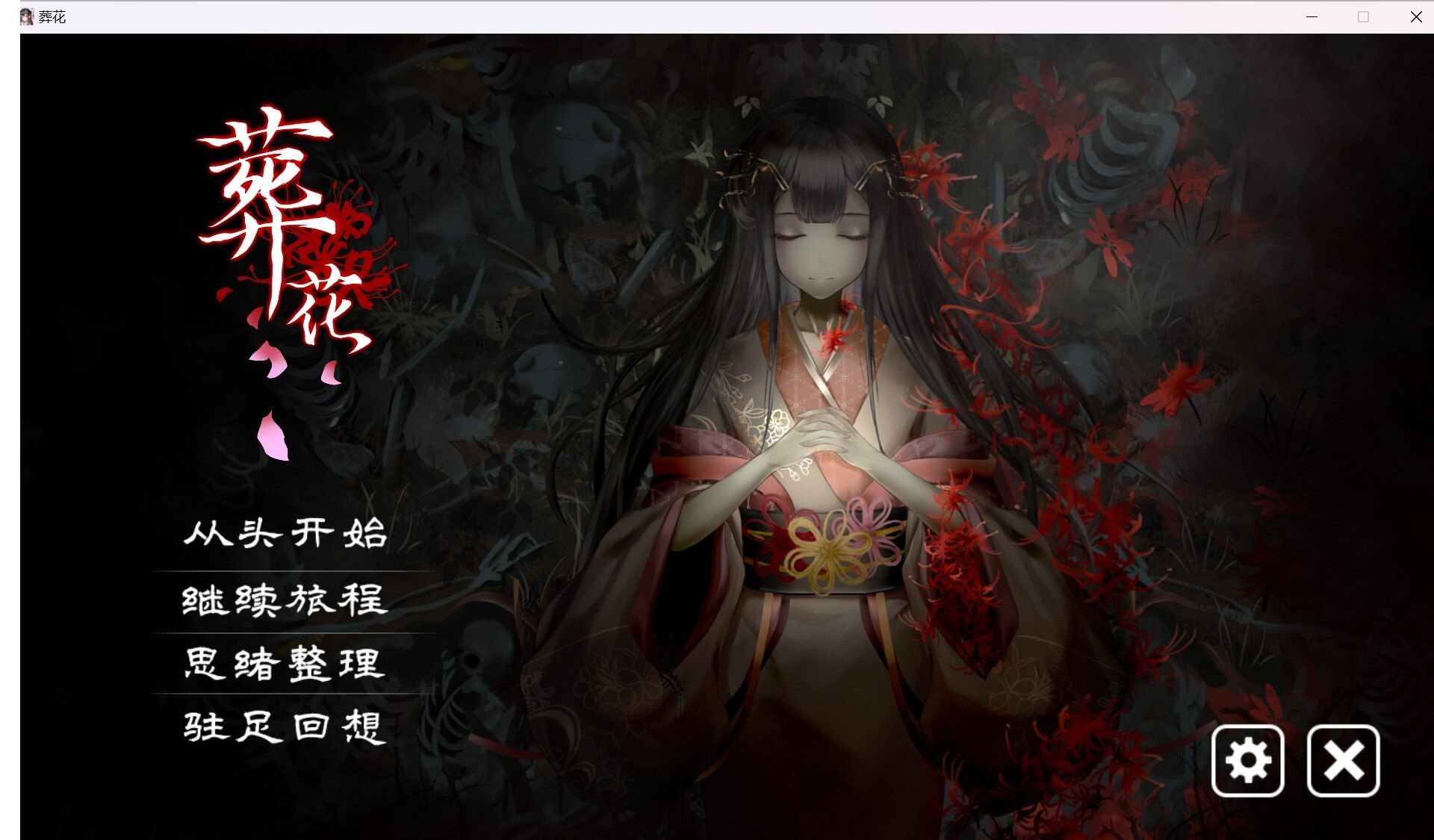
The setup is pretty clichéd—a modern-day “Peach Blossom Spring.” The protagonist stumbles into an isolated village and gradually uncovers the secret buried beneath it.
The main story is actually quite short. The protagonist is a detective who takes a job to find a young heiress. She’s suspected to have gone after an urban legend circulating online—a place called the “Peach Blossom Spring of this world.” So he goes there himself and successfully enters the “Peach Blossom Spring.”
The villagers seem stuck in the Spring and Autumn / Warring States period. The protagonist actually has a pretty good time—the residents are warm and hospitable, and the village chief really wants him to stay. He also meets a girl named “Shuanghua,” known as “Lady Goddess,” who is supposed to perform a dance at the upcoming festival.
But the chief also warns him: never go out at night. There’s a “mountain ghost,” and it eats people.
Naturally, the protagonist gets curious and goes out at night. He meets someone who looks almost identical to Shuanghua, but with a completely different personality—darker, edgier. After talking to her, he learns she’s also from the village and has no idea what’s going on outside. There are plenty of choices here, but he’s still curious about what this “mountain ghost” really is. And at night, almost none of the villagers are home—there’s firelight coming from the altar in the mountains. So he sneaks over.
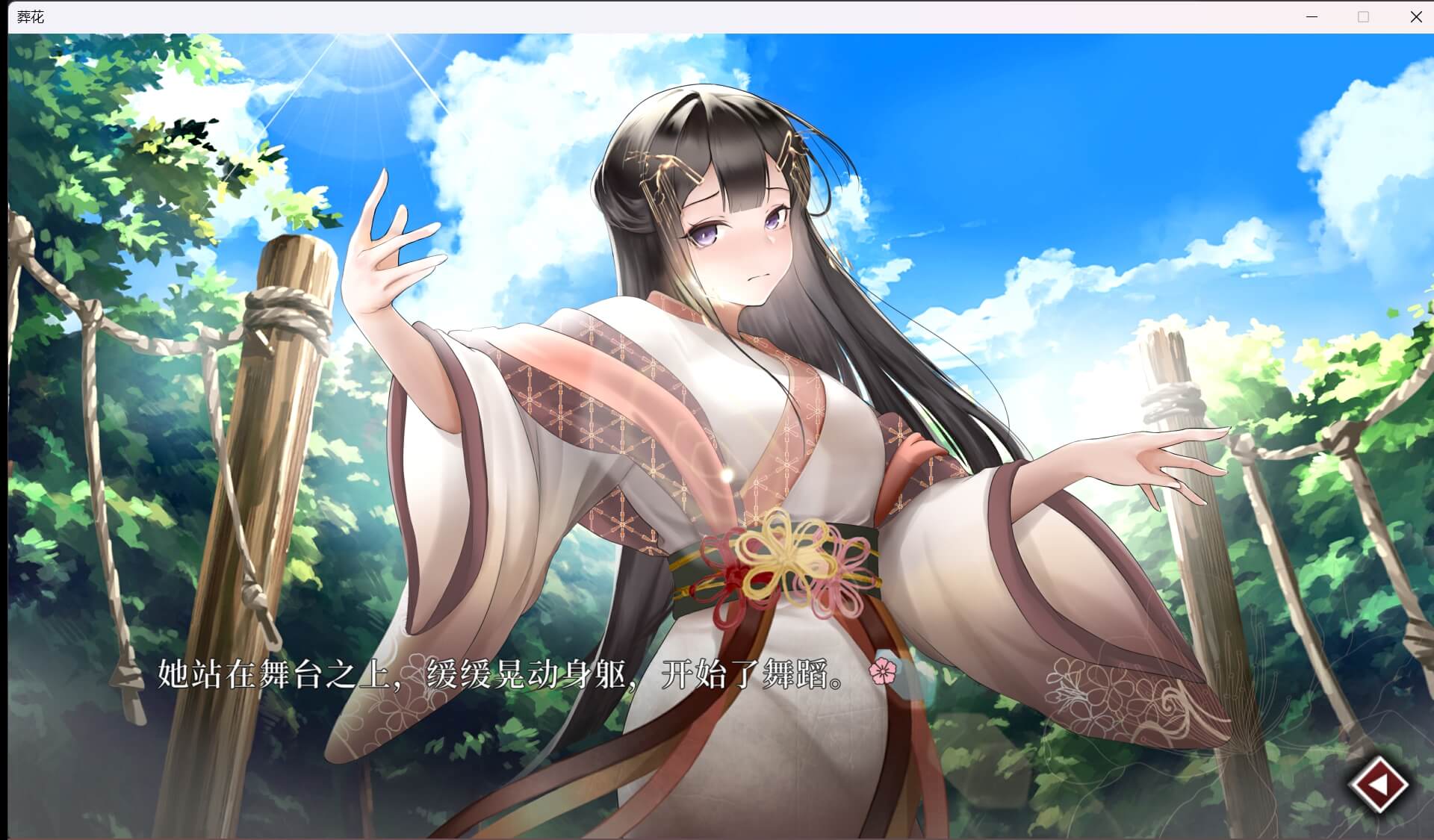
At the altar, he finds most of the villagers going completely insane—drinking, gorging on meat, orgies (the game doesn’t say it, but that’s what it means). The village chief especially wants to eat him alive. After struggling for a bit, the protagonist meets the mysterious night woman “Shuanghua” again, and she tells him what’s really going on.
Back in the Warring States period, Qin was about to unify China. The people here belonged to a small state the game calls “Huyue” (I only remember the pronunciation). The state was weak, but it possessed an immortality secret. The King of Qin wanted it, so he sent troops to attack. The king refused to submit, so he used the secret along with an immortality stone to perform a ritual, sending the princess and some villagers to this hidden paradise, where they lived on for ages.
But as immortal life dragged on, the villagers grew bored—so bored they abandoned all morals and gave in to desire, becoming more and more like beasts. No matter how they killed each other, they’d revive the next day. They could never die. The princess, the “Lady Goddess” the villagers speak of—that’s Shuanghua—split the villagers’ memories in two to maintain peace: day and night. By day, they’re the kind of people who keep up appearances. By night, they’re what they’ve become after a thousand years of immortality.
After a thousand years, Shuanghua is bored too, but there’s nothing she can do. The protagonist also learns that everyone in the village is actually dead. Princess Shuanghua was buried holding the “immortality stone,” and the villagers were her sacrificial offerings. This Peach Blossom Spring is a prison for souls that can never reincarnate.
In the end, the protagonist chooses to leave. He finds the heiress who wandered in by mistake and escapes with her through the midnight village, dodging the crazed villagers and fleeing through the cave. Inside the cave, he sees Shuanghua’s coffin—the corpse clutching a green immortality stone, surrounded by piles of bones from the sacrificed villagers.
That’s the game’s canonical route.
There’s also a so-called True End where the protagonist falls in love with Shuanghua and decides to escape with her. But Shuanghua is already dead, and her soul is bound to the immortality stone. The stone will lose its power seven days after leaving the barrier, and any mortal who carries it out will die within seven days. Still, he decides to take her away, and the game ends with them spending seven days as lovers.
Beyond the main plot, there are tons of branching stories—the village chief’s story, the widow’s story, the hunter’s story, the heiress’s story, and all sorts of deaths from bad choices where you turn into a pig or sheep the next day and get eaten. Lots of endings, but most don’t add much. They’re more like collectibles.
I’ll start with the flaws. First, a lot of the story feels unnecessary. At the beginning, the protagonist enters the Peach Blossom Spring but finds only an ordinary cave with nothing inside. He suspects it’s the entrance, but only people who “have no attachments to the world” can get in. So he asks someone to hypnotize him, making him forget his identity and become a memoryless young man, and only then does he succeed.
This setup exists only to create the game’s first mystery: the time on the protagonist’s watch doesn’t match reality. When the timer runs out, he awakens, which is supposed to feel hype—but it lasts about five minutes before the whole thing is dropped.
There are tons of restrained “censorship” traces. The many Bad Ends are probably just the protagonist getting killed or eaten, but to avoid scaring the kids, they’re changed to turning into a pig or sheep and then getting killed. The most obvious one is the night villagers’ orgy party. In a Japanese game of the same genre, that’d be a fully animated group HCG (Clockup: I know this). Here, it just vaguely says “drinking heavily, eating meat, venting desires”—you know, well-fed and warm leads to lust—and skips the rest. Lots of content has a “softcore” shadow: night Shuanghua, the widow at the east end of the village. Probably because of the domestic environment, they didn’t dare go further. It’s obvious that Shuanghua, as the princess, was buried holding the immortality stone to gain eternal life, and the villagers were sacrifices. The game only describes bones piled around her coffin and doesn’t dare say more.
Honestly, if this game went “full power,” it’d be pretty scary and genuinely unsettling—horror style. But it never felt scary to me at all. I even played it past 3 a.m. Say what you will, but “Chinese Galgames just make me feel safe.”
The game has tons of branch choices, and very few are useless. Most determine the story’s direction—pick wrong and you die. It also gives you a clear “branch chart” to help you collect different endings. The problem is that some branches are impossible to figure out. The hunter Dani’s route especially—you have to go hunting with him at a specific point to trigger it. If you’re not using a guide, you’re almost certainly not getting the True End. I’d suggest listing all options at key choices and graying out the ones you haven’t unlocked—that would work better.
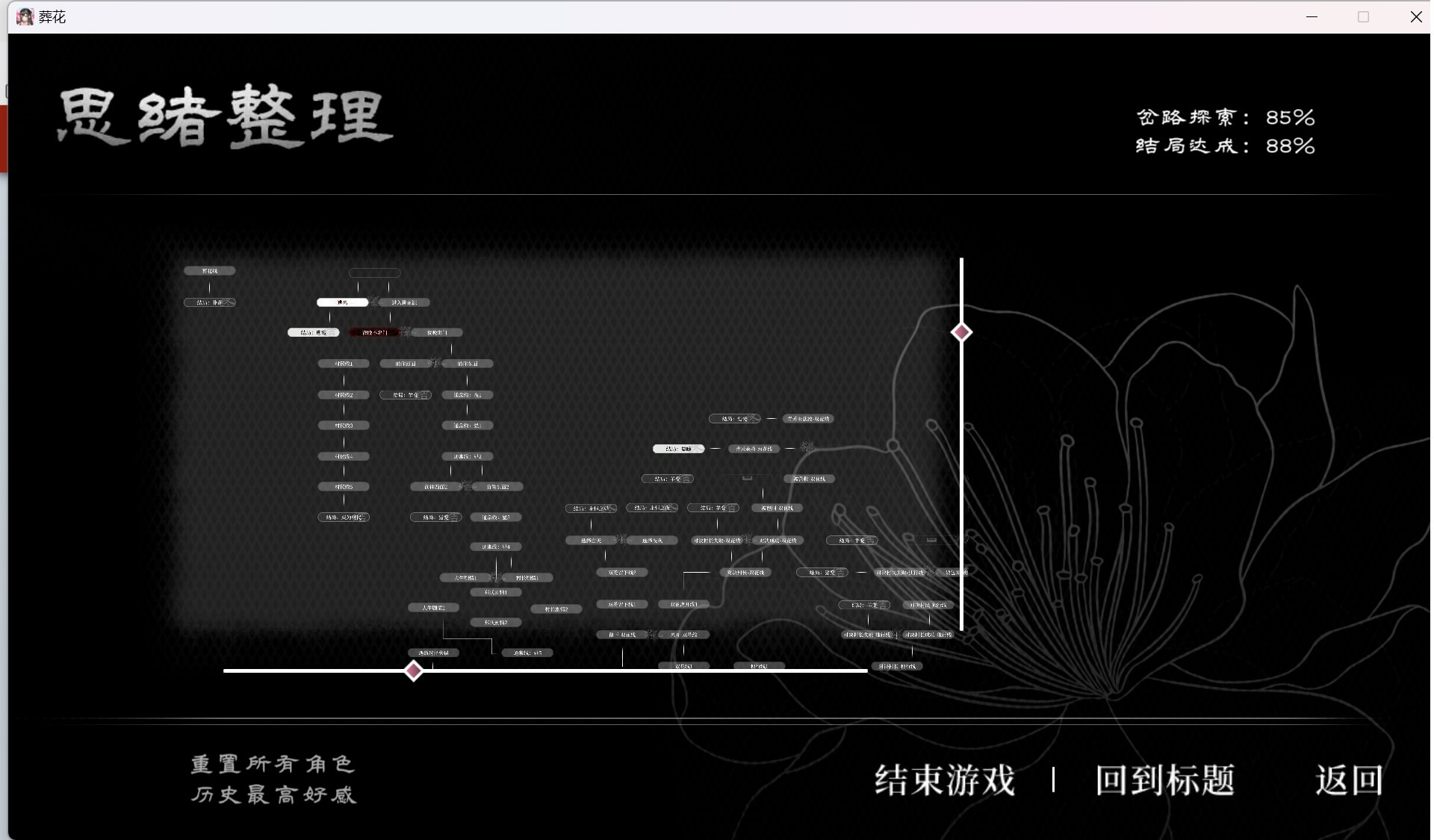
The story content is clearly insufficient for that many choices and branches. The side effect is a ton of copy-pasted text. The main spine is always: enter the Peach Blossom Spring -> discover the night secret -> confront Shuanghua and choose to leave or stay -> escape at night. But with all the branches, you have to repeat these choices over and over to All Clear. By the end I was sick of it—even the final True End just tacks a short segment onto the same copy-pasted ending.
Oh, right—according to the game’s own rules, the protagonist carries the immortality stone out of the barrier and will definitely die seven days later. For such a tragic ending, the game downplays it. During the ED, you see some scenes of the protagonist and heroine on dates. A story that should’ve been moving loses its impact because of that softening. I don’t know if it was censored or not, but the flaw is real.
Now for the good parts. There are actually a lot of them—more than any other Chinese Galgame I’ve played.
First off, the game uses Unity, which I hate, but the power consumption and system usage are well controlled—no random 100% CPU or skyrocketing memory. The programmers are clearly professionals. Second, the writing and text have almost no “anime vibe.” The dialogue feels like normal conversation, which gives the Chinese voice actors a lot of room. You’ll hear their performances sound natural and traditional. I never liked Hanser—I thought she couldn’t sing or voice act—but thanks to the normalized dialogue, her heroine here actually feels alive. At least she crushes the nonsense-speaking characters in Genshin Impact.
The setting uses the traditional Chinese “Peach Blossom Spring” and echoes the original text with a Warring States background. The narrative is steady, doesn’t force memes, and you can tell the writer wanted to tell a real story.
I later searched for interviews about the game’s production. The creator had worked on several Chinese comics, and this game is adapted from one of his manga. He apparently decided to make it a Galgame after playing some Yuzusoft games and finding the genre interesting—so he turned his manga into a game. Choosing Hanser and the like was just his personal preference.
I won’t joke about the producer probably having a mine at home, but I have to say: to truly localize a Galgame, you need someone who hasn’t played many Galgames.
Some people accuse the plot of copying Japanese “night visit to a lonely village” horror AVGs. I don’t think that matters—I’ve seen so many of those. The moment I see a mountain village with midnight revelry, I think of orgies. The game’s developments didn’t surprise me much. But because it actually “speaks like a human” and “acts like a human,” it gives the artists and voice actors room to shine, without all the tiresome “Japanese anime flavor.” That makes it a Chinese Galgame that ordinary players can accept more easily.
I already said there are quite a few flaws, though I’m not sure if they’re from censorship or budget. Still, I think the direction is right. If they keep trying, more domestic users might accept this already-small market.
At least don’t let those idiots hear “playing an eroge” and immediately think of Nekopara, okay?
Of course, to show support, I bought a legit copy on Steam, including that DLC I don’t think much of.
Comments are hosted on the Chinese main site. This mirror is read-only.