Hands-on: Miyoo Mini
Miyoo Mini: A Handheld in the Truest Sense
Everyone knows the “handheld market” is hot right now. On top of the old crop of “open-source handhelds,” we’re drowning in “high-performance handhelds.” Plenty of people are chomping at the bit for these things, but most of them are “playing with the machine, not the games”—buying one after another, testing for a bit, then stopping cold.
Some call this “electronic impotence.” I don’t buy it. I just think most of today’s “handhelds” don’t deserve the name. They’re more like a “giant desktop PC you can cradle in both hands.”
Whether it’s Aya or GPD, each new machine is bigger than the last, and heavy too. I basically have no desire to take them out anymore—you need a dedicated shoulder bag just to carry one. And that’s not even the main issue. The most awkward part is that battery life on these handhelds tops out at two hours. Good luck getting enough playtime out of one on a trip.
Aya even showed off a concept machine called the Next 2 that ditches the battery entirely and has you play plugged in. Which is basically an admission that this thing isn’t a “portable handheld” anymore—it’s just a mini desktop you can hold in your hands.
If that’s the case, why not just use the TV at home?
Early this year I saw a bunch of people on HiPDA (now called 4d4y—no idea what got into their heads or whether the site got sold) discussing the Miyoo Mini. It looked great. Sure, plenty of people complain about the feel, but given the size, that’s unavoidable. And it was dirt cheap, shipped from NewYork, Henan, so I just bought one.
I started fiddling with it the moment it arrived. I’ve been playing it on and off for over half a year now—flashing firmware, loading games, upgrading the system—and I’ve come to feel this machine fits the definition of “handheld” better than anything else in every respect.
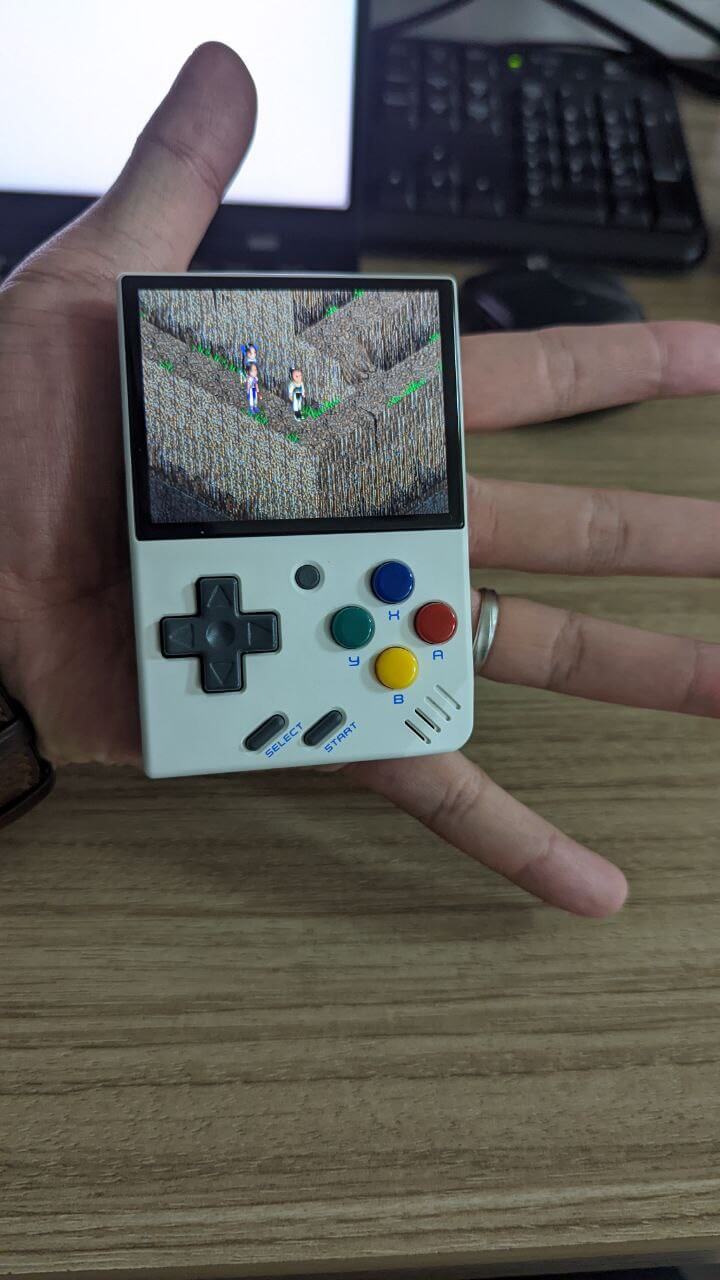
The first impression is “tiny.” It’s about the size of a deck of cards, fits easily in your palm, and slides into any pants pocket. A true “game console in your hand.” The SoC is nothing special—its ceiling is PS1 games, anything beyond that is a no-go—but for this machine, that’s enough.
The stock system comes with a ton of emulated games, a whole dazzling spread. What annoys me is that they’re all Chinese fan translations. I personally can’t stand these “forced localization” versions of old FC games—they feel weird to play.
The UI is sensible. The 640x480 screen shows almost no visible pixels—a handheld-grade Retina, I guess. The default filters for old emulated games are set up nicely too, with plenty of that original flavor.
There are two shoulder buttons on the back. The feel is garbage, but at least the function exists, so you’re not locked out of certain games.
I didn’t test battery life rigorously, but it feels long—four hours seems about right. Most importantly, this little handheld handles standby drain well: leave it off in a drawer for two weeks, turn it on, and there’s still a decent charge.
Miyoo Mini has a third-party system called Onion OS, essentially an upgrade and overhaul of the stock firmware. Installation isn’t a hassle. The killer feature it adds is “Switch”—not Nintendo’s Switch, but the ability to switch between multiple games.
You can be playing game A, switch to game B, and both games’ progress is saved in real time. It’s a lot like task switching on a phone.
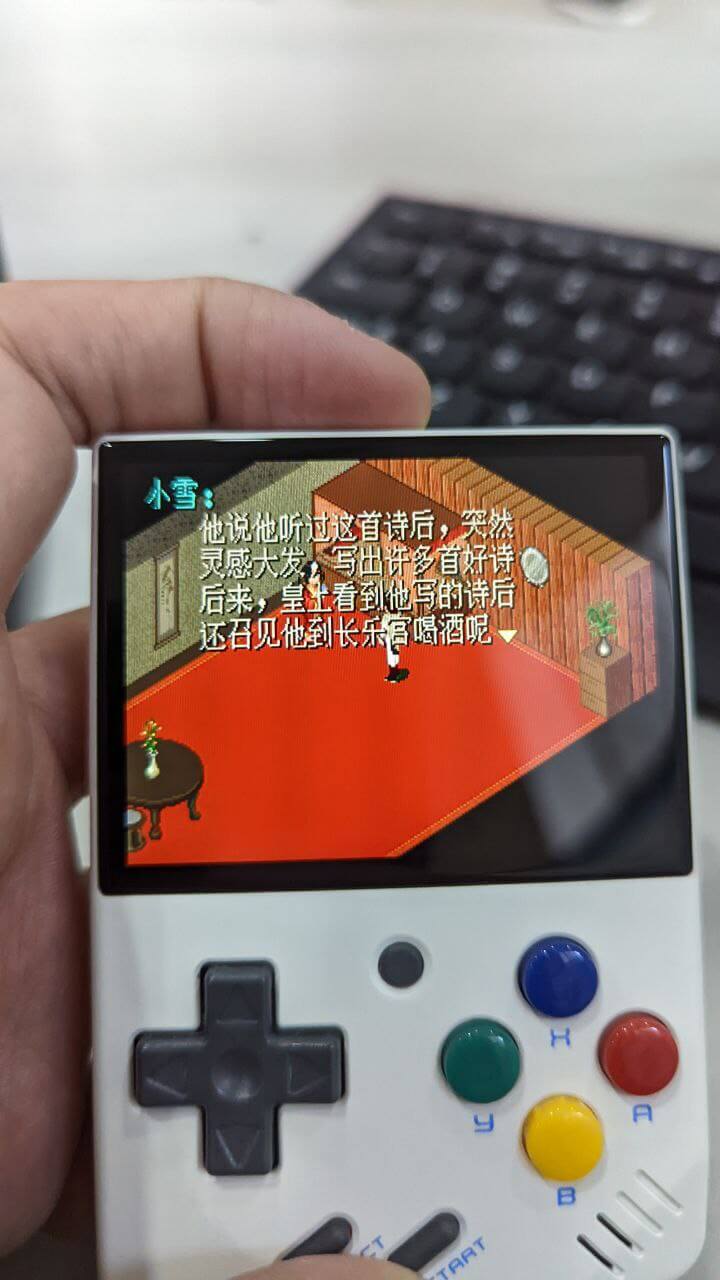
The Miyoo Mini’s system also supports ports of classic games—most famously the Chinese Paladin I mentioned before—and some others run on it too, but I’m too lazy to tinker.
There’s a whole mod scene too: replacement shells, replacement buttons, grips, decorative docks. Of course, the mods end up costing more than the machine itself—whether it’s worth it is up to you.
As for shortcomings, besides being too small and uncomfortable for long sessions, there are some build-detail issues. Mine has no other flaws, but the battery cover doesn’t sit tight and falls off easily. Not hard to fix yourself.
There are three generations of the Miyoo Mini. The V1 has a battery you can pop out and replace, like an old Nokia phone. The V2 switched to a fully laminated screen, went back to a single-plug battery, and increased capacity. As for what the V3 updated, I’m not really sure—probably build quality optimizations.
Thanks to its tiny size, the Miyoo Mini actually fulfills my handheld dream of “pull it out and play a quick game whenever.” Paired with Onion OS’s task switching, that “play anytime” becomes genuinely practical. The feel may not be great, but it’s portable enough, looks good, takes up no space in a pocket, turns heads when you pull it out, and is cheap. Probably the most worthwhile buy among open-source handhelds. (If you can get one at MSRP.)
Comments are hosted on the Chinese main site. This mirror is read-only.