Japanese school life! (Japanese school life!) Review
A Very Abstract Game
More and more Japanese studios have figured out just how much money the overseas otaku crowd is sitting on, so we keep seeing visual novels pop up on Steam—including a whole crop of “Steam exclusives” planned specifically for the overseas market, with the domestic audience written off entirely, all in the name of moving units and making a buck.
Most of these games sell like crap. Maybe it’s that Japanese “don’t cause trouble for others” instinct, but they always try to read overseas players’ minds using their own assumptions. They figure anything “too Japanese” or “too hardcore” won’t land with foreigners, and they unilaterally decide that what overseas weebs want out of Japan is ninjas, cherry blossoms, JK, school festivals, and so on. This kind of presumptuous pandering reliably produces results that are deeply, painfully cringe. If you need a reference point, look at how Japan “localizes” for overseas markets: they assume Chinese users want to hear Japanese anime girls speak Chinese, so they record exclusive Chinese theme songs, and some games even rewrite the scenario for overseas players. Nobody buys any of it. Back then the Japanese side genuinely couldn’t understand why so many Chinese users who don’t speak a word of Japanese insist on the Japanese voice track—like, does not understanding it not bother you?
On one hand you’ve got all this localization for overseas releases; on the other, Japan loves stuffing foreign elements into its own localized-feeling works. Every school has a handful of Nordic exchange students, names that go on forever in katakana keep showing up in some heroine’s name field, and these foreigners—despite clearly being foreign—always speak fluent Japanese with no need to worry about anyone checking their credentials. They slot naturally into Japanese society and heap praise on every last bit of Japanese culture, and the dialogue is guaranteed to include a line about how they “love Japan more than anything.” It reads a little like a Japanese Fleischmann’s-style livestreamer.
This whole “won’t show foreigners the real us, but keeps using foreign mouths to loudly praise us” routine always strikes me as deeply contradictory. It gives off a weird, abstract feeling every time.

So a game with the incredibly on-the-nose title Japanese school life! gave me exactly that weird feeling. Just from the name and premise I could picture precisely what this thing was, but because I had nothing better to do, I played it anyway. It turned out to be even more abstract than I expected.
The story isn’t long, and it’s exactly what the store description says: the protagonist goes to a Japanese high school as an exchange student, and under the guidance of two Japanese JK, spends spring, summer, fall, and winter in Japan soaking up the Japanese lifestyle. Right at the start the protagonist acts like a total dumbass, marveling at every little thing in Japan and carrying some seriously heavy stereotypes—clearly he’s watched a lot of anime. He transfers in, and immediately beautiful girls swarm him, strike up conversation unprompted, and are already deeply fond of him.
The two girls walk you through Japan’s various traffic rules, 24-hour convenience stores, standing on one side of the escalator, karaoke, the summer festival, the beach, the school festival, Japan’s heavily modified version of Halloween, and finally the uniquely Japanese White Day. You can even pick one of the two girls to confess your feelings to…
What stuck with me most was the protagonist’s dialogue, which is wall-to-wall praise: “Convenience store, good! Escalator, good! Summer festival, good! Karaoke, good! Halloween, good! …Japan, daisuki!”
The production isn’t exactly polished. The main artist, Pikopikoguramu, draws some genuinely lewd characters, but for some reason in this game they look almost exactly like Karory’s—is it the coloring? There’s also no OP or ED to speak of, so I guess the whole budget went to the two voice actresses.
I went in with zero expectations, but after finishing it I got to thinking: this game’s whole identity is basically a “Japanese culture guide,” except they hired two cute girls as ambassadors to walk you through everything you need to know about visiting Japan.
And the protagonist’s gushing is really just a Fleischmann’s-style self-satisfaction. Experiencing a year of studying abroad in Japan through a game is, I suppose, a decent enough piece of work.
Naturally the game dodges every real problem Japan has and beautifies everything. What I couldn’t stand most was the “crowded train”—anyone who’s been through it knows how miserable it is, and the game just waves it off as a “special experience.” Same with the customer-service smiles and the distance between people in Japanese society; none of it comes up.
The most bullshit part is that the game hands the protagonist a shot at romance at the very end. You can pick one girl and give her a gift on Valentine’s Day—it doesn’t change the ending, it just leaves an open thread telling you the protagonist and the girl he likes have made a connection, and if he ever comes back to Japan, something new will surely happen between them.
Right. I think Shasha would have the most to say about this—do Western exchange students really show up at a Japanese high school and have cute girls walk up and get all cozy with them? Surely not. If anything, the whole story is fictional by definition.
But a few days ago I saw a piece of news about Shandong University: they announced they’d keep improving their “study buddy” system, making sure every international student gets one or two cute girls accompanying them the whole time. There were even stories about buddies needing emergency contraception after a party and then getting an abortion.
Seen that way, this supposedly fake game starts looking realistic again. If anything, it gets even more abstract.
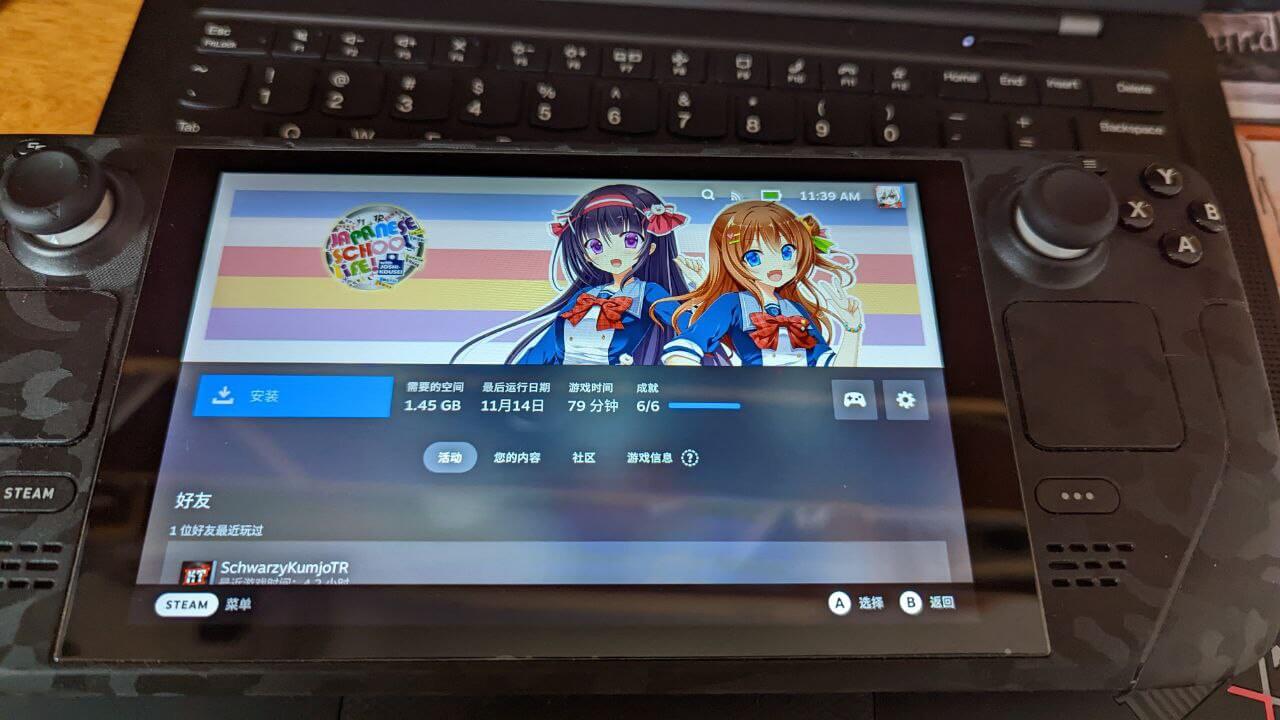
Oh right, the game has six achievements. Do one playthrough of each heroine’s personal route—if you can call it that—and you’ve got them all. No Chinese support, English and Japanese only.
Speaking of which, this studio code.jp’s other game is actually very proper and gorgeous, though the unchanged part is still that “give the overseas market what it wants” production policy that ends up being completely unnecessary.
Comments are hosted on the Chinese main site. This mirror is read-only.