Same to Ikiru Nanokakan (サメと生きる七日間) Review
Same to Ikiru Nanokakan: The Longest B-Movie
Taiwanese rapper MC HOTDOG shows up in a lot of movies too, but he’s a bit different — he only does “low-budget,” “rough around the edges,” the kind of thing you look at and think, yeah, this is gonna be a mess. He’s worked with the likes of Xiao Shenyang, Da Peng, Yue Yunpeng. Sometimes he even pops up in Taiwanese horror films by directors nobody’s heard of. The results are about what you’d expect: most of these movies got panned. Basically everything he’s been in is a stinker.
A lot of people, me included, were puzzled. The guy is arguably the face of Chinese-language rap. Eminem made 8 Mile. Hotdog should at least have the ability and the resources to make something decent — even a vanity project shouldn’t turn out to be a “bad movie.” But in a later interview he brought this up himself, and his answer stuck with me.
Hotdog explained that he doesn’t like so-called “big productions.” He prefers that “cheap” B-movie feel. And he laid out all the upsides of B-movies: because they’re niche, the subject matter can be sloppy but also way more unhinged; because they’re niche, the content can be bolder, more willing to shitpost, even touching sensitive territory that “big” films won’t go near; because they’re niche, the style gets more exaggerated — horror gets scarier, gore gets bloodier, comedy gets to cut loose.
And because it’s a B-movie, niche audience, niche marketing, nobody’s really watching, so it’s just more free. There’s a decent-sized crowd of B-movie lovers out there going nuts over films that “don’t belong in polite society.”
That idea hit me, and it reminded me of when I first got into visual novels. For a market that’s been called a sunset industry for years, the B-movie approach works just as well — in both subject matter and plot development, visual novels are freer, and a lot of the “masterpieces” were born inside that freedom. No wonder so many people find “healing” in themes of darkness, death, torture, even training.
So finally some developer remembered the common ground between visual novels and B-movies. Like CUBE’s Same to Ikiru Nanokakan (サメと生きる七日間), “Seven Days Living with Sharks.”
Like the title says, the story isn’t long — the span is just over seven days. But like the title of this article says, the game’s plot is anything but short. For a B-movie, it’s actually on the long side.
Plenty of you probably already guessed: the core mechanic here is the time loop.
The protagonist wakes up on a beach with a blank mind, zero memories. Next to him is a naked girl who calls herself “Kuu,” because she keeps trying to bite him and making a “kuu” chomping sound, so she gets named “Kuuko.” Once he’s ashore, his suspicious identity gets him hauled to the police station, where a pretty female officer who calls herself Funahori-oneesan asks him some questions and lets him go. Outside he runs into a blonde named Reisu who seems to know him, claims to be his “childhood friend,” and takes him back to his house — except he has no memory of the place at all.
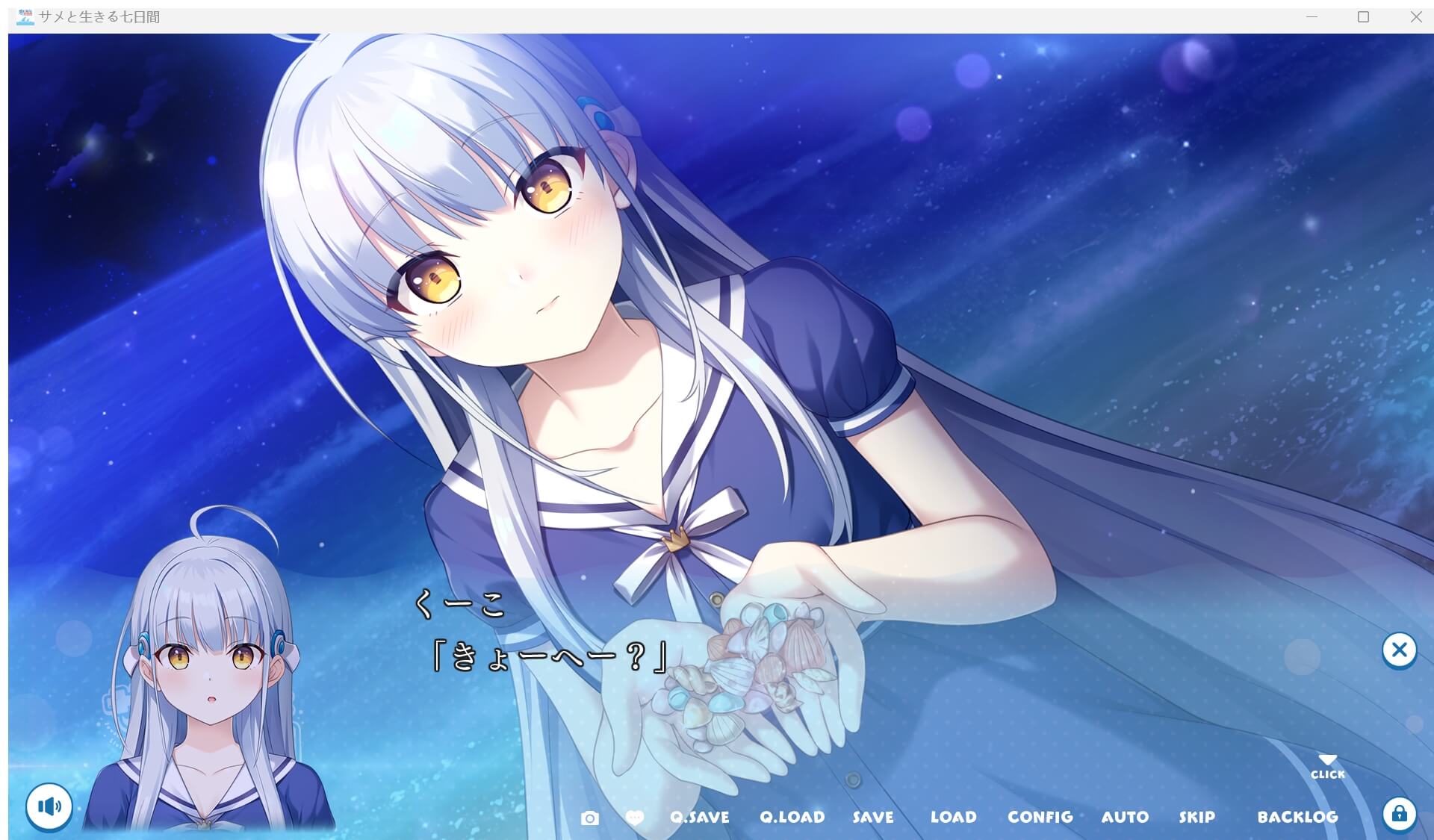
Later, with Reisu filling in the blanks, he slowly accepts his role: he’s apparently a resident of this island, attends the island’s school. The island has rumors and real risk of shark attacks — innocent islanders die to sharks every day, so you have to be careful living here. The islanders worship a god called “Tako” (which also means octopus in Chinese), and “Lord Tako” supposedly protects them from being eaten by sharks.
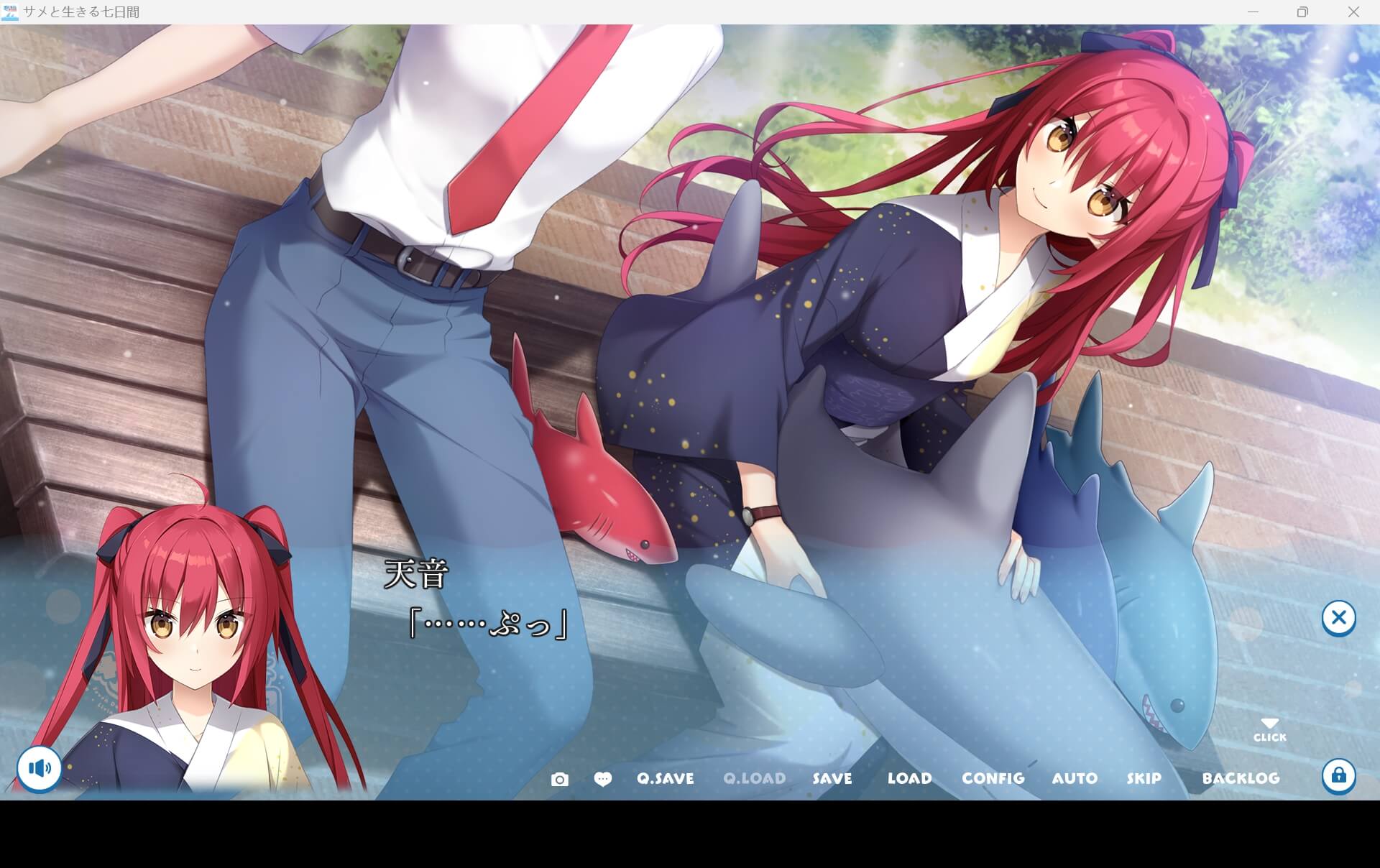
To honor Lord Tako’s protection, a festival is coming up on the island in a week. Before the festival, during school days, the protagonist meets some classmates: the very reserved girl Maruri, the sharp-tongued Enka who’s obsessed with the island’s history, and an outsider he bumps into on the island, Yamato… no wait, “Amane.” And of course there’s Funahori-oneesan, who holds down basically every job on the island — convenience store clerk, police officer, teacher, you name it.
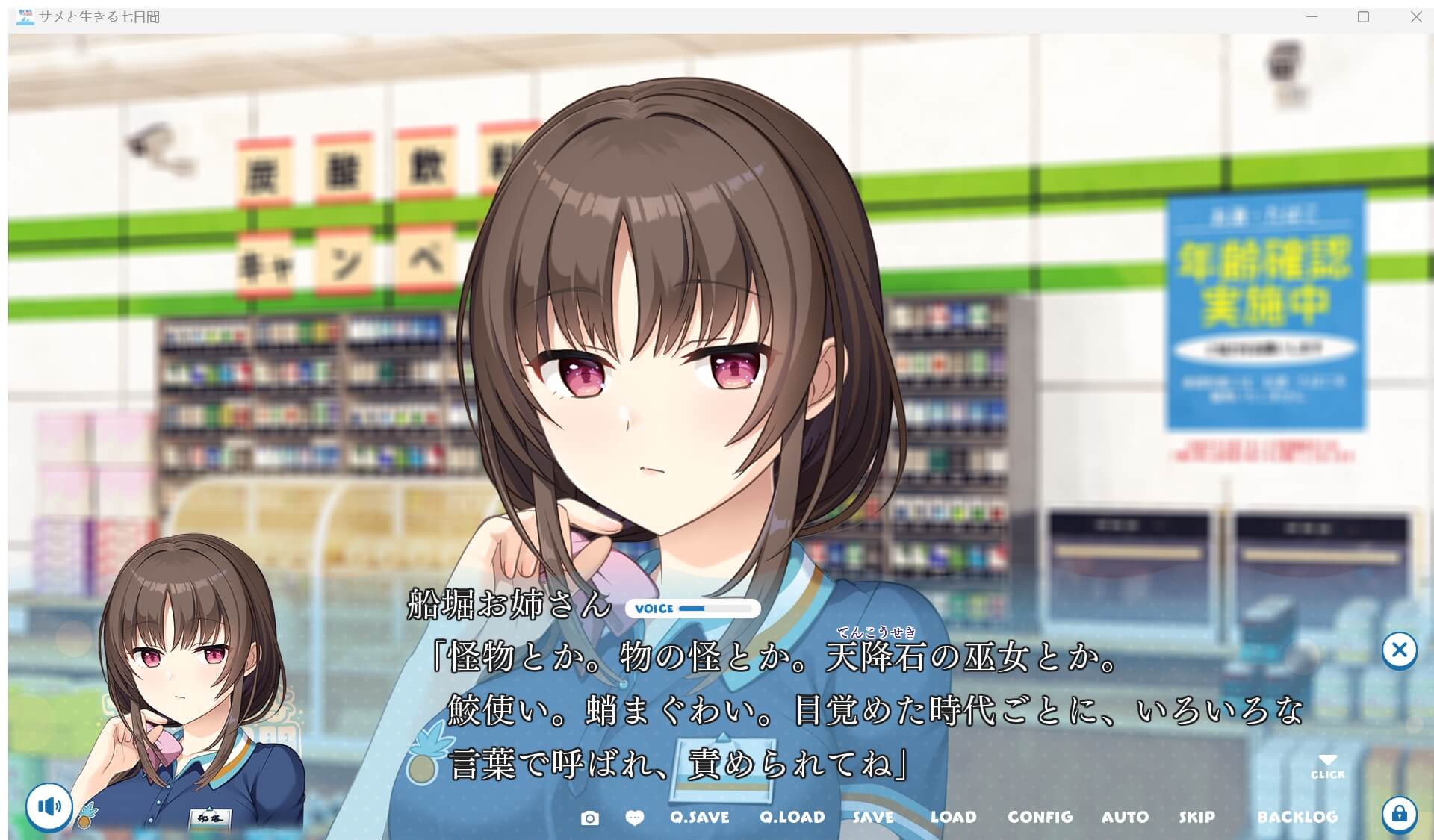
Time rolls around to Lord Tako’s festival, and after it’s done, the protagonist spots “Amane” at the beach at night holding a knife, muttering “I shouldn’t have killed the shark.” Then a loudspeaker voice comes from the distance:
“…Filming complete. Set dismantling.”
After that, he loses consciousness.
He opens his eyes and he’s back seven days earlier — waking up on the beach, the girl called “Kuuko” lying next to him, hauled to the police station, picked up by Reisu, all the way to that loudspeaker voice seven days later. Over and over. So begins the protagonist’s loop inside this “endless seven days,” with no idea how to escape.

Of course the game doesn’t just copy-paste those seven days. You pick routes into different heroines, work your way through them across the loops, and piece together the island’s secrets along the way. A few playthroughs and you can pick up these clues:
- The island’s “seven-day loop” isn’t a real loop. It’s some method of brainwashing the whole island so everyone thinks time has rewound.
- Since time isn’t actually rewinding, the dead don’t come back. If key islanders die (the store clerk, the cop, etc.), new people get slotted into those positions, memories get rewritten so nobody notices anything off.
- Maruri says Lord Tako is real — deep in a cave in the back hills there’s a tentacle brain made of assorted octopuses. She’s seen it herself. And the octopuses scattered everywhere on the island are all Lord Tako’s eyes and ears.
- Before the protagonist lost his memory, Enka was his ex-girlfriend, and she knows a lot of the island’s Tako legends: Lord Tako demands a “maiden” sacrifice in exchange for protection. The islanders offered up a girl once, and she became Lord Tako’s shrine maiden — ageless, immortal, carrying out Tako’s will, still alive on the island to this day.
- The island is shrouded in the terror of “sharks.” Everyone steers well clear of the topic. Nobody wants to know the truth, nobody dares question whether this repeating “seven days” is really a loop. Someone tried once. Then he got eaten by a shark and was never seen again.
- Over time the islanders got used to “eaten by a shark.” The person joking with you yesterday is gone today. Nobody’s surprised anymore.
- Amane, the outsider, is really a “shark hunter” — here to hunt the man-eating shark. In some loops she almost pulls it off, but most of the time she regrets what she’s done.
- The shark is Kuuko, which surprises nobody. What does surprise people: Kuuko is the protagonist’s little sister, and she knows Amane. The three of them share a memory of playing a hunter–civilian–shark hide-and-seek game together — except now that memory has become reality.
- Even though the seven-day loop isn’t real time travel, in some loops the protagonist has maliciously killed nearly all the heroines to stop it. I mean, with everyone dead there’s no show to put on. But the mastermind behind the island can just use “parallel worlds” to keep going.
- Remember the sacrificed shrine maiden? That’s “Funahori-oneesan.” She wears every hat on the island, filling in for anyone the sharks eat, and to some extent she’s the one pulling the strings behind this whole “shark massacre” farce.
Once you know the mastermind, the ending isn’t far off. Clear all the heroine routes and the Grand End unlocks — and that’s when the island’s mystery finally gets solved.
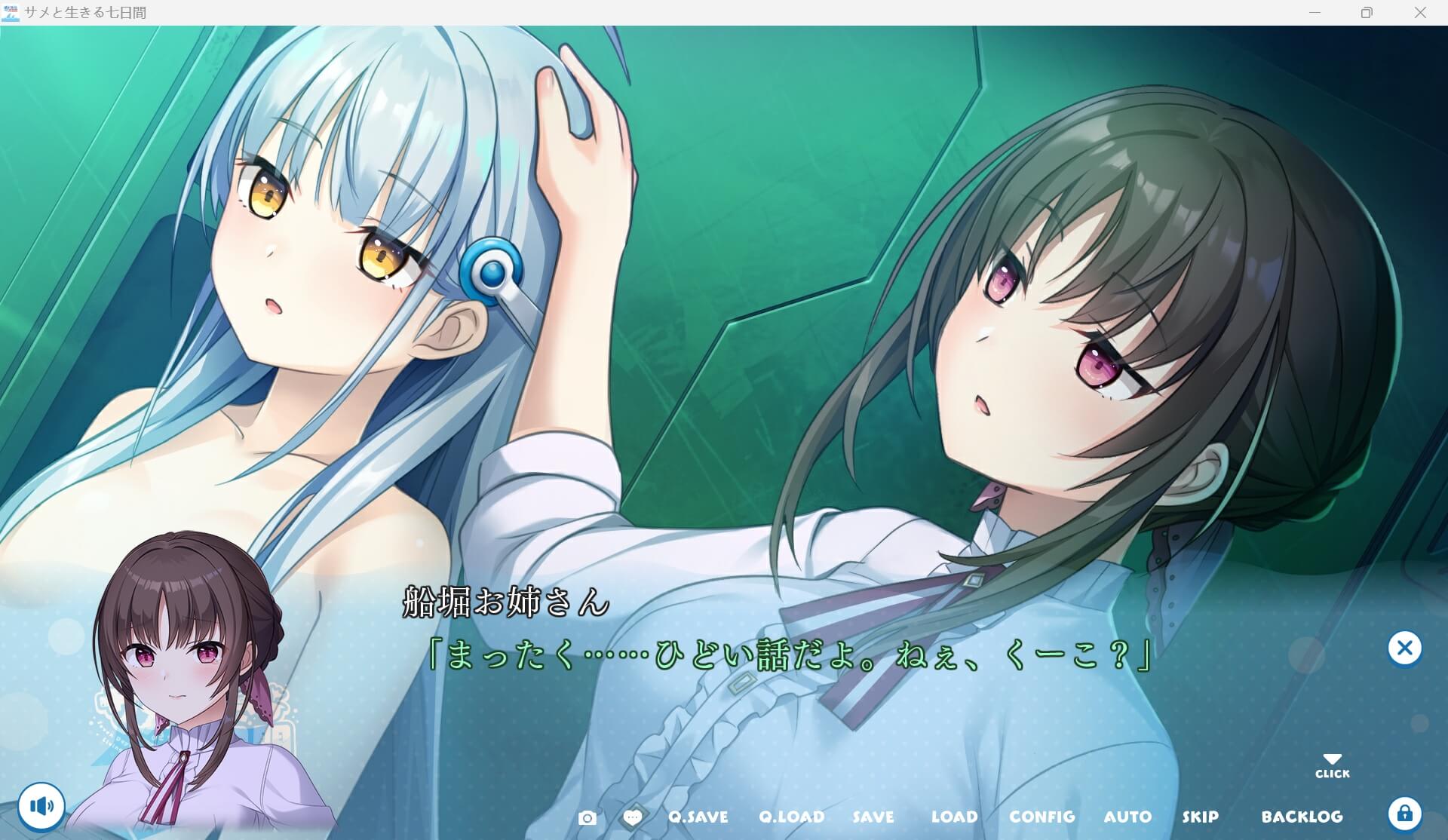
This place, “Samejima,” used to be wasteland. Then a batch of slaves got exiled here and scratched out a living. Later a meteor fell from the sky carrying an alien species — they look like octopuses but have tremendous power. (Think the kind of thing you’d find in Cthulhu Mythos.) Pretty soon the “octopuses” ruled the island. The islanders worshipped them as gods, built a shrine, held all kinds of rituals. They even sacrificed a girl to become the shrine maiden — the current “Funahori-oneesan.”
Becoming the shrine maiden gave her an immortal body and a job to do for the god. So “Funahori-oneesan” became the god’s mouthpiece. Then World War II broke out, the Japanese navy came to build a base here. The god used the opportunity to absorb modern science and technology and started modernizing the island, opening limited contact between this outer island and the mainland. The former slaves got to live modern lives.
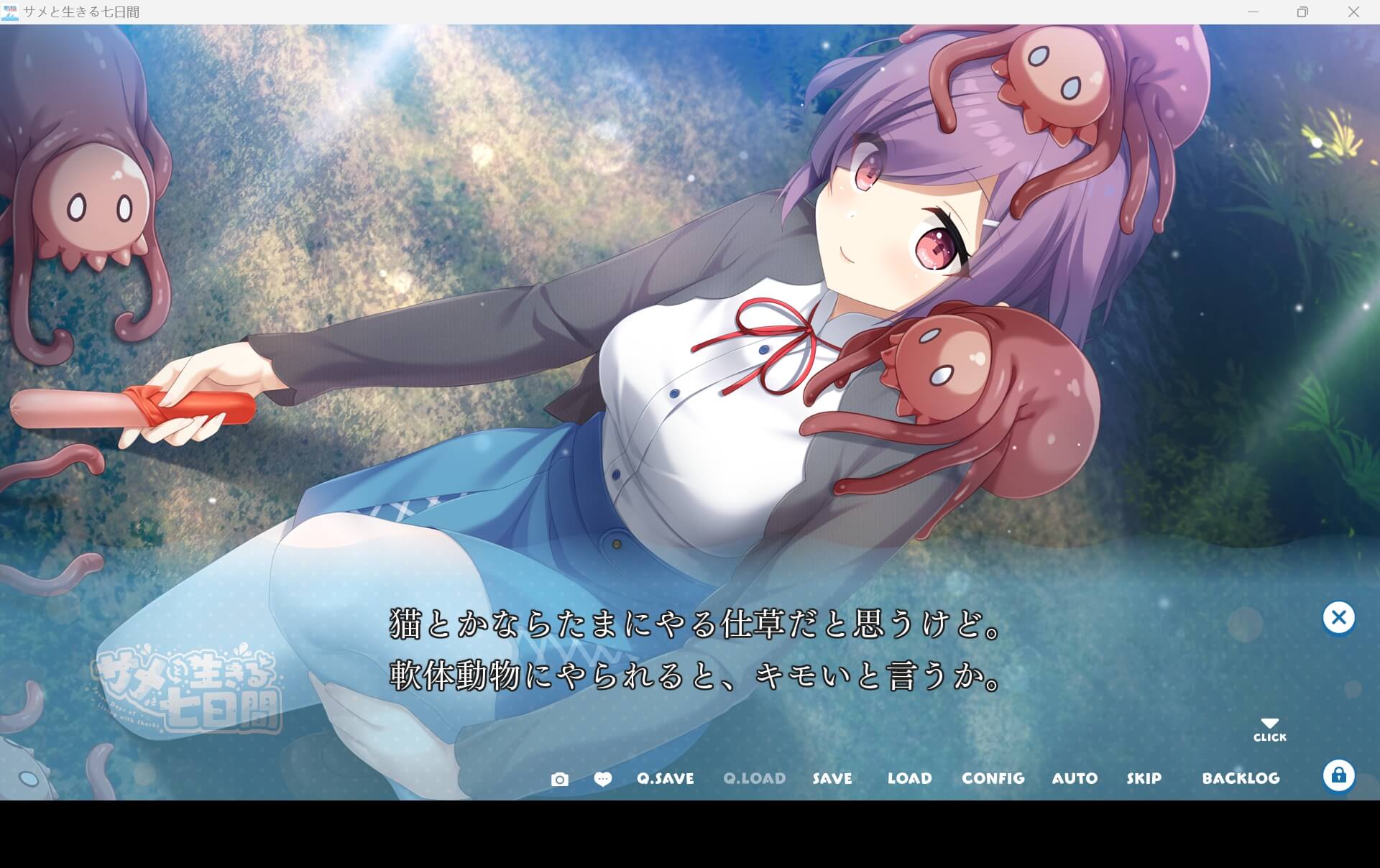
Then Lord Tako got a whim: it wanted to play a bit of “role-play” on the island — the kind of B-movie story you’d get from Jaws. With Tako directing and “Funahori-oneesan” helping, this little island became the set for a “reality show.” Some people play the shark, some play civilians, some play the shark hunter. Every seven days the residents’ collective memories get rewritten and the whole thing repeats, all to entertain the high-dimensional alien octopus things from space.
So the island’s seven-day loop is all a show, staged to put on a performance for the alien monster. Once the protagonist learns the truth, “Funahori-oneesan” helps him, secretly transferring her divine power into him. Then in a new “loop,” the protagonist gathers all the heroines, tells them the truth, and decides to destroy the island’s so-called Lord Tako — the meteor that fell from the sky.
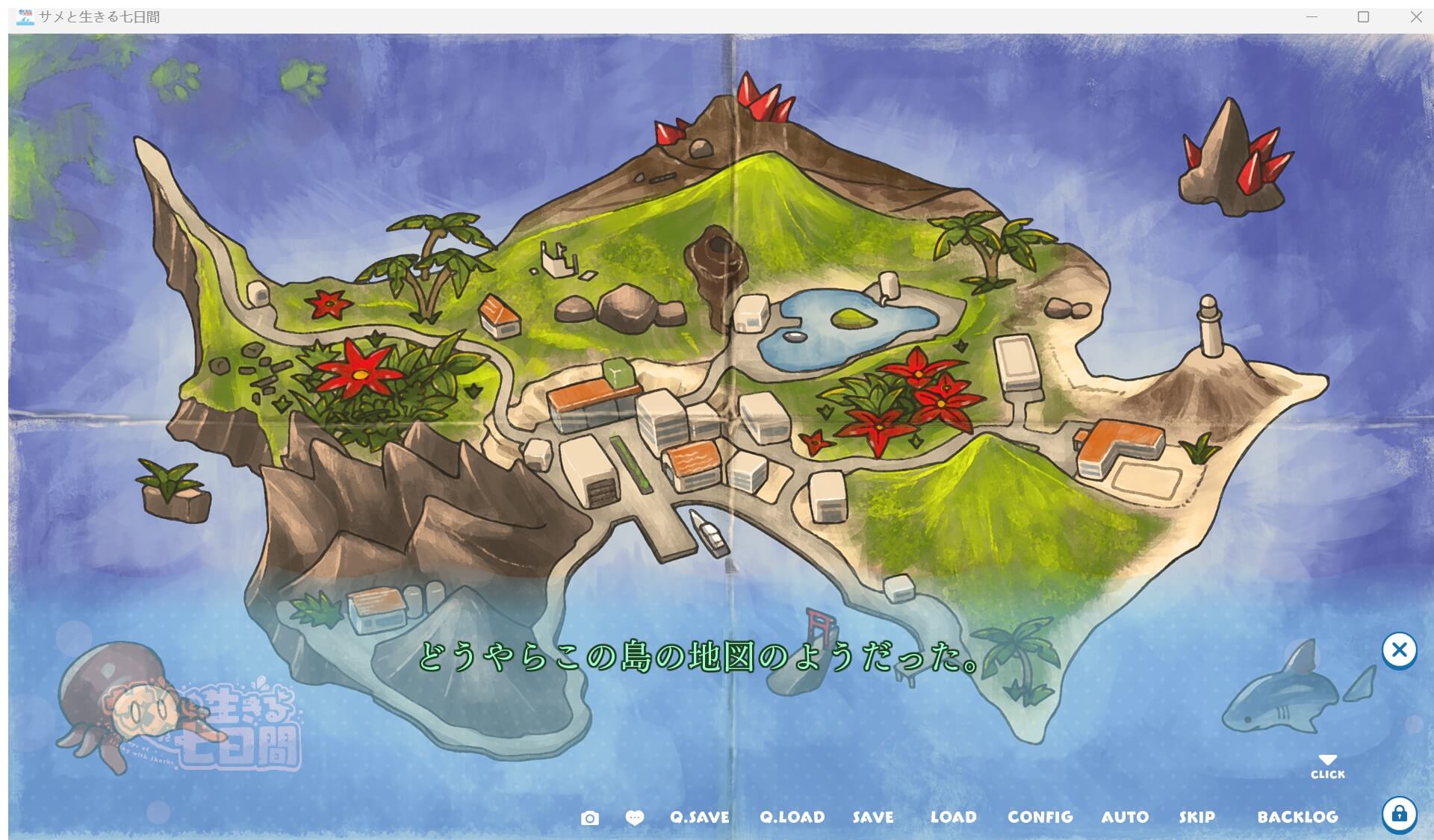
After a whole lot of chaos, the meteor and Lord Tako are destroyed together, dead octopus corpses everywhere on the island, and the islanders are finally freed from Lord Tako’s control. “Funahori-oneesan,” who was about to kill herself out of guilt for aiding the tyrant, gets talked down by the protagonist and goes on to lead the islanders in building the place up.
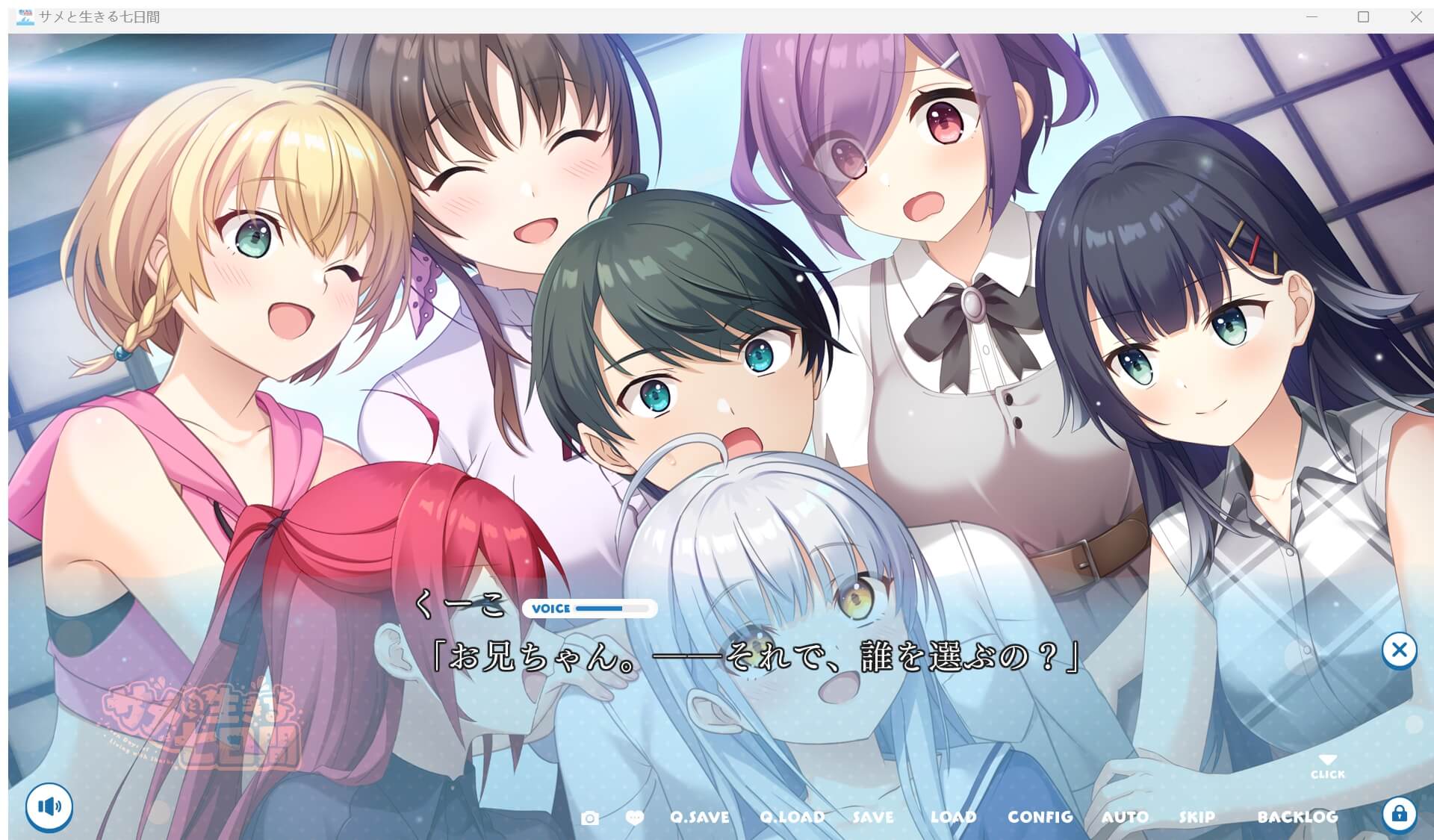
Years later the island is thriving, and the protagonist has entered full harem battle-royale mode with his crew of heroines.
Halfway through I started feeling something was off, because this doesn’t look like a CUBE game at all.
What’s the CUBE style? Harems, soft and sweet, elementary-school-level prose… that sort of thing. But clearly this company’s been upping the shitposting game in recent years. From Yurumeku Kokoro ni Michita Sekai de, Kimi no Yume to Yokubou wa Kanau ka a few years back, to Kamisama no You na Kimi e last time, CUBE’s games have been breaking out of the old “moege” mold and daring to touch topics the industry usually won’t. If last time’s Kamisama no You na Kimi e expansion only briefly mentioned “big-data-driven echo chamber brainwashing,” Same to Ikiru Nanokakan maps onto a lot more. Beyond the classic battle royale and the gore-and-horror shark-movie elements, the game also skewers real-world stuff — whipping up mobs for easy nationalism, censorship of the internet and media to manage the islanders better. You can feel the specifics for yourself in-game; I won’t belabor them.
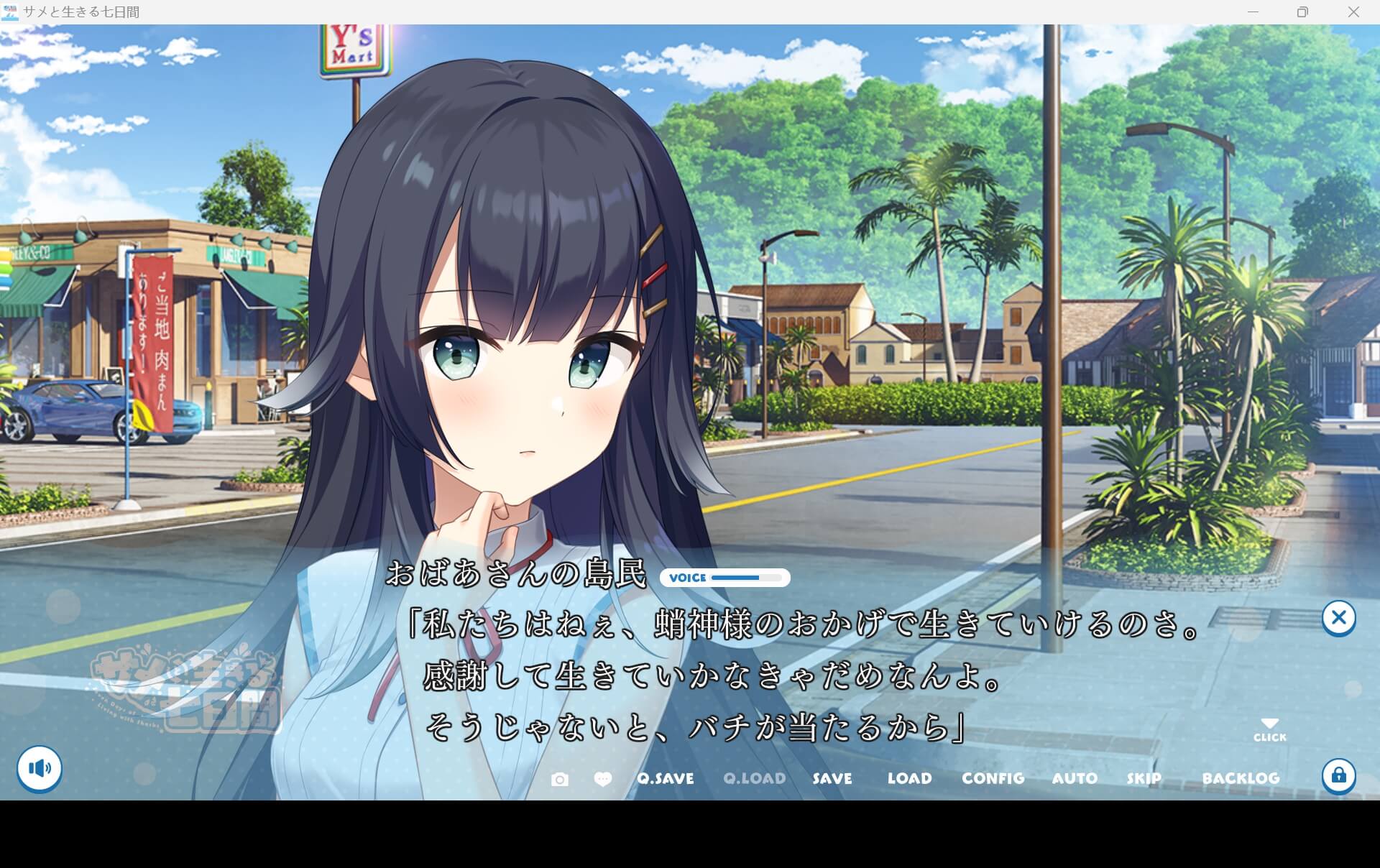
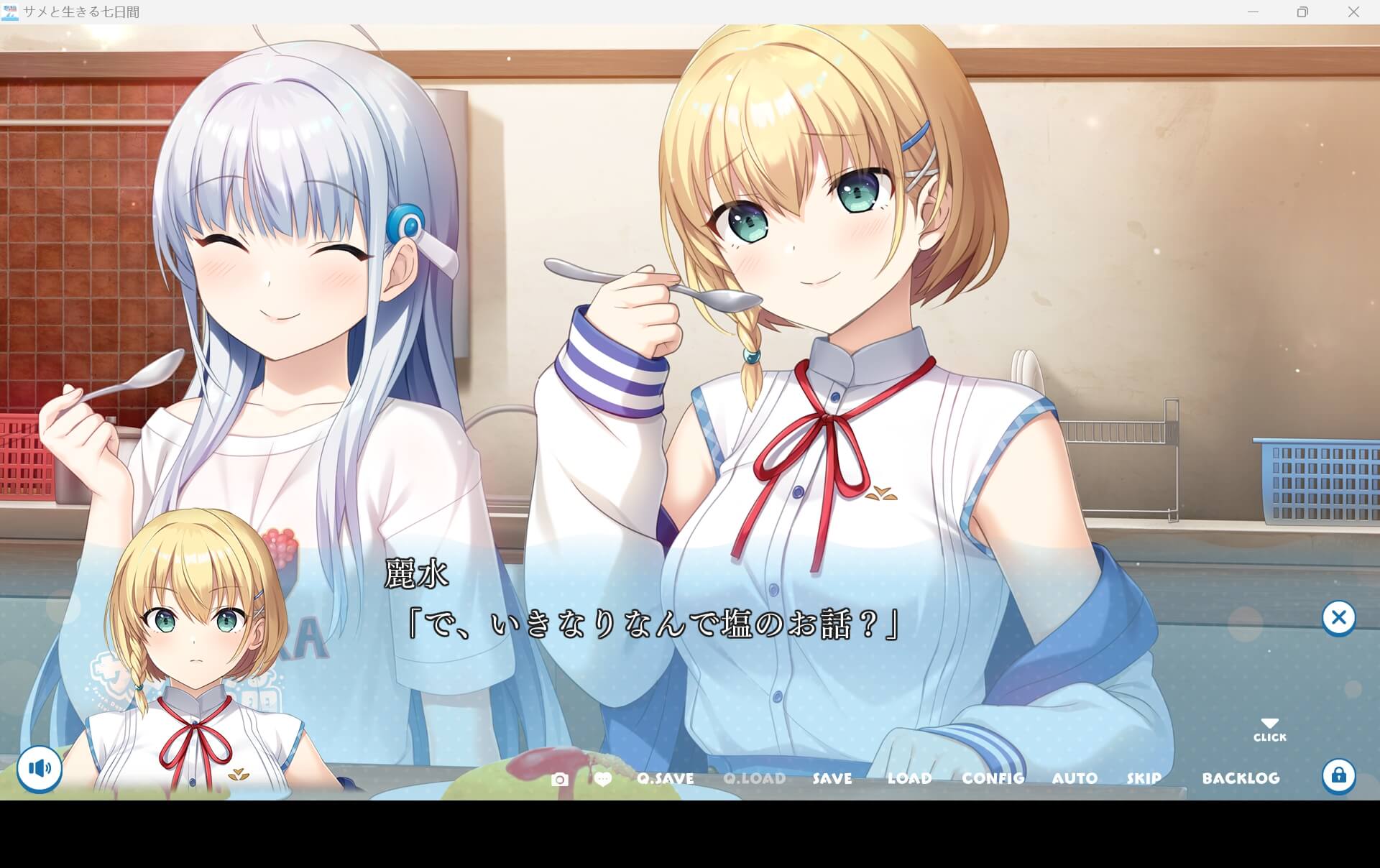
The story in Same to Ikiru Nanokakan isn’t especially novel, but it mixes a ton of elements — classic visual novel beats plus everything you’d find in a B-movie — and dumps it all in. The dev team doesn’t even hide that they made this with B-movie logic. So the whole thing feels “rough” and “stitched together,” but that also brings more breakthroughs, and it hits people like me — tired of the same boring romance formulas — with a much more direct sensory punch.
Honestly I always assumed that kind of punch would come from ClockUP. Never expected it from CUBE.
All that said, Same to Ikiru Nanokakan isn’t a “masterpiece” visual novel, but it’s definitely a “special” one. It’s not just an overlong B-movie delivered in visual novel form — it’s the rare thing that reminded me why I love this niche little corner of content in the first place.
Comments are hosted on the Chinese main site. This mirror is read-only.