DEVILS DEVEL CONCEPT Review
Singing a Hymn to Truth, Goodness, and Beauty by Way of Forced Edginess
There’s a certain writing style I’ve always hated, but I’ve never been able to put my finger on what to call it.
Put simply, it’s when someone can’t just say a thing directly — they have to wrap it up first, so you have to squint at it for a second. Like the cafeteria lady serving your rice: she doesn’t just scoop it onto your plate, she digs the ladle in, does a little fairy pose in front of you, and then flings it into your bowl.
If the lady happens to look younger than you and is wearing a sexy black-stocking getup, or if the rice is free and comes with three big pork chops, fine. Otherwise you just think the lady in front of you is sick in the head, and after a while you start to find her downright disgusting…
…even if she gives you five pork chops.
So when a story dresses up its wording or its pacing, if the payoff turns out to be worth the dressing-up, whatever. But if it’s some trivial bullshit dressed up like the apocalypse and a blood feud… that just pisses me off.
DEVILS DEVEL CONCEPT is exactly that kind of game. What drew me in was the insanely good OP and the original art by my beloved master Refeia. At first I played the raw Japanese version, but the experience was kind of weird, because I genuinely had no idea what it was trying to say.
Then one day I found out the thing had been fan-translated. So I picked the game back up, figuring that with my native language in front of me I’d definitely understand the story more deeply. I was wrong. I understood it even less.
The game is stuffed with words I don’t recognize. Not recognizing them in Japanese is one thing… but translated into Chinese, I still didn’t recognize them. That’s because the writer invented these terms from scratch — it has nothing to do with what language they’re in.

What’s fucking great is that the game has routes and a story lock: you can only unlock the True End after clearing every heroine’s route. So I had no choice but to go through them one by one. Even better, each heroine has two endings, every one of them twisted, and the plot gets even more incomprehensible. What I could grasp was that the protagonist is some incredibly badass demon who hasn’t awakened yet and doesn’t know how badass he is, and that almost everyone around him is abnormal — demon hunters, half-blood demons, plain humans, et cetera et cetera. They fight, they fuck, and before the fucking they deliver long rambling speeches about god knows what, leaving you completely lost. Most of the individual route endings go like this: the protagonist falls in love with someone, a Boss suddenly pops out, the protagonist walks up and one-shots the Boss without a word, route over. The one creative bit is the student council president Amatsu’s queen route, where the protagonist doesn’t awaken and Amatsu becomes the queen who controls him at the cost of being gang-raped herself. That at least felt fresh… other than that, nothing else.
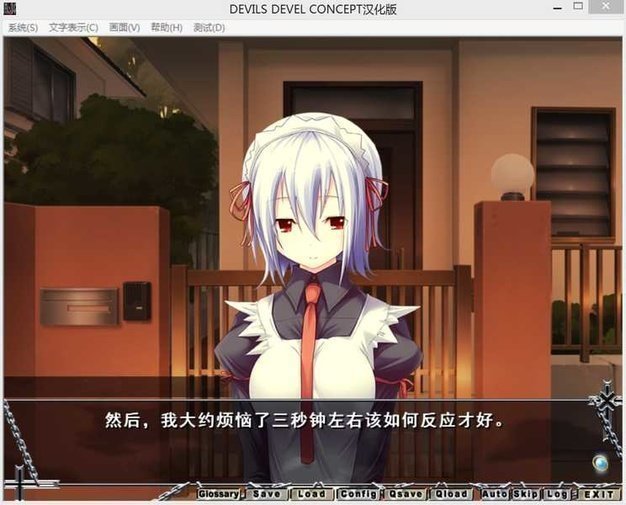
So the more I played, the less I understood what the game was trying to say, because there are way too many proper nouns. The game has a glossary that explains them, sure, but the explanations introduce even more proper nouns, so you end up more confused than before.
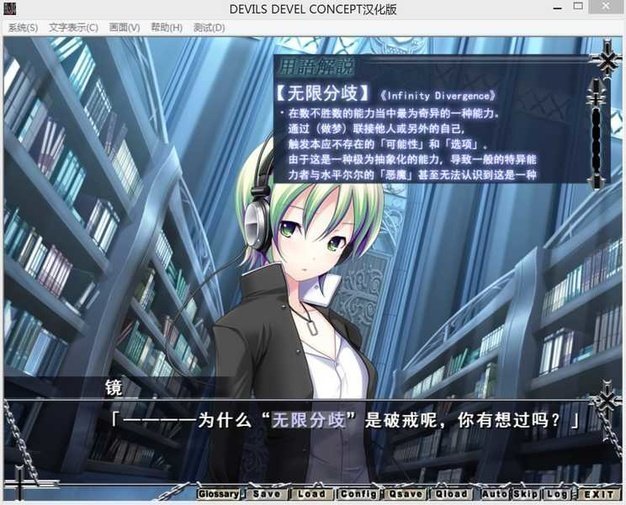
And so, not really understanding any of these terms, I reached the ending. And at the very end of the game, suddenly… the story became easy to understand.
Suddenly, all the proper nouns were gone…
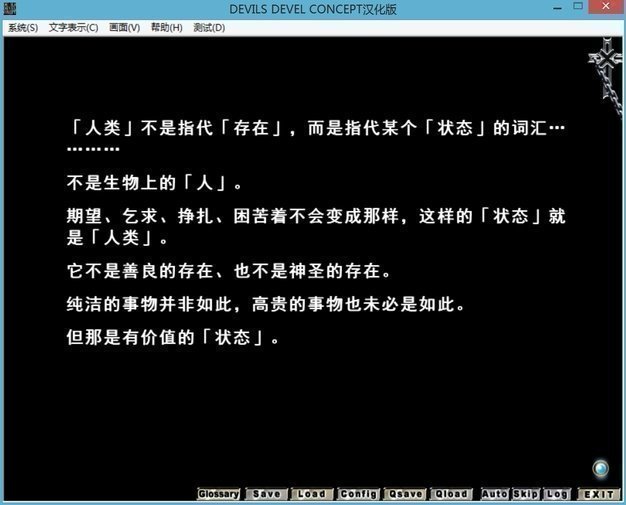
Suddenly, I realized the story this entire game wanted to tell was so simple…
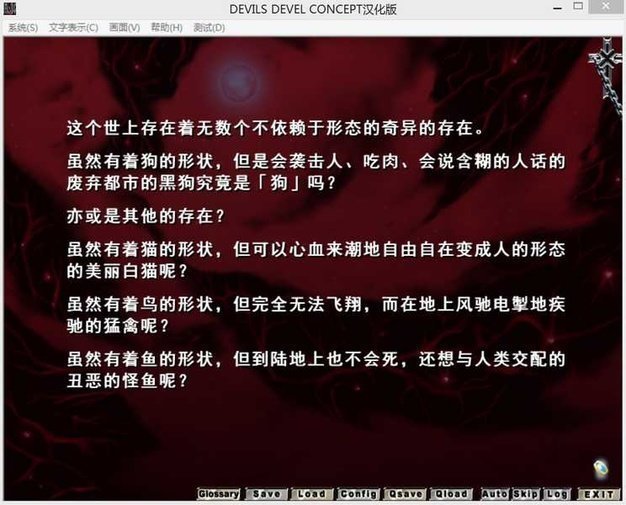
The core plot of DEVILS DEVEL CONCEPT is frighteningly plain: the protagonist is a demon with a unique bloodline, a demon with tremendous power, and he ought to be able to become the overlord of demons.
But he doesn’t want to be an overlord. He just wants to be human and live a human life. And in the demon world, wherever there are demons there are demon hunters, and half-blood demons too, and they all have their eyes on the protagonist’s unique bloodline — some want to kill him, some want to recruit him, some want to tempt him, some want to use him.
Meanwhile the protagonist wholeheartedly just wants to live his human life, and refuses to use demon power, and refuses to awaken. Someone kills him once, and after he revives he still wants to be human. Someone puts a curse on him demanding he go slaughter demons not of his own kind, but after finishing the killing he still chooses to keep being human.
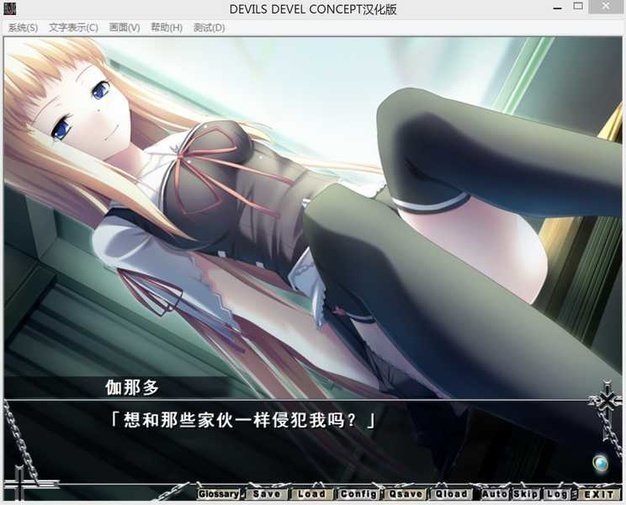
After the protagonist fucks up the final Boss, the low-presence female demon he saved asks him a question: “Why do you want to be human? Humans get sick and die, humans get hurt, get bullied, get dominated — why do you still want to be human?”
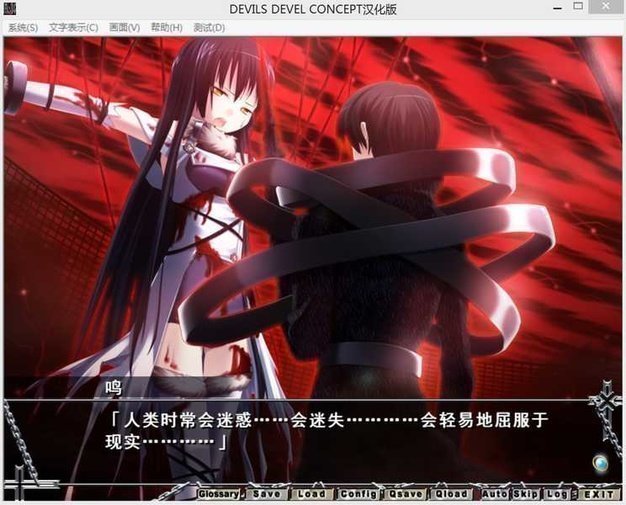
And then the game crudely hands you its central message: “Because humans have flaws, but human life has joy. Demons are powerful, but too powerful — everywhere it’s scheming and backstabbing, so there’s no fun in it. It’s actually exhausting.”
Basically the same routine as those Chinese legends where an immortal gives up immortality to be a mortal…
After seeing the whole story and then thinking back on all the plot before it, that’s when I realized what this narrative style I hated was called. That’s when I realized just how goddamn annoying this narrative style is.
DEVILS DEVEL CONCEPT taught me a new narrative technique. It’s called: Forced Edge.
Padding out the length with endless monologues and dialogue between two people whose identities are never clear. Replacing the objects and people being referred to with pronouns like “that thing,” “that guy,” “that stuff.” Replacing everything else with made-up terms — “Furnace of Wind,” “Night of Fire,” “X of X,” “Rod of Flesh,” all that nonsense — and then helpfully including a manual in the back so you can look up what each word means.
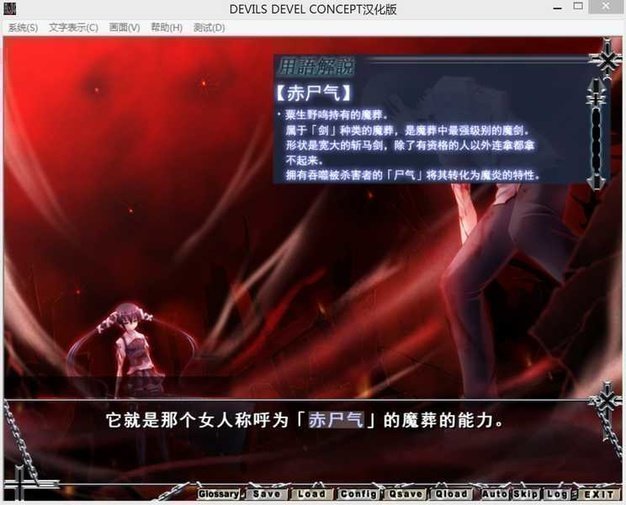
In short, the two of them talk back and forth for ages and give you that “holy shit, why can’t I understand what these two idiots are saying” feeling, but at the same time you sort of feel like those two idiots are saying something profound and badass and high-class, with edge smeared all over your screen — when in reality what they’re talking about could be explained in two sentences.
Among the games I’ve played, the books I’ve read, and the films and shows I’ve watched, I’ve seen plenty of plots with “edgy” elements, and Galgame — the home base of chuuni — has even more. But some games are edgy because the story needs it, and some games ride the momentum into edginess. Something like DEVILS DEVEL CONCEPT, where the substance is trivial bullshit with no edge to be had, yet it defines its own edge function and then calls itself recursively to flex — that can only be called Forced Edge.
The writer’s goal is simple: depict the ugliness, the kill-or-be-killed, the instability of the demon world, in order to highlight how wonderful and beautiful the truth, goodness, and happiness of being human is — something even immortal demons long for.
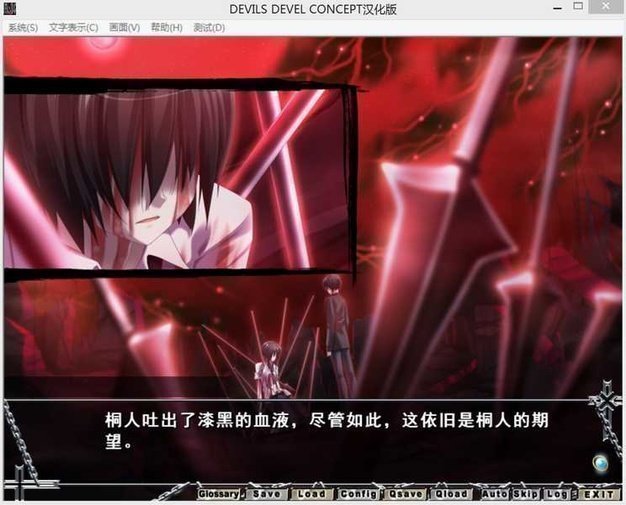
Unfortunately, he didn’t figure out how to tell this story. Or rather, from the very start the writer fell into a self-indulgent high from Forced Edging and couldn’t stop. Only the person writing the story could fully understand it, and the writer never considered whether anyone else could follow it — he was just high in his own corner. And only at the very end did he snap out of it: “Oh crap, what if nobody understands the masterpiece I wrote? Whatever, I’ll just explain it at the end.”
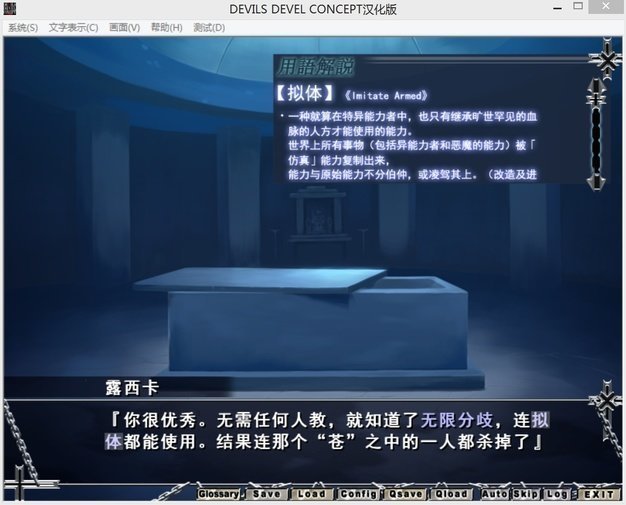
So at the end we get a “central message” so blunt it can’t get any blunter, and after combining it with the central message and looking back on the story…
…we realize the earlier stuff was all worthless bullshit, and the only real substance was that last little bit…
“Forced Edge” really is a great narrative technique. It somehow takes content this hollow and stupid and builds this kind of structure out of it. Toxic. Authentic. Masterful. I’ve learned so much.
So I’ve decided to put my new learning into practice and try out the Forced Edge method myself:
As for DEVILS DEVEL CONCEPT itself? If you’re really that bored out of your skull, go play it. Or if you want to study “Forced Edge,” then Irogami and Guilty Crown: Lost Christmas are both fine textbooks on the subject.
Comments are hosted on the Chinese main site. This mirror is read-only.