Imasugu Oniichan ni Imouto da tte Iitai (いますぐお兄ちゃんに妹だっていいたい) Review
Ima Sugu Oniichan ni Imouto da tte Iitai
It’s been years since I played Love, Election and Chocolate (恋愛と選挙とチョコレート). I actually got into it through the anime — the anime itself is okay, nothing great, nothing terrible. What’s worth mentioning is that while the anime was airing, it went all out to advertise a certain game, and that game was Ima Sugu Oniichan ni Imouto da tte Iitai (いますぐお兄ちゃんに妹だっていいたい — “I Want to Tell My Brother I’m His Little Sister Right Now”).
I’d had my eye on this one for a long time. Back when I couldn’t read Japanese at all, and then when I could read a little, all I knew was: it’s all-ages, the voice cast is stacked, the music is good, and the art is… decent. So when I got around to it before playing Ao no Kanata no Four Rhythm, I thought… “might as well clear this one first, at least it’s got Ai-chan.”
Honestly, I didn’t finish it. I cleared the main sister route and Ai’s Mao route, and the rest I just couldn’t push through…
Not for any other reason — the story is just too… flat…
The plot can be summed up in one sentence: the protagonist’s mother dies, his father remarries, and he falls in love with his stepsister, who’s been pretending to be a boy. And the whole game reeks of what I’d call “all-ages galgame inferiority complex.”
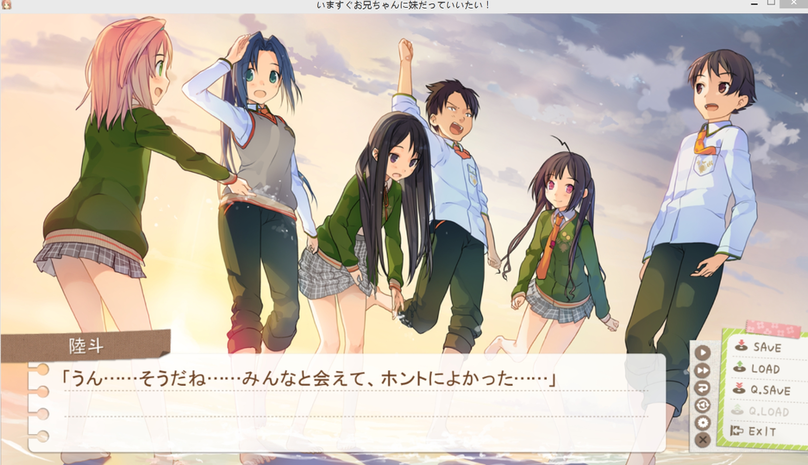
Everyone knows 18+ is where the money is in the galgame market. Plenty of companies have tried all-ages and died horribly; at best most of them release the 18+ version first and then port to consoles for an all-ages cash grab. So as a game trying to move units in the 18+ field while being all-ages, Ima Sugu Oniichan ni Imouto da tte Iitai had to show its sincerity some other way.
In a nutshell: if you can’t fuck, you’d better bring something that can compete with fucking.
So Ima Sugu Oniichan ni Imouto da tte Iitai goes all out on production. Every CV is a big name, the CGs clearly had serious money poured into them, the OP is straight-up animation, and each heroine gets her own ED sung by a famous CV or group. And as a galgame, its story picks one word: safe.
I remember back when I took the college entrance exam, my Chinese teacher was constantly worried about me, because I always liked to screw around in my essays and refused to write the three-part structure he wanted.
“There’s a trick to scoring on the exam essay. State your thesis, use this formula to present your argument, then wrap up with a conclusion. Even if it’s not great, you’re guaranteed a decent score. But you!” The teacher pointed at me. “You always go writing narratives and little stories. If you do it well you might score a few points higher than everyone else, but if the grader happens to dislike you, you’re screwed! Can you not take the risk?!”
Just like my Chinese teacher said, when it came to the choice between risk and safety in its story, Ima Sugu Oniichan ni Imouto da tte Iitai picked the latter.
So the whole game is drenched in caution. The protagonist’s first meetings with people at school, the arrival and preparation of the school’s Ouka Festival, the ball tournament depicted during the festival, the teacher’s characterization — all of it takes the orthodox, safe route. The protagonist is sunny and cheerful every day, the heroines are all smiles, daily school life is bright and shining, everyone is so kind and cute…
Sure, that kind of lovely life is nice…
But… but… if it goes on like this forever, I’m going to fall asleep…
Ima Sugu Oniichan ni Imouto da tte Iitai is excessively conservative in how it tells its story. I used to think the slice-of-life parts of Love, Election and Chocolate were already conservative, bland as water, but Ima Sugu is even more cautious. Even the usual goofy best-friend character barely tells any dirty jokes, and there’s not even much in the way of exaggerated antics — a real waste of the famously perverted Matsuoka. On top of that, Love, Election and Chocolate has clear character conflict and plot background: the daily life is conservative, but the election backroom dealings, the love triangle, and the poor student getting bullied all give it gentle ripples. Ima Sugu doesn’t even have ripples…
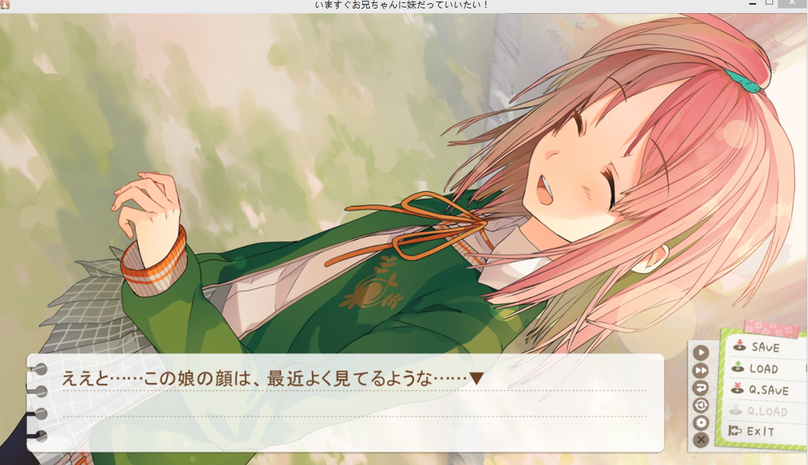
If Love, Election and Chocolate is weak tea, then Ima Sugu Oniichan ni Imouto da tte Iitai is plain bottled water.
What’s worse, the common route in Ima Sugu is long… really long. Even after you’ve picked every choice that determines the branch, you still have to go through a long, long stretch before you actually enter a route. And even after entering one, the pacing keeps the slowness of the common route. In the sister route, at first it’s just school life continuing as usual, then the protagonist finds his sister’s diary and learns that her claim to be a boy was a lie — meaning at this point he already knows her real gender. By any normal logic the plot should start moving, but no! He keeps living his daily school life with her, the two of them continue their ambiguous closeness. The game’s title says “I want to tell my brother I’m his little sister right now,” but I can’t see any “right now” in there at all. The sister’s dawdling drove me up the wall, and what’s more, the protagonist has already discovered the secret and she still avoids talking about it… After all that dawdling, the conflict suddenly explodes: the protagonist’s refusal to accept his stepmother.
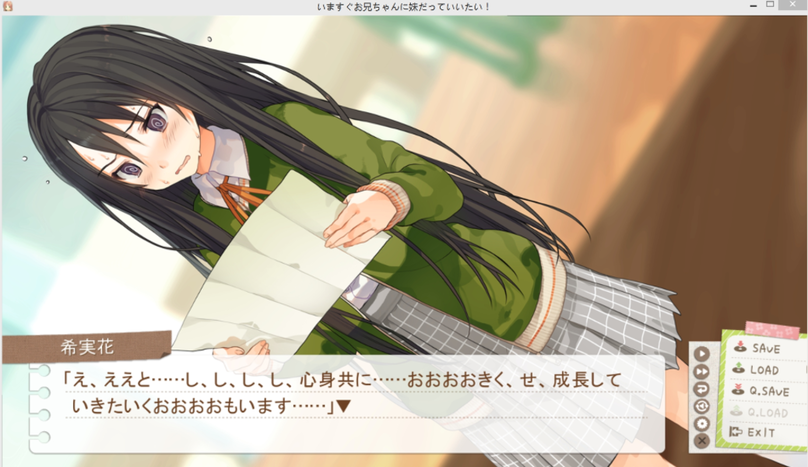
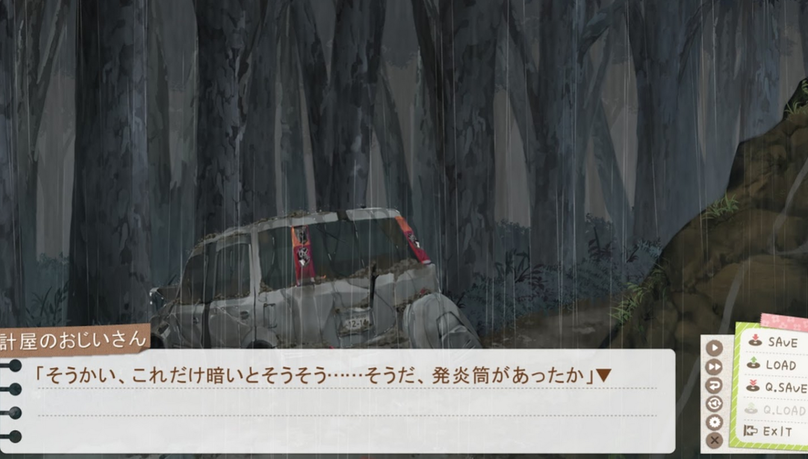
From the very start of the game, the protagonist says “even if my father remarried, I only have one mother.” He also constantly wears a women’s wristwatch — his mother’s keepsake. At the end of the sister route, this single bit of foreshadowing finally pays off. His refusal to accept his stepmother combines with a misunderstanding with his father (the father tells him he disposed of his mother’s keepsake, when in fact that’s not what happened — he just didn’t finish his sentence), and the protagonist’s anger comes pouring out. Then he actually comes around on his own, feels bad about it, and his father hands him a letter from his mother. After reading it he understands his mother’s and father’s good intentions and decides to change — but then his watch breaks, supposedly from seawater getting into it (probably from that trip to the beach with his sister). He’s sad but says nothing, and his sister, knowing the watch is like a mother to him, secretly takes it to find a watch shop to repair it. Of course something goes wrong: the watch shop owner is driving her to look for parts when the weather turns bad and they go off a cliff. They don’t die, just get stranded in a ravine (kind of like the Amane route in Grisaia). Of course it doesn’t end that tragically — the protagonist rallies his friends to search, they find her, the two become a proper couple, and he starts to accept his current mother. And there, everything reaches a Happy Ending.
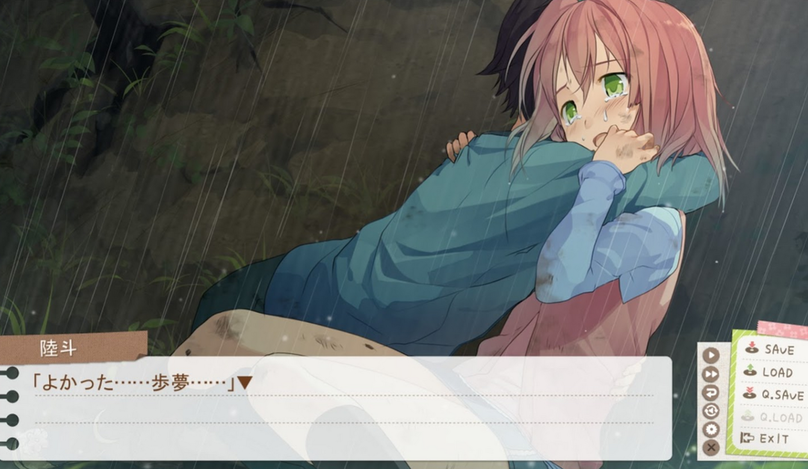
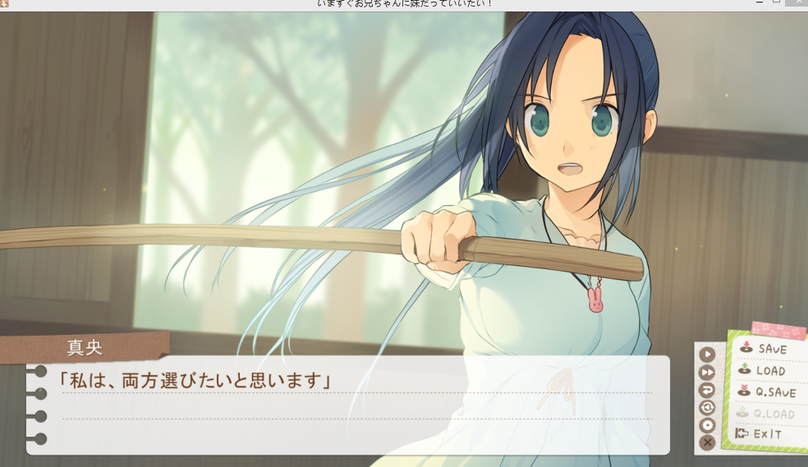
Sure, the sister route finally delivers a big development, but first, it comes too late, and second, it’s too sudden. It’s like drinking Nongfu Spring and having the water suddenly turn chili-flavored at the last sip. Unnatural. Outside the sister route, the other character routes are much shorter… In Mao’s route, Kayano Ai starts out living at school as a boy; the protagonist eventually learns she wanted to stand on her own, so she made a promise with her grandfather at the kendo dojo to become as strong as a boy, gradually closing off her feminine side. Her grandfather is a classic tsundere who doesn’t want his granddaughter to keep going like this, so he picks a fight and expels her from the kendo disciples, hoping she’ll be an ordinary girl. In the end, naturally, Mao finds a balance between kendo and being a girl and lives happily…
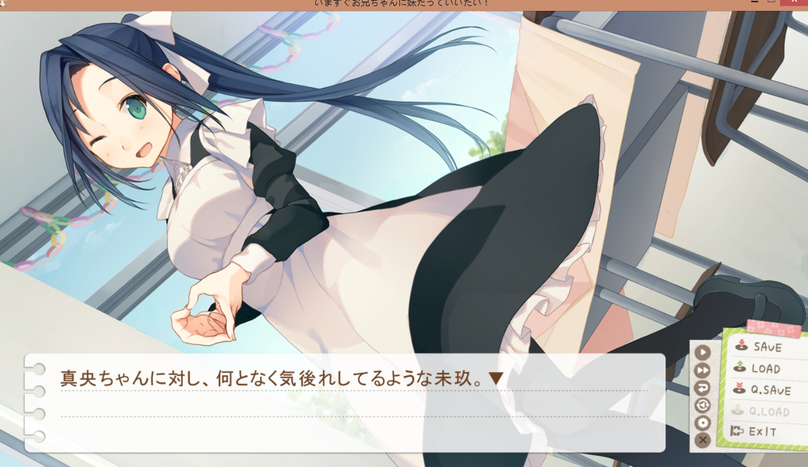
Well… there really aren’t many all-ages games. Most who dare to make them are confident in their scenario writers. Plenty of them are pretentious trainwrecks, sure, but most aren’t that bad. It’s just that this kind of bland story gives off a subtle vibe of bowing down to the otaku audience in shame. The scenario writer worked on Love, Election and Chocolate, so they should understand the basic galgame formula, and I think they could have cranked up the story’s ups and downs considerably. But after this overcorrected restraint, the whole game ends up being nothing more than a voice-actor showcase radio drama.
Which makes you sigh: an 18+ game can have slightly off character designs, unknown CVs, crude music — but as long as it has one inexplicable H scene, nobody says anything. An all-ages galgame, no matter how much sincerity you pour into every aspect, gets casually dismissed with three words: “can’t fuck.” And the whole of Ima Sugu Oniichan ni Imouto da tte Iitai seems to spend its entire runtime timidly telling you, “Look, we crammed in this many CGs, hired this luxurious cast, put in this amazing music — do you think that makes up for ‘can’t fuck’?”
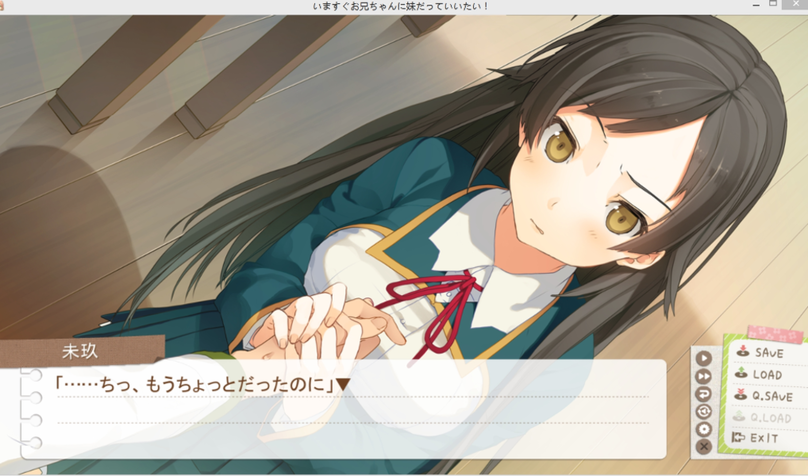
Ima Sugu Oniichan ni Imouto da tte Iitai wants its sincerity to convince you it’s worth it even if it “can’t fuck,” but being too conservative makes it feel overcorrected.
It’s like being told alcohol is bad for you and junk food makes you fat, but if you eat nothing but fruit, vegetables, and bland food every day, even genuine health will start to feel tedious.
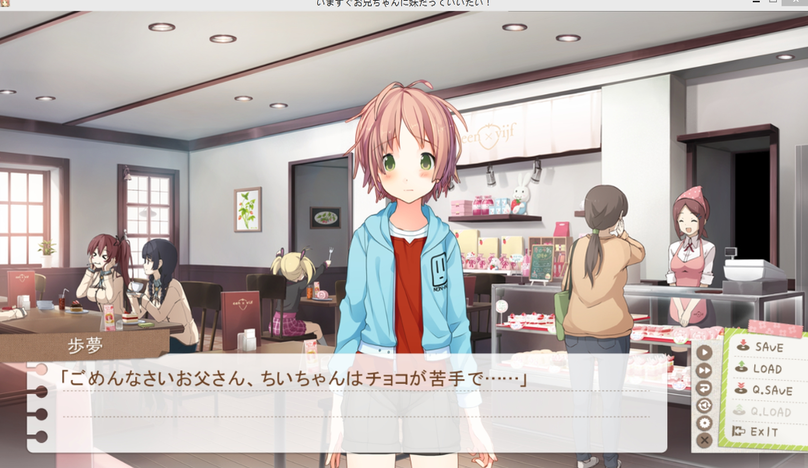
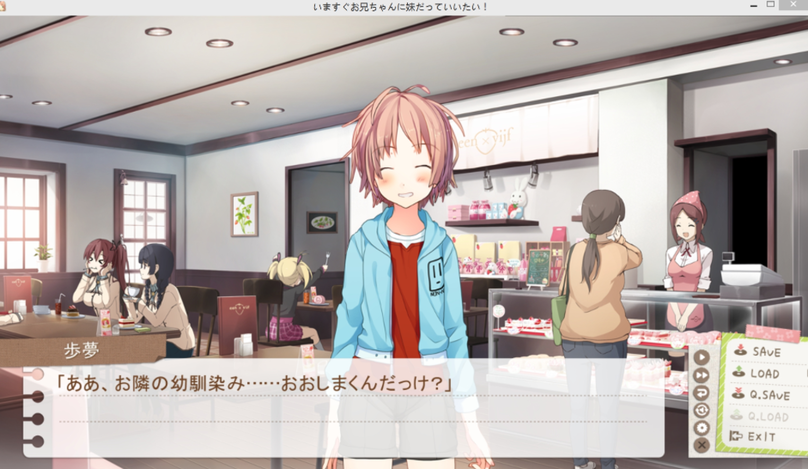
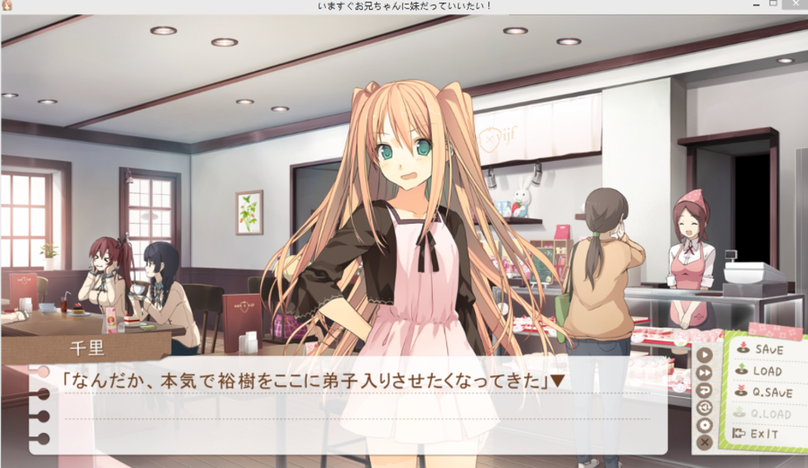
Fortunately, for those who like Love, Election and Chocolate, Ima Sugu Oniichan ni Imouto da tte Iitai still has real value: characters from the previous game show up. Whether it’s Sumiyoshi Chisato or Shinonome Satsuki, the timing of their appearances gives you a warm, familiar feeling, because Ima Sugu takes place two years before Love, Election and Chocolate. And some of Chisato’s and Satsuki’s dialogue in the game shows that the protagonist influenced their life paths to some degree.
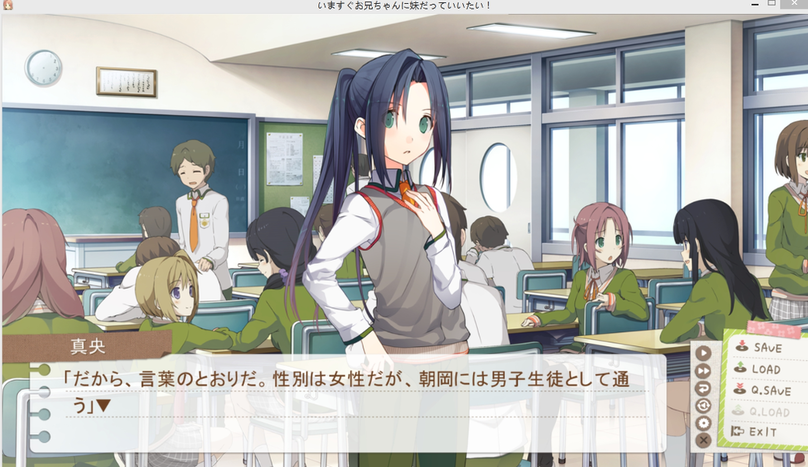
For example, Chisato can’t eat chocolate.
The late Oshima-kun’s name gets mispronounced again.
Boys who make sweets are the coolest.
The big sister who’s always sick and keeps coming back to school — should you get on good terms with her? (Would it kill you to let Mizuhashi-san say a couple of lines?!)
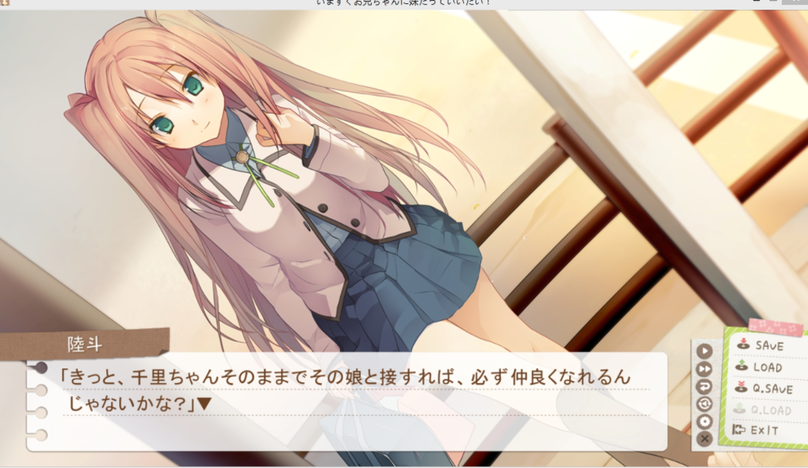
The sushi shop and the sweets shop all know each other.
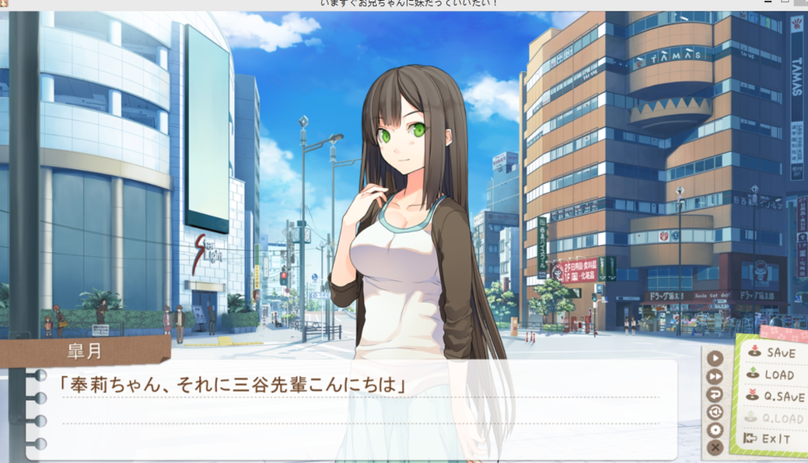
At least during these scenes I genuinely smiled. These are probably the few moments in the game that surprised me.
How should I put it? If you’re a slow-paced person who likes calm, even watery romance, this might be fine. Or maybe you just want a few more looks at Sumiyoshi Chisato… then give it a try.
Honestly I just wanted to say that the character designs in Ima Sugu seem like a step back from Chocolate. Chisato’s sprite blows the other heroines out of the water from every angle, and the extra blush on their faces really doesn’t do them any favors.
Comments are hosted on the Chinese main site. This mirror is read-only.