Amairo Chocolate 3 (あまいろショコラータ3) Review
Amairo Chocolata 3: What You Think Isn't True
A while back, while I was working on a commercial piece, the editor hit me with a request: could I write something about Amairo Chocolata 3 (あまいろショコラータ 3)?
As a former internet editor who got canned over a decade ago, writing this kind of article is no problem. The problem is: why? Why write about this game?
Amairo Chocolata 3 is the kind of game where you can see the ending from the first glance, and its marketing was pretty mediocre too. I honestly don’t even get why Cabbage Soft (きゃべつそふと) would push this thing out to a third installment.
And the other “why”: does anyone actually want to buy this game?
So, to write a better commercial piece, I looked up the relevant data—and got a very unexpected result.

Cabbage Soft, commonly known as “Cabbage,” has put out a bunch of titles—mostly traditional “story-driven” ones. There’s the early Hoshikoi (星恋*ティンクル), the later well-received Amazing Grace and Sakura no Uta*Scarlet no Koi (さくらの雲*スカアレットの恋), plus the practically “AAA”-scale Jewel Hearts Academia (ジュエリー・ハーツ・アカデミア). But alongside all that, this little trifle called Amairo Chocolata keeps chugging along in steady iterations, with thoroughly average reception across the board and barely any discussion at all. Anyone with eyes can tell Amairo Chocolata is a total bandwagon imitation of the hottest thing on Steam, “Nekopara” (NEKO PARA). The story starts out completely “abstract” from the get-go—it dead-seriously dumps a mountain of setting that nobody cares about, each entry introduces one or two new romanceable characters, pairs them with some fairly “heavy” lewd art, and the price isn’t that high…
Let me just be honest: from the second entry of Amairo Chocolata onward, I couldn’t keep playing. I had zero desire to even look at Amairo Chocolata 3 this time—if the editor hadn’t come to me, I wouldn’t have bothered downloading it.
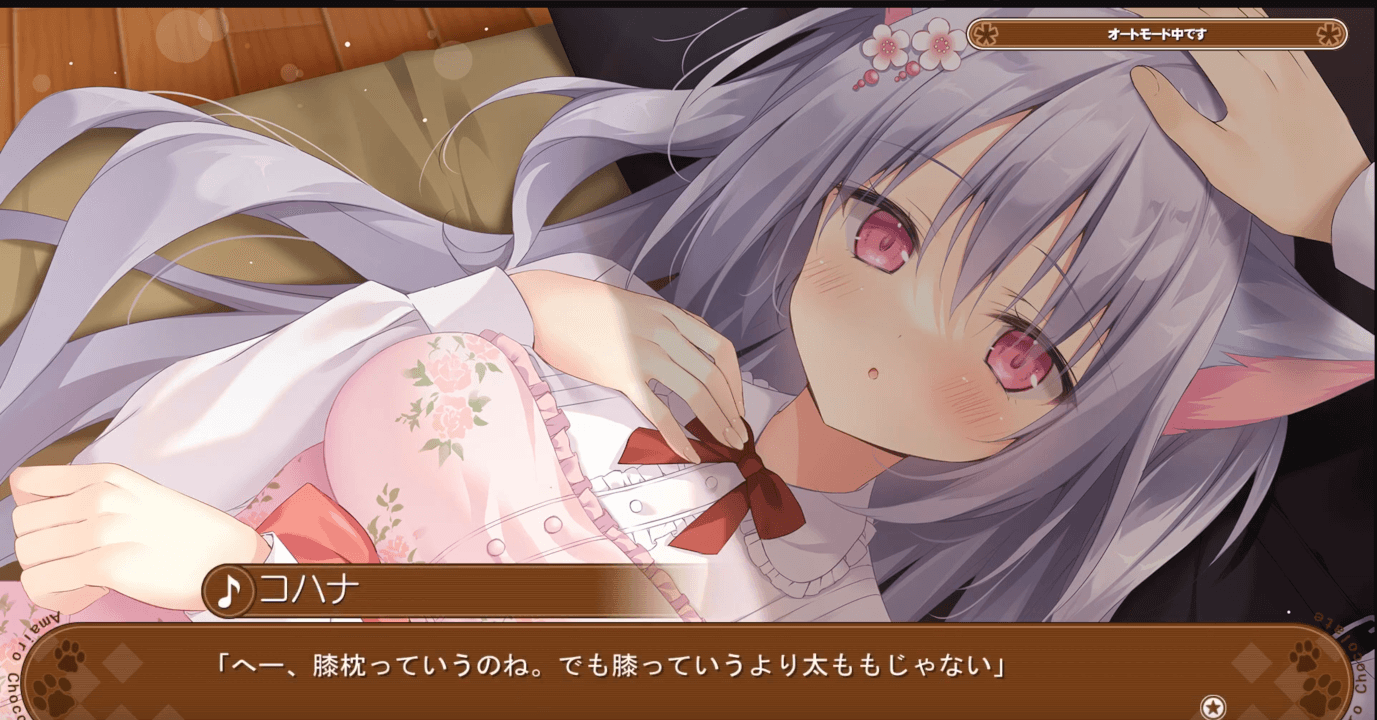
Oh right, I guess I haven’t actually given a plot summary of Amairo Chocolata 3 yet. There’s not much to say anyway: it adds one new sealed-away divine heroine, promotes one of the existing heroines to a romanceable route, and drags the old cast back out for a “harem ending” or whatever…
Just as I was agonizing over how to write this commercial piece, I remembered seeing news a while back that Yuzusoft’s Senren * Banka had broken platinum sales… and I had a thought:
Is there any chance this game’s Steam sales aren’t actually that bad?
No point dawdling—I went and checked. Considering Steam’s API is limited these days and SteamSpy’s numbers can’t represent true sales, there’s still at least some reference value.
There are currently three Cabbage Soft games on Steam, with estimated sales like this:
Amairo Chocolata: around 30,000 (it was 28,000 three months ago when I was writing the commercial piece) Amairo Chocolata 2: around 9,000 Amazing Grace: around 4,600
Pretty shocking, right? And what’s more, Amazing Grace is a full-price game. Sure, it released later, but shouldn’t a “masterpiece” like that sell like hotcakes immediately? Especially since its price isn’t that much higher than the other two “cash-grab” titles—just a few bucks’ difference.
So setting aside the Steam data, let’s look at the domestic Japanese side. Domestic sales are hard to track too, so let’s grab a monthly sales ranking from Getchu—after all, visual novels are first-wave products:
Amairo Chocolata: 2nd place that month Amairo Chocolata 2: 4th place that month Amazing Grace: 6th place that month
You can see that even in the domestic Japanese market, where “story-driven games tend to sell well,” these two cash-grab titles still have strong sales momentum. Sales have nothing to do with whether a game gets any discussion.
Domestically it’s not slacking—actually slightly ahead—and globally it’s a monster seller. I instantly understood why Cabbage Soft keeps making this series. Low cost, high profit—why wouldn’t you? Sure, Steam sales haven’t broken 50,000, but tens of thousands is already a “big hit” for a visual novel. Setting aside the overseas publishing cuts, purely on the data, Amairo Chocolata is clearly more popular.
And the more ironic part: plenty of games players praise aren’t actually as commercially successful as you’d think. Those “cash-grab” trifles don’t sell badly at all—they even rival the former—while the latter clearly cost less to develop and turn more profit.
This reminds me of some small game studios that build up funds by making gacha games, then use that money to make the games they actually want to make. Maybe Cabbage Soft is taking the same route: the intent is to make “grand story” masterpieces, and the development funding comes from an extremely commercial thing like Amairo Chocolata.
Yes, Amairo Chocolata is a purely commercial product—you could say it was greenlit to make money. The devs have been adjusting their production strategy the whole time. For instance, once they noticed Shiratama’s art style sells well, they decisively increased the share of characters she’s responsible for. When they saw that Yuzusoft-style YouTube countdown marketing worked well, they copied it without hesitation. Everything is about making money—making money is what’s real.
And the commercial effect of Amairo Chocolata has gradually influenced Cabbage Soft’s main titles too. For example, Shiratama is clearly more popular than Kuwabara, so the new game just made her the sole lead artist—all to boost sales a little.
So sometimes “what you think isn’t true.” Our taken-for-granted assumptions aren’t the real “facts.” Many people criticize those “trifling cash-grab games,” mocking their lack of discussion, rough production, and stupid writing—but in reality they’re making plenty of money.
So who’s the one always mocking them like that? Oh, that’s me. Never mind then.
Comments are hosted on the Chinese main site. This mirror is read-only.