E Piao: Mingmo Qianli Xing (饿殍:明末千里行) Review
Efu: Mingmo Qianlixing
I bought this game ages ago but never had time to actually play it. Finally got around to finishing it recently. Same familiar flavor as when I played Zanghua: Anhei Taohuayuan (葬花·暗黑桃花源), but improved in a lot of places. Overall it left me genuinely pleased, and even surprised me a few times.
Let me state my stance up front: Efu: Mingmo Qianlixing (饿殍:明末千里行) is a very good game. Building on its predecessor Zanghua: Anhei Taohuayuan, it fixes a lot of the weak points, and honestly it’s the most “correct” game I’ve seen this year in terms of production choices. The studio has found the right approach, and sticking with it will definitely lead to bigger success.
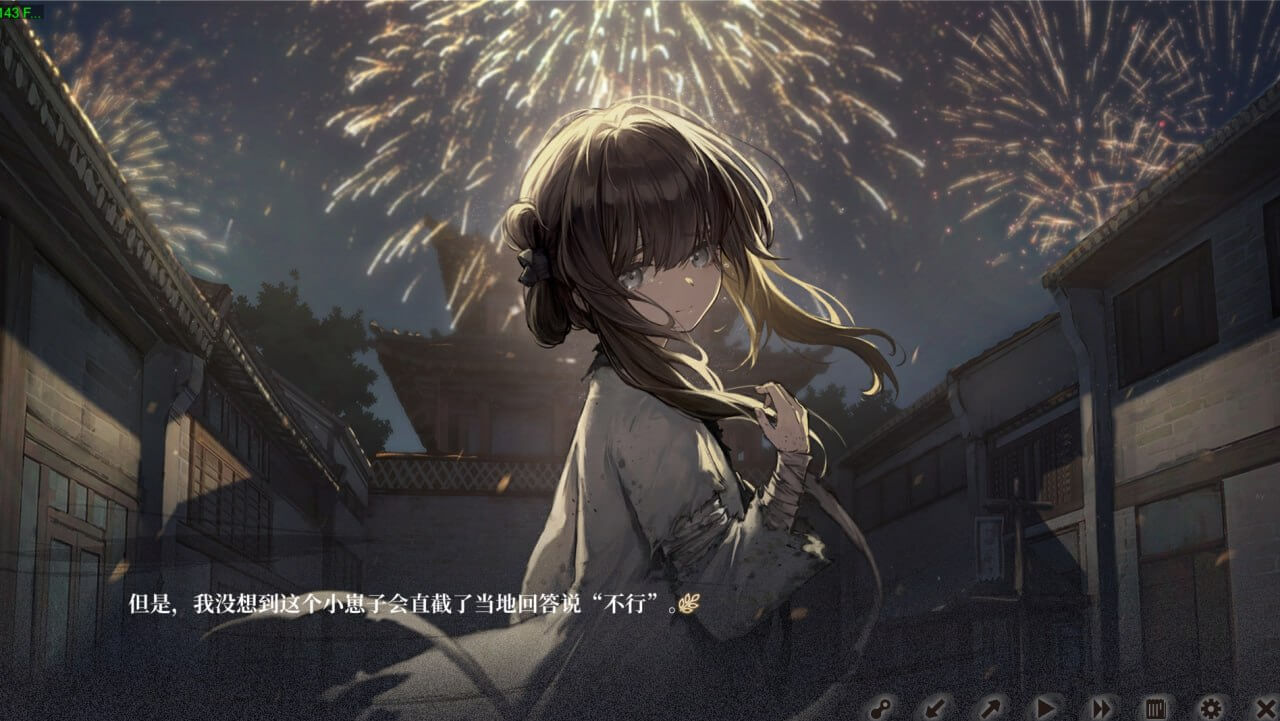
Before I get into what makes this game “correct,” let’s think about the problems with the so-called “galgame” market right now. People say galgames are a sunset industry, that the Japanese side is half-dead, sales are dismal under pressure from mobile games and light novels. Plenty of people in China want to make their ideal galgame too, and we’ve seen more and more “Chinese galgames” in recent years, but they rarely make waves. Even now a lot of people sneer at this “click a mouse and read” genre, wondering where the fun is supposed to be.
I’ve played a fair number of galgames, mostly Japanese. At my most obsessive I was doing 50+ a year, grabbing every new release the month it dropped. That enthusiasm lasted several years, and now it’s fading. Not because I don’t have time, and not because I’ve lost interest in the genre. The bigger issue is that most of these games are “all the same” and “make no progress.”
Let me lay out the biggest problems with this type of game:
The narrative is bloated as hell. A full-price galgame often runs 20–40 hours, when the main story could be told in one. The rest is all “slice of life.” Fine if it’s interesting, but most of it isn’t—it’s the same worn-out gags that have been recycled for decades. And many so-called “masterpieces” have slice-of-life content that isn’t just unfunny, it’s sleep-inducing. New players drawn in by the “masterpiece” label get turned off by the boring filler, and some “veteran” always tells them with a smug look: “That’s just how the script is,” “Hang in there, it gets good at the XXX route.” That’s PUA, as far as I’m concerned. If it gets good at route XXX, why did you make me read all that garbage before it? This “watered-down slice-of-life” structure is painful for the writer and miserable for the player. Why not trim and optimize it?
Barely any gameplay. I’ll say this: early galgames actually had more complex systems than today’s. Most of them made a token effort at “playability”—like Alcot, which is about to go under, had an achievement collection system in their debut Clover Hearts. Modern galgames have gotten more bare-bones: some have exactly one choice from start to finish, some are a straight line with no choices at all. You click the mouse from beginning to end, they don’t even give you a backlog. That’s not just barely a “game”—it’s not even a decent “visual audio book.” I firmly believe that even though galgames are primarily about reading a story, they still need some “interactivity”: let players “explore story chapters,” “solve puzzles,” “interact with characters.” That’s what gets more people to keep playing and find the fun.
Cookie-cutter story frameworks. Anyone who’s played a lot of galgames knows this. Most are stuck on “student council” and “school,” the eternal “school festival,” and classroom scenes that get written even when not a single class has been depicted. Even the Japanese themselves find it absurdly fake. What’s more abstract is that Chinese galgames feel the need to copy it too. It’s like modern rap songs mindlessly imitating gangsta rap when nobody’s even held a toy gun. There are galgames that break out of the school framework, but they still can’t escape the same old edgy trappings. Galgame and eroge may overlap, but they’re not the same thing. Right now the word “galgame” is basically glued to “porn” in the public mind. Tell someone you play galgames and nine times out of ten they’ll go “Ohhh, galgame, like Nekopara, right?”
Now let’s look at what Efu: Mingmo Qianlixing does differently.
First, the game is lean. A lot of people call that a flaw—too short—but to me it’s the biggest strength. A new player gets into the main plot within half an hour, understanding “who I am,” “where I am,” “what I’m doing.” No baffling multi-hour common route, no ten hours of incomprehensible text before a “real” OP kicks in. That helps players get invested fast and get story feedback quickly.
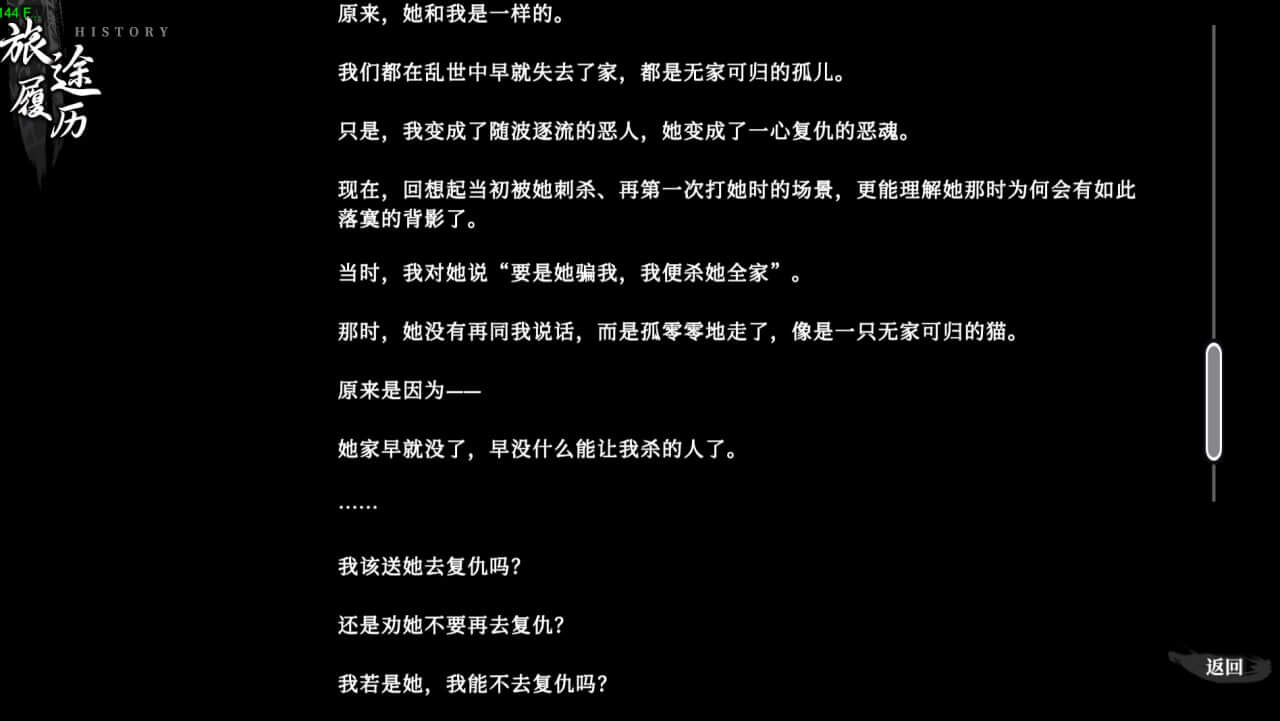
Second, the game has some “playability” thanks to its many bad ends. Choices during the story force the player to make decisions, and failing them leads directly to a tragic end. These bad ends are mostly disconnected from the main plot, but they add tension and, more importantly, entertainment. Pick right and the story continues; pick wrong and a clean flowchart lets you jump right back. The multiple endings plus flowchart make repeat playthroughs quick to unlock, and locked scenes hint at conditions, giving players a sense of exploration through trial and error.
Sure, this “gameplay” is a drop in the bucket compared to regular games, but it’s there, and for a text adventure it’s more than enough—a nice bonus on top.
Finally, the story’s setting: late Ming dynasty, a very grounded Chinese native theme with zero Japanese elements, no “anime-flavored” terminology or text. The story isn’t especially deep or twisty, but it’s direct and clear, using things like cannibalism to drive home the cruelty of history. There are familiar elements—Chuang Wang and the like—and some satire that might reflect on the present. I think that’s enough.
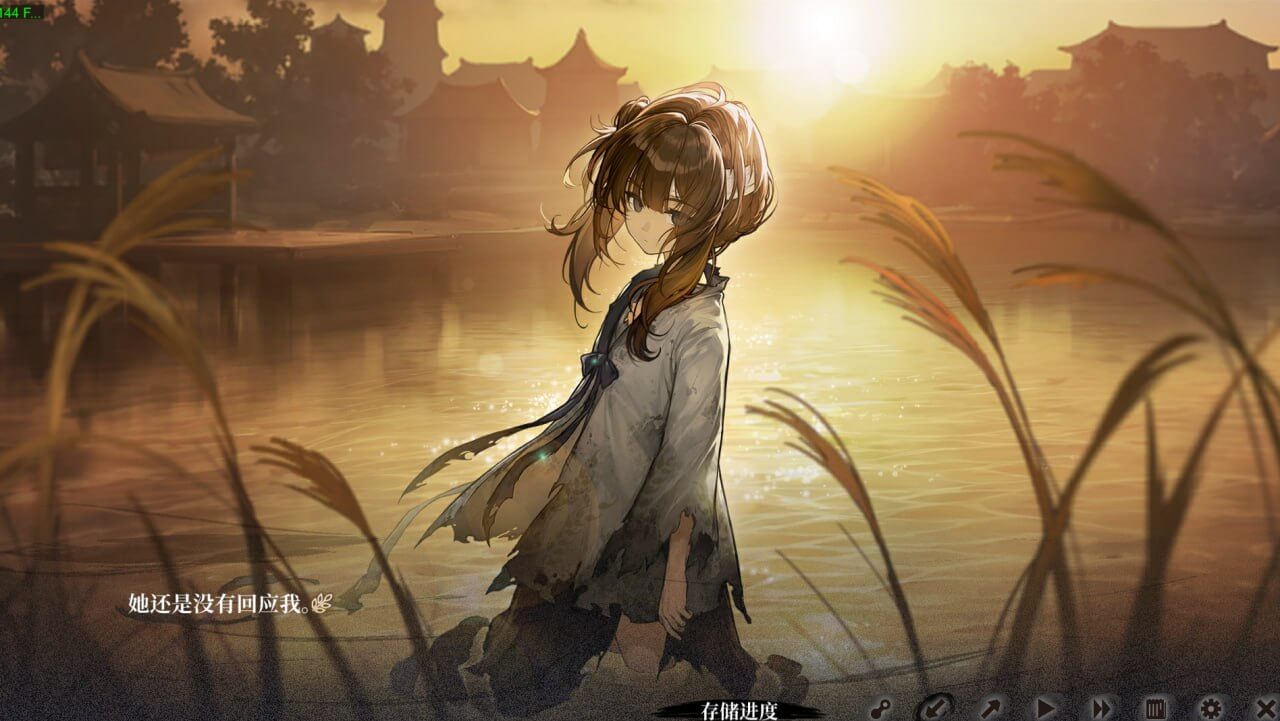
Overall, Efu: Mingmo Qianlixing improves on Zanghua: Anhei Taohuayuan in many ways: a more direct story with historical and humanistic elements, a more polished flowchart, clearer plotting, better visuals, while keeping those landmine choices to boost interactivity. All of this makes the game very “easy to pick up.” It lowers the barrier to “galgame” enormously—even players who’ve never touched a traditional Japanese galgame can jump in and enjoy it.
And that’s how I witnessed a pretty amusing situation: the game getting compared to “Genshin” on a lot of galgame forums.
I can understand where those people are coming from. They rely on the niche status of “galgame,” the language barrier, and the high barrier to entry to feel superior. They lament that the industry is doomed while not caring whether galgames should attract more players—they just want to maintain their “everyone’s drunk but me” superiority built on information asymmetry.
So when a low-barrier game like Efu: Mingmo Qianlixing shows up, bringing in new players and discussion, these smug “old-timers” can’t sit still and start mocking it to preserve their aloof taste. What they like is the stuff with crude systems, chuuni “philosophical” word salad, and preferably the “hidden gems” that will never get translated—otherwise how would they prove their worldly detachment? They don’t realize the so-called galgame golden age is long gone; honestly, some new releases these days might be worse than Genshin post-3.0.
Actually, I have more respect for the producer behind Efu: Mingmo Qianlixing and Zanghua: Anhei Taohuayuan. I remember years ago he pulled a stunt on a certain anime dating account on Weibo, and he’s complained on Zhihu about how abstract anime conventions have gotten. He’s a hardcore otaku himself—the insistence on hiring hanser for voice acting is basically his personal fangirling. He surely understands exactly what those “old otaku” idealize in a galgame. But even so, he kept tremendous restraint and a clear head while making the game. He knew exactly what kind of game would qualify as a “real Chinese text adventure.” He didn’t make a “Japanese game in Chinese skin,” didn’t mindlessly copy the Japanese galgame framework. Instead he rooted it locally, adjusted the product for the audience, and made a lower-barrier “text adventure” that suits most players—and got the genre mainstream attention. That’s rare.
I’m very much looking forward to his next game, and I hope he finds even bigger success.
Pros:
- Easy to understand, readable story
- Purely Chinese native story and setting
- Some gameplay and exploration
- Cheap
- Good length
Cons:
Story lacks depth
hanser’s voice acting is limited (even if the producer is a fan)
True End transition feels a bit forced
Comments are hosted on the Chinese main site. This mirror is read-only.