How to Run Neverness to Everness on Linux, and What I Think of It
Neverness to Everness, the game hyped as “anime GTA,” is out, and since I was bored I jumped in on day one. It’s mainly a Windows title, but it also runs fine on the ROG ALLY X—at least at medium settings you can hold around 50 fps.
So what about Linux? After some tinkering I found it does run, and pretty well at that.
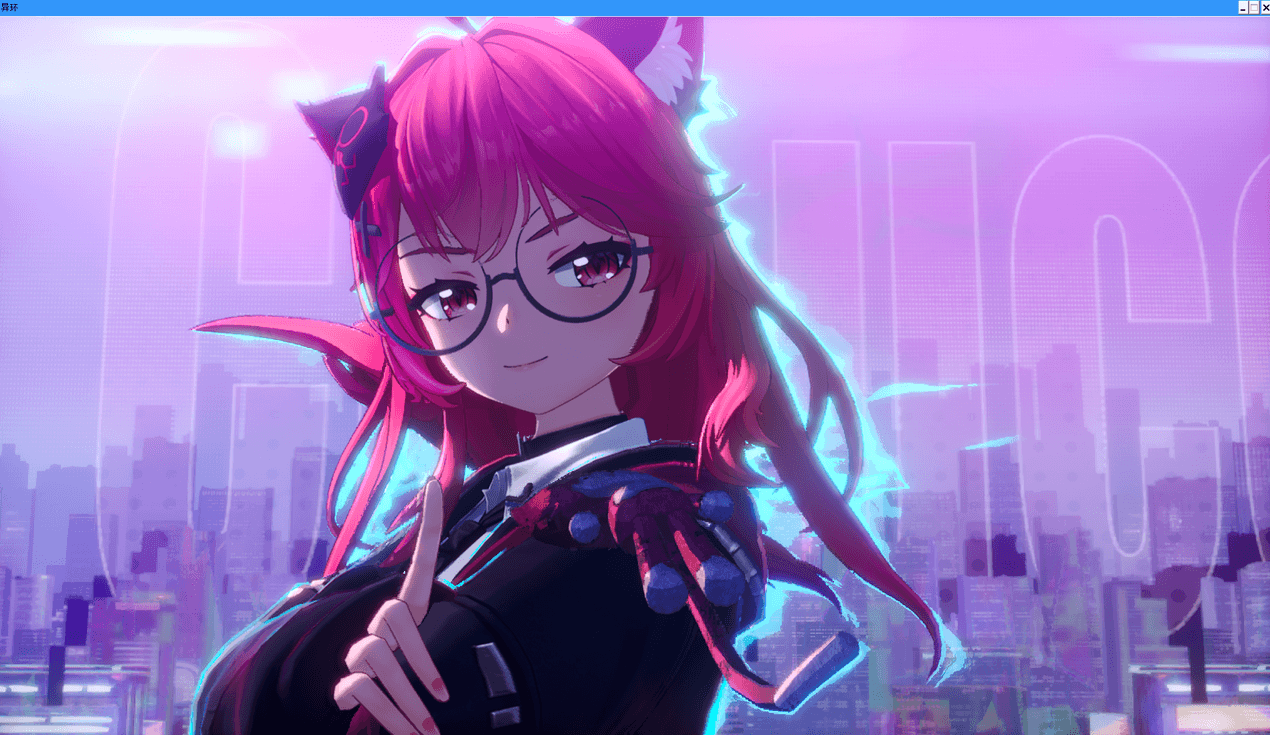
Obviously you’re going to use a compatibility layer for gaming. Given that games like Neverness to Everness come with all sorts of DRM and anti-cheat, there’s a special Proton build called dwproton made specifically for this use case.
https://dawn.wine/dawn-winery/dwproton
You can grab the binary package from the Releases page. Personally I’d recommend running the container through the Bottles frontend—the flatpak version is less hassle. Just drop the downloaded files into the corresponding path:
/.var/app/com.usebottles.bottles/data/bottles/runners
You can also install this runner into Steam. I tested it under SteamOS and dwproton works there too. Just run the exe installer downloaded from the official site and follow the guide to complete the installation. On SteamOS you’ll need to edit the shortcut path after installation.
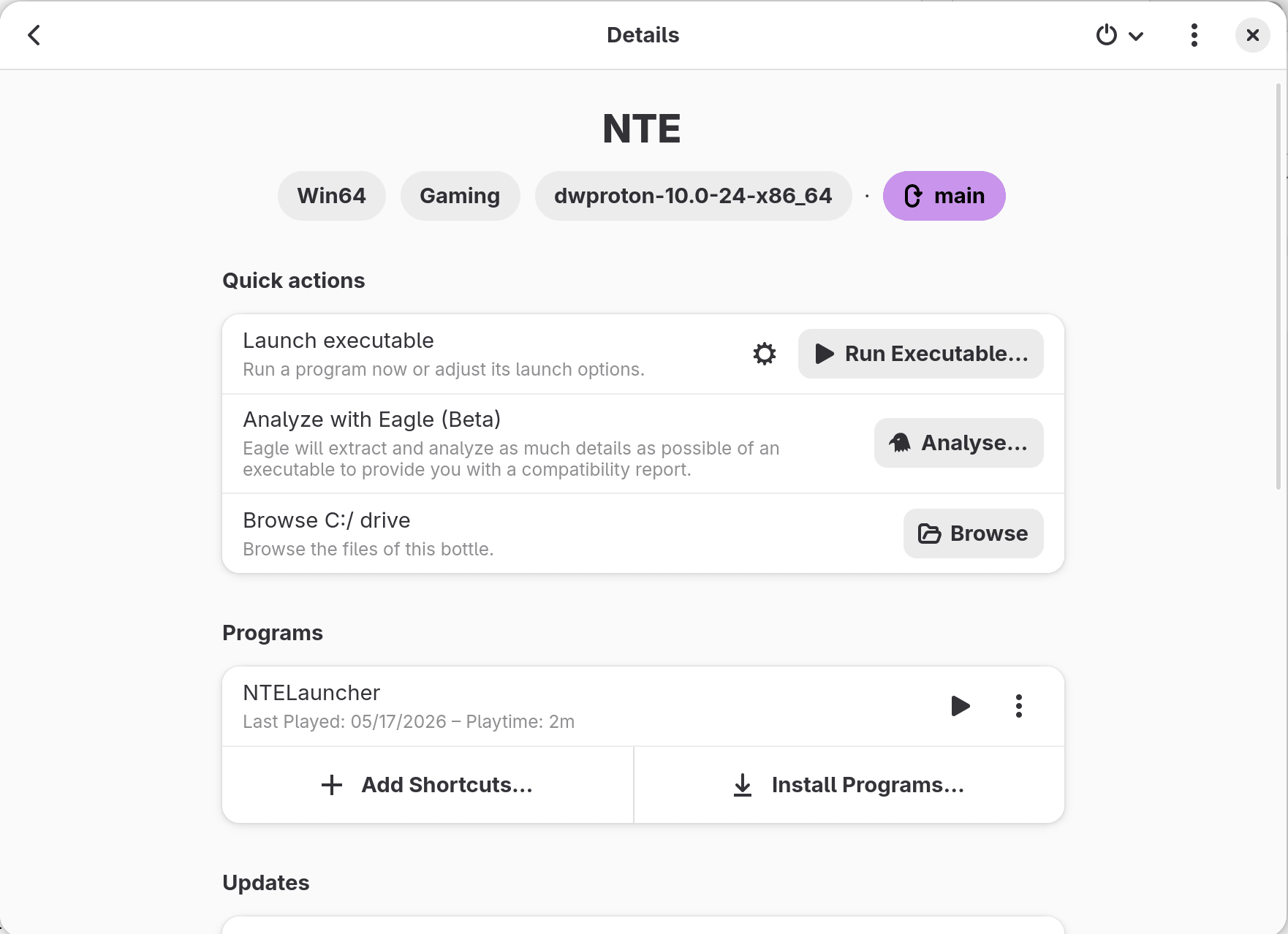
Now here’s a huge trap: the PC installer for Neverness to Everness defaults to the second drive on your computer—usually D: rather than C:. On SteamOS that’s a pain, because on your Steam Deck or similar handheld, D: is almost certainly your TF card. It’s very easy to accidentally install the game onto a painfully slow TF card and tank your experience. Watch out for this.
Once installed you can launch the game. Controller and basic configuration are supported, though FSR and similar features are more limited through the compatibility layer. At least it’s playable. I ran it on an Ayn Loki MAX 6800U, a Steam Deck, and a ThinkPad with Arc 140T integrated graphics—all ran smoothly, 1080p at medium-low settings holding 50+ fps is no problem. On handhelds I’d suggest 720p with higher effects settings.
Finally, my thoughts on the game:
I tried Genshin Impact before. Honestly it’s a decent game. What I rated highest was Dragonspine—one of the few exploration maps that actually felt like a single-player game. My biggest complaints were the so-called “empty open world” and the boring resource acquisition. But what I really couldn’t understand was the “50/50 loss.” I don’t get why, when a pity system exists, you still need to lose the 50/50—and nobody calls it unreasonable, nobody questions it. I see people pulling, seeing the gold light, praying like crazed gamblers that they don’t lose the 50/50, yet no one asks why the 50/50 exists. I can accept a higher pity count. I can accept a high flat price. But why put a 50/50 in the middle?
I can only interpret it as a game around “gambler’s mentality.” You pull for a character you like, lose the 50/50 the first time. You console yourself that the next one is guaranteed, so you start spending to pull again, and keep paying.
This 50/50 system has even influenced many subsequent gacha games, becoming a weird “industry standard” everyone takes for granted. That’s not normal.

So I think whether or not you like Neverness to Everness, you should support it for being the first to reject the “50/50” model, rather than mocking it or complaining that it hurts your favorite game’s revenue. Your support for it can benefit the games you’re playing too. And I’ve never understood revenue-obsessed fans—they’re like sales-chart fanatics in extreme fandoms. Someone exploits you to make money and you’re happy about it?
Then there’s the escalating competition in the gacha space: many gacha games are becoming more “single-player-like.” It’s no longer the old “raise characters + grind Abyss for stars” formula. From Wuthering Waves and Endfield to Neverness to Everness, the content is moving toward more interesting gameplay—deep high-speed combat, pulling wires and building infrastructure, open-world metropolises. Players can do more and more in the game instead of just grinding. And Neverness to Everness puts real thought into the details: the integration of gameplay ideas and clever touches in dialogue make just wandering around fun.
As for the story, I can only say that as the years go by, “old-school otaku” really seem to have lost their rights. Neverness to Everness goes for a classic old Japanese otaku style: weird wavelength dialogue, repeater characters with verbal tics, manga-style camera work—you can tell they’re aiming for something like a four-panel manga with a do-anything-shop request structure. But I also see the new generation of gacha players completely not getting this content. They still think “gacha game” just means a traditional game with cel-shaded graphics, and story-wise they prefer grand narratives about suffering and “something big is coming.” They find daily-life stories stupid, annoying, noisy…
If you think that kind of story is stupid, most daily-life school nukige plots aren’t much better—often worse. I can only say it’s a generational gap, but you can also see that the Neverness to Everness team is pure old-school otaku.
What interests me more is the development pipeline. Geekerwan mentioned in a sponsored video that for the big map creation, Neverness to Everness built an engine similar to Cities: Skylines, where you can drag and drop to rapidly create an urban streetscape with AI, then refine the details manually. AI assistance shows up in many subsystems too: art, billboards, movies, and random rules for some minigames. And they’ve faced backlash for using AI.
I used to hate AI output too, but now I’m more open-minded. Like guns, AI isn’t wrong—the people using it are. Using AI correctly to massively boost efficiency, letting the game you play get faster updates and new content, is clearly more meaningful than endless “polishing” and delays.
This reminds me of the Black Myth: Wukong producer’s attitude: done is better than perfect. Sometimes, with AI’s help, we can quickly realize our ideas and let others play our creations. Sure, there will be bugs—fix them slowly. The fun stuff can even become new modes. This kind of communication, a bit like agile development, makes the game more interesting to me.
Lots of Bilibili cuties keep saying that Project Mugen is better, more badass, more excellent. But here’s the thing: have you actually played it?
This was written within days of Neverness to Everness launching. I hear the game might come to Steam soon, which would be more convenient, but if you’re playing the Chinese server you might still need my method.
Comments are hosted on the Chinese main site. This mirror is read-only.