Relirium -Iseki to Deai to Bouken to- Review
Relirium -レリリウム- 遺跡と出逢いと冒険と
Back in January, when Whirlpool announced their new game, they also announced it would be their last. After it shipped, they’d play a small live show, then dissolve for good.
Honestly, Whirlpool disbanding didn’t surprise me. What surprised me was how sudden it was. I thought their reputation had just started to turn around. Their smaller titles were selling decently on Steam too. Why the hell would they suddenly drop dead?
They later explained it on their blog. It wasn’t that they’d run out of money. The main reason was that they’d run out of ideas. They’d made all the games they wanted to make, pitched all the projects they wanted to pitch. If they kept going, it’d just be more crap, so they figured they might as well disband.
It’s kind of like Qiong Yao killing herself before things got ugly. Quit while your name still means something, rather than stick around until your brand is a landmine and you’re doing a humiliating bankruptcy liquidation.
Anyway. As a final work, how does Relirium -レリリウム- 遺跡と出逢いと冒険と actually hold up?

Honestly, it caught me off guard. The story is extremely formulaic and flat.
The setup: a mysterious island suddenly appears on Earth, full of ruins, drawing adventurers from everywhere. The island later becomes an independent nation, and exploring the ruins becomes one of its main industries. The protagonist’s parents went to the island ten years ago to explore and vanished, leaving him an orphan.
Now grown up, he receives an admission letter from the island’s elite academy. He decides to go there, study, and explore the ruins on the side to find out what happened to his parents—he has a gut feeling they’re not dead.
Once at school he meets the principal almost immediately. Her name is a hell of a name: イブ, Eve in English, which I guess makes her share a name with the heroine of Stellar Blade. She says she knows about his parents’ disappearance, which is why she invited him. But she doesn’t plan to send him into ruins right away—first he’s assigned to be the manager of an “idol club.” There he meets a girl who’s obviously a sharp-tongued tsundere named トワ, which is a very loaded name if you think about it. Turns out Towa wants to be an influencer, but her social media account has no traction, so she ropes the protagonist into helping. He gives her the old follower-farming playbook, then rushes off to sign up for adventurer training.
You want to explore ruins, you have to take the adventurer course. The instructor is 七海凪 (Nanami Nagi). Bro, I’m telling you, the moment I saw that name and the brown hair I got to work—wondering if she has a shark tail. Nagi’s adventure rank is high, but she can’t be bothered to teach the protagonist much, outsourcing a lot of it to a girl named ガグや. Regardless, the protagonist improves fast and starts running dungeons within days. His freakish talent catches the eye of the school’s “expedition corps” leader, who wants him on the survey team. Before long he’s surrounded by beautiful girls.

Next comes a school festival—a national holiday, basically. Formulaic festival, formulaic hero-and-heroines performance, formulaic tug-of-war between clubs over the protagonist. The one non-formulaic bit: a giant dragon invades during the festival. Everyone fights, gets tossed around, and then Gaguya blows it away with a single railgun shot. The dragon doesn’t leave a corpse or a bag of flour—it turns to stone. Towa sees this and runs to the principal, saying stuff the protagonist can’t follow—“demon god weapon,” “ancient divine beast.” The principal just says she understands everything and will make decisions.
After that the game settles into a very long loop of grinding mobs, running dungeons, and romance. Each heroine’s route starts roughly the same: base camp at a tavern called “Dragon Steak,” daily training, loot hunting. Each route does reveal some lore tied to the main plot, so let’s run through them quickly.

Gaguya’s route is about her identity and mission. She’s not human—she’s a “golem” dug out of the ruins. You know, the stone guys that always show up in dwarf dungeons in World of Warcraft. Her body holds enormous magical power and she’s sapient, so she was excavated and modified into the ultimate magical humanoid weapon. Normally she assists with teaching at school; in a pinch she goes out and railguns people. The principal directly maintains and manages her. But Gaguya was originally a human from another world (otherworld humans are still humans… probably). To protect her homeland she sacrificed herself and became a magical weapon, then got dug up from the ruins. Gaguya and the principal both know an ancient demon god will soon descend on the island. To fight it they need to find eight seal nodes (called 神依 in-game), but only seven exist—meaning someone has to die. Originally that job was the principal’s, but Gaguya volunteers to do it, and the principal conveniently fades into the background. Then the monsters actually come: a giant eyeball monster called “oculus” (also the name of some stillborn product from Thread’s parent company). Conventional magic can’t beat it, so Gaguya has to be spent in battle to seal it. The eyeball gets sealed, the world is torn, the island drops into another dimension, Gaguya stays behind, the principal stays in the original world, and Gaguya can keep fighting as a humanoid weapon. (Wait, this is basically the plot of the new Doom. Someone get Gaguya a shield, a helmet, and a ballista.)

Knight captain Lizette’s route is even simpler. Her older sister had an accident exploring ruins years ago. She survived but can’t wake up—her soul might be sealed. Lizette wants to save her, but she’s genuinely terrible at everything: can’t lead the corps, can’t fight, can’t command, and loves playing the inspiration mascot. Still, given her noble blood, keeping her around as a lucky charm to pull in sponsors seems fine—the vice-captain does all the actual work. Then someone reports seeing Lizette’s sister deep in the ruins. Lizette can’t sit still. She ignores the vice-captain and everyone else, accepts disciplinary action if it comes, and insists on going down there. In the end it’s not the real sister—it’s a copy, an illusion. After beating it, they discover the illusion was actually keeping the sister’s soul locked away; the sleeping sister wakes up. And because Lizette insisted on exploring the ruins herself, she gets stronger, stops being a total scrub, and reaches her good ending.
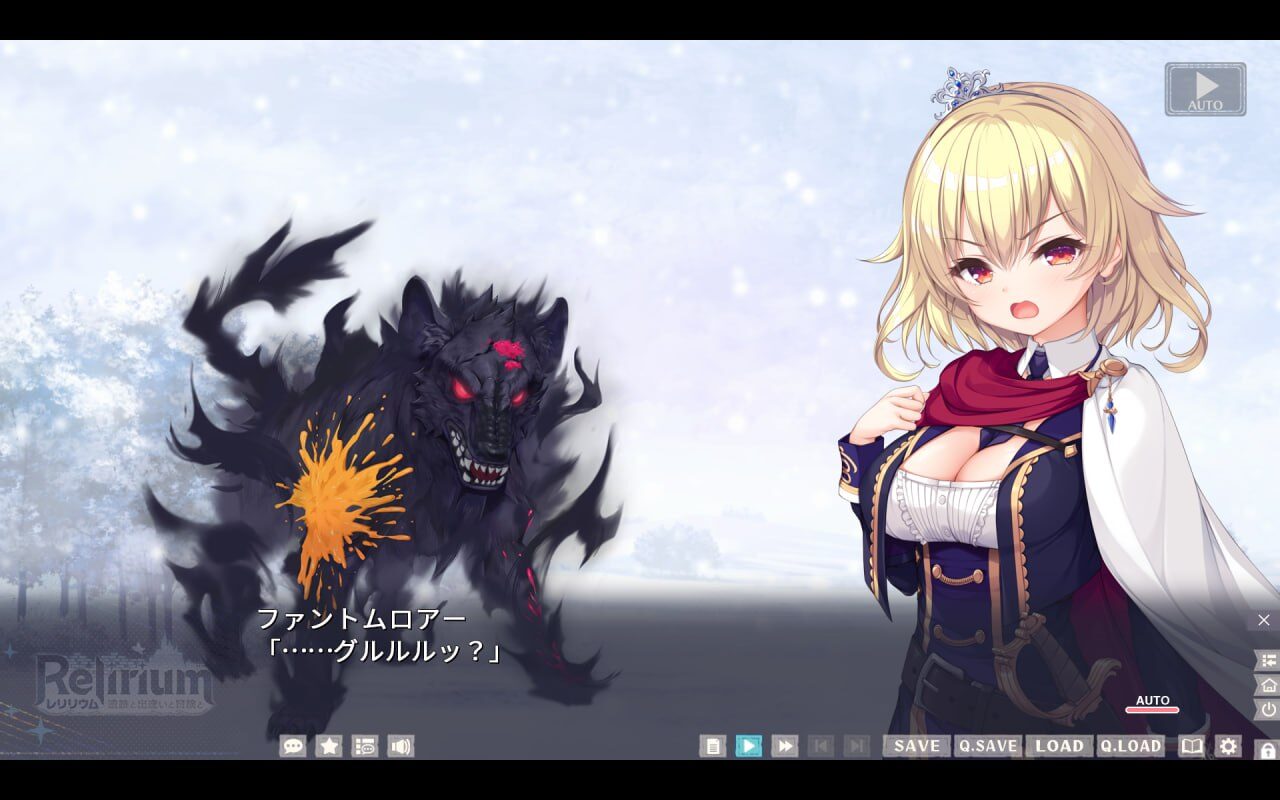

Nanami… no, Nanami Nagi’s route is a cut above. She’s always wanted to explore the depths of the ruins, she’s not much of a teacher, she has no hobbies besides leveling and adventuring. Later you learn she has a terminal illness that should have killed her long ago. She’s alive thanks to a ring on her hand that controls time—stopping it or reversing it. She uses the ring’s stop ability to freeze her illness and keep living. Then she finds the ring’s magic is almost spent, and the ring houses the soul of a girl named Lily. Lily says she wants to go home—her home is in another world beyond the portal deep in the ruins. So Nagi figures she’s lived a full life and might as well do a good deed and take Lily home. That’s why she’s so obsessed with exploring. Following her, they learn Lily’s homeland was destroyed by a demon god. Everyone there had the power to control time; the demon god coveted it, turned them into ore, and made Lily into a ring. Then comes the fight, the win, the people restored, Lily sent home, and Nagi’s illness cured. The protagonist thinks she’s dead, but years later he returns and finds Nagi alive, saved by Lily’s people with magic. The catch: she can’t go back to the original world, she’s stuck there forever.

Towa’s route is closest to the main line. From the other routes you learn the island has ruins, the ruins have portals to other worlds, and really the ruins are a “jump node” to parallel worlds—a Dark Portal, basically. Soon a demon god will descend on the island, and if they can’t beat it they can only seal it. The principal, as the island’s top authority, seems to know a lot and has prepared. Towa’s route keeps building this lore until the True End. The protagonist quickly realizes Towa is not what she seems. So-called idol club, wants to be an influencer—but she has insane special powers, wings on her back, telepathy. Confronted, she comes clean: she’s from another world, an elf. Her parents knew the protagonist’s parents years ago and went into the ruins together, then got sold out by his parents and vanished. His parents never came out either. Towa’s mother, apparently out of resentment, summoned an ancient monster deep in the ruins called the “Serpent of the End,” which will soon emerge and destroy the world. The protagonist doesn’t want to believe his parents were backstabbers. The principal greenlights the investigation. They find out his parents didn’t sell anyone out—they went back to get help. They’re not dead, just trapped deep in the ruins. What’s left is to suppress the Serpent and explain things to Towa’s mother.
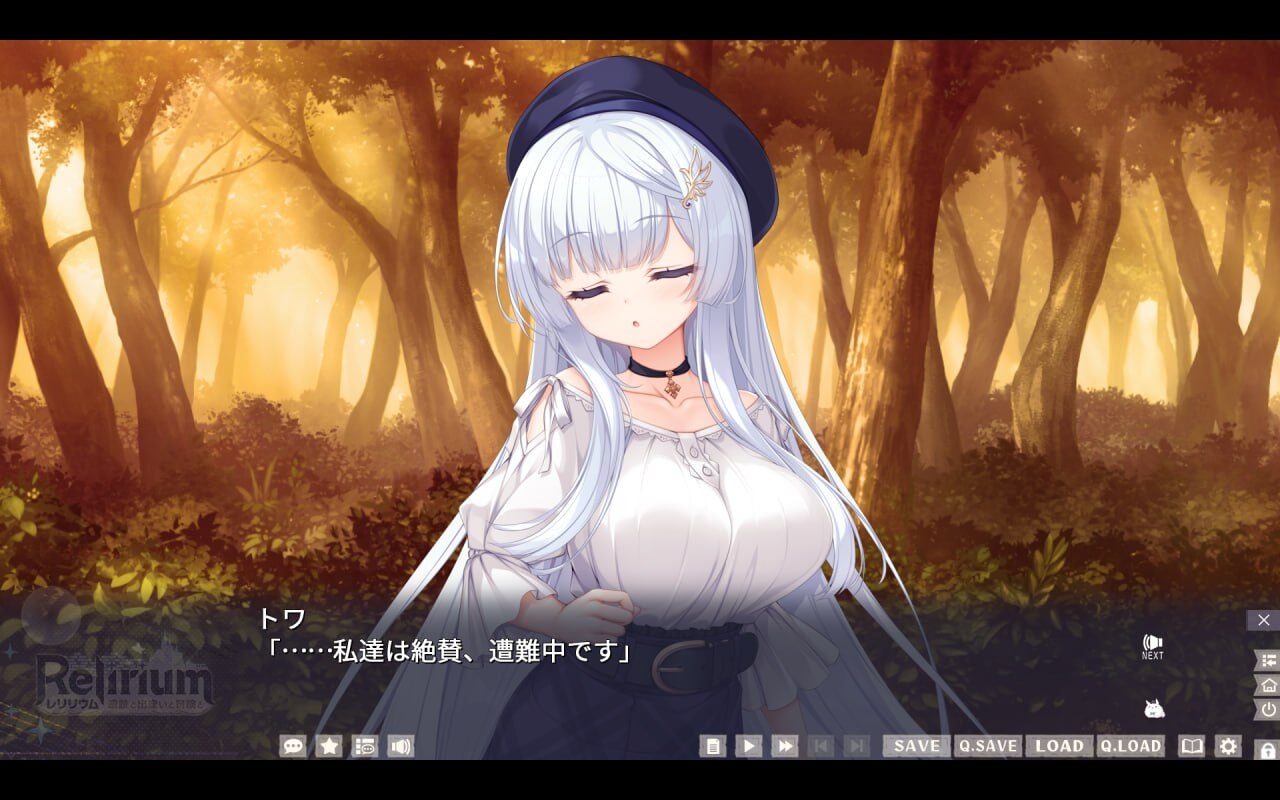
To gather everyone’s strength, Towa goes public with her otherworld elf identity and uses her powers to clean up all the messes from the other routes—curing Nagi’s illness, that sort of thing. Everyone’s worries resolved, Towa assembles the raid and speedruns the final floor. The whole crew marches in, explains the situation to Towa’s mother, kills the final boss. Unfortunately Towa’s mother still dies. After the boss dies the island starts collapsing, and everyone has to choose: follow the collapse through the Dark Portal to the Outlands… wait, wrong game—follow the collapse and stay in the other world, or go back to the original world. Either way, the node connecting the two worlds is about to break, so they may never see each other again. In the end everyone carries the memories of adventuring together and keeps living their lives. The game ends.
Like I said at the start, Relirium felt strange to me. Too templated, too by-the-numbers, exactly the kind of generic isekai adventure plot you’d expect. And the story entirely abandons the old “mystic bullshit” style—it just tells things straight. Mostly it’s adventure and slice-of-life; the serious plot doesn’t last long. Most of it is moe and romance. The company finally seemed to be getting somewhere—shouldn’t your final work be a big one? Why go back?
Then I thought about it and I think I get it: maybe Whirlpool themselves never liked the “mystic bullshit” stuff.
Whirlpool was founded in 2006. The whirlpool logo and name were meant to suck everyone in with fun stories, growing bigger and bigger. Like most visual novel companies, Whirlpool grew out of an outsourcing shop; games weren’t the main business so much as a projection of the higher-ups’ personal hobbies. From day one the company stuck stubbornly to “fantasy” plus “moege,” year after year. That was always its true nature. The fantasy-moe path isn’t hugely popular, but it has a steady audience. Facing waves of browser games, mobile games, and gacha, it tried to change and even won praise, but found that wasn’t its original intent anymore. Starting with the Pieces series, the stories got more obscure, the developments more mystic, and the “boundary marker” setting still has no official explanation. The joke is, the less people understood, the higher the reviews—while sales stayed miserably low. It’s The Emperor’s New Clothes: everyone assumes the cryptic plot is deep, and nobody wants to admit they didn’t get it. I even suspect Whirlpool was running some kind of social experiment with those games. Good thing their final work went back to their comfort zone.
Looking back at Relirium, the verdict is simple: it’s a thorough moege with Whirlpool’s traditional fantasy flavor. “Moege” isn’t an insult here—it’s a return to the visual novels of the previous generation. The game is stuffed with classic elements you’d think were out of season: the airhead, the tsundere, the schemer, the older sister type—every character cranked to max personality. Each route is different but easy to follow, and every development serves to show off the heroine’s charm. The main plot about finding out why the parents vanished wraps up safely without any nonsense. You can play it relaxed, like reading a light four-panel slice-of-life manga. The dialogue stitches together old and new memes and a ton of references to past Whirlpool games—if you catch them, you’ll smile.
Sure, you can criticize it the way people criticize every moege: flat plot, obvious main line, childish dialogue, heroines throwing themselves at the protagonist unnaturally. So what? As a male-oriented visual novel it packs in nine romanceable heroines, each with her own flavor, plus solid art and good sound production. I genuinely can’t think of a reason it “fails.” The core of a bishoujo game is the bishoujo; plot is just one tool to frame their charm. With its final work, Whirlpool proved its choice was right and summed up its whole 20-year history. A perfect curtain call.

In short, Whirlpool’s heart was always in moege. For the last game, they trusted what they loved—sales didn’t matter since they were closing anyway. And the reception and sales turned out pretty good, which proved their point: moege was the right call.
One last thing. I don’t know how many Whirlpool veterans are out there. Some say the higher-ups are all over 50 now. I checked the wiki yesterday and found that it’s not just the previous generation of visual novel producers—even Mami-senpai’s voice actress, Mizuhashi Kaori, is 51. Actually, this game has one huge narrative reference: Whirlpool’s second game after founding, MagusTale Sekaiju to Koisuru Mahoutsukai.
That game is about a protagonist whose little sister goes missing. He searches for her and stumbles onto an unknown island nation. He finds his sister, and discovers the island has portals to all sorts of other dimensions, all powered by the World Tree at its center. The school principal is also the island’s leader, and the protagonist befriends people from various other worlds.
Some time after release, Whirlpool said: “Most of our later games share a worldview with this one.” That’s a little chilling if you think about it. Was Whirlpool planning that far ahead? Was this finale part of your plan too, Whirlpool! 🌀
So you see?
MagusTale 世界樹と恋する魔法使い Relirium 遺跡と出逢いと冒険と
In a way, this game is a remake and completion of Whirlpool’s existing worldview framework. MagusTale never had a proper ending; Relirium fills that in. Relirium is also full of characters and references from old Whirlpool games—I haven’t played enough to catch them all, but I spotted several. Using MagusTale, the foundation of Whirlpool’s fantasy worldview, as a final setting completion and remake to close things out is a genuinely clever choice. You could call it a perfect curtain call.

A lot of people say the ending is a microcosm of Whirlpool itself—especially when the characters choose whether to stay in the other world, and when the link between that world and reality breaks. That’s Whirlpool, the company devoted to “fantasy other worlds,” reaching its own ending.
I don’t want to get too sentimental. Traditional visual novels are a product of the last century anyway. In the new era, with AI and VR, and with the rise of interactive film-games and high-end interactive titles, a new generation of “visual novels” is slowly rising. These days, as long as you have ideas and tokens, you can cobble together your own visual novel. At least Whirlpool bowed out gracefully. Let the time you spent with their games be a good memory.
Comments are hosted on the Chinese main site. This mirror is read-only.