Pure X Connect (ピュア X コネクト) Review
Pure X Connect: What If Love Were This Simple
The first time I heard of a dating sim was in elementary school, when I found something called Tokimeki Memorial from a pirate-game dealer. Not a CD version, of course — it was in a folder on a disc with a “Cangjinge” label.
After installing it, I saw the name written as “Jun’ai Shuzha” (I even misread it as “Jun’ai Shouli”), and somehow, following the GameZ88 install wizard, I put a shortcut for the thing on my Windows 98 desktop.
I played it for a while and found it pretty baffling. Bear in mind I was an elementary schooler then — I was dying to grab a gun and blast monsters, not sit down and hit on girls. The whole business of getting entangled with several women every day made no sense to me.
“Why isn’t he fighting?” “When does the fighting start?” were the biggest questions in my head.
Even so, I kept playing on and off, and found that as the protagonist, your daily job was deciding what to do that day. Oh God, that was literally how I spent my own days back then. Real life was already being ground down by teachers that cruelly — and you want me to do the same in a game?! Then I found out keeping good relationships with the women in it was hard: sometimes they’d agree to go out with you, sometimes not. Busy yourself with studying every day and the women ignore you; don’t study and… the women still ignore you.
I stumbled my way to the ending. The protagonist goes to confess, and the girl turns him down. I figured, finally, this is where she transforms into a boss and we start fighting — but the game just ended.
“What the hell is this?” I couldn’t even be bothered to run the uninstaller. I just deleted it.
That was my first encounter with a dating sim. For a long time after, I was absorbed in action games…
Well, it wasn’t absolute. Later I found two H-games in another “Cangjinge” disc, “Koukou Joshi Sei Nikki” and “Kanzen Kyuuketsu.” For the first one I was too stupid to use a Big5 conversion tool, and the second had no choices at all — the first time I saw the male lead’s おちんちん I nearly pissed myself and hit the Reset button on the computer, heavy mosaic and all.
Okay, I’m getting off track. I just mean that the image of a dating sim in my head was originally the Tokimeki Memorial kind, and later I came across all sorts of dating sims… in magazines. Princess Maker, Memories Off, that sort of thing. But the formula I had in my head for these games was mostly “daily life” — “choices” — “affection” — “confession” — “couple.”
Of course, that formula is something I haven’t seen in ages now. At some point, galgame plots became fully novelized, and it’s not hard to see why Westerners classify them as visual novels. Even when that formula does show up, it’s in old games like True Tears, or the newest Tokimeki Memorial — and those barely count as galgames anymore; they’re more like raising sims.
But ピュア X コネクト is a genuine throwback. It has the flavor of a classic “dating sim” while carrying the air of a “modern galgame.”
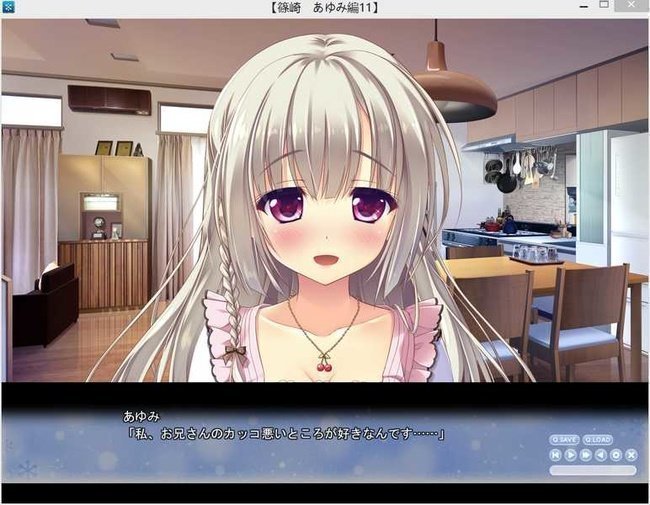
To put it bluntly, ピュア X コネクト has no real main plot. The prologue just introduces the characters one by one — how each woman met the guy, how they came into his life. There’s the little sister Ayumi, the mixer partner Arisa, the childhood friend Sora, the classmate Moemi, the proprietress of the place where he works, and so on. The story unfolds in a very chapter-based way: it starts in winter, and each chapter focuses on one heroine and tells the story behind her. It’s a bit like a harem anime, but that’s not a bad thing. The common route centers on Christmas, and on Christmas the game tallies the protagonist’s affection with each heroine to see if the confession conditions are met. Confess successfully and you enter that heroine’s individual ending.
So how is affection decided? Aside from choosing where to go during work breaks, the most important thing is who the protagonist picks to email every night — the emails have a few small choices that affect affection. The game doesn’t force you to keep emailing every heroine, and I suspect that with careful management you could set things up to have several heroines available to confess to at Christmas, though no walkthrough I’ve seen says so.
Simply put: one chance to send an email per chapter, each email raises a heroine’s affection, Christmas is the tally, and if you clear the passing line, the heroine with the highest affection gets confessed to and you enter her route. Fall below the line and it’s straight to a Bad End. (There’s probably a ?? in there.)
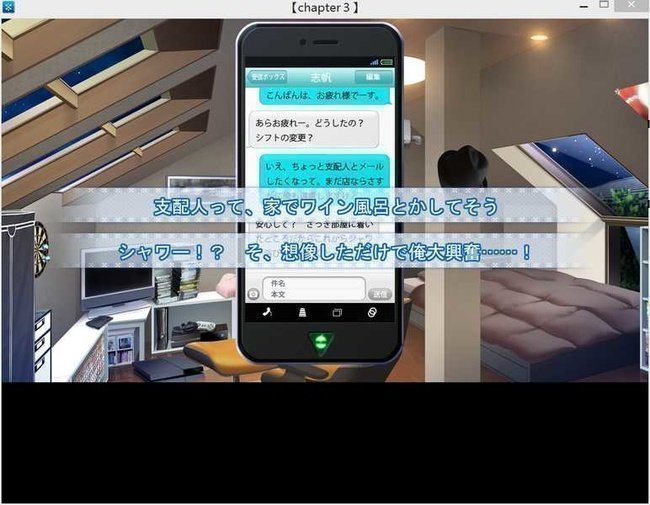
By the way, the game lets you name the protagonist, and I stupidly entered “Plum Race” — which turned out to screw me over, because the protagonist has a ton of degrading, self-deprecating lines later on. Still, all these various quirks really do feel like early Tokimeki Memorial; the raising-sim process has just been streamlined down to sending emails. But that also creates a huge problem: the different routes are heavily repetitive.
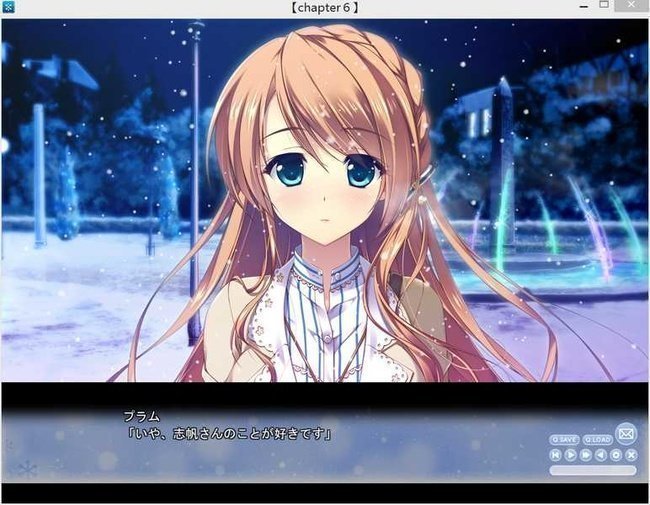
If you want to do multiple routes, you have to start over from the beginning and re-pick everything each time. And at the confession, the protagonist is always in that same idiotic park — he’ll drag the heroine there even if it’s a stretch — and confesses on a snowy Christmas night, and the confession is always, always this one line:
“俺は 君のことが だいすきなんだ/です”
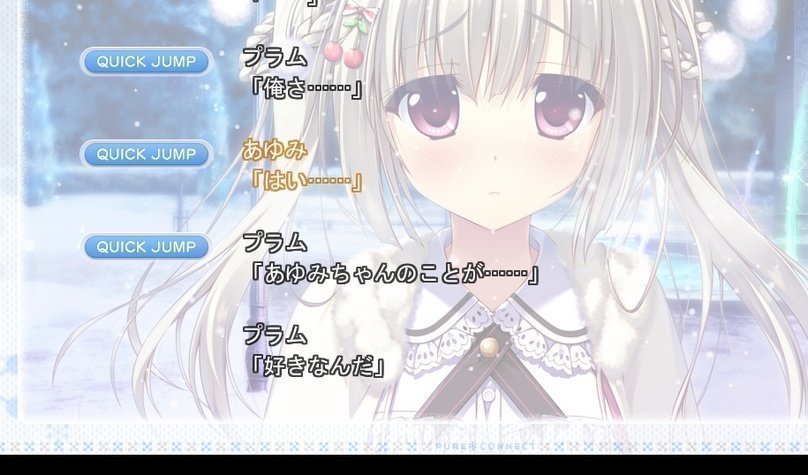
Honestly, the first time I did the sister route, I read that confession out loud. But then came Moemi’s route, the proprietress’s route, Arisa’s route — same line every time, same place every time, same memory-flashback after, and the heroine tearfully accepts every time.
Over and over, and you get sick of it…

And the most jarring thing: because it follows this classic Tokimeki Memorial-style structure, the game doesn’t really build up the romance. The protagonist jokes around with everyone day to day and then suddenly confesses. Funniest is the proprietress route — he’s barely talked to her, never gotten to know her on any deep level, just texted her every day and then confessed at Christmas, and she accepted. It really feels like there’s a gap in the story.
Fortunately, the daily-life parts are pretty good. Even though a lot of the heroines have weird art — terrifyingly big eyes, necks that look snapped at certain angles — the static CGs are passable and the voice acting is solid. The pacing of “common route: 70% comedy, 30% emotion; individual route: 70% sweetness, 30% comedy” means there’s never really a boring stretch. It’s a game — 面白い、楽しめる is enough. Especially when it’s just a simple romance game.
But still — the protagonist wins over women entirely by sending them nightly emails. I’ve heard of romance-by-text in real life, but from my own experience it feels a bit too surreal. Maybe I’m just too dull or too bad with words; most of my emails and texts with girls end up point-to-point “I ask, you answer,” often with no reply, and plenty of chances to get to know a new girl fizzled out that way. Even when the texting with a girl doesn’t stop, you still have to worry about meeting up for meals and all the extra probing, nowhere near the protagonist suddenly dragging someone to a small park at night and succeeding at a confession like that.
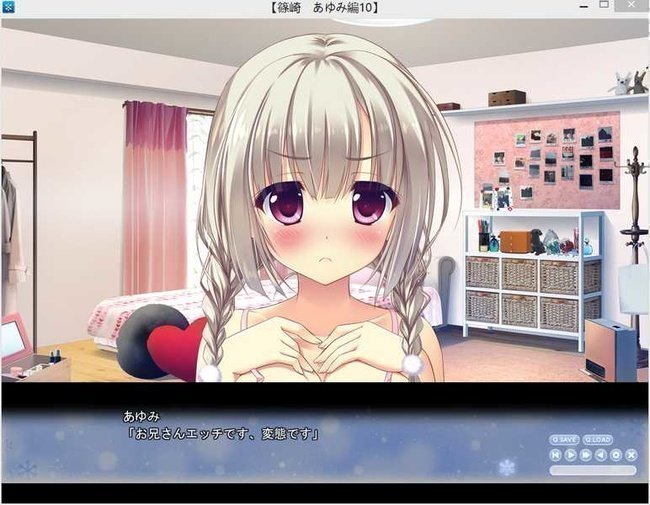
I can’t help but sigh — if only love were as simple as it is in ピュア X コネクト…
Comments are hosted on the Chinese main site. This mirror is read-only.