The Weeping Swan: Ten Days of the City's Fall Review
Good Girls, Bad Girls; Good Games, Bad Games
I bought The Weeping Swan: Ten Days of the City’s Fall (哀鸿:城破十日记) pretty much on release, off the goodwill and trust earned by the developer’s previous game. For various reasons I didn’t get around to actually playing it right away.
Honestly, back when I first learned the game was going to be about the “ten days of the Yangzhou massacre,” I already expected it to catch all kinds of flak after launch. There was the Mingmo: Yu Xu Zhi Yu precedent, after all. The devs couldn’t possibly have been unaware of how players, netizens, and the general舆论 would react. And under the internet’s black-and-white pressure of “if you’re not fully against it, you’re fully for it,” I figured this game wouldn’t be some totally one-sided, extremist work either — and that it would inevitably get dragged through the mud, get its rhythm hijacked, maybe even get a few clipped phrases blown up and nailed to the pillory. All of that was plausible.
Of course, the devs — especially the producer-slash-writer — are smart enough to understand that risk. Choosing to keep making this game anyway means they’d prepared for it. Plainly: you touch this subject, you eat this traffic, you take on the huge risk.
And it blew up after launch, just like I thought. But the direction of the explosion wasn’t what I expected. The final conclusion was still the classic “labeling” and “wrong politics” routine, but the trigger wasn’t mainly historical sensitivity or nationalist sentiment — it was arguments about “good girls” and “bad girls,” that vaguely mala-flavored stuff. That caught me off guard, and probably caught the producer off guard too.
By the time I finally had time to boot the game up, some time after release, the reviews were still mixed. I hear the producer put out some explanations and patches. Still that bleak a reception after all that shows how much recoil the thing generated.
All this time later, and people still won’t forgive you, huh.
That’s enough rambling. Let me just get to my own take on the game.
Small Game, Big Dreams
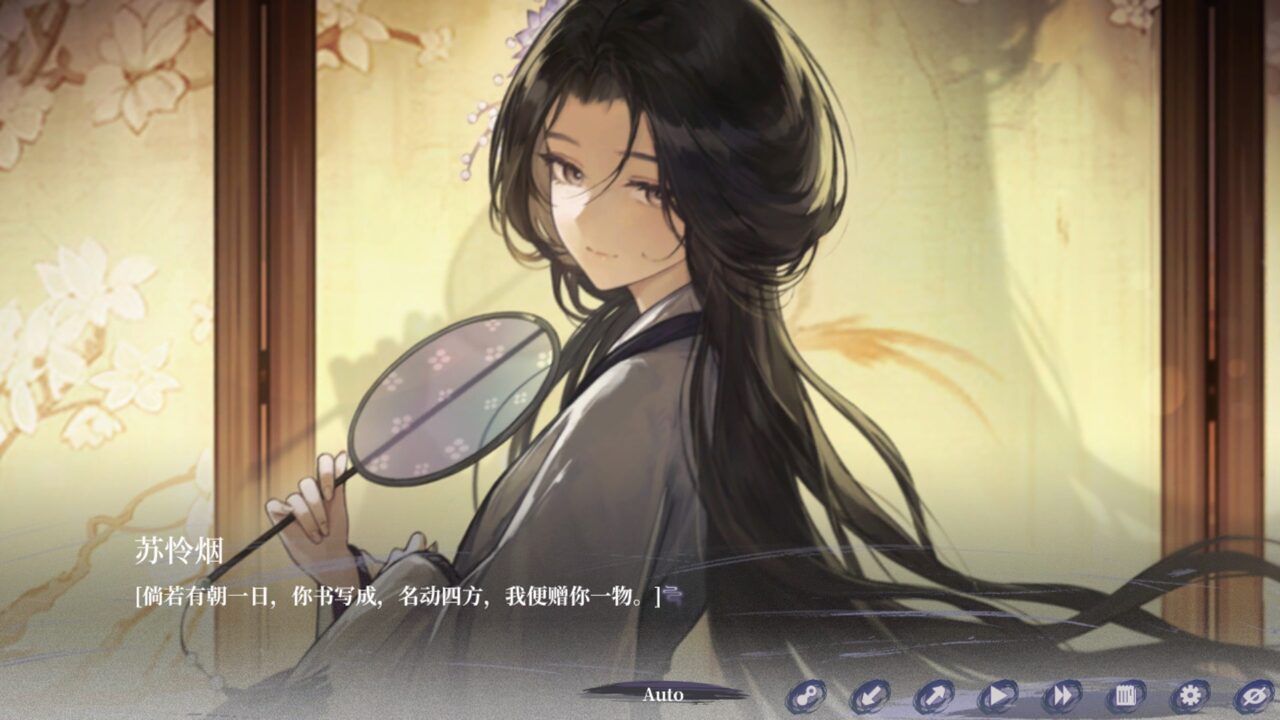
Let’s start with the flaws. The game’s longer than the previous one, but the main route isn’t actually that long — about ten days of main plot. I personally don’t have much of a problem with multiple heroines being “courtesans” or even “prostitutes.” Read some history, understand the environment of the time, strip away the costume-drama and over-imaginative alternate-history filters, and you’ll actually find the author was being too restrained. Real commoner life back then was crueler. The main story: the male lead, a scholar, tries to survive the chaos of the Ming-Qing transition while reminiscing about his first love, a famous courtesan, and, through another heroine’s interjections, eventually chooses a kind of release and reconciliation.
Put plainly, it’s a story about a man hung up on his dead ex-girlfriend who, after some big events and conversations with other women, finally lets go of his obsession, makes peace with himself, and moves forward. Not a rare story at all — plenty of literature, film, TV, anime, even Japanese visual novels have written it. The “heroine who lives forever in the protagonist’s flashbacks” trope is everywhere, and some of those works are excellent. Strip off the “romance” label and just emphasize “letting go, moving on,” and the list of masterpieces gets even longer…
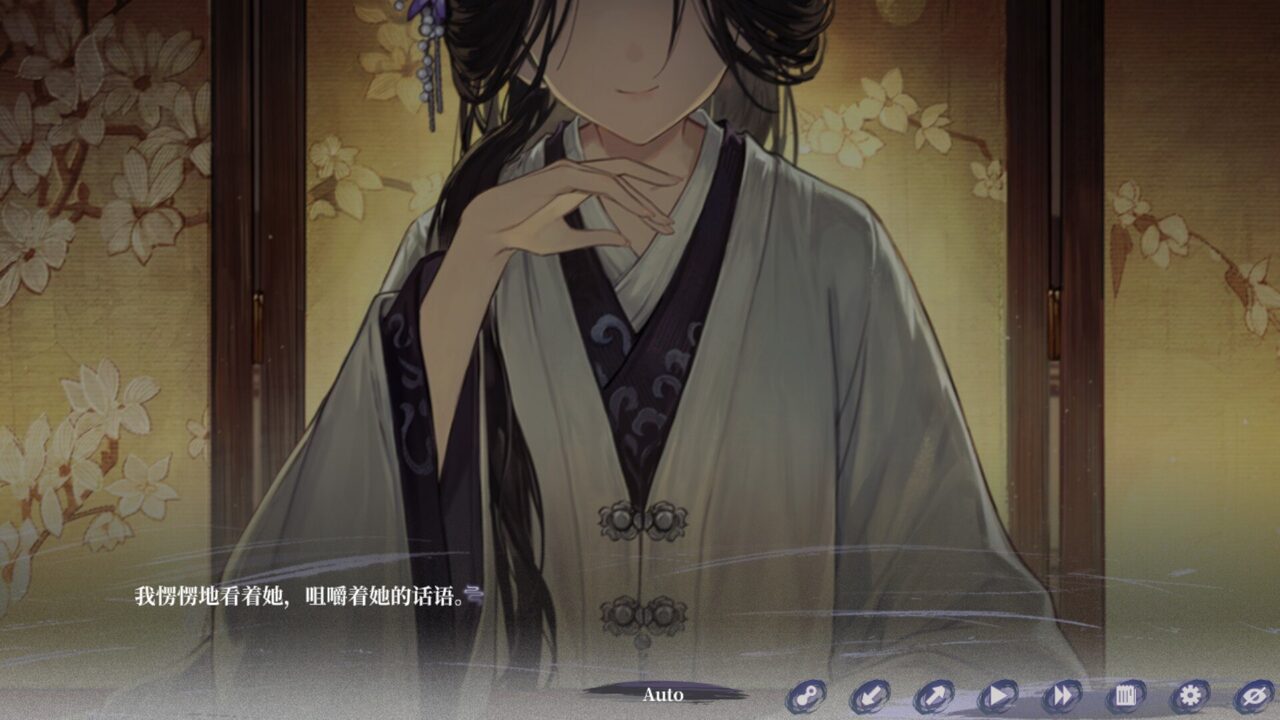
But that’s where the game’s first problem shows. If you look only at the relationship between the protagonist and his first love, the story isn’t actually good — it’s downright childish, even needing to blame ALS to force the two apart. Simple and crude. Like those formulaic Korean dramas from years back where the moment they want tears, the heroine gets hit by a car. Real emotional writing doesn’t need all those plot devices; it uses techniques that sink deeper into you, letting readers resonate on their own, spontaneously feeling the unwavering love between the two. That takes real writing chops, and this game clearly falls short there, exposing the author’s limitations. This isn’t a normal school visual novel’s “contact — affection — confession” trilogy. You’ve set up the protagonist as hopelessly stuck, and unless you write it deeply enough, movingly enough, enough to bring tears, how are you supposed to support his devotion?
Besides, the romance between the protagonist and his first love doesn’t even make up the bulk of the story. It’s scattered in fragments, trying to use the protagonist’s escape from the Yangzhou massacre as a trigger — seeing things reminds him of her, colliding memory and reality. But that technique creates the second big problem: the constant, jarring jumps between memory and reality chop the whole story to pieces. I’d rather they’d written a longer, more integrated romance between the protagonist and his first love instead of this fragmented back-and-forth. Add to that the insufficient length given to the actual romance while tons of ink goes to unimportant parts explaining what this is and what that is — it’s both frustrating and boring.
Worth noting: the romance between the protagonist and his first love, Su Lianyan, happens before Yangzhou falls. Meaning a core part of the game’s main story has nothing to do with “the fall of Yangzhou.” And that’s where the third problem appears — whether the protagonist has the beast-sight disease, whether he’s fleeing through Yangzhou, whether he’s wandering around looking for people with the previous game’s protagonist… what does any of that have to do with “the protagonist is trapped in his own love and lives in the past”?
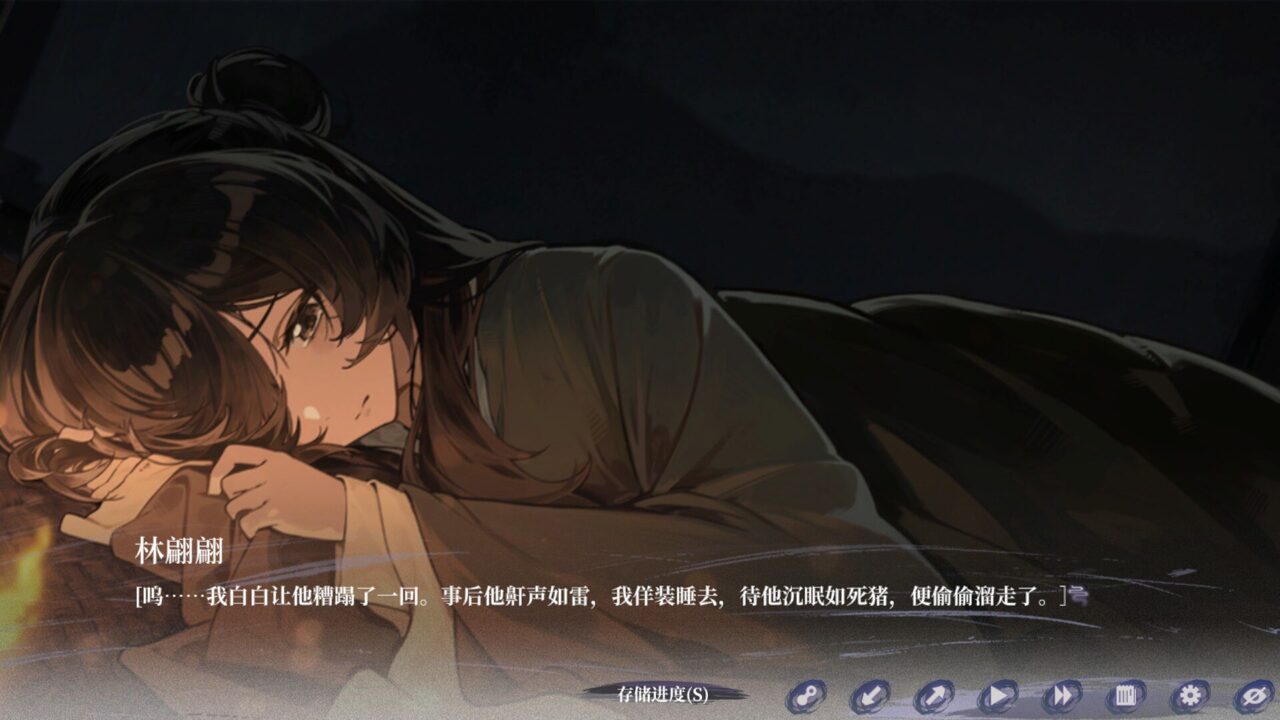
In other words, you could move this story to some mountain village in the northwest. Set it in the Tang dynasty instead of the Ming-Qing transition, in peacetime, in the Republican era — wouldn’t it work just as well? Why set it during the fall of Yangzhou, making our protagonist flee for his life while recalling things that have nothing to do with the massacre? Hell, the final resolution has nothing to do with the massacre either. Even Lin Pianpian, the second heroine who caused the most controversy, doesn’t really need to exist — you could use a maid, or a letter left by the first love, any other means to tell you the truth. Lin Pianpian herself feels more like a passerby, and then she gets a baffling death sentence handed to her at the end. Why do that? Why dodge the important and dwell on the trivial? Why insist on this historical backdrop?
I think I might know the answer…
As I said earlier, this game’s core story has been written by plenty of other works, some of them quite well — many are hall-of-fame tier. As a “visual novel” or “text adventure” game, if you just quietly write about a man appreciating the arts with a courtesan and being haunted by her death, you might get some resonance and a small handful of praise, but ultimately it’d be too mediocre, just another nobody, unable to make a splash.
So you must add “Qing army massacre” on top of this story — a topic that comes with built-in conflict, discussion value, and traffic. Suddenly the game gets a new meaning. The Qing massacre portions almost completely reproduce the contents of the Yangzhou Ten Days Diary, especially writing out the cruel, the brutal, the dark in nearly naked fashion — the whole point is shock value, which brings even more buzz. Can’t blame the author; it’s an old traffic-farming technique, and plenty of readers eat it up. When I first started following Puella Magi Madoka Magica back in 2010, the first two episodes had almost no discussion. Then episode 3 hit and the traffic exploded. Frontwing’s anniversary work Grisaia no Kajitsu had a 50-hour common route almost entirely unrelated to the main plot, and it was the later individual routes’ — now frankly contrived — “cannibalism” segment that gave the game enormous influence, to the point they’ve been coasting on it ever since.
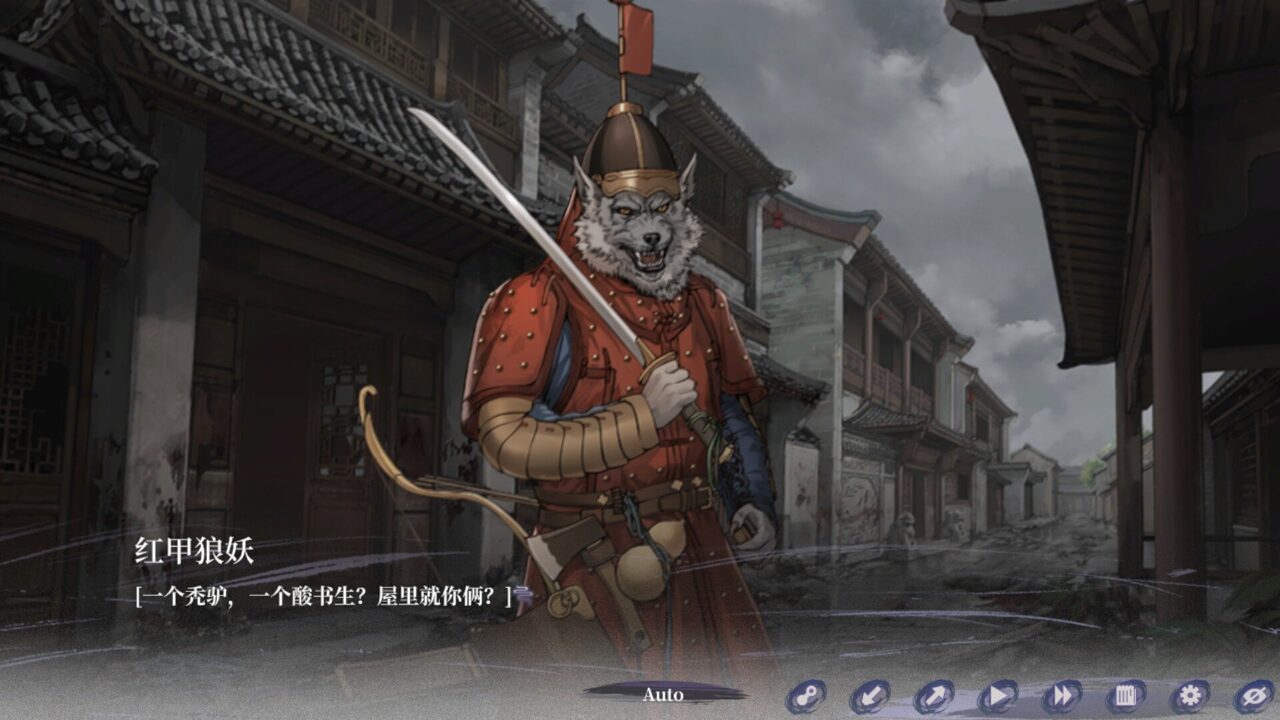
Of course, the author was somewhat careful with using the “Qing army massacre” backdrop — for instance, the “beastification disease” setting dilutes the “Manchu Qing” marker and avoids unnecessary trouble. But historical bait wasn’t enough; he also added the previous game’s male and female leads and cast, trying to please the previous game’s fans, and the content isn’t short either. The latter half makes our scholar protagonist feel more like a supporting character, heavily diluting the story this game was supposed to tell well.
In short, I can see the author is somewhat smug, wanting to write that delicate emotion but lacking the ability; wanting to use sensitive historical events for traffic, to elevate his work’s stature so it doesn’t look like a pure love story, but everything meaningful is just copied from the Yangzhou Ten Days Diary — he can’t write anything himself; and at the same time he thinks his established base of supporters all came from the previous game and wants to give them treats, forcing the latter half into a fandisk for the previous game, forgetting this game already has a new protagonist. That “want it both ways” attitude ends up losing the watermelon while picking up a sesame seed — the whole game’s plot feels loose, unable to resonate, nobody gets into the story, and for the cloud players who heard secondhand and came to slap labels on it, naturally few people step up to say a fair word.
It’s a small game carrying too much of the author’s ambition and “dreams,” and the author himself doesn’t have the ability to handle it. That’s the result.
Dimensions of Evaluation
Having covered the flaws, I should probably say some good things, to balance the scales.
But I don’t really want to praise it with the clichéd “good graphics, great voice acting, lovely music” angle. I’ve said this many times when reviewing Lay a Beauty to Rest: The Darkness Peach Blossom Spring and The Hungry Lamb: Traveling in the Late Ming Dynasty — this game’s producer is the only person I’ve seen so far who actually gets how to make a “Chinese-made visual novel.” This game inherits that fine tradition, and goes a step further.
Of course, many people probably can’t understand that, or don’t want to hear it — the producer’s reputation is like the V-tuber circle’s Lefu, full of controversy. Let me put it differently, using reverse thinking.
On Bilibili there’s a chef called “Sui Po” who often visits restaurants as a professional and gives his verdict on the food. Observant viewers notice he uses different standards for different tiers of restaurant. Many a noisy, chaotic hole-in-the-wall with no plating or ingredient quality gets high praise from him, while some exquisite high-end restaurant gets nitpicked over tiny problems, and he expresses dissatisfaction.
The reason is simple: they all provide food service, but at different price points, different positioning, different dimensions — naturally different standards. A small eatery’s dishes are cheap; if it’s clean and hygienic, generous in portions, and the taste has a little highlight, then it’s excellent for its tier. At a high-end restaurant, expectations are naturally higher — higher tier, higher price, should mean higher standards.
Another example: Chinese Paladin 3 and Chinese Paladin 4, revered as masterpieces by many single-player gamers, scored 9.2 (92 on the original 100-point scale) and 8.9 respectively in Popular Software, then the mainstream magazine for Chinese single-player game reviews. What level is that? Medal of Honor and the first Call of Duty, even BioShock and The Witcher 1 — all were sitting around 8.5 at the time. Objectively, did those two Chinese Paladin games surpass those contemporary “big titles” in graphics or gameplay? Clearly not — their production level was even behind. But Popular Software gave them such high scores for a simple reason: in the field of “Chinese RPGs,” they reached an extremely high standard, their stories were more moving, more likely to resonate with players, to bring more emotion.
Bringing it back: when we evaluate or even criticize The Weeping Swan: Ten Days of the City’s Fall, what standard are we using? Sure, its plot is chopped to pieces, the romance is perfunctory, the massacre content is uncomfortable, there’s no good ending, and the heroine is written as a courtesan with explicit descriptions of selling her body…
But:
- It’s fluently written, uses words correctly, doesn’t have that “looks like Chinese but is actually Japanese vocabulary” problem.
- The voice acting is natural, the emotion lands properly, no “native-language cringe” — it’s a game with a genuinely Chinese flavor.
- It crowdfunded, but reported progress on schedule, launched on time, didn’t delay, the developer didn’t run off.
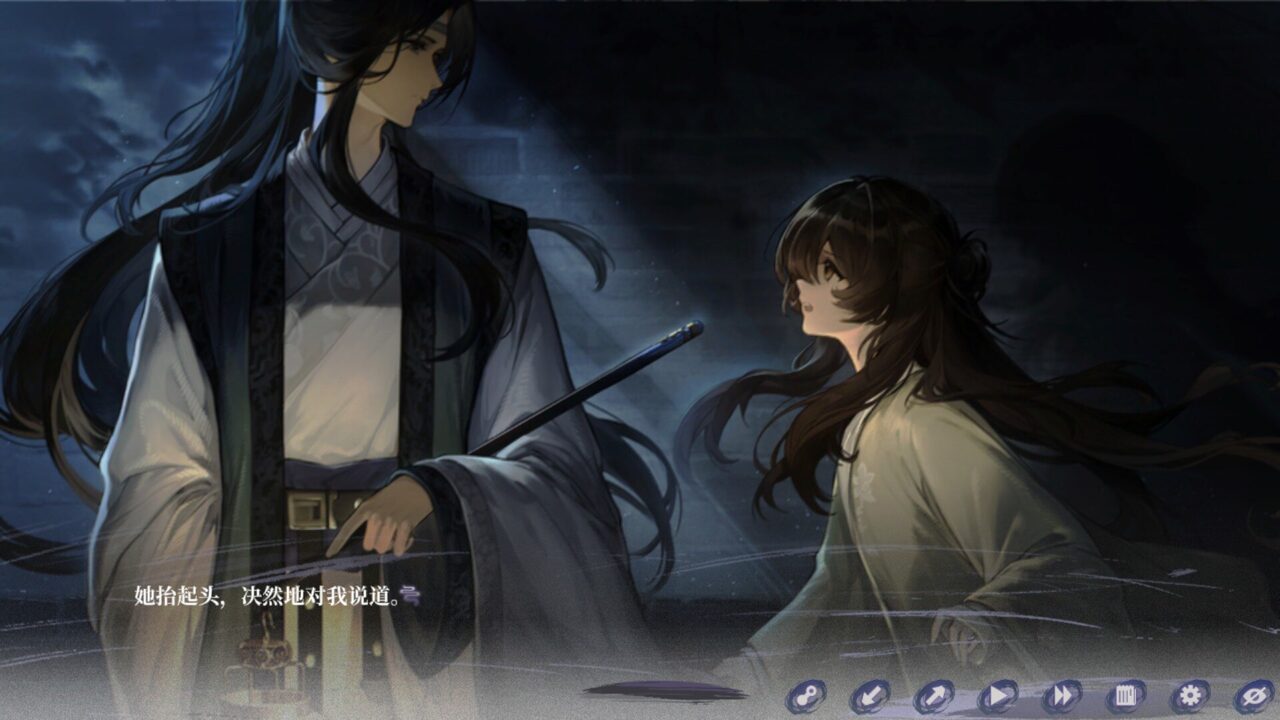
- The system is smooth, offers Backlog search plus timeline jumping, letting you see the story’s structure at a glance.
- It proactively did multilingual adaptation, bringing the story to players in more regions.
- The art is beautiful, the cutscenes don’t crash, it supports ultra-high resolutions.
These reasons might look absurd, but honestly, conservatively at least 90% of so-called “Chinese visual novels” can’t manage the above. Plenty of games claiming to be Chinese gacha games have dialogue and story that “don’t sound human.” Never mind the crowdfunded ones on Modian — I’ve still got a crowdfunded “Chinese visual novel” on my hands that’s a year past its promised date with no game in sight. Never mind the many “Chinese visual novels” with gorgeous interfaces but no Backlog, memory leaks, and multi-playthrough runs that require manual saves and frantic fast-forwarding.
Oh right — Japanese visual novels still mostly don’t support 1080p these days; most are stuck at 720p. So by that measure, The Weeping Swan: Ten Days of the City’s Fall has already won, hasn’t it?
That’s my point: the biggest strength of The Weeping Swan: Ten Days of the City’s Fall is that in project management and production quality, it delivers a crushing blow to its so-called “Chinese visual novel” peers — even breaking out of the niche, attracting many Chinese players who don’t play Japanese or Chinese visual novels, who’ve never touched this genre, to come try it and join in. When you criticize its plot as bad, its story as fragmented and hollow, when you blast it for deliberately disgusting you — you’ve already, without realizing it, started treating and evaluating it as a higher-dimensional “narrative-driven Chinese visual novel with a historical backdrop,” already entered the realm of entertainment products, already able to sit at the indie game festival table. Meanwhile, where are those Chinese gems that the “Chinese visual novel” niche circle reveres as masterpieces making their money? Is it possible that those “lights of Chinese visual novels” still doing “Sino-Japanese collaboration,” formulaic softcore擦边 with one-click harem picks and the three-axe campus romance — maybe their production quality is worse than The Weeping Swan: Ten Days of the City’s Fall, their stories more abstract, unable to even get people to play through, not even worthy of getting labeled, not even worth a few curses?
Different evaluation dimensions, different answers. As a Chinese indie game with a historical backdrop, The Weeping Swan: Ten Days of the City’s Fall isn’t exactly a success — at least its plot and character work aren’t better than the previous game, The Hungry Lamb: Traveling in the Late Ming Dynasty. But compared to those products claiming to be its “peers,” that’s underestimating it. I’ve seen too many self-proclaimed “Chinese visual novel producers” with terrifyingly long titles, self-styled Key visual novel gods, whose games — never mind the system — are more like the incoherent ramblings of an autistic mental patient who can’t even form a sentence.
Good Girls, Bad Girls; Good Games, Bad Games
After The Weeping Swan: Ten Days of the City’s Fall launched, before I’d played it, the thing I heard most was: “Ji Ling is disgusting people on purpose, writing the heroine of a romance game as a prostitute, making players into cucks, blah blah blah.” And in our country’s chaotic young-people internet environment, with severe gender antagonism in society, plus the game’s high heat, all kinds of marketing accounts — jackals sniffing for relevance — came running, pretending to give fair sharp commentary while actually riding the winning side for traffic and paid gigs. The game became the internet’s emotional punching bag. Many people joined the criticism without having played, without even having bought it — the completion rate for all endings is around 20%, which says something.
Frankly, the internet is chaos. Many people online don’t care about truth or facts; they need a target and an emotional outlet, to see what winning team they can join today and who to curse and stomp on. What happens afterward, nobody cares.
Here’s something interesting: the “courtesan prostitutes” many netizens sneer at were not, in the historical period the game depicts — the Jiangnan region during the Ming-Qing transition — purely places of sexual transaction. The high-end brothels where “huakui” (top courtesans) resided functioned more like cultural salons in modern terms. They provided guests with ample companionship and emotional value, even friendships. A huakui-level famous courtesan wasn’t just pretty; she needed her own conversation, talents, temperament, and aesthetic taste. They built reputations through poetry, calligraphy, painting, and a particular style of socializing. So the high-end brothels attracted mostly upper-class people — scholars, officials, nobles — and most weren’t necessarily there just for sex. They might come to hear music, drink, converse, recite poetry, or build a long-term relationship with a courtesan they admired. Some wealthy men showed off their cultural name and status through gifts of poems, presents, patronage, and special relationships. For top-tier courtesans, what guests bought often wasn’t just a single service, but her time, her talents, her attention, and the chance to build a special relationship with her.
Maybe that’s hard to understand. Let me put it another way…
Most high-end “huakui” famous courtesans won’t easily pay you attention. If you pay her, and reach a certain threshold, she’ll consider responding. If you give her more money, she’ll get familiar with you. If you keep paying, she’ll start expressing thanks, chat with you, listen to you, sing for you, dance for you, sometimes give you a small gift as thanks. If you give enough, her going home with you isn’t impossible.
And the money you give her doesn’t all go into her pocket — the brothel operator takes a cut as a platform fee. I don’t know the percentage; maybe 50%.
Sound familiar? Seemingly similar professions exist in our society today. Human society has always had industries that convert talent, personal charisma, and intimate relationships into economic value — different eras just provide different media and institutions.
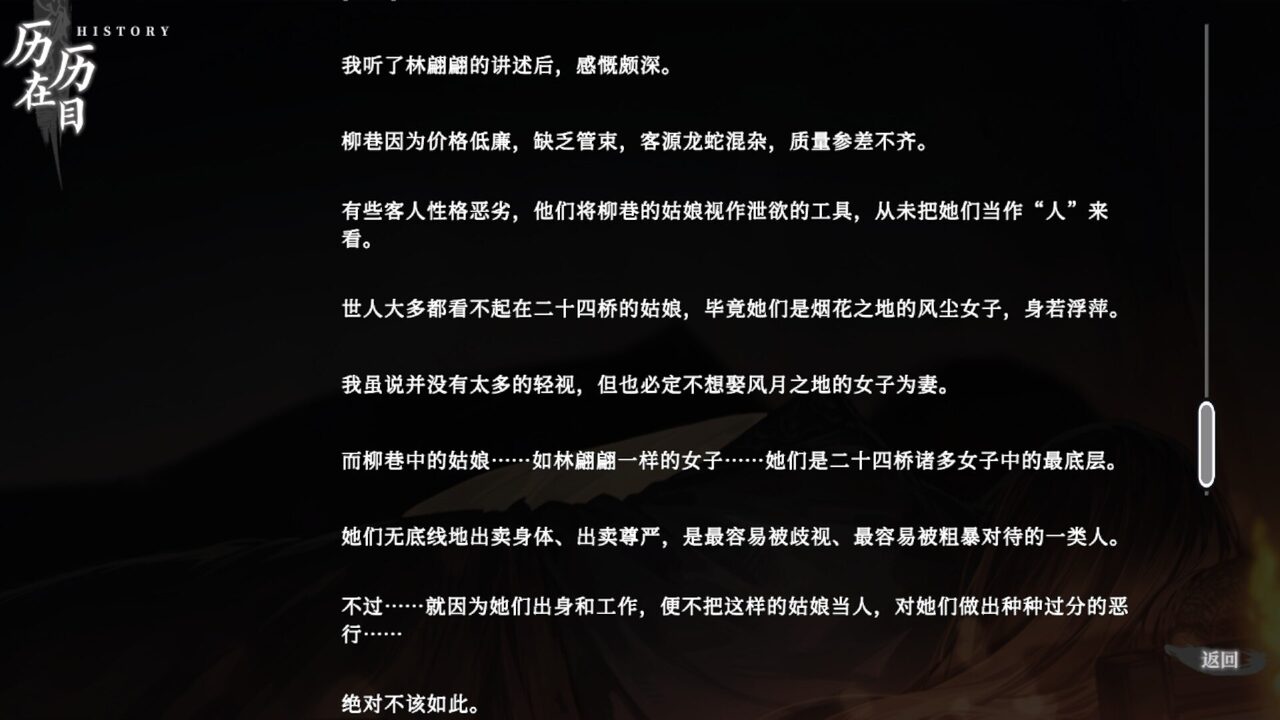
The difference is that many courtesans in ancient times were truly driven to the wall — especially in times of chaos, when women faced circumstances beyond their control. Compared to lower-class men being made slaves or killed, women’s fates were never in their own hands either.
Just like The Weeping Swan: Ten Days of the City’s Fall — after launch, once it got all those labels slapped on it, the game’s own reception spiraled out of control. As I said at the start, that was predictable, and it was the producer’s own choice (or his own fault). I even think he probably just wanted to write the Yangzhou ten-day massacre backdrop and made up a scholar’s love story specifically for it. The game added a lot of new content that looks at a glance like him疑似 sliding into a kneel, but by then it was beyond explanation. Whether the game achieved what he expected — only he knows.
The world is complex, the internet is chaos, things aren’t black and white…
Are the courtesan heroines good girls? Is The Weeping Swan: Ten Days of the City’s Fall a good game?
Stand at different dimensions, get different answers.
Comments are hosted on the Chinese main site. This mirror is read-only.