Dekinai Watashi ga, Kurikaesu. (できない私が、くり返す) Review
Repeated Time Travel Did Jack Shit for Me
できない私が、くり返す。 left a decent impression on me, and not because of the art or anything like that — mostly it was a bunch of people saying it’s a “tearjerker” and “the best.” Generally a game that most people approve of can’t be that bad, so I played it during June when there was nothing else out.
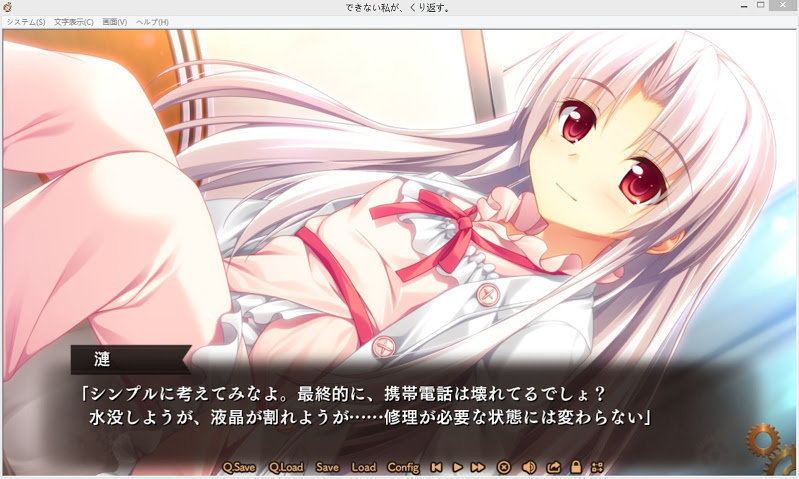
The title is weird. Going by my Japanese level of a one-year-old infant, I think it’s trying to say that no matter how many times I go back, I can’t change a damn thing. Early on, the protagonist gets a pocket watch from a big-sister type named Ren, who tells him it can travel through time and return to the past.
“But there’s no point in going back, because the future can’t be changed.”
A time leap that can’t change the future is basically useless, and Ren hammers it in every time she talks about the watch:
未来は変えられない
So the story begins five years after big sis Ren dies, at the moment the watch-holding protagonist meets a girl named Shino.
Honestly the plot is pretty simple:
The protagonist meets Shino, they chat day to day, and he learns she has cancer and not long to live. He feels a bit of sympathy, spends a fair amount of time with her before she dies — friends, more or less. He meets her friends too, and goes with them to visit her. Shino, late-stage cancer, lying in the hospital bed, puts up a brave front. The protagonist asks what she wants to do before she dies.
“Saying it now wouldn’t change anything.” Shino smiled.
Then one day Shino’s friend suddenly comes to tell the protagonist that Shino died…
The protagonist remembers how Shino was before she died — she seemed to have a wish but thought it was too late to say it. He’s a helpful guy, so he figures he’ll go back once and grant her dying wishes. He takes out the pocket watch and rewinds to the first time he met Shino.
After the rewind, the protagonist quickly gets close to Shino again, and one day asks her, “So what wishes do you have before you die?”
Shino thinks about it and pulls out a note that looks like an apple.
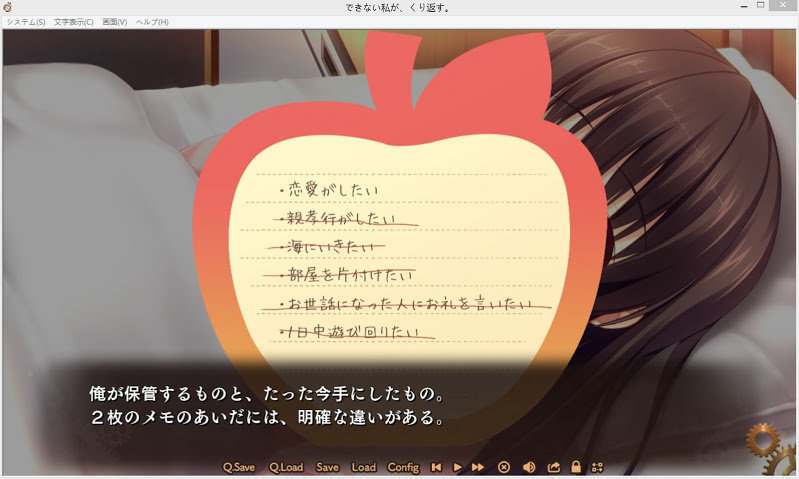
“I have seven wishes.”
“I want to fall in love.” “I want to be a good daughter.” “I want to go to the beach.” “I want to tidy up my room.” “I want to thank the people who took care of me.” “I want to play for a day.”
And the last one? Shino says, “That one’s a secret. I’ll tell you at the very end.”
So the protagonist volunteers: “If you want to fall in love, I’ll be your boyfriend. Actually, I liked you from the start.”
Shino thinks it over and accepts his confession, and they start checking off the wishes — visiting people, going to the beach, playing, tidying the room. At the beach, Shino asks him:
“Why did you confess to me?”
The protagonist thinks and says he once knew a big sister named Ren who had the same disease, and before he knows it he’s rambling on and on about Ren. Shino accepts that reason.
Then Shino’s condition worsens, and on her deathbed the protagonist asks about the last one, the seventh wish she never told him.
Shino pulls out the note, and the first line, “I want to fall in love,” hasn’t been crossed out.
“You never loved me. You loved Ren, didn’t you…”
Shino’s expression is complicated, almost resentful.
“Since you lied to me, my last wish is this: leave. I don’t want you to see me die.”
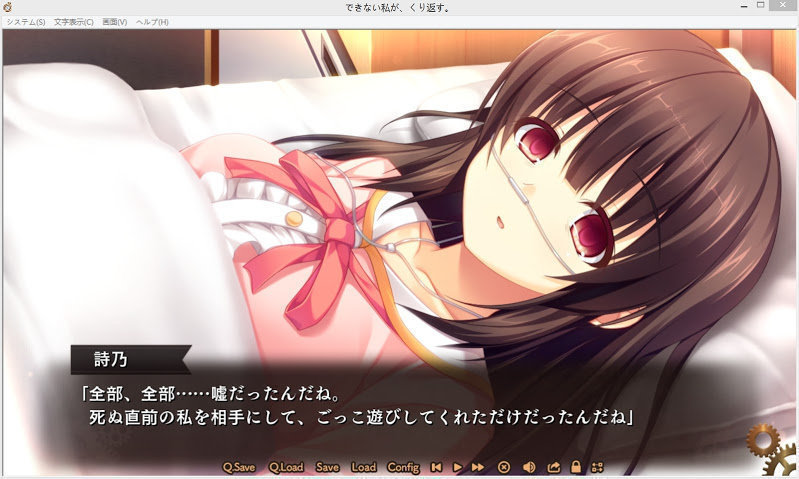
The protagonist leaves, depressed. The next day Shino dies, and she’s left him a letter — writing about her love for him, but saying she realized long ago that he didn’t love her, that he was just playing a romance game with her under the pretense of granting her wishes.
The protagonist regrets it and wants to actually save Shino, so he remembers big sis Ren. Even though Ren told him when she gave him the watch not to use time travel to come see her, he does it anyway.
He meets Ren and explains: five years from now a girl will die of cancer, and he wants to save her. Ren doesn’t get it at first and asks what he plans to do.
“I’ll study medicine over the next five years, with curing cancer as my goal. If I can’t save Shino in five years, I’ll go back another five and keep studying until I cure cancer.”
“Then… even if you cure cancer, what if Shino gets some other disease and dies later? I told you the future doesn’t change. Maybe Shino’s death is something that can’t be changed.”
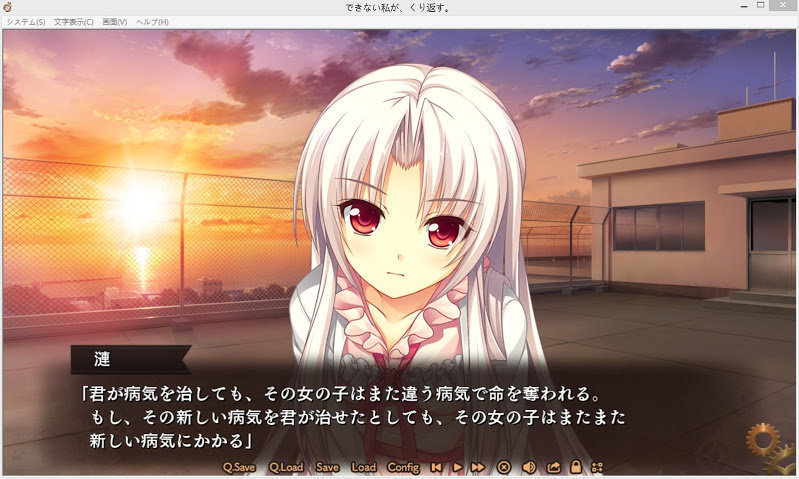
The protagonist is speechless. He gives up on the idea for now and stays with Ren to think about what to do.
After some time with Ren, and after a little girl in the same hospital bed as Ren suddenly dies, the shaken protagonist tells Ren the whole story of him and Shino. Ren thinks for a moment…
“I think you just need to not lie to her. Tell her how you really feel, and it should work out.”
The protagonist is skeptical. Time comes to five years later, and when he meets Shino again, things play out the same as last time — the confession, the beach, thanking her friends. Only this time, when it comes to Ren, he doesn’t lie.
He expected Shino to be angry, but instead she’s happy and forgives him.
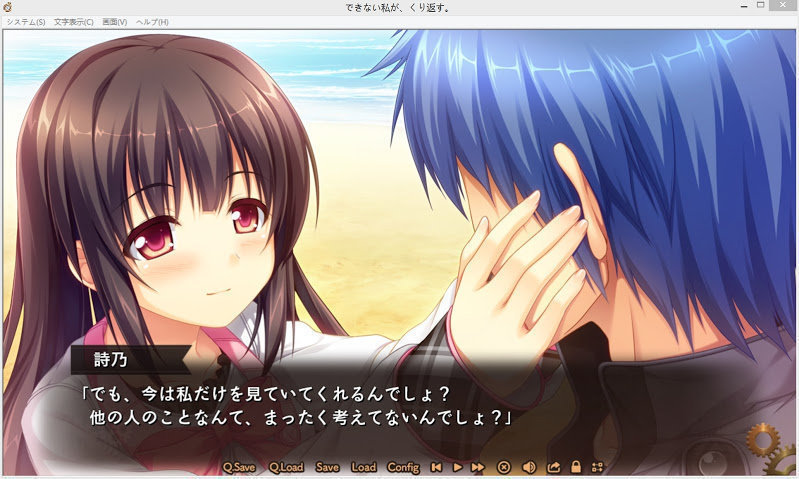
In the end Shino still dies, but this time she dies happy.
She leaves him a letter again, and this one has no resentment in it — just forgiveness and love.
Years later the protagonist visits Shino’s grave, leaves the pocket watch there, and tells her he loves her more and more. But even so, he can’t see her anymore — he can only faintly feel her soul.
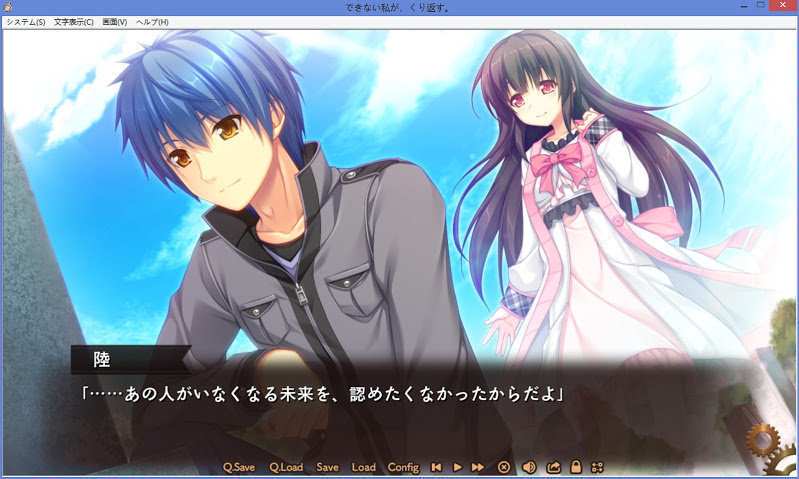
And that’s the story…
Broadly speaking, the core idea is good: be sincere with people, and have the guts to let go of the past.
“Time travel never changes anything, and the game sticks to that rule to the very end” — that part is good. At least the protagonist doesn’t suddenly pull a cheat and overturn a whole pile of earlier plot.
But don’t think the game’s story is actually what I just described. I mashed it up and processed it. The real thing is way crueler than you’d imagine. Even if my retelling has a bit of tearjerker factor, the game has plenty of problems. First, the other heroines’ routes — I can say this outright — have absolutely nothing to do with Shino’s route. Especially Yume’s route. That one’s a landmine: the protagonist dates the shut-in Yume, and then Yume’s best friend gets jealous and yandere, ties Yume up and kills her, and comes to kill the protagonist too. So the protagonist rewinds once to stop the friend’s murder plan, and then Yume learns her friend loves her and proposes a threesome with her and the protagonist. It gets approved. It ends in a threesome ending…
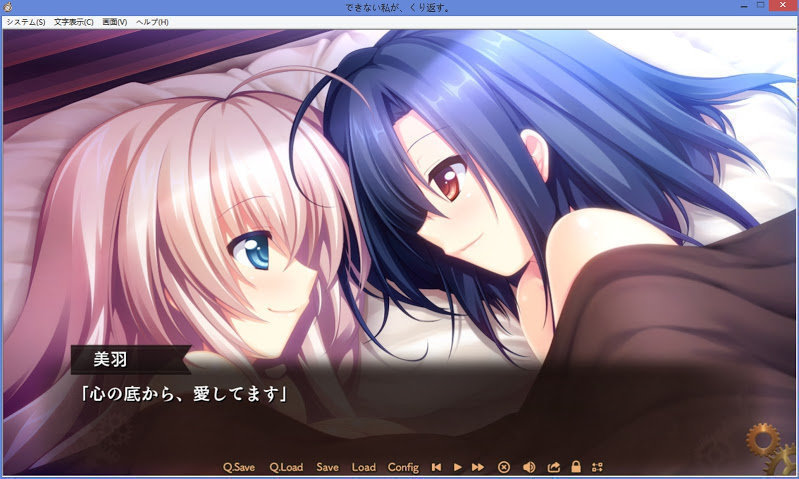
I was a threesome now.
Yume’s route was such a landmine it grossed me out so much I skipped the other two girls entirely and went straight to Shino’s route (which is story-locked). Even so, Shino’s route isn’t well put together either.
First, in the common route Shino is suddenly declared dead. The protagonist is chatting and laughing with her, then suddenly learns she’s hospitalized, doesn’t pay much attention, then she dies, and then Shino has nothing to do with anything anymore — not the other routes or whatever. It makes you wonder whether the earlier Shino plot needed to exist at all.
Then in Shino’s route, Shino again inexplicably dies at first, but the protagonist asks about her wishes. On the second rewind, he asks about her wishes, and here’s the highlight: Shino says she’s dying, and then with 500% more energy than the protagonist, she yaps and yaps and yaps and yaps and yaps and yaps and yaps and yaps and yaps and yaps and yaps and yaps and yaps and yaps and yaps and yaps and yaps and yaps and yaps and yaps and yaps and yaps and yaps and yaps every single day without end. Even later when Shino can’t move anymore and is stuck in bed, she’s still yapping and yapping and yapping and yapping and yapping and yapping and yapping and yapping and yapping and yapping and yapping and yapping and yapping and yapping and yapping and yapping and yapping and yapping and yapping and yapping at the protagonist nonstop. At the end of the first rewind, with the breath of someone about to croak, Shino slowly says “you don’t love me” — eyes hollow, expression darkening — and even as the protagonist keeps saying “違う,” Shino keeps yapping and yapping and yapping: “you don’t love me, you don’t love me, you never loved me from the start, I figured it out long ago” and so on.
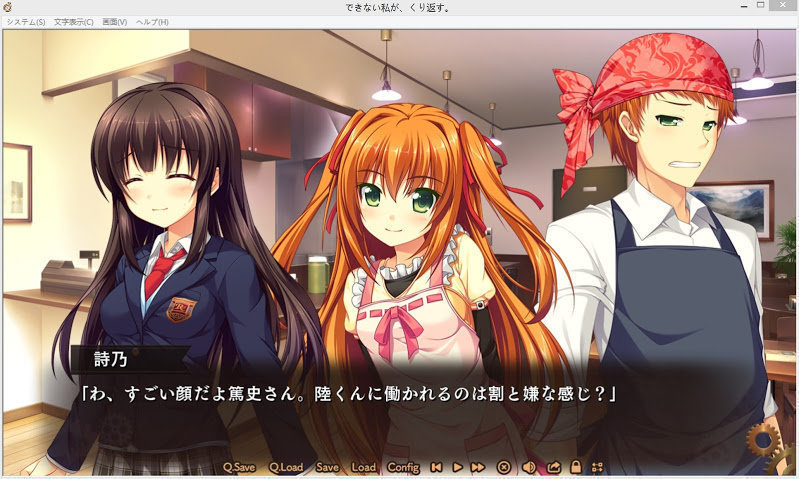
At this point I have to wonder whether Shino really had a terminal illness, or whether she was perfectly healthy and got literally nagged to death by the protagonist’s fake romance game. The story says at the start that Shino has cancer, but it never really specifies what kind. Later it seems to emphasize brain cancer, but brain cancer doesn’t present like this — at the very least, you wouldn’t be speaking that coherently.
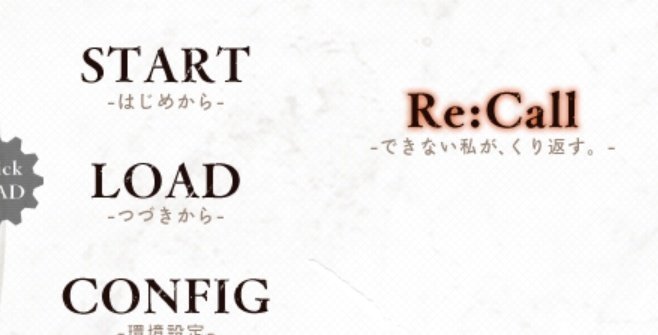
After the first ending there’s no ED. Instead a new Re:Call option opens on the game’s title screen. By the way, there are also some short stories there after you clear everything.
So after the protagonist’s second rewind — after he meets Ren — the game starts another round of yap yap yap yap yap yap yap yap yap yap yap yap yap yap yap yap yap yap yap yap yap yap yap yap yap yap yap yap yap yap yap yap yap yap yap yap yap yap yap yap yap yap yap yap yap yap yap yap yap yap yap yap yap yap yap yap yap yap yap yap yap yap yap yap yap yap yap yap yap yap yap yap yap yap yap yap yap yap yap yap yap yap yap yap yap yap yap yap yap yap yap, except now it’s aimed at Ren. The main plot should kick in after Ren rejects the protagonist’s plan, but the game doesn’t do that — it just goes back to the daily bickering. Look, adding daily dialogue in a visual novel is fine, but daily dialogue has standards. Some games’ slice-of-life is fun, some just puts you to sleep. Unfortunately this one is in the latter camp, same as SPPL. And the heroine spends most of her time buzzing like a fly — yap yap yap yap yap yap yap yap yap yap yap yap yap yap yap yap yap yap yap yap yap yap yap yap yap yap yap yap yap yap yap yap yap yap yap yap yap yap yap yap yap yap yap yap yap yap yap yap yap yap yap yap yap yap yap yap yap yap yap yap yap yap yap yap yap yap yap yap yap yap yap yap yap yap yap yap yap yap yap yap yap yap yap yap. No punchlines, just boring conversation.
Even more ridiculous is the game throwing in H-scenes with a dying person. Yeah, I know it’s an eroge, but you can’t just screw like that. It looks like the girl was fine until the protagonist banged her to death. Even more ridiculous: the protagonist goes back twice and bangs the dying girl three times each time. I’m starting to suspect he has a weird fetish.
Also worth mentioning is the BGM. The OP, Re:Call, is a god-tier song, but every other BGM in the game is annoying — no flowing melodies, just thick electronic noise, plus brutal switching. It’s hard to get immersed, especially when the daily scenes are already so sleep-inducing… And the person who did the music seems to know this, because Re:Call gets abused in tons of places, like 1/7 Mahou Tsukai — which just makes it look even cheaper.
At least the art is fine and reaches a decent level, but for a visual novel, if the core story and music can’t draw you in, then the visuals alone are destined to be a game you extract the CGs from and then delete.
Looking at the praise for Dekinai Watashi ga, Kurikaesu. now, most of it rests on “the protagonist sacrifices and repeats time over and over for the heroine.” But look closer: he repeats fewer times than Okabe Rintarou, the daily setup has too many unreasonable parts, the character routes are nonsense, and the whole “late-stage cancer patient with more energy than a healthy person” bit at the end is just unbelievable. I can’t vibe with much of it. Especially that last part — Shino saying she’s about to die while yapping endlessly and refusing to actually die just gave me the horrible dark thought of “why won’t this motormouth hurry up and croak.” Ultimately it all comes down to failures in the game’s planning.
Even so, I get what the story was trying to say, and I get what the writer wanted to express. He just took the wrong road. As the title says, できない私が、くり返す — no matter how many times “わたし” (the protagonist) repeats, the result is just a “できない.” The same goes for this game for me: no matter how it plays that trick, for me it’s “できない.”
Maybe “できない” isn’t quite right. Let’s use a more down-to-earth phrase: it’s all for nothing.
That’s roughly my take on the game called “Repeated Time Travel Did Jack Shit for Me.” Whether to recommend it or play it — up to you.
Comments are hosted on the Chinese main site. This mirror is read-only.