Futagoza no Paradox (双子座のパラドクス) Review
Twin Paradox
Twin Paradox (双子座のパラドクス) is another Cotton Software title. Why’d I play it? Mostly because its predecessor, Sekai ga Owaru Basho to Birthday, left such a strong impression on me. So even though the character designs are still shit as always, I was willing to give it a go. No other reason — I just wanted to see a story that could stand shoulder to shoulder with Birthday. That’s all.
But before I get into the game, I want to talk about something else: the science and pseudoscience elements in stories.
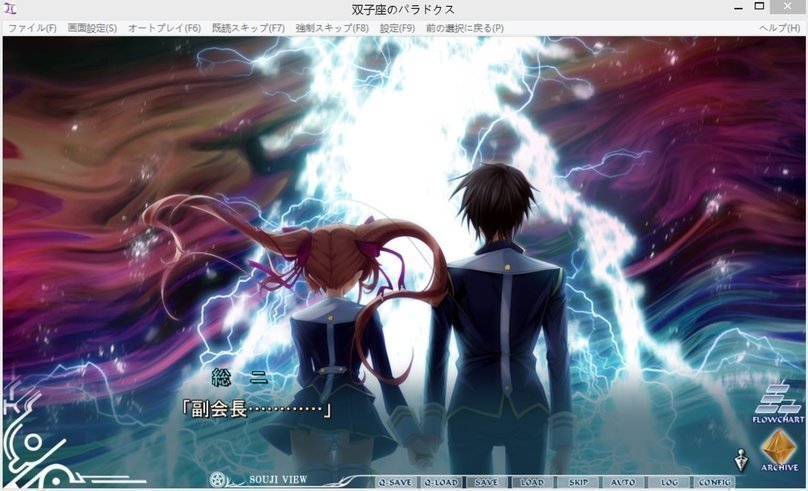
As everyone knows, a story is just a series of descriptions of specific interactions between specific people at a specific time and place. If you actually wrote it out straight, it’d bore you to tears. So we add all kinds of embellishments — detailed descriptions of psychology, detailed descriptions of appearances, padding the dialogue with mundane chatter so it’s not too dull, or maybe letting the two people interacting develop some feelings for each other…
And with that, you’ve got a passable little romance story. If it were a regular romance novel, that’d be enough to keep expanding.
But for an ACG work, that’s apparently not enough. In the ACG sphere, pure romance has basically no selling point because everyone’s banging heroines. Yours might be sweeter, yours might be more stable, but it’s hard to catch anyone’s eye. So some people started trying to fuse more content into the story — like cuckolding you, or the heroine being a monster, or the heroine already being dead, or the heroine not being human.
But these developments are all too low. There’s one thing that can attract those science-minded guys who stare at the universe and electronic components all day and have no girlfriend: sci-fi elements.
Sci-fi elements aren’t something you can just throw in. They’re inherently high difficulty, and… you have to make them sound plausible… at least superficially plausible.
A major shortcut to plausibility is tying the plot to some real historical scientific mystery and giving it a seemingly reasonable explanation. This kind of development is not only well-received but also lively and interesting, and it can attract fake science guys too… I say that because this is all still bullshit at the end of the day. A true science guy takes one look and knows it’s nonsense; unless your heroines are drawn well, they’ll still stomp you into the ground and call your work dogshit.
The prime example of taking this shortcut is a certain company’s “science fiction ADV” series. I won’t rehash how that series turned out; I just want to say that Twin Paradox is one of those games trying to take the same shortcut.
Twin Paradox’s story core has two points: one is the name, the Twin Paradox (双子悖论), and the other is the Philadelphia Experiment. In the Twin Paradox, one point is sending the brother out and bringing him back, and the game cleverly chooses the Philadelphia Experiment as the method of sending him out, combining the two and significantly raising the pretension level.
The game begins with the protagonist and his twin brother attending a school in the city called the “Superpower Research Academy.” Corresponding to the twin brothers are twin sisters, and one day, an explosion with a massive electromagnetic wave occurs at the school, and the entire campus disappears…
After this explosion, the twin brothers and twin sisters are separated into two worlds. The school is transported to a void-like otherworld, and the investigation into this phenomenon begins.
Looks like a great development, right? Unfortunately, that’s all there is to it. After that, the game kicks off a long, boring slice-of-life…
How boring? I thought about it for a while; it’s basically elementary school kids trading insults. It reminded me of a day I passed by my neighborhood and saw two kids trash-talking:
“Fuck your mom! You dumbass!” “No, I’m not a dumbass, you’re the dumbass, fuck your mom!” “You’re talking shit, I’m not a dumbass, obviously you’re the dumbass, fuck your mom!” “You’re bullshitting, obviously you’re the dumbass, you dumbass you dumbass you dumbass…” Then the other kid raised his volume too, “You dumbass you dumbass you dumbass you dumbass…”
My example isn’t exactly polite, but it does illustrate how weak this game’s slice-of-life writing is… And the reason I used this example is that I really didn’t want to resort to Qiong Yao-style dialogue.
What’s even more unacceptable is that this game is an 18+ title, and the developers, afraid you won’t know there’s fanservice, cram HCGs into every crack while the two sides are fleeing…
And they’re crammed in in a lowbrow way — like going to the countryside and seeing some middle-aged woman suddenly pull down her pants without warning, exposing her black forest and posing at you… In fact, most of the game’s HCGs involve scenes like going to the toilet, pissing, and masturbation. Not sexy at all; instead it gives off a smell of urine and shit. Combined with the Zhao Benshan-face art style, it’s purely disgusting.
Put simply, after that initially awesome “world separation” development, the game settles into a long, tedious, even slightly nauseating slice-of-life. No worthwhile investigation, just pointless wandering, and people bantering about “how to eat, how to bicker.” Especially on the void side — even though the cafeteria food is only enough for two meals, a bunch of people cheerfully play games, laughing and joking with no idea what’s going on. Meanwhile on the outside of the otherworld, progress is extremely slow, or even nonexistent.
So the slice-of-life drags on inexplicably for about two days. Then one day in the outside world, the teacher suddenly says, “Let’s go find the principal.”
At that point the protagonist notices everyone on the street is being mind-controlled (wearing sheep heads). The teacher’s earlier insistence that everyone not run around was probably to cover this up.
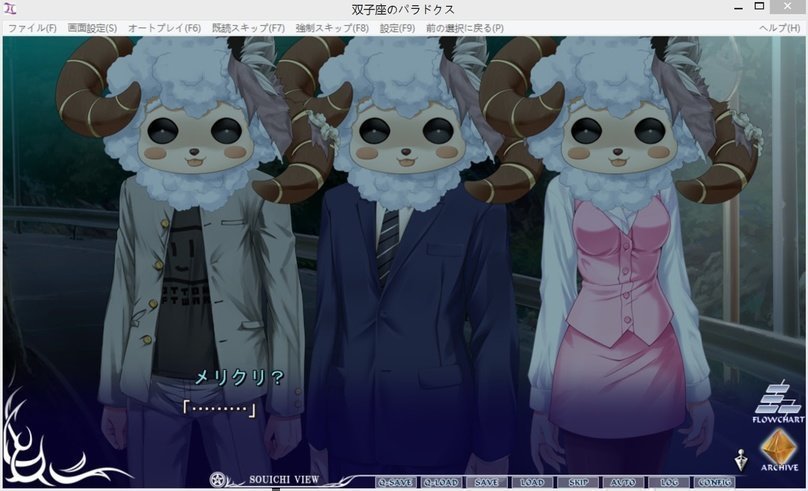
After much effort, the group crosses the street full of mind-controlled zombie-like people and meets the academy director. The director readily admits he’s the mastermind. He then says he has no interest in destroying the world or wiping out the Earth; he just wants to expand his superpower so he and his wife can live long lives.
Then the story enters a flashback, which also declares that the stupid slice-of-life from before is finally over.
Around 1943, the academy director had a twin brother. At the time, he and his brother were caught up in the Philadelphia Experiment conducted by the United States (Philadelphia Experiment). That experiment was largely a failure; almost everyone involved died, including the director’s brother. The director himself was the sole survivor and gained superpowers.
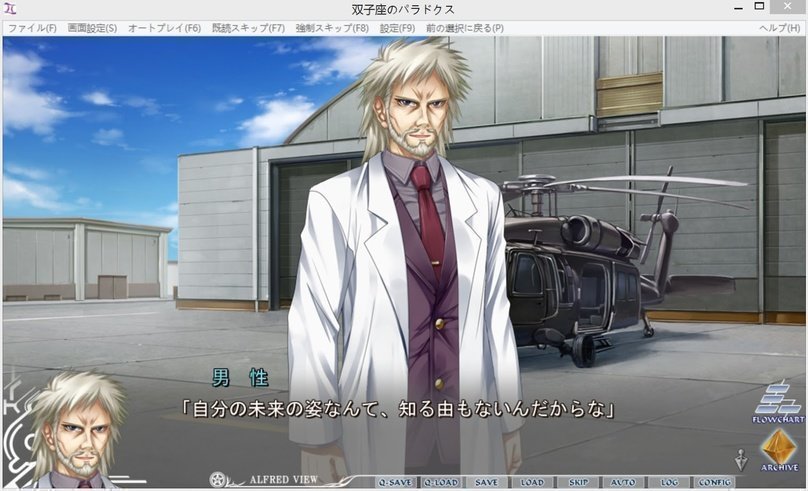
The director’s superpower is controlling the growth and development of living things — simply put, he can rejuvenate himself at will and won’t die of old age. But this ability has a drawback: each rejuvenation causes memory loss, because switching between brains in different developmental states inevitably leads to amnesia. The director also discovered that the people in the Philadelphia Experiment didn’t die; their souls traveled through time — for example, a person from 1943 might travel to around 2004 and possess someone. The director exploited this trait to develop a mind-control device.
The director has no grand ambitions; he just wants to be with his wife Tesla forever, to live forever. He tried rejuvenating himself and his wife together, but it went terribly wrong: his wife lost her memories and doesn’t really remember him. He then realized his superpower is limited, and to achieve true “lossless” rejuvenation and immortality, he needs another “Philadelphia Experiment” to gather more data and discover more people with superpowers.

So the director came from the US to Japan and founded this school for researching superpowers, so that when the time was right, he could conduct a second “Philadelphia Experiment.” That’s what caused the electromagnetic explosion at the beginning of the game. Obviously, the Philadelphia Experiment succeeded, and the school, like the ship in the original experiment, flew off to another world. The director also collected enough data, and naturally faced resistance from the protagonist, because the director’s actions completely ignored the students who flew off in the Philadelphia Experiment part of the school. The protagonist’s brother and childhood friend (the older sister) are still over there. The protagonist protests.
At this point the Boss — oh right, the academy director — raises a question to the protagonist: “Are you and your brother really twins?”
Then the game enters a second flashback. The protagonist recalls that when he was little, he was alone, laughing and chatting every day with the twin sisters (his childhood friends). Until one day, he and the older sister went to the beach, a huge wave came, and swept the sister away. From then on, only the younger sister remained of the twins. The protagonist was heartbroken and hated himself. At that moment, the soul of the director’s brother from the first Philadelphia Experiment suddenly traveled through time and possessed the protagonist. The protagonist then had a dual personality. The possessor sympathized with him and told him he had the ability to take him on a world-line jump, go back, change history, and save the twin sisters.
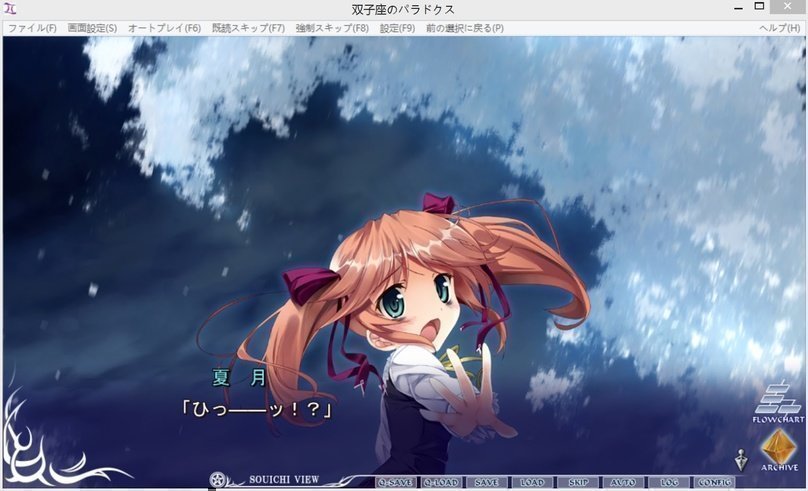
The protagonist didn’t believe it at first, until a portal opened and he went through, then he believed. Same day at the beach, same playing sister, same huge wave. The time-traveling protagonist found he hadn’t replaced his past self but became independent. He watched his other self flounder helplessly, then decisively saved the sister, preserving the twin sisters.
But the past protagonist looked at the time-traveling protagonist and couldn’t help asking, “Who are you?”
After some hassle, the protagonist convinces his past self that they’re twins. Their names are arbitrary: one is “Soichi,” the other “Soji.” This is where the game ties into some Twin Paradox setup — like the older brother traveling back in time and meeting his younger brother again, who’s older, etc. But the time travel here actually uses parallel worlds, which is basically bullshit with no reference value, at most just cool.
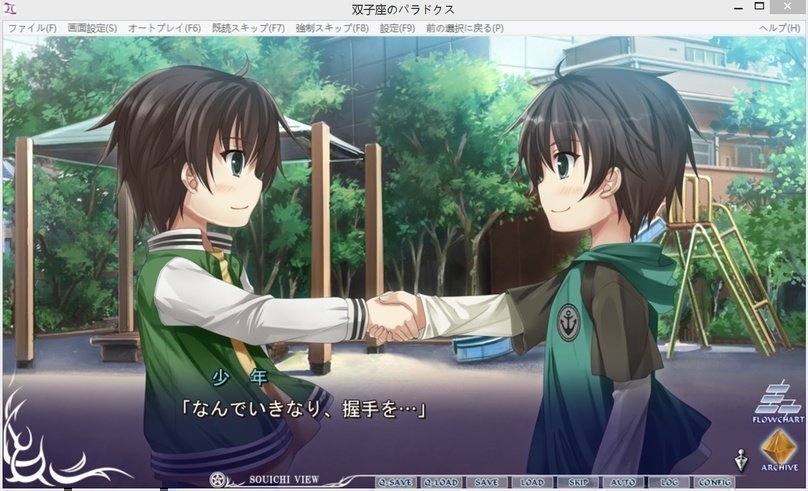
So the story begins in a very chaotic world line. The protagonist, who isn’t originally from this world line, becomes the younger brother of the original world line’s protagonist. And the older sister who should have died didn’t die; the twin sisters are preserved, enabling the twin vs. twin setup at the game’s start. That’s the beginning of the original world line.
After the flashback ends, the protagonist finally remembers that his twin brother is just himself from another world line. Now the story has become a mess: the director wants to kill people, the protagonist has become brothers with himself and the other self is stuck in the otherworld. After finally foiling the director’s plan, the director sees the soul of his dead brother in the flames and finds peace. The group runs back to school and finds the chaotic streets restored and the school back. But the protagonist’s other brother — his self from a different world line — hasn’t returned.

Just then, a person appears — the one who’s been wearing a sheep hood the whole time. He removes his mask: it’s the self from another world line, the brother. He explains that after being trapped in the otherworld, he was suddenly transported back, but to a different world line where he had already died, and the twin sisters had died too, leaving only the younger sister. So he and that world line’s teacher researched and regained the ability to travel, and came back to this world line early to wait for this moment of grand reunion.
Then the game ends.
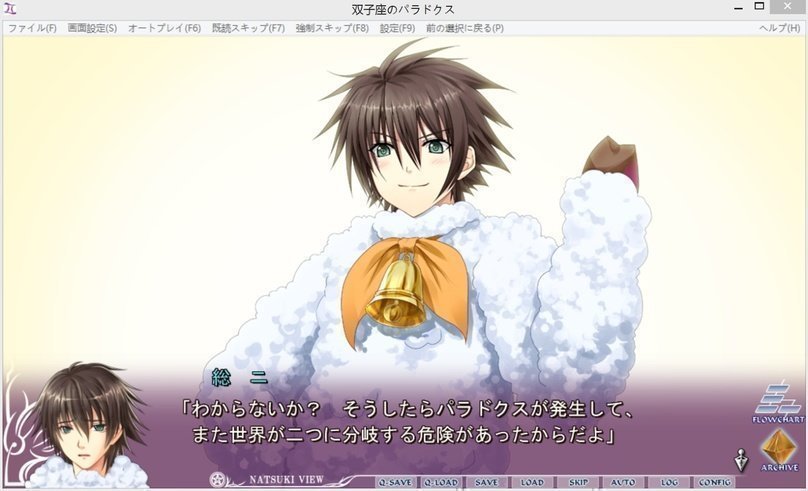
Dizzy yet? I sure as hell am…
To summarize the plot broadly: the protagonist travels back to the past as a child, changes the world line to save someone, and becomes brothers with himself. Meanwhile, a director seeking to extend his life recklessly triggers a knockoff Philadelphia Experiment, splitting the brothers into two space-times. In the end, the protagonist lost in the other space-time finds a way back and restores everything. Nothing happened, except the director wasted his effort.
Maybe that explanation is easier to understand.
The first point, the setup of becoming brothers with yourself, is similar to the “Twin Paradox,” while the Philadelphia Experiment replaces the original Twin Paradox’s “brothers flying off in a rocket” method.
Even so, the game’s plot is still a mess. I consider myself decent at parsing plots, but this jumbled mess is really hard for me to explain clearly. Yet after stripping away unnecessary stuff, I find the plot actually has nothing much to say — it’s just a chaotic world line returning to normal. There isn’t even a proper boss battle at the end. Aside from the True End, the other individual routes have some interest, including the berserk student council president’s superpower duel with the protagonist, and the utterly stupid vice president getting blown away by the protagonist.

The game uses too many unnecessary things and smoke bombs to bury the twist that “the school explosion was actually a Philadelphia Experiment jump to the void,” including nameless monsters in the void campus, various silly underground research cannibalism subplots, and that inexplicable senpai route where the senpai pops out to kill her alternate-world self to ensure she can stay with her father (a bit like Yuno Gasai from Future Diary). The writing is so juvenile it only makes you laugh.
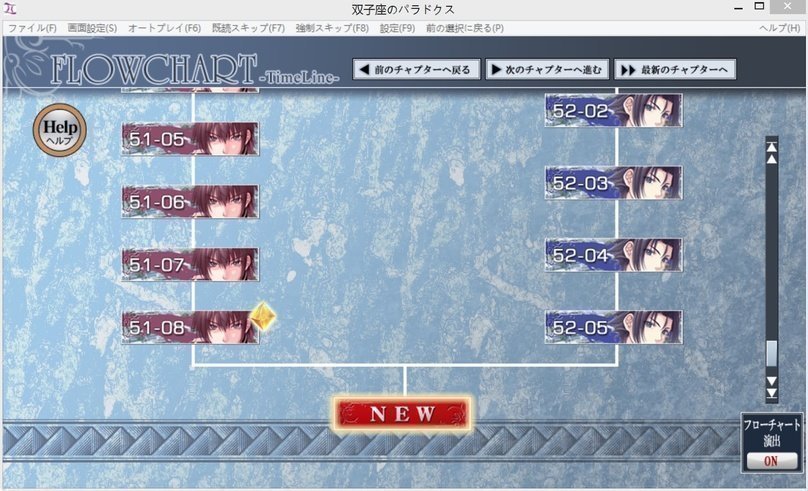
How should I put it? The game’s setting, plot framework, and even the flow of developments are quite good. To showcase this, the game specifically uses a timeline system to show you the direction of each story flow, and a multi-perspective system where the two protagonists and different heroines have separate viewpoints, with clear indicators at branches telling you this is a branch point and so on.
But none of that matters.
Because no matter how good the framework is, the scriptwriter’s ability to present the story is too poor, and he arbitrarily stretches out the game’s foreshadowing line, like stretching a low-resolution image further and making it even more unbearable. This problem was already visible in Sekai ga Owaru Basho to Birthday — whether it’s the “God morning” or the inexplicable bickering, or the particularly stiff “artificial A.I. setting insertion,” the execution wasn’t great. But that game’s plot was so tight that the flaws were like detail textures in a fast-paced game, not very noticeable. In Twin Paradox, perhaps the scriptwriter felt too good about himself and just went wild. Clearly not his strength, yet he deliberately shows off, trying to flex and failing, leaving only deep disgust. Whether it’s Tesla’s “My god” or that retarded foreigner’s English written entirely in katakana, it made my buddy twist and squirm like he’d broken his back — a whole-body goosebumps discomfort.
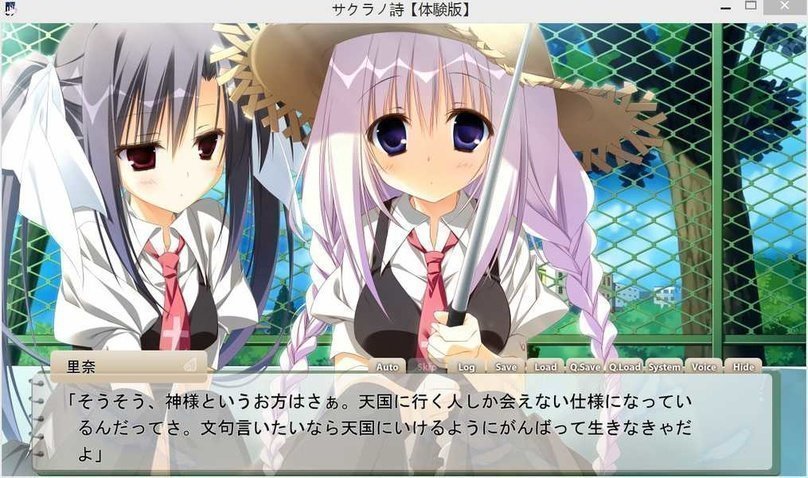
The game’s use of CVs is also a waste. The heroine is the famous Ono Ryouko, the senpai is the famous Matsuda Risa, and even that Meri sheep is Fujimori Yukina. So many powerful CVs, but because the script lacks character development, they can’t show their stuff. Compared to Sakura no Uta, which I played around the same time, with mostly the same CVs, it’s heaven and earth.
Only now do I realize that a big reason Birthday ranks high for me is its tight plot and well-timed developments. Twin Paradox not only abandons tight plotting and starts padding, but also makes a mess of the developments, explaining nothing clearly.
So the only fighting strength it had is gone. What’s left?
Music? The OP and ED are decent, but the BGM really doesn’t cut it. Art? Don’t make me laugh… I can’t be bothered to talk about it… just look at the screenshots. CVs? I’ve seen CVs carry a game, but this is the first time I’ve seen a game waste its CVs.
So for this game, I can only say: fast-forward through it to get the general setting and basic plot. As for the details, no need to understand them, and no point either. The science stuff is pseudoscience anyway, and it can’t even explain itself well — it’s downright confusing. Plus this is a nukige; even if you know it, you can’t go to Reddit and show off to your buddies because almost no one wants to play a game with such disgusting art. In the end, learning about it is a waste of time. The framework is good, but in the process of understanding it you’ll inevitably eat a lot of shit… and after eating shit you won’t get even a bit of satisfaction, like me.
So, life is beautiful — why be a fag? High mountains, flowing water, cherry blossoms, flying birds — wouldn’t it be better to go play some moege?
Comments are hosted on the Chinese main site. This mirror is read-only.