Impressions: Logitech UE TF10 / Etymotic ER4P / Creative IE3
No Mysticism, Just Impressions
I’m the kind of guy who feels like something’s missing without BGM, so I need music with me in all sorts of situations — whether I’m alone for a long stretch or just trying to wall myself off for a while. Anyway, this habit started back in middle school when I began listening to the radio.
In high school I got my first MP3 player, a Walkman perfume-bottle model. I honestly can’t say exactly when I started inexplicably chasing sound quality. Anyway, once I had a job and money, I accumulated a bunch of slightly more audiophile-ish gear — players, sound cards, headphones, earphones. So this time I’ll talk about the three IEMs I’ve actually been listening to: TF10, ER4P, and Creative IE3.
I really hate using baffling vocabulary when describing sound quality — half those terms I can’t even feel the meaning of myself. So, as the title says: no mysticism, just impressions.
Source: Sony F807, all music in FLAC.
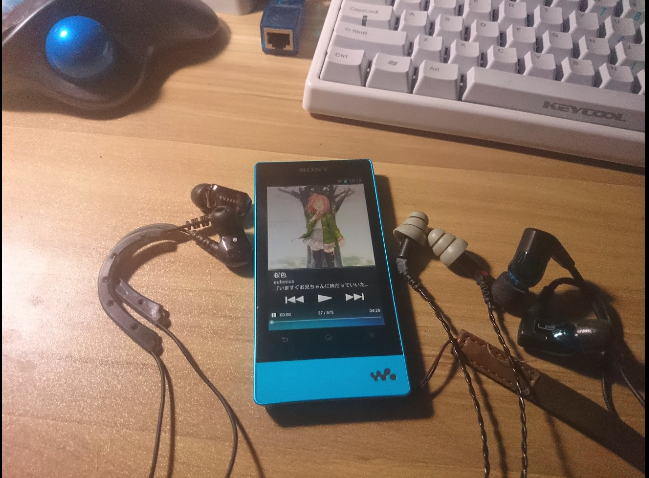
Logitech UE TF10
This was probably my first expensive IEM — and honestly, the one I’ve used the longest.
I’m not going to bust out any mystifying jargon here. I’ll just say the TF10 is a “spec-sheet stacker.” I don’t mean that as an insult — for an IEM to present well, solid fundamentals are a must, and the TF10 has them. In fact its performance is genuinely impressive: hand it to someone who’s never heard this price bracket, and the improvement in sound quality is obvious.
The TF10 emphasizes detail in every aspect of a track — the little sound effects added during performance, the spatial positioning in the recording. If you listen to the YuruYuri OP on the TF10, you can clearly tell where each of the four singers is standing. This trait stands out even more on live recordings: on Jacky Cheung’s live version of “She Comes to My Concert,” the guitar and the singer’s position are clearly distinguishable. Close your eyes and it’s almost like being there.
Beyond that, the TF10’s sound suits mass tastes. For most users, the biggest benchmark for sound quality is whether the bass hits hard, and the TF10 satisfies that nicely. Pop, electronic, even symphonic music — it maximizes the detail advantage.
As for downsides… the TF10 is a bit of a pain to wear. And on presentation: sure, all the details are there and the bass is punchy, but under that premise the singer’s voice easily gets buried in the instruments. On busier tracks you can clearly tell this is the synth, that’s the drum kit, even a faint flute accompaniment is distinguishable — but the vocal no longer stands out…
Etymotic ER4P
My reasons for buying this were complicated, but simply put: I got tired of the TF10’s noisy style and wanted something quieter, with less booming bass. So I bought it.
Lots of people praise the ER4 series — ER4S, ER4B and so on. But I figured I didn’t have gear with that much power, and a little MP3 probably couldn’t drive the high-impedance ER4S, so I bought the phone-friendly ER4P. Turns out even then, the Sony F807 can’t fully drive it… Compared to the TF10, the volume is noticeably lower. Even so, some character comes through.
As I said earlier, the TF10 lays out all the detail and backs it with strong bass. The ER4P has the detail too, but the bass isn’t as strong. That doesn’t mean it has no bass — it means the ER4P presents music as “what you give me is what I play.” If a track was recorded with light drum hits, you won’t hear TF10-style thumping from the ER4P… nor will you feel obviously surrounded by the music. It’s a bit like taking the recording as it was and reproducing it verbatim. Maybe the F807 lacks power, maybe it’s the ER4P’s monitor nature — either way, this thing adds zero decoration to whatever you’re listening to.
That’s not a knock, nor exactly praise, but honesty is always right. The ER4P’s virtue: you can clearly hear whether a track was post-processed or recorded from a real performance. The fake bass and synthesized piano in R&B are so obvious on the ER4P. Listening to music with that slightly critical attitude is actually pretty fun.
The ER4P’s downsides: massive microphonics — you need to clip the cable carefully. And the triple-flange tips go deep into the ear canal, which some people find unpleasant. I think… it’s pretty good…
Creative IE3
This is my most recent purchase — still in the honeymoon phase, listening to it constantly. I’d heard from various places that Creative’s model does vocals well, so I grabbed it on sale to fill the vocal-IEM gap in my collection.
I’ve always been reserved about Creative’s audio products — they left me with an impression of garbage QC. Sure enough, I got hit again: out of the box, only one ear worked. I contacted the seller and got a replacement, which went smoothly enough. The replacement arrived before Spring Festival.
I plugged it into the F807 and was startled — a huge noise floor… I looked it up and plenty of people call this thing a “noise-floor detector.” The name is well earned. People always say the F807 never solved Android’s noise-floor problem, but I never really heard it with the TF10 or ER4P. The IE3 exposed it instantly.
Being a “noise-floor detector” means power isn’t an issue — even a little volume feels like plenty. Compared to the TF10 and ER4P, the IE3 is incredibly comfortable to wear — so comfortable you almost forget you’re wearing IEMs. That’s a standout plus.
Sound quality is hard to judge, because the IE3 suits so few songs. They say vocals stand out, but… only vocals stand out. Play bass-heavy rap or R&B and you’ll feel almost no bass, plus the noise floor — it’s less clean than the ER4P. And maybe to emphasize vocals, it deliberately overemphasizes slightly shrill sounds. The downside: listen to electronic music, or intense tracks with synth sounds… tough luck. The IE3 plays it as pure noise, screeching the whole way through. Even some female singers — Fish Leong, for instance — whose recordings are full of saliva, teeth, and breath sounds: the IE3 makes those details even more obvious, to the point of irritation.
But that doesn’t make the IE3 garbage. I said it suits few songs — you need to meet these conditions:
- No electronic synthesis; real instruments only
- Few instrument types, on the quieter side
- For female vocals, nothing with constant runs and high notes
There should be plenty of songs like that — Makino Yui, for instance, or Xiong Tianping’s “Matchstick Heaven,” or Oku Hanako, or Jacky Cheung live. All good choices. Through the IE3, the instruments truly become accompaniment rather than stealing the show, and the singer’s voice comes forward. It’s intoxicating.
So what do I recommend…
Having briefly introduced these three, if I had to recommend one, I’d still say the TF10. The reasons are solid:
- First, it’s an all-rounder. Whatever genre, you can listen to it well. Even though I said vocals get buried, it’s not that severe.
- Second, durability. Spend over a thousand on earphones and one accident ruins you. For the ER4P, finding an original cable is basically impossible; the Creative IE3 doesn’t support cable replacement at all. The TF10’s cable swaps freely — if you snap it, just buy another on eBay; you can get a usable one for under a hundred.
- Finally, device compatibility. Driving the TF10 doesn’t require worrying about power. The TF15 version is also worth recommending — it has a mic and one-touch answer, a blessing for phone users. Plus foam tips are easy to buy.
Come to think of it, besides IEMs I have plenty of headphones — Koss PP, K420, Creative Live!, Q7011, HD201 and so on. But most of those are plugged into the computer and I’ve never done proper testing. I’ll write about them another time if I get the chance.
Comments are hosted on the Chinese main site. This mirror is read-only.