Koisuru Natsu no Last Resort (恋する夏のラストリゾート) Review
The Awkward Reverse Bucket Effect: Koisuru Natsu no Last Resort
There’s a line literary types like to throw around: “Life should include a trip you take on a whim—pack your bag, hit the road, get away from the city noise, and find inner peace.”
Honestly, that’s not wrong. Most of the time even when we do travel, we lose the fun to planning and second-guessing, so one carefree trip really can be a decent way to blow off steam.
Unfortunately, I hate traveling…
Or rather, I hate traveling in China.
The reason I hate it goes back to some childhood trauma. I’d forgotten most of it, but a conversation with some dumb blind-date woman a while back dredged it all up again.
In elementary school my dad took me along on his workplace group tour to Changdao—oh wait, “vacation” is more accurate.
I’d never seen the ocean back then. Changdao sounds like a Japanese name but it’s actually in Shandong. I was hyped at first, but the hype curdled into misery fast.
We went by train. Just getting from Zhengzhou to Shandong and then to the coast ate up more than two days. Two days isn’t long, but being stuck on a train turns it into house arrest. Meals were all instant noodles, the berth had no AC, and the constant rocking left me bored stiff and wiped out. When we finally got to Changdao, the place had nothing—just an archipelago of little islands with sea, trees, hills, and apartments. That’s it.
Day one, they dragged us up a mountain. Climbing a mountain on an island is weird, but the guide said it was “scenery”…
At the top, someone told me shouting at the distant mountains would make me feel better.
“Fuck—your—mother—”
I yelled it at some far-off peak on Changdao whose name I can’t remember now.
“Fuck—your—mother—”
The mountain shot it right back without missing a beat. That made me even more irritated.
A seemingly isolated island should be romantic and relaxing, but nope—two days in we got hit with bad weather. The waves roared outside while we huddled in the apartment playing cards. I didn’t even know how to play Dou Dizhu, so I was stuck watching TV, which had exactly two channels. By the end of that stretch I was getting hard just looking at the female news anchor. Then on the last day the sky cleared, we took a walk on the beach, I felt nothing special, and Dad told me we were heading back.
At first I was thrilled—finally escaping this nightmare. Then it hit me: we had to take the train back.
I don’t know what state I was in when we got off at Zhengzhou station. All I know is my takeaway was: I never want to travel again.
And honestly, I haven’t since, even though the travel situation these days is a bit better than back then.
Lots of people tell me travel is a great way to decompress—get away from work, go somewhere nobody knows you, explore the unknown, take in the scenery. Sure, that can relax you.
But to me, modern travel is just boiling hotpot in a sea of people.
That said, work recently forced me into some short outings that barely count as travel. The destination was an impoverished county with a mountain. At the summit I remembered what that Changdao guide told me, and with work stress weighing on me, I decided to give it another shot.
Except this time I wasn’t gonna be a dumb kid about it. I’d add the target’s name.
“Di—rec—tor—” I glanced around, saw nobody, and let loose. “You—are—a—dumb—ass—”
The distant mountain answered quickly, but the reply was weird…
“Mas—ter—you—are—a—dumb—ass—mas—ter—you—are—a—pig—dumb—ass—pig—mas—ter—you—are—a—dumb—ass—”
The echoes overlapped into a mess, but my ears still took serious damage.
So I no longer believe in travel as a stress-relief method. Whether it’s some far-off island or a lonely mountaintop, all you get is garbage noise. None of which stops Galgame companies from using “island resort” as a premise.

There are actually quite a few island-resort Galgames, and they’re popular for good reason: the setting is small and easy to bullshit without contradictions, and islands mean beaches and swimsuits—prime fanservice territory.
So a beach-swimsuit-themed game like Koisuru Natsu no Last Resort naturally brings a bit of summer vibes. The setup is pretty ordinary: a proprietress who wants to open a resort that offers “true relaxation and healing” hires some waitresses, a cook, and muscle, all working toward the grand opening. The protagonist is a broke college student hunting for work, and with the heroine’s help he gets in through the back door as her “fake boyfriend” to earn cash—and ends up dating one of the waitresses. The pay is 25,000 yen a day. That’s literally heaven. But weirdly, after working there a while, he notices the resort has zero customers. When he asks the proprietress, she dodges the question and instead lays down rules: everyone reports to her daily, covering work observations and personal mood journals.

At first the game just explains why the protagonist came to work on this island—very ordinary, very flat. The real mystery only shows up once you realize there’s a full staff, high wages, and not a single guest.
The protagonist wonders: why?
I wondered too: why?
This is classic detective-drama island setup, right?
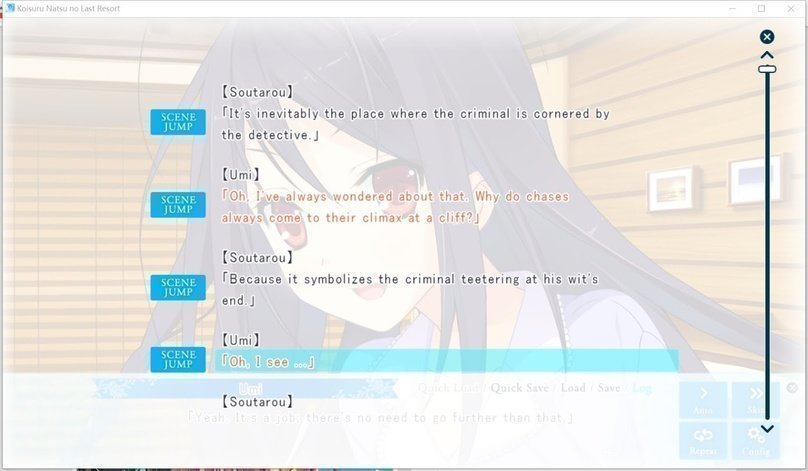
By normal Galgame logic, the proprietress must have some wild secret—maybe a killing game and class trial? Maybe it’s a rich guy’s private orgy apartment? Maybe it’s actually a place where someone is being kept?
But the game gives a really weird answer: the proprietress’s lack of confidence.
She says she wants to make this resort great. A truly excellent resort should make people feel joy, relaxation, and healing, so she’s dissatisfied with the current state—she doesn’t think it achieves that. A perfectionist, she hand-picked girls with varying degrees of mental issues as staff: some are overloaded with stress, some too introverted, some panicky, some unable to control themselves. She gives them jobs and demands daily reports on their feelings, observing whether they’re being healed and relaxed.
Sometimes she pressures herself so much over it that she takes it out on the staff.

“If my resort can truly soothe people, these girls will naturally be healed by it too.” That’s her thinking—but she herself is trapped in obsessive-compulsive perfectionism. Only now do I realize this is a flag for the proprietress route.
Because she chases perfection too hard, the resort never opens. I get the logic. It even sounds plausible.
But isn’t it a bit too forced?
If you ask me, this shitty setup shouldn’t exist at all. Just go work there, fall in love, bang, and even if the proprietress lacks confidence, you can trigger that flag after opening. No need to shoehorn this whole contrivance in just to set up her route—but without it, there’s basically nothing left in the game.
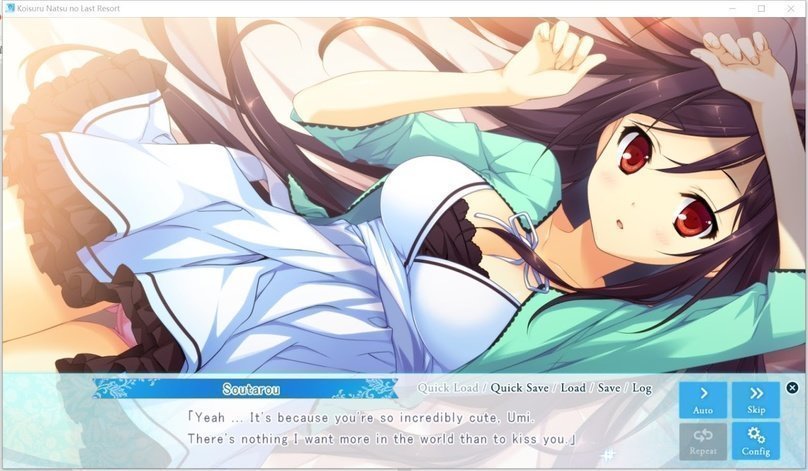
Koisuru Natsu no Last Resort isn’t short. From the protagonist and heroine getting to know each other, to working there, to the fake relationship, to the truth coming out and deciding to date for real, to all the lovey-dovey stuff after—the long romance line guarantees sweetness, and Umi’s CV Nakajima Saki does a standout job selling the girl’s charm.

But outside the romance, the slice-of-life is just… boring.
Most Galgames have some gags in the daily scenes. This one has basically none—just plain girls talk and a loop of good morning, good afternoon, good evening, breakfast, lunch, dinner, lol bye, shower. Fine for a day or two, but a few more and you’re nodding off. I get why the writer added mystery to keep you awake, but that mystery is so drawn-out it doesn’t even deliver a payoff.

The game seems to have plenty of routes: Umi, the other waitresses, probably the proprietress—if not here then in a later FD. I say that because I only did Umi’s route, since hers is the canonical one: meeting, fake dating, fake becoming real, leaving the island after the job with fond memories, and ending up together. That’s how a normal romance should go. In a main plot like that, having the protagonist suddenly cheat on the island or hit on the proprietress would feel wrong no matter what.
This game is hard to rate. It has no real flaws—good art, competent CVs, music that fits the setting, and Duca’s OP Taiyou to Kimi to gives you all the hula-dancer summer ocean vibes you need. The OST carries that style throughout. The story… the mystery is dull, but it doesn’t feed you shit, so you can’t criticize it too hard.
Still, I can’t call it good. And ErogameScape’s classification baffles me even more:

Koisuru Natsu no Last Resort is tagged straight-up as a “nukige.” But come on, it’s nowhere near nukige territory—plenty of games are way more fap-worthy. Koikano, Hoshi Ori Yume Mirai, Daitoshokan no Hitsujikai, even Witch’s Dinner are all more practical than this. Koisuru Natsu no Last Resort doesn’t even have a white flash during the sex scenes, let alone squelchy sound effects. How is it a nukige?
Then I thought about it: the game has no flaws in art, music, CVs, or story—but no highlights either. In the Galgame flood, no highlights means no selling point. If you have an god-tier twist, you can be crowned a god; even if your game is shit, some idiot will happily eat it, like the anime Charlotte—making something shit can still generate buzz.

But Koisuru Natsu no Last Resort isn’t a masterpiece and doesn’t make you eat shit. Try to say the story’s bad—the romance is sweet. Try to say it’s mediocre—aside from that pointless drawn-out foreshadowing, it has no weak spots anywhere. Most, most, most importantly, the art is good and the music is good—but the artist isn’t famous and the composer isn’t either. In short: nothing to discuss, nothing to snark about. That leaves a lot of moe-critic types stumped.
Finally we find its highlight: the game has multi-player sex scenes. If I’m not mistaken, not just 3P but full-on naked orgies.
Beach, uninhabited island, more women than men… and eroge players. That kind of scene is the first thing anyone would think of, and it ended up being the game’s only marketable highlight.
There’s a thing called the bucket effect: the shortest stave determines the level. For Koisuru Natsu no Last Resort, all its staves are the same length—only “multi-player” sticks out as the single longest board.
Sometimes you can evaluate a game with the “reverse bucket effect.”
“Let’s just call it a nukige!” the eroge critics slapped the label on Koisuru Natsu no Last Resort and breathed a sigh of relief. Finally they could add a fresh line to their glorious eroge-criticism career and look cooler in front of the grade-schoolers on the forums.
But having a game defined so hastily is just awkward.
Comments are hosted on the Chinese main site. This mirror is read-only.