Save the Person First, Then the World
I’m obsessed with reading all kinds of stories. As I said before, I like to soak up the thoughts and feelings inside a story, not just extract some bare conclusion. And stories aren’t limited to novels—they come in all shapes and sizes. So yeah, AVG games count too.
Lately I’ve been bouncing back and forth between novels and visual novels. I’ve read way too many stories—some happy, some sad, some boring as hell. Maybe it’s because I’m a sucker for “philosophical mystery” plots, but I’ve got a real soft spot for Japanese storytelling. Compared to the brainless harem wish-fulfillment you get from Chinese stuff, or the intense, spicy flavor of Western media, the Japanese style—a little chuuni, a little slow—hits different.
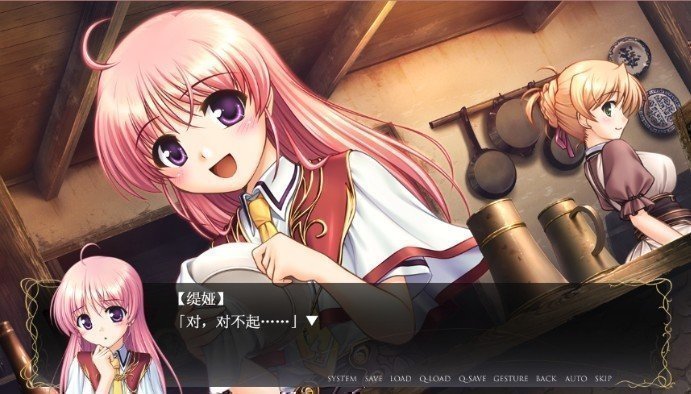
I’m getting off track. I’ve played a fair share of visual novels, and honestly, very few have plots that really hold up to scrutiny or give you a complete sense of immersion. Most of them can’t escape the usual banter and girls throwing themselves at you. Just having some payoff at the end or in the True End is already a rare feat—like Hatsuyuki Sakura. I used to wonder: is there a company out there brave enough to ditch the mindless harem romance, take a cold, clear-eyed look at things, avoid all that sappy lovey-dovey bullshit, and tell a genuinely thought-provoking story? That would be amazing. But eventually I figured that was just naive. Gal is still short for Girl and Love—without harem and sexy elements, who’d even make one? Of course, that was before I played Eustia of the Tarnished Wings (穢翼のユースティア)… The reason I say that is because this game actually pulls off that idea—“ditching the sappy romance and seriously telling a story”—and it does it well. Everything is handled with care. Playing through it, I was floored by the scenario. The way it builds layer by layer, all the way to the end, leaves you with this endless aftertaste. Major spoiler warning for the rest of this post
The Chinese translation of Eustia of the Tarnished Wings came out pretty early. The reason I’m only playing it now is because I got spoiled a long time ago. The spoilers were roughly:
- Eustia sacrifices herself to save the world
- The blind saint is a fake
- Alice is a yandere and she’s so cute aaaaaah
But looking back now, not a single one of those spoilers was true… I guess I should thank those unprofessional spoilerers for not ruining too much of the experience. The game is called Eustia of the Tarnished Wings, but I think the real protagonist is Caim. The story is really about Caim—about justice, independence, faith, fairness, and redemption…
Fione and Justice
Thanks to those sloppy spoilers, I initially thought Fione was just a passing heroine. Her actually becoming a main heroine was a bit of a surprise. Fione’s chapter doesn’t focus much on the romance between her and Caim—actually, that’s true for every heroine in the game. Fione is a Feather Hunter, part of the state-run military. You can think of them like the city’s urban management… yeah, their reputation is about the same. Caim and Fione cross paths while tracking a monster called the Black Feather. Fione is portrayed as upright and rigid, loyal to the country. Even though the Feather Hunters have a bad rep, she believes what she’s doing is justice. But it’s exactly these types who break the hardest when they realize their so-called “justice” isn’t justice at all. Fione discovers that the Black Feather she’s been hunting is her own brother, and the featherized patients she’s been escorting aren’t being protected—they’re being killed. She’s been an executioner all along, dressed up as justice. Fione completely falls apart. I said the same thing when I watched Gargantia on the Verdurous Planet: the scariest thing is realizing that what you’ve believed in is fake, or that the justice you trusted is a lie. It’s like suddenly finding out your emotional pillar isn’t light but a tumor—the only possible result is instant collapse. Fione’s brother, the Black Feather, tells her before he dies: “You must wield the sword, not be wielded by it.” He tells her that true justice has to be built by yourself, not handed down by someone else—you can’t just blindly believe whatever you’re told. Caim has never liked the Feather Hunters, but Fione gets to him. In the end, he uses sarcasm and mockery to provoke her into pulling herself together, to pursue real justice and gain an independent self. But… she also ends up hating Caim.
Playing through this part, I got the feeling Fione sort of understood Caim was deliberately provoking her to cheer her up, but maybe she’s just too thick-headed and went along with it, ending up on the opposite side. Fortunately, there aren’t many chances for them to actually clash afterward—just some verbal sparring.
Alice and Independence
Honestly, there’s a fair gap between Fione’s chapter and Alice’s chapter. They seem unrelated, very standalone. The only connection is that Tia is safe as a featherized patient. On the other hand, even Alice’s chapter isn’t really about Alice—it’s more about the gang war between the Notos and the Windrust. And honestly, that gang war isn’t very interesting. It’s mostly there to build suspense and set up the next chapter. In other words, this chapter is just laying groundwork, using the gang conflict as a device to explain Alice’s past.
Alice was raised as a puppet from childhood. Everything she did was dictated by her parents: “You should do this, you shouldn’t do that.” Alice just followed orders like she was controlled. Then her parents were killed by Caim, the assassin, and she ended up in a brothel as a prostitute. Caim, feeling guilty, bought her freedom. Saved, Alice decided Caim was her master, and she wanted him to tell her what to do and what not to do. But Caim wanted to give Alice her freedom back. Unfortunately, Alice had been a puppet her whole life—telling her she’s free was like cutting her strings. She completely collapsed, lost, not knowing what to do. To get Caim to give her orders, or just to get him to look at her more, she pretended to be stupid, hurt herself, even betrayed him—all just to hear Caim tell her what to do. At this point, I can only say Alice is a tragic woman, not some yandere. I didn’t find her cute at all—I just felt sorry for her.
Honestly, that puppet feeling—maybe we’ve all experienced it to some degree. From childhood, we’re told what our life stages should be. In kindergarten, we know junior high is next. After junior high, we know high school is next. After high school, we know university is next. And after university, a lot of people just get lost.
Because no one is guiding us anymore. The only choice left is our own. Ah, sure, some people have their parents arrange a job, some study their asses off to get into grad school and delay entering society, but what happens after that? Society’s flood will swallow you sooner or later, and those who aren’t prepared will still flounder in the whirlpool.
“Please, Caim, tell me what to do. I don’t know what I should do. I don’t know whose orders I should follow.” At the end of Alice’s chapter, she begs Caim to point her in a direction, even to give her orders. Someone used to being a puppet has completely lost their independence. A person, a living human being, who doesn’t know their life purpose, who doesn’t know why they’re alive—how is that any different from a puppet? As Caim says, Alice has the ability to survive. She has good medical skills. She could make it in society. But she’s afraid of society. She doesn’t have the courage to act, or to make her own choices—she doesn’t even have the ability to choose, because what she should and shouldn’t do has always been chosen for her.
What’s even more ironic: if you want to enter Alice’s route, you’re supposed to choose to be her master. But to keep the story going, you have to let Alice become independent. Honestly, I couldn’t bring myself to reject Alice at that moment—she was just too pitiful…
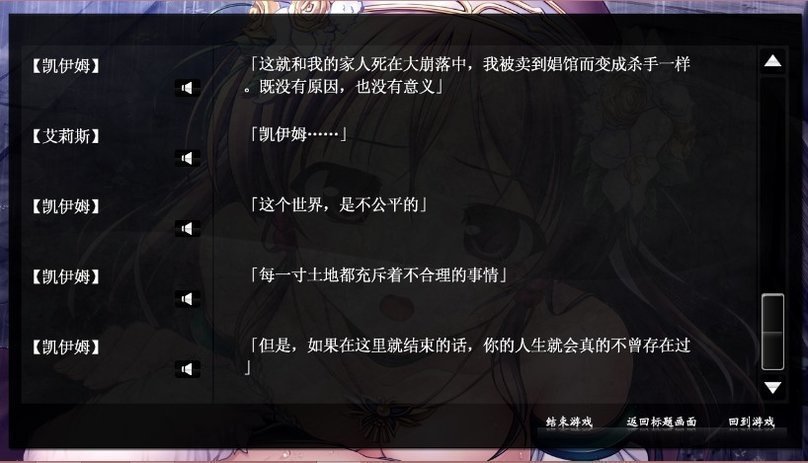
“The world itself is unfair. Drifting in an unfair world, surviving in the face of unfairness while still holding onto yourself—then… you have value.” Caim uses these words to make Alice accept the world’s unfairness. And Alice finds herself, no longer willing to be a puppet. The process is a bit forced—maybe due to length constraints—but it’s still a kind of redemption for Alice.
This reminds me of graduation from university. A lot of people joke that they “got fucked by the university.” I used to agree. But looking back now, what university gave us wasn’t so much learning or deep study—it was more about establishing connections between people… and letting us get a taste of the unfairness in this world, and accept it.
Colette and Faith
In the world of Eustia of the Tarnished Wings, the entire city floats. They say it’s the power of an angel that keeps it afloat, and the saint chosen by God prays to the angel every day to maintain that floating. If the world becomes unstable, if the floating city starts to collapse, then… it must be because the saint’s prayers aren’t enough, and the angel is angry—punishment.
That’s what the masses have always believed. Caim too—until he meets the saint, Colette…
Colette’s chapter actually doesn’t start off that heavy. Caim, a victim of the Great Collapse, has never liked Colette. He thinks the world’s collapse has a lot to do with her insincere prayers. When Colette complains that she’s like a puppet and that none of the believers have ever truly had faith in her, Caim thinks to himself:
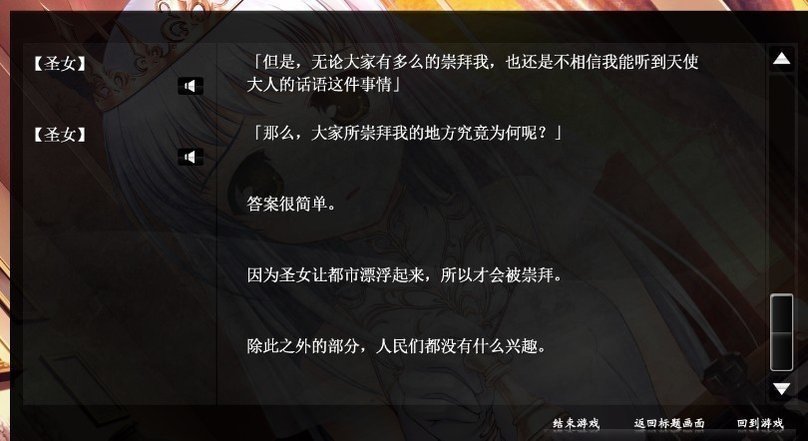
“The so-called saint is only worshipped because she can keep the world afloat. When the saint can’t save the world, who’s gonna believe in you?”
This reminds me of the aunties downstairs who belt out knockoff Christian hymns every day… They’re supposedly cancer patients or have other terminal illnesses. They didn’t even know who Jesus Christ was originally—they just heard from some missionary that believing in the Lord could cure them. So they hastily picked up faith, begging God to give them a little more time…
I don’t think that counts as faith.
As Colette later confesses to Caim, she’s never once prayed for the world to float. Something else maintains the world. Her prayers are just sincere confession and listening to the angel. Later, Caim discovers that Colette really can hear the angel’s voice… Maybe, on another level, she really is a saint.
The saint is a fake in terms of the “floating city” concept. She’s not the one keeping the world afloat—she’s useless, she can only communicate with the angel… This shocking truth hits Caim hard. And then he finds out that the saint’s role is just to be a scapegoat the king sets up. Tell the people: she brings peace to the world; if the world isn’t peaceful, blame her.
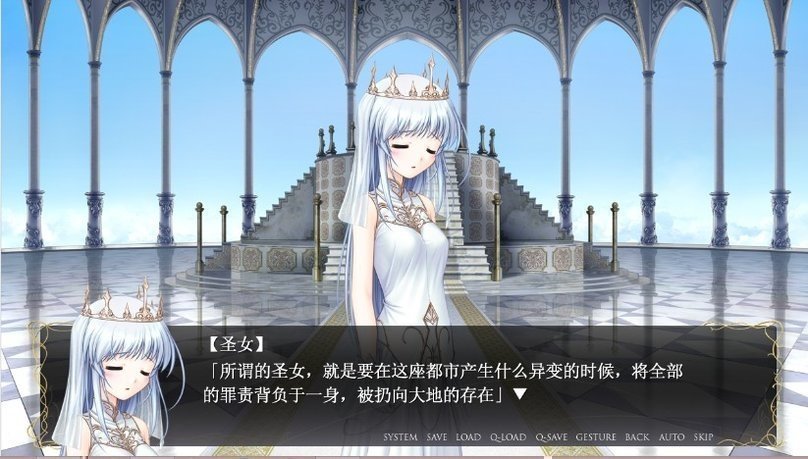
The selection of the saint isn’t rigorous—any girl will do. The saint’s job is, when society is unstable, to be pushed out and declared the cause of everything, then executed to appease the masses.
Colette is pitiful. Even if she might be a true saint on some level, she can’t keep the world afloat, so she has to die. No one truly has faith in the saint, no one truly has faith in the angel. The believers just think: “I believed in you, why aren’t you giving me benefits?”
I wonder if those hymn-singing aunties downstairs curse Jesus Christ on their deathbeds for not giving them more life… Someone once said Chinese people have no faith, only equivalent exchange and profit. “A faith that doesn’t bring benefits—no one wants to believe in that. But who knows, maybe true faith is simply peace of mind for your own heart,” a real Christian I know told me…
People only grab that last straw when someone brings them benefits, saying “I believe in you.” True, unconditional trust… almost doesn’t exist.
Sometimes we really need to ask ourselves whether we need some faith—real faith.
Licia and Doubt
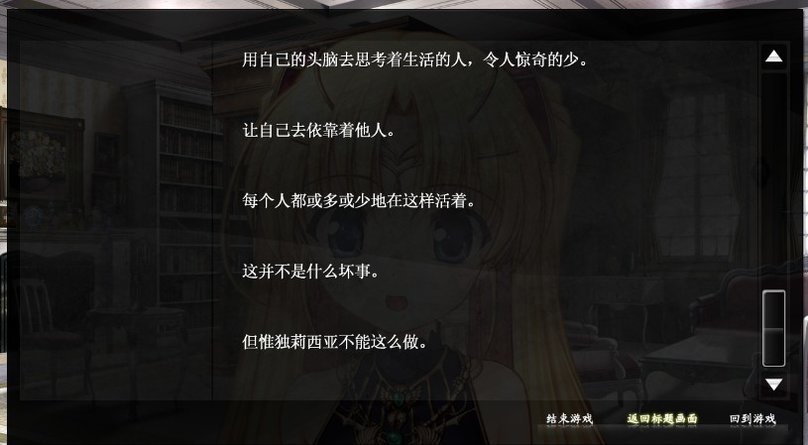
Licia’s chapter is basically the main storyline. Caim enters the royal court and learns that the current ruler is Princess Licia, but the real power is the regent. The regent is ruthless, controls everything, uses the king as a puppet. Licia is a child living in the regent’s shadow… like Alice, a puppet. She knows nothing, can do nothing. She just blindly believes what others tell her. No doubt whatsoever.
“The regent says the people are doing well. The lower levels were hit by the disaster, but we’ve sent a lot of supplies, so it should be fine.”
Caim, being from the lower levels, can’t stomach this… So he decides to show the princess the real lower levels, to let her know the regent has been lying. After sneaking out of the palace for a day and seeing the real society, Licia is lost. She can’t believe she’s been deceived all this time. She wants to doubt the regent, but she has no power. No army, no independent thought, and more importantly, no presence as a king.
The noble Lucius supports the king’s view, but most of the royal family won’t agree with the king’s approach…
For example, you have a house, money, fine food and drink. Suddenly someone tells you society is unequal and you should share your wealth equally… so you can live more securely. I don’t think anyone would immediately accept that gap, even if it’s reasonable.
There are righteous people and good officials in the royal city, but they don’t believe the current princess has what it takes to be king. Without basic trust, the king has no authority. Without authority, she can’t overthrow the regent.
To be a ruler, you need to govern and make judgments. Unlike normal people, a good ruler shouldn’t let personal feelings cloud their view of things. The old Licia trusted the regent infinitely. Now Licia rejects the regent infinitely and trusts Caim infinitely. For Caim, that’s good. But for Licia, who’s supposed to become king, it’s the wrong path.
“To be king, you must doubt everything. Only what you see with your own eyes is trustworthy. Everything people tell you should be questioned first.”
“What about what you tell me, Caim?”
“Even me—you shouldn’t trust absolutely. That’s the lonely path of a king.”
Someone once said God has no emotions. With emotions comes bias, and judgment becomes unfair. A king is still human, so they can’t be absolutely cold-blooded, but they need to maintain fairness and justice in the world as much as possible. Build a strong mind, trust everything and doubt everything—that’s what gives you the aura of a king.
So Licia abandons her attachment to Caim and becomes a cold-blooded king… Loyal officials follow, the coup succeeds, the regent is overthrown, the secret of the floating city is revealed, and the final chapter arrives.
Tia and Redemption
The city floats because of the angel, true. But the angel itself is imprisoned by humans… The angel has the power to save humanity, and the desperate humans, afraid the angel would leave them, tied it up in the center of the city… The regent’s goal wasn’t to save the angel, but to extract the angel’s power to save his beloved woman.
The regent falls, but the woman isn’t saved. The imprisoned angel is dying, filled with hatred for humanity. The world is on the brink. The city without the angel’s power is about to fall.
Tia has had wings from the start. The saint Colette foresaw that Tia is the angel’s child. She has the power to save the featherized patients. Lucius tells Caim that to save the world, Tia needs to undergo some experiments. It’ll be painful, but without the world, there’s nothing.
So Caim tells Tia: the world is about to fall, only you can save it. It will hurt. Are you willing to sacrifice yourself?
Tia agrees. And so the lab is filled with Tia’s screams every day. Tia herself is in pain, but she endures it because it’s Caim’s wish.
At this point in the story, something starts feeling off. Lucius’s enthusiasm for the experiments exceeds my expectations, but he doesn’t seem to ignore Tia and Caim’s feelings either. He just poses a question: “Save the world, or save Tia?”
Save one person, or save a group.
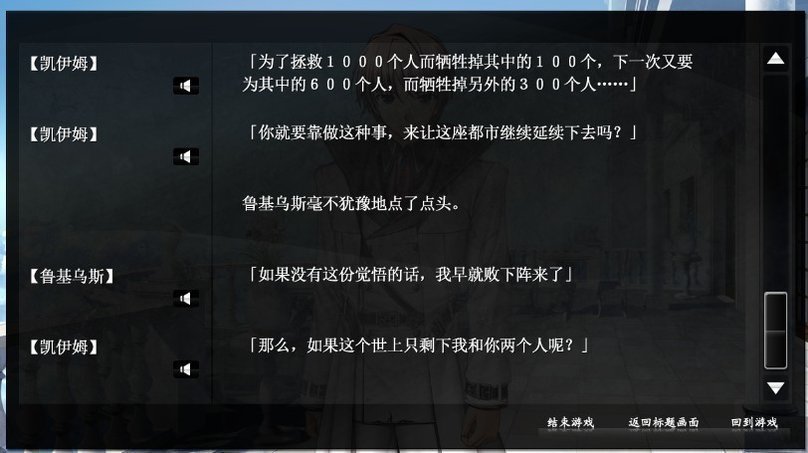
It seems like a simple choice. What’s wrong with saving more people?
But after Caim visits Tia twice, her suffering shakes him. Lucius says Tia might die from this. Sacrificing one person to save the world—is that worth it?
Still the same question: save one, or save many.
Worth it. Of course it’s worth it. By now Caim has seen Fione’s fake justice, gone through Alice’s independence issues, met the pitiful sacrificial saint, and learned from Princess Licia about the country’s ugly reality. And Tia herself is willing to sacrifice herself, willing to save the world. Lucius’s argument is flawless.
Until he meets his good friend Jick: “Caim, you look like a complete upper-classer now. But it seems you’ve forgotten how to walk on your own.”
That’s when I got it. Lucius, Tia, Jick, Licia—none of them are wrong. They’re all moving forward on their own paths. The one who’s lost is Caim himself.
The city’s collapse continues. The lower levels no longer feel safe. And Tia’s experiments still show no progress…
Jick can’t take it anymore and wants to revolt. Caim tells him the world is collapsing and needs saving, just give it a little more time.
Jick says something profound:
“I know, Caim. The world is collapsing, and we might even need to sacrifice the lower levels to ensure the world’s survival. But I was born in the lower levels. I only represent the lower levels’ interests.”
Saving the world requires sacrificing the lower levels, but Jick wants to protect the lower levels, not the so-called world.
What is the world? Does it exist because of people, or does it exist for its own sake? Saving the world is supposed to be about saving the people who matter. If the world is saved but the people who matter are gone, what’s the point?
Tia’s perspective here is also worth noting. I don’t know if the author did this intentionally, but while Tia is enduring her pain, not a single thought is “I want to save the world.” Every word, every thought is “I want to save Caim.”
What Tia wants to save isn’t the world. It’s Caim.
Caim is still lost. Then Lucius reveals another truth: he’s actually Caim’s brother. But he doesn’t use this to pressure Caim into agreeing with him. He just asks Caim one question.
“Have you found your reason to live?”
Caim survived the Great Collapse. His whole life has been forced by circumstances—sold to a brothel, became an assassin to avoid being a male prostitute, took only normal jobs to avoid killing, Jick gives him tasks, Caim completes them. That’s it. His curiosity about Tia’s background was his first autonomous action, but he still doesn’t understand what he’s living for.
A person alive without a goal, just drifting with fate, waiting for someone else’s answer. And now Caim doesn’t know if following Lucius is right, if it’s true justice. At the same time, Caim’s overly calm questioning and weighing of pros and cons has cost him his self. Even when he sees Tia, sees her sacrifice for him, and feels he doesn’t want to sacrifice her, his so-called rational cost-benefit analysis tells him that saving the world is more important than saving Tia.
By this point, the story is clear: Caim wants to save Tia, but he needs to sacrifice her to save the world.
Caim’s Redemption
Saving the world or saving one person—which matters more?
Caim has always been the observer, mocking Fione’s justice, scolding Alice’s blind obedience, provoking Colette’s faith, guiding Licia’s naivety. In the end, as a “calm guy who holds justice, never blindly follows, has no faith, and questions everything,” he’s lost himself. He’s no longer human.
This reminds me of the three stages of maturity.
First, in the growth stage, everyone easily imitates and accepts the views imposed on them, blindly believing what others say, possibly even becoming a puppet, waiting for someone to guide them.
Then, as understanding deepens, people start to question, start to become calm, know that everything should be considered and judged, know how to weigh pros and cons, choose what’s advantageous from a macro perspective. But they also start to become cold-blooded…
The king needs to be cold-blooded to rule, but there’s only one king.
Finally, we realize what we really want to protect… Is it people, or the whole world?
Each of our worlds is made up of ourselves and the people around us… A lonely world is no different from extinction. In Ashita no Sekai, the protagonist chooses to be with his friends rather than just survive. I think Caim would choose to save Tia, not sacrifice her.
In the story, Caim’s awakening comes regrettably late… too late. The 18+ content here feels jarring and detracts from the game. After they have sex, Caim actually sends Tia back to the lab. I was furious.
Fortunately, in the end Caim makes the right choice. Lucius’s choice, as he said, is to save the many by sacrificing the few. But he’s not a villain either—he’s happy that Caim found his reason to live. Or rather, his standpoint. Everyone has a role and a standpoint in the world. Finding your standpoint is the best proof that you’re alive.
Saving Tia comes too late. Tia has already merged with the angel. The old angel once wanted to save humanity… but greedy humans had no faith or respect for the old angel, just like with the saint—they only needed the angel’s floating power. Until human malice was fully exposed and they tied the old angel up, shamelessly demanding more.
“Humans aren’t worth saving. Destroy this world!” The old angel gives Tia this order…
Tia begins to chant, until she sees Caim and regains her senses. Caim chooses to save Tia. It’s late, but better than not doing it at all.
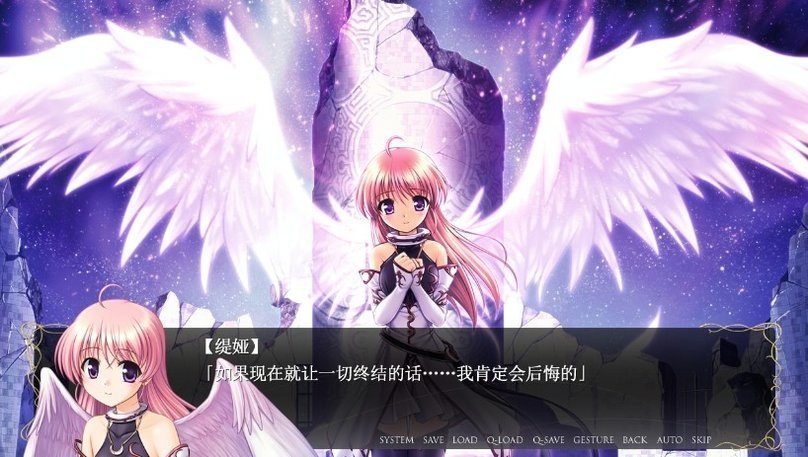
Now Tia faces a choice: save the world, or save herself.
Unlike the indecisive Caim, she doesn’t hesitate to choose to save the world, because saving the world is the only way to save Caim. She just wants to save him.
Ending and Speculation
Some people call the ending of Aiyoku no Eustia (穢翼のユースティア) a happy end. I don’t buy it. Eustia sacrificed herself to save the world—but she did it for Caim. As the old angel said, there’s no guarantee Caim won’t change his heart… because Eustia no longer has a body; she’s become the land itself.
In the future, as the land’s wounds reopen, Eustia will be hurt again. Who knows whether she’ll end up repeating the old angel’s mistakes. And even setting that aside—say Caim stays faithful to the very end. After he grows old and is buried, what is Eustia supposed to protect then? Maybe another end of the world comes around right then.
The game’s OP is great. The ED is titled Dear World, but I don’t think Eustia ever wanted to save the world. She just wanted to save Caim.
How do you save people? That’s an eternal question. A friend of mine was discussing this not long ago. The choice there isn’t as agonizing as saving-one-person vs. saving-the-world, but it’s still a matter of how many people you can save.
The choice is actually simple: save the person who matters to you first. Play the saint? None of us have the right.
Everyone’s world is made up of the people close to them. Take those people away and your world stops existing.
Save the person first. The world comes after.
Other thoughts
I was genuinely surprised by how polished this game is. It’s probably the most sincere production I’ve played so far—character designs, music, story, even the staging and the style of the voice acting. What surprised me more is that the game doesn’t pander with cheap moe or fanservice; the whole story stays in a serious register. That’s probably why the protagonist is voiced too. August really wanted to tell a story, not get you off.
For routes, I recommend going straight down the true end—in other words, turning down every heroine’s affection along the way. Honestly it didn’t feel like rejecting them to me; it felt more like helping them reach their own salvation. Because apart from the main line, the other routes are too fake… more like a pleasant dream. And playing them after I already knew the true end made it hurt even more.
I hear Daitoshokan no Hitsujikai is getting an anime. Sure, but compared to that lighthearted one, Aiyoku no Eustia is far more deserving of a screen adaptation… though with this plot, unless it gets FSN or FZ-tier treatment, I think the odds are higher that it just ruins the source…
Anyway, if you have the patience, I’d suggest actually playing this one properly and taking in the story… a rare good work in recent years—that’s about the size of it…
Comments are hosted on the Chinese main site. This mirror is read-only.