Ten no Sora Retrospect (天ノ空レトロスペクト) Review
Ten no Sora Retrospect
I wonder if anyone else out there likes fairy tales as much as I do.
Fairy tales are, of course, stories meant for children. I’m not a kid anymore, but I still find myself drawn to that childish style of story…
Ancient legends, gods in the sky, princes and princesses, forests and sunlight, and cute flat-chested skinny twintail girls you just want to scoop up into your arms…
So yeah, I like fairy-tale-style stories, and visual novels too. This has nothing to do with being a lolicon, of course. Nothing at all. Really, nothing.
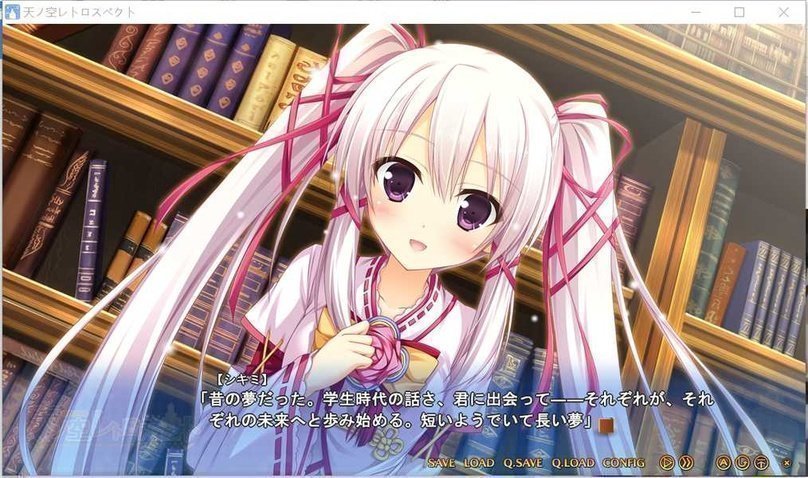
Ten no Sora Retrospect was made by GLace, a subsidiary of the company behind Onii-chan, Migite no Shiyou o Kinshi Shimasu, so the art style feels a bit like that game—same staff and all. The story goes for a fairy-tale vibe, and so do the music and art. It still brushes up against school life, but at least it’s different from your usual school setting. Different from the start, anyway.
I played the demo early on, and by the time the full game came out I was still furiously grinding through Sakura no Uta, so I didn’t have time for this one. By the time I got around to it, I’d forgotten a good chunk of the early plot. I barely remembered the setting, and the second half of the game doesn’t have any “summarizing” lines to help me piece the story back together, so some of the details felt murky.
Still, the game’s strengths are obvious, and so are its weaknesses.
The biggest strength is the opening, which straight-up proposes the theory that “the world was made by monkeys.” Through a series of coincidences and the word “monkey” popping up in conversation at just the right moments, the plot ties everything around this “world made by monkeys” idea. It feels a bit like a movie… (a Chinese New Year movie, say).
So is this “world made by monkeys” theory bullshit? Actually, no. It’s based on an interesting idea called the “Infinite Monkey Theorem.” Also known as the “monkey and typewriter” experiment, it was proposed in the early 1920s by the French mathematician Émile Borel. Borel argued that if an infinite number of monkeys typed randomly on an infinite number of typewriters for an infinite amount of time, then at some point they would inevitably produce Shakespeare’s Hamlet—or indeed his entire body of work.
Wikipedia describes the theorem like this:
“A monkey hitting keys at random on a typewriter keyboard for an infinite amount of time will almost surely type any given text, such as the complete works of William Shakespeare.”
Basically, it means the world has infinite possibilities, and no matter how tiny the probability, one of those possibilities is the one you want. So even if monkeys are all randomly hammering away at typewriters, one of them will eventually bang out a masterpiece…
But thinking about it always feels like nonsense—and I’m not the only one who thinks so…
The point of the experiment is that given infinite time and infinite participants, anything can emerge. The experiment made monkeys famous, and in 2003 a bunch of scientists at a British zoo insisted on dragging the long-famous monkeys into “testing” this theorem that can’t be reproduced in real life—a computer and keyboard were placed in the primate enclosure. Unfortunately, the monkeys didn’t cooperate, and instead of producing a sonnet, they typed out a string of characters mostly consisting of “S.” Bored mathematicians calculated that for a monkey to type the first sonnet, it would take at least 200 billion years, while the universe is only 15 billion years old. Well, so much for ever seeing the monkey world’s Hamlet within my finite lifespan. And I don’t have to wait 200 billion years watching monkeys type infinite “S"s until I puke. —-"Monkeys and Typewriters” (Xinmin Evening News, Ma Dan)
Nonsense or not, this is still a game. Guided by the “world made by monkeys” theory, the protagonist and his friends from the school’s “Cleaning Club” ride a secret elevator code up to the roof of the observatory and enter a mysterious library called the Ten no Sora Memory Library. There they discover that gods really do exist, and that the gods manage the world through books. The books record every little thing about this street, every event and every memory.
The god who runs the library calls herself Amahoshi. She’s a god, but only the local deity of “this street.” This loli land god tells them she has no memories of her past—she just discovered that a bunch of sealed books recording the street’s memories have escaped from the library into the human world, some possessing people, some becoming independent spirits. She asks the protagonist and his Cleaning Club friends to help recover them, and that’s how the story begins.
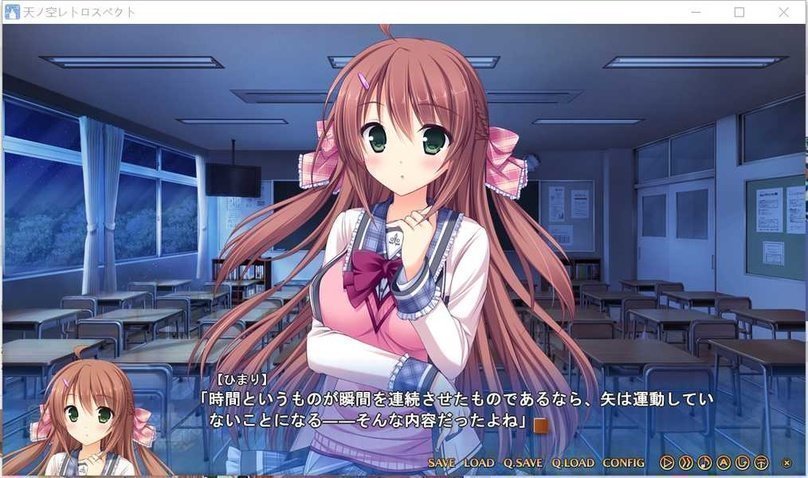
Rare for a game, there are no route locks. There are four routes: childhood friend Himari, the school’s mysterious senpai Misumi, the school’s kouhai Shinon, and finally the land god Amahoshi. There’s only one choice—who to go look for at the festival—and whoever you pick is the route you get. The game is so friendly it’s almost hard to believe, and honestly it threw me off. Normally there’d at least be a lock on Amahoshi’s route, but nope… oh… so out of sheer compulsive habit, I saved Amahoshi’s route for last.
Aside from Amahoshi’s and Misumi’s routes, the routes have little to do with the main plot. Himari is the childhood friend who confesses to the protagonist on her own initiative. Because she has a wish in her heart not to graduate—after all, graduating means separating from the protagonist—some unknown land god answers her wish, causing time to stop moving forward. Eventually the problem is resolved and the two graduate.
Shinon’s route also has her quickly confessing to the protagonist (god, this protagonist is annoying), and then Shinon has some selfish desires that happen to get answered by an unknown land god, throwing the street into chaos. The problem gets resolved in the end too.
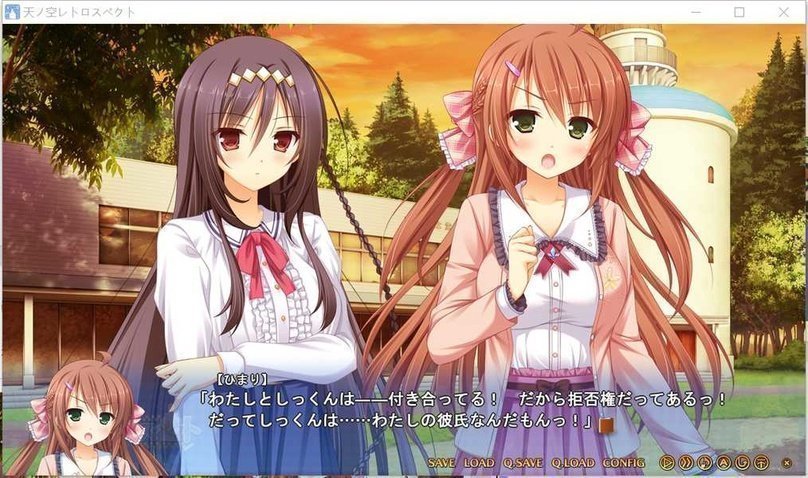
Misumi’s route also has her suddenly confessing to the protagonist (motherf—!). Then Misumi discovers another version of herself has appeared—the unknown land god from the previous two routes. That land god tells Misumi that Misumi is a part of her body and asks Misumi to merge with her. She also tells the protagonist that Misumi and the land god named Misumi are both books that escaped from the Ten no Sora Library, and that they split into two because the sealing of their book failed for some reason. In the end, Misumi wants Misumi to come back and help her complete the resurrection of “Enkaku.” “Enkaku” is the name of a philosopher who once did historical research on this street—an old lady who has since passed away.
Why resurrect her? This route explains it very poorly, so poorly that I couldn’t follow it either. By the end I didn’t even want to read it, so I just skipped to the ending. Naturally, Misumi refuses to cooperate and chooses to exist independently, ending up with the protagonist.
The final route is Amahoshi’s. Yes, the protagonist gets found out by Amahoshi, confesses, and the confession speed is basically the speed of light. After that, Amahoshi mentions she has no memories of her past, and Misumi shows up again, showing Amahoshi a keyword. Amahoshi searches the library and finds a book left behind by “Enkaku.” Reading it, she understands what she did before.
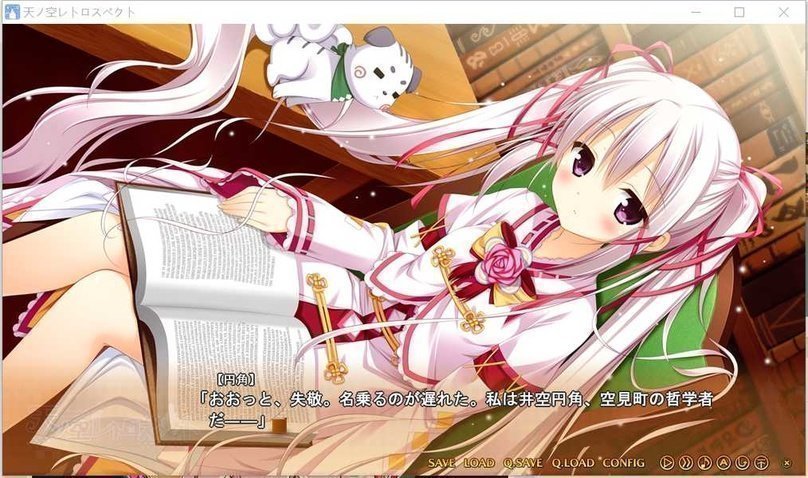
It turns out Amahoshi had been the land god of the Ten no Sora street for a long time, but she only did things by the book and never left the library. Then one day, an old lady philosopher named Inosora Enkaku wandered into the library and met Amahoshi. Inosora Enkaku loved this village and street, always wandering around enjoying everything it had to offer, and she even wrote a history of the street. She and Amahoshi talked a lot and became friends, and she told Amahoshi many things—including the Infinite Monkey Theory.
Inosora Enkaku also proposed a hypothesis: “If the world is written by a series of memory books, then using the Infinite Monkey Theory, you could also prove that the world was actually made by monkeys…”
This is actually the explanation and understanding behind the game’s opening “the world was made by monkeys” idea. But although the two got along well, in the end Amahoshi was a god and wouldn’t age, while Inosora Enkaku was just an old lady who would eventually die. Before she died, the old lady told Amahoshi:
“This street has always been maintained by us old folks, but in the end it belongs to the young people of the future. So I want you (Amahoshi) to guide this street well into the future.”
After that the old lady passed away and never saw Amahoshi again. Amahoshi was terribly lonely. She realized that she, a god, had become friends with a human, and how empty her heart was when that friend left. After Inosora Enkaku died, another land god named Sorami came and asked Amahoshi to seal herself (sorry, I absolutely cannot remember why she wanted to be sealed), saying it was for Inosora Enkaku’s wish. During the sealing, Amahoshi’s mind wandered because she was thinking about her friend, the seal failed, and the book split into two parts that fell to the mortal world. At the same time, she sealed away part of her own memories, which became the little dog that follows her around later (probably?).
After remembering all this, Amahoshi realizes she caused the whole mess on this street. She was supposed to be guarding the library, yet she lost so many books and even lost her own memories. Then thinking about her romance with the protagonist, she realizes he’ll grow old and die someday too, and she can’t take that blow, so she locks herself away.
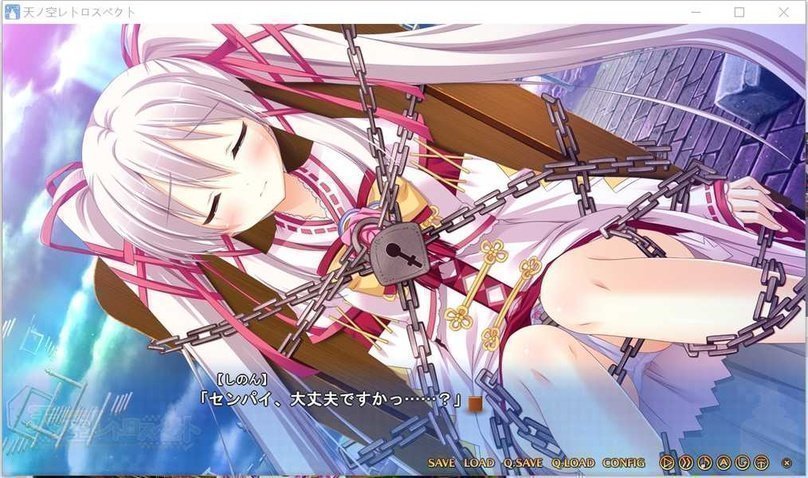
In the end, of course, true love conquers all and talk-no-jutsu conquers all. The group reaches the heavenly realm above the library, rescues Amahoshi, recovers Sorami’s book, finds the words the old lady Inosora Enkaku left behind, and decides to face the future together with the protagonist, working hard to serve this street. Game over.
How should I put it? The game’s biggest highlight is the opening where it ties everything to the Infinite Monkey Theorem, plus all the comedic bits in the middle. Beyond that, the mid-to-late game is just plain boring. It’s not long, but it’s still boring. The ending is completely predictable and way too clichéd. It starts out funny, then suddenly turns dead serious about “fighting for the future,” which feels like kids playing house…
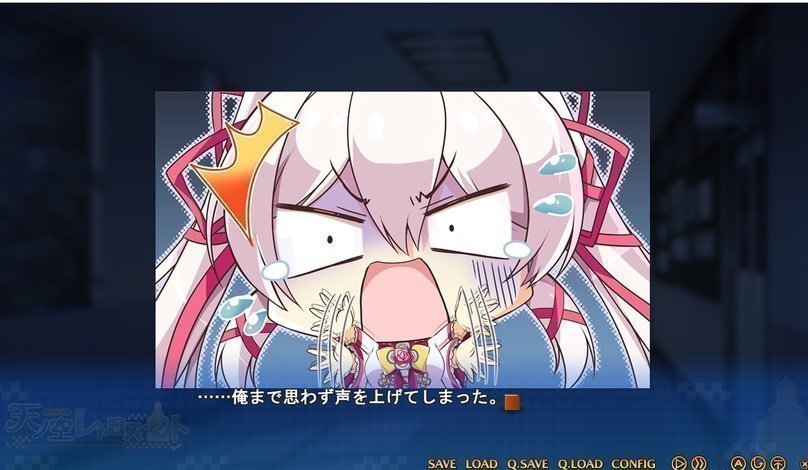
Ah… wait, no. This is a fairy-tale-style game to begin with, so kids playing house is only natural…
The art is good. Actually the SD CGs are better quality than the normal CGs, and they feel more professional too. The music follows a main-theme style, all variations on the OP and ED, but the OP and ED are good songs to begin with, so it’s not really a point against it.
As for the CVs, Himari is Tohno Soyogi, Amahoshi is Ono Ryouko, Shinon is Akino Hana, and Misumi is voiced by the same CV as Yako from Kami no Ue no Mahoutsukai. Nobody does a bad job—the recording quality is just a bit poor, maybe because of the equipment.
All in all, as a lighthearted, brain-off little throwaway game, it’s pretty good. What I don’t get is why ErogameScape scores it so low. One of the reasons given was even “I don’t understand why the game brings up this boring chuuni theory that ’the world was made by monkeys’…”
………………
You dumbass, if you don’t get it, can’t you just Google it? Would it kill you to search up the Infinite Monkey Theorem? If the infinite monkey thing counts as chuuni, then what were those scientists who actually tested it in 2003? Retards? I just can’t understand it.
Comments are hosted on the Chinese main site. This mirror is read-only.