Boku wa Kimi dake o Mitsumeru (僕はキミだけを見つめる ~I gaze at only you~) Review
Boku wa Kimi dake wo Mitsumeru ~I gaze at only you~
Boku wa Kimi dake wo Mitsumeru I gaze at only you isn’t a new game — it’s a remake, to be precise.
What’s a remake? Think of it like a TV drama or movie getting redone. There’s a pretty solid reason Innre (インレ) remade this one: the original was from 2006, and both the art and production were pretty rough. Look it up if you don’t believe me. This 2015 remake is a whole different beast — the art, coloring, and soundtrack have all been completely overhauled.
The same artist did the original art, but you can really see how much they’ve improved. The coloring actually gives me the same vibe as SAGA PLANETS. They brought in Elements Garden for the music, Ayane (彩音) sings the OP, and the ED is performed by the main heroine herself, Mishiro Mashiro (三代眞子). If you don’t know who that is, go look up Yonezawa Madoka (米澤円). Most importantly, the original game had no voice acting — the remake naturally has full voice.
At first I figured remakes were just cash grabs, but this one feels like too big a leap. The devs even said this remake goes way beyond a simple “visual upgrade” — they heavily reworked the story too. Definitely doesn’t feel like a cash grab.
So I dove in. Not for any other reason than the premise grabbed me: the protagonist gets hired to protect a girl targeted by an assassination syndicate. That’s it. I’m honestly sick of boring school romance plots.
The game isn’t long, and it has almost no choices — the one branch is purely symbolic. I don’t believe anyone could pick wrong unless they’re deliberately trying to fuck up. People like to call these one-choice-and-done games “ipponmichi” (一本道). Speaking of which, another game I’d call “ipponmichi” is SinClient — I played that one before. Funny thing is, that game’s premise is kind of similar, since SinClient later has the protagonist acting as a bodyguard for one of the heroines too…
Yeah, of course, after finishing it I realized they’re completely different.
Boku wa Kimi dake wo Mitsumeru starts with the protagonist’s flashback. He explains that he and two childhood friends from this town started an organization called… uh, I forgot the katakana, but in Chinese it’d be sabertooth. The organization looked like a yakuza outfit — recruiting underlings, taking jobs — but they were really doing vigilante justice the cops couldn’t touch. Like helping gang-raped girls hunt down the perpetrators and putting holes in their dicks, that kind of thing. It operated in the gray zone, but it did good for the people and got the whole town’s support — they called them “chivalrous men.” Under the protagonist’s leadership, the Sabertooth gang also wiped out the drug trade in the area. But soon his actions pissed off some big shots. One day, both of his childhood friends turned up dead — gruesome deaths, decapitated with their organs gouged out. Sabertooth fell apart, the protagonist lost control of the streets, drugs came back, and there wasn’t a damn thing he could do about it.
After that flashback, the game’s main route begins. A little girl shows up out of nowhere to hire the protagonist as her bodyguard. A few days in, he fights off some punks, and the girl introduces him to a nightclub mama-san, who also hires him as muscle and bodyguard. His performance earns the mama-san’s trust, and she tests him a few times — he passes every time. She says someone higher up wants to hire him and asks if he’s in.
He goes. Partly out of curiosity, partly because he’s broke. He arrives at a production company and meets the president. The president explains that his top star, Kazahaya Towa (風早永遠), is holding a three-day ticketed live show in eight days. But they’ve received threats from the mafia — stop the show or she dies. So he wants the protagonist to be Towa’s bodyguard until the concert ends. All that earlier stuff with the mama-san and the little girl was just a screening process to find the right person.
The protagonist thinks it over and agrees. He starts living with the big star, sharing meals and a roof, and finds out she’s actually pretty spacey and naive. The live date approaches, days pass peacefully, no suspicious characters — except one day he spots a figure in a Beijing opera mask outside the apartment.

The day before the live, someone lures the protagonist back to his old neighborhood, claiming to know about the mafia’s assassination plan. He finds the informant dead, and the masked man suddenly attacks. After a brawl, the protagonist gets knocked down. The masked man reveals he’s the hitman “Nightmare” and warns him: cancel the live, or Towa is in danger.
The protagonist returns to the star and asks if they should cancel. After some discussion and Towa’s own insistence, she says she’s not afraid and wants to go on. He believes her and tightens security. The first day goes off without a hitch. On day two, one of Towa’s female assistants is slashed by the killer, and then the protagonist finds a threat letter on Towa’s apartment wall — meaning the killer can get right into her room. Things are getting worse.
The protagonist starts investigating and notices something off about Towa’s manager, Morito Miya (森戸美夜). He overhears a phone call where the person on the other end sounds a lot like “Natsu,” a former underling from his Sabertooth days. After some digging, Morito admits she’s the mole — but she was forced into it, she doesn’t actually want Towa dead. Natsu turns out to be her younger brother. His real name is Xu Qiena (徐切那), and Morito’s real name is Xu Qiexiao (徐切咲). Both are children of Xu Qierong (徐切荣), boss of the Qinglong gang — a Chinese criminal organization that claims to have Japan’s underworld and political circles in its pocket.

Finally the protagonist remembers Natsu had approached him before, and he didn’t seem like any kind of killer then. Was everything just an act? The protagonist decides to let Towa go ahead with the live, and lures Natsu out to a church in the suburbs. Natsu drops the facade the moment he arrives — he’s the killer, and his personality is completely twisted. He’d infiltrated Sabertooth from the start, and he murdered the protagonist’s two best friends on purpose. They fight, and after a long struggle the protagonist wins thanks to a female cop who shows up to help. Natsu flees. The cop and protagonist track him to the hideout of his father, Xu Qierong. By the time the protagonist arrives, Xu Qiena has already been shot dead by his own father, lying in a pool of blood. Xu Qierong claims he doesn’t know the guy and tries to distance himself. After some heated words, Xu Qierong realizes he’s cornered and tries to attack — and gets gunned down on the spot.
The killer is gone. Just as the protagonist thinks he can get back to Towa and finish the last live, a security guard lunges out and stabs him. Morito — Xu Qiexiao — throws herself in front of the blade out of guilt and duty, and dies. Towa, seeing her manager and best friend die right in front of her, suffers a massive shock and loses her voice…

The third and final live is a bust — the singer can’t sing. The production company is dissolving. The president thanks the protagonist, says he’ll settle his pay and arrange new work, and asks if he wants to cash out. The canon route is to refuse. The protagonist says he’s already her bodyguard and shield, and he’s not stopping now. He takes a sum from the president and brings Towa back to the countryside to convalesce.
Life in the country is slow. Old friends send letters now and then, but Towa still can’t speak. One day the protagonist finds Morito’s grave on the island — and finds Natsu there too, who didn’t actually die. (He’d already figured out during the fight that Natsu was a woman disguised as a man.) Natsu says she won’t hold a grudge against him for now. She mocks her sister, herself, and the protagonist for being fools, then quietly leaves after a moment of melancholy. She kicks the protagonist unconscious — not to kill him, just to knock him out — then calls Towa to come rescue him and walks off.

While he’s out cold, the protagonist sees Morito herself at her grave. He asks if she hates Towa. She shakes her head. He asks if she’d forgive Towa. She nods. When he wakes up, Towa can speak again. The only thing missing was Morito’s forgiveness — and Towa opening that knot in her heart.
Towa, now able to speak, confesses to the protagonist right away, and they become a couple. In the end, the old production studio crew comes back together, the president even tracks down the audience members who bought tickets for the third live but never saw it, and everyone gathers on the island carrying sunflowers. They hold the canceled third live again, and the game ends.
Honestly, I was disappointed right after finishing it. I came for the “assassination,” “bodyguard,” “conspiracy,” “tracking,” “counter-tracking” thriller stuff, and the game’s handling of that is just hilarious. The boss is from a Chinese gang that controls Japan’s underworld and political circles — what is this, a web novel? A Chinese gangster named Xu Qiexiao? I’ve never seen the character “咲” in a Chinese name, sorry. And even more ridiculous: from the moment the protagonist takes the bodyguard job, the game launches into a long stretch of slice-of-life with zero tension. Ten chapters plus an After Story, and maybe two chapters total have anything to do with bodyguarding. The rest is pure daily-life bullshit. And the heroine’s characterization feels more like a moege than anything.

But I can’t just write it off. It has a strength few other games have: the fight scenes are absolutely insane. I can say without exaggeration these are the smoothest, most visceral, most satisfying fight sequences I’ve ever seen — nothing tops them. The animation, facial expressions, effects, impact sounds — all flawless. It’s a blast to watch, better than any second-rate light novel anime fight, no contest. But sadly, as I said, there’s barely any bodyguard plot, so even fewer fights — maybe three total in the whole game…


The conspiracy explanation gets crammed into two chapters, and it’s still clumsy. The female cop delivers a long infodump before the protagonist understands what’s going on. Why does the Qinglong gang want Towa dead? Because Xu Qierong is a total scumbag — ruthless and horny. He NTR’d someone’s wife and fathered a child. When he first came to Japan, he took a liking to Towa’s mother, but she wouldn’t give him the time of day. Xu Qierong went home and beat his wife. When he found out Towa’s mother had married someone else, he beat his wife even harder — until she couldn’t take it and killed herself. From then on, Xu Qierong hated Towa’s mother and sent people to kill her and her daughter. Through some twist of fate, the daughter escaped and later became a star.

So Towa was targeted for assassination purely because some old man couldn’t get his dick into her mother. All the mafia-versus-production-company conflict is just a bullshit tsundere excuse. Give me a break.
So is the story stupid? It’s a game that wants to tell a proper story but spends only 20% of its length on the main plot, and the rest on slice-of-life. What the hell?
But then I thought — maybe I got something wrong.
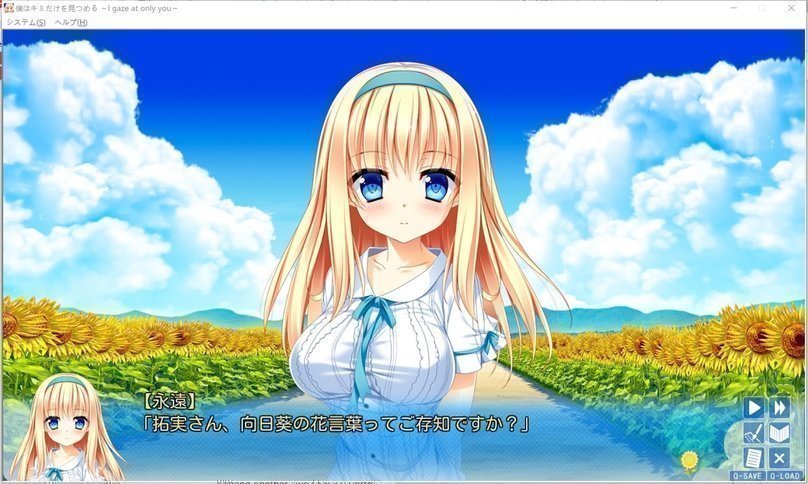
The game’s title is Boku wa Kimi dake wo Mitsumeru I gaze at only you. The meaning is obvious: “I only look at you.” From the first line — “Do you know what sunflowers mean?” — to the last line, which repeats that question, I tried to recall the whole game.

First, Towa has this quirk from her very first appearance: every time she introduces herself, she emphasizes “my favorite flower is the sunflower.” That’s weird — like the author is hinting at something. And in the daily scenes I noticed foreshadowing, like how the game keeps trying to explain why Towa’s singing matters so much, why everyone at the production company would protect her voice.
Around the midpoint, it’s revealed that the protagonist and Towa knew each other as kids — which explains why he felt she was familiar the moment he saw her. They were both orphans and had met before. The president tells him Towa’s past: she was abandoned by her mother, and when her mother finally came to her senses, Towa lost her. At first she couldn’t speak, then one day she mysteriously started talking and had a beautiful singing voice. The doctor called it a “miracle,” but also said it might not last — she could lose her voice again at any time. That’s what explains the final chapter.

Everyone sees Towa as innocent, cheerful, kind, and brave, and they’d protect her voice for her sake. And Towa herself says she only ever looks at the protagonist, since he helped her when she was young.
The “I only look at you” thing isn’t just Towa — her manager and the final boss Natsu also “only look at the protagonist.” Both have feelings for him; the final boss’s is just twisted.
Seen through the title, the game suddenly seems much stronger. All the foreshadowing pays off, and the “I gaze at only you” element is well highlighted. For a romance story, that fits — the details are weird, but that’s not a big deal. Like the battle scenes in Qiong Yao’s romance novels: full of holes, but nobody cares because that’s not the point.

Ah… maybe this game isn’t about “assassination” at all. It’s about this girl Towa’s love story…
The guy she admired as a child reappears years later, they meet again, and over a long slow-burn process they come to understand each other. When she’s hurt, he never leaves her side until she recovers. That’s the prince every girl hopes for, right?

I have to admit the slice-of-life stuff has little to do with the main plot, but it’s not bad either — with the solid voice acting, you can just enjoy it as comedy. Speaking of voice acting, I have to mention the main heroine and the main boss. The heroine is Yonezawa Madoka — her voicing a singer again is probably deliberate on the devs’ part. The boss is Kiritani Hana (桐谷華). She first appears as a male character, then during the fight it’s revealed she’s actually a woman, and when she shows up again in the final chapter, she looks pretty attractive in female form… oh my.
Another fun detail: in the 2006 original, Kiritani Hana’s character Natsu was actually a man — and gay. There’s even a CG of the gay guy giving the protagonist a straw. But the remake changed the gender, avoiding the BL-game awkwardness. And the whole final chapter is probably remake-exclusive, since the original didn’t have the heroine losing her voice — it just ended after the fight.
So how should I sum this up? I want to say the “assassination” plot is hilarious, but that’s not really what this game is — it’s more of a romance game. From the romance angle, the story progresses decently, the art is great, the fight animation is incredibly, incredibly, incredibly well done, the music is good, the voice acting is solid. Ah… maybe this is a good game after all.
I just had it in the wrong genre in my head from the start.
Comments are hosted on the Chinese main site. This mirror is read-only.