Miagete Goran, Yozora no Hoshi o (見上げてごらん、夜空の星を) Review
Staring Up at the Stars in the Night Sky
Miagete Goran, Yozora no Hoshi o is PullTop’s release from the end of this year. Honestly I hadn’t really touched this company’s games before — well, that’s not quite right either. What I’d played were mostly works from its sub-brands, like Natsu Iro Recipe, like Koisuru Natsu no Last Resort… The company did have that one pretty impressive game, Kono Oozora ni, Tsubasa o Hirogete, but I never got around to playing it.
The marketing angle from the start was “same staff as Kono Oozora ni, Tsubasa o Hirogete,” with the theme being staring up at the stars and astronomical observation. Unlike the earlier plane-building game, this one locks its season to winter, around Christmas, which fit nicely with a December release.
Ah — actually I wrote a big long intro for this and then realized I’d accidentally turned it into smut again, so let me just get straight to impressions. Keep going like this and there’s no turning back from the road of filth.
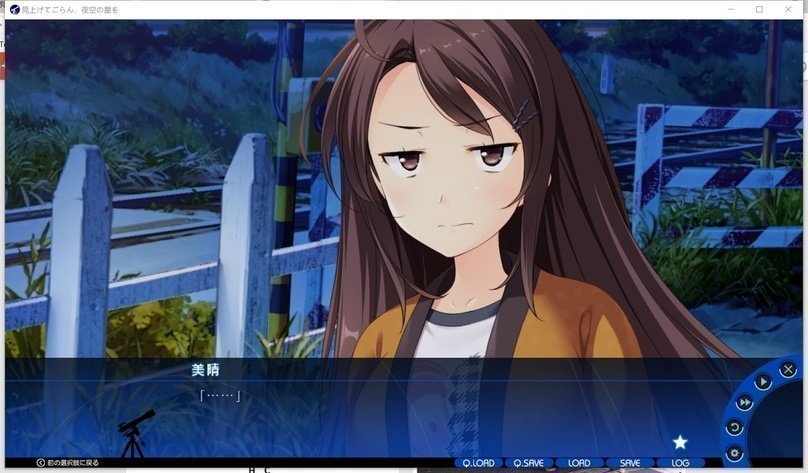
Put simply: as a visual novel, this game is very good. But as a game “about astronomical observation,” it falls a bit short.
There are four heroines: childhood friend Hikari Hōshiboshi, the transfer student Saya Amanogawa whom he met as a kid, Shirayuki Orihime — the club president from another school who later ropes the protagonist into stargazing with her — and Kusakabe Korona, the little sister of the protagonist’s good buddy. The story splits roughly into three chunks: one common route, then two parts of the individual routes that follow. Those two parts aren’t parallel world lines so much as a chronological sequence.
The common route intercuts the protagonist’s present with his memories, centering on the return of his childhood friend Hikari. He recalls how, after both parents died, he came to the countryside to be taken in by his grandfather, met Hikari and Saya, and — led by Hikari — started doing astronomical observation.
His father worked in astronomy, which is where the protagonist’s own interest comes from. On one birthday his father bought him a $499 telescope and promised they’d go look at the stars together. But like most death flags, the parents later got into an accident and both passed away, leaving the protagonist to follow his grandfather to the countryside with nothing but the telescope his father gave him. Unfortunately, he had no idea how to use it — he stared through the wrong lens for ages and concluded he’d broken the thing.

That’s when Hikari shows up. She teaches him how to use the telescope, watches constellations with him at night, and shows him what makes stargazing fun. Around the same time, a peculiar transfer student arrives — a girl with heterochromia named Saya Amanogawa. She hides her eyes behind sunglasses and won’t let anyone see them. The protagonist and Hikari befriend her and organize their classmates to observe the Sirius constellation at night, using the blue and gold of the main star and its companion to get everyone to fall in love with Saya’s mismatched eyes — and to break down the wall between Saya and everyone else, the protagonist included. Later, the town plans to build a dam that could mean demolishing the school and the railway. Hikari sees on the news that some students got a meeting with the mayor for a good social-practice project, so the kids figure: if they pull off a project of their own and win something at the town or even higher level, they’ll get to meet the mayor and ask him face to face not to build the dam. What project, though? The protagonist’s telescope comes to mind, and just like that they’re doing stargazing. Saya joins the protagonist and Hikari in a group dedicated to observing the stars, they keep records, and they make a vow: no matter what happens from now on, the three of them will always watch the stars together.
In the common route’s present, though, Hikari has already left the village, the dam is finished, and Saya has gone off to another school. The grown protagonist is a member and de facto head of his school’s astronomy club when he gets an invitation from Shirayuki Iori, president of a nearby school’s astronomy club. She says fewer and fewer students want to stargaze, several nearby schools’ clubs are about to fold, and it’d make sense for them to pool resources and observe together. The protagonist refuses at first. He says he’s in the astronomy club and even lives in the club room, but he doesn’t look at the stars anymore. Everyone’s curious; he dodges the question. Only Saya knows why — and she hints that it has to do with a fight he had with Hikari as a kid.
The common route doesn’t explain that fight. It only says the protagonist and Hikari had a falling-out, that Hikari left for somewhere else and never came back, and that the stargazing project fizzled out.

The multi-school stargazing plan isn’t going smoothly either. More people means better equipment, and there’s no money — they’re all students. President Shirayuki can’t supply that much either, and everyone’s stuck. Then one night the protagonist runs into Hikari, back in the village. She’s completely unbothered, not hung up at all about their last meeting ending in a fight, and picks right up where they left off. She asks flat out whether he still looks at the stars. He says no, but he’s still in the club, and he tells her about President Shirayuki. Hikari, being Hikari, dives right in and starts rallying people. She ends up building a crude homemade telescope out of leftover materials from the old school demolition, with help from folks around the village. When the protagonist looks through a telescope again, he realizes he still loves stargazing — the passion reignites.
After that Hikari leaves town again, and it’s several months before she’s back. When they meet again the protagonist suddenly asks whether she came back for a reason. She says it’s only temporary and she’ll be leaving again soon. He asks whether she likes him — he still has the love letter she gave him as a kid, he says, he just never opened it.
Hikari panics, insists he give the letter back, and even sneaks into his house to take it. Later the protagonist finds a letter that fell off Saya — and it’s the very love letter Hikari snatched from him. He opens it and finds it’s from Saya: she likes him, she wants an answer, and she’ll be waiting at the bridge.

He’s baffled. The letter was from Hikari — why is the content Saya’s? And why does Saya have it? Turns out it’s connected to that childhood fight. Back when the three of them were stargazing as kids, Saya had already fallen for the protagonist and was going to confess. Hikari noticed and encouraged her. Saya was too shy, so impatient Hikari offered to deliver the letter for her. The protagonist received what he thought was a love letter from Hikari, figured she had feelings for him, agonized over it, and never opened it. To push him and Saya together, Hikari deliberately picked a fight and told him to stay away from her — she was sick of stargazing, she said, bored of it, and she wasn’t doing the project anymore. The protagonist, furious, tore up their observation notebook. Then Hikari left the village. Saya, watching all of it, was devastated and blamed herself. She secretly taped the torn notebook back together and kept it, and from then on she went stargazing alone and kept adding to that diary. She convinced herself the protagonist had read the letter and simply hadn’t shown up at the bridge that night — that he’d dumped her — and she started keeping her distance from him.

Then one day the grandfather who’d adopted the protagonist died, leaving him alone. Saya, seeing how broken up he was, wanted to cheer him up and spoke to him again. The two gradually grew close and became friends — though Saya no longer believed he had feelings for her.
Eventually the protagonist learns the whole story, understands why Saya vanished from his life after Hikari left, and why she kept her distance when they were kids. There’s a choice here — whether or not he likes Saya — though the route plays out more or less the same. Naturally, the protagonist confesses to Saya anew, and she accepts. Word of their closeness spreads through the school and soon everyone’s saying Saya has a boyfriend. Saya’s mother hears about it and is furious, forbidding it; Saya starts fighting with her. In the end the protagonist goes to apologize to Saya’s mother in person. When she learns her daughter’s boyfriend is him, she accepts instantly — she’d assumed Saya was sneaking out every night and had taken up with some thug (and the protagonist isn’t a thug sneaking out every night, huh?). The protagonist remembers Saya’s diary: every stargazing entry since his falling-out with Hikari, all kept up in secret, all in the hope of going back to the days when the three of them watched the stars together.

In the end the misunderstandings clear up and everything’s fine. Meanwhile Hikari hasn’t been idle — she plans to use President Shirayuki’s joint-observation network to put on a big event, get more people to discover the appeal of the night sky. She wants the villagers to turn off their lights for a while on New Year’s night — right when the once-every-six-months meteor shower hits — and look up.
“The celebratory lights are too bright. They blot out the beautiful stars above.”
At first the villagers refuse, but Saya’s observation diary — “the stars visible these days keep decreasing” — strikes a chord with a lot of people, and Saya and Hikari’s teacher steps in to help. The event succeeds. Under the stars, Saya, Hikari, and the protagonist fulfill their old wish of looking up at the night sky together, and the story reaches its ending. Years later, Saya becomes a teacher herself, leading more children to discover what makes the stars worth watching.

Honestly, I think Saya’s route is the game’s true route. The letter delivery and the love triangle are all led by Saya. I’d assumed Hikari would be more important from the start, but in the story she’s more of a catalyst — her whole role is kid-ringleader / she-devil / organizer, and she never reveals much about her own feelings for the protagonist. She’s always a passerby who “comes back to town for a bit,” and even during the love triangle she just blindly eggs the protagonist on without a single emotional scene of her own. Maybe she’s the one who drives the plot forward, and Saya is the actual main line.
After the common route the game offers a choice: in one scene, whether the protagonist honestly goes back. If he does, it’s Hikari / Saya’s route; if not, it’s Shirayuki / Korona’s. The two routes are chronologically ordered — as I said, only Saya’s part leaves the story incomplete. In Saya’s story Hikari has already come back to town a second time, and the stretch between the first return and the second is the content of the other part.
The Shirayuki / Korona route is simple. The protagonist doesn’t yet know the truth about the letter, and Shirayuki and Korona are still agonizing over the stargazing organization. Saya is still around, but she lets slip in conversation that she needs to compete with Hikari head-on and plans to explain the letter the next time Hikari comes back. In other words… this route is just the protagonist getting conquered by two other girls before he learns the truth about the letter…

It’s not quite that simple, of course. This route also explains some things from Saya’s route — why Shirayuki later stepped down as president (she graduated), why Korona transferred to Shirayuki’s school (she’s a top student and wanted to keep participating), why Korona and Saya get along so badly (jealousy), and so on. It’s not unrelated to stargazing either: Korona’s route later pivots the main plot to radio telescopes, observing the sky through clouds with one and eventually succeeding and spreading the practice. But it’s still a side route, barely connected to the main line.

Overall the real main line is Hikari-driven, ending in Saya’s route: the common route’s memory sequences, Saya’s letter, the misunderstanding caused by Hikari’s meddling, Saya’s final turmoil — that’s where the writing is fullest. Shirayuki and Korona’s part isn’t worthless either; being set earlier in the timeline, it explains a lot of the “whys” in the later story. It’s part of the game, that’s all.
Setting all that aside, I’d give the sound director full marks. The music is different from most visual novels — it uses a film-like approach, meaning there isn’t BGM playing the whole time; music only kicks in when the story moves forward. The music itself is great, the atmosphere is beautifully built, and the voice acting is steady throughout. The voices are also positional — if a girl’s on your right, her voice comes from the right; if she’s behind you, it comes from behind. Not binaural recording, just computer synthesis, and plenty of games do it, but carrying it through the entire game like this deserves praise.
No need to say much about the art. The quality speaks for itself, and as a stargazing game the starry sky direction really delivers — lots of animated video, and a rare bit of 3D when showing the homemade telescope, which sent my Surface Pro 4’s fan spinning so fast it nearly exploded. So visuals, direction, and sound effects are no problem at all — honestly they’re the highlights.
The system has some nice details too. Scene transitions have a gauge marking three timelines: Past / Ago / Current. Past is childhood, Ago is the common-route present, and Current is mostly the individual routes right after the common route. Every time the story switches, it tells you, so unlike some games where you have to guess the timeline, it massively cuts down on confusion. Though you could also read it as the story being so fragmented that it needs a gauge as a guide, or you’d have no idea what’s going on.

Yeah, the story is fragmented. From “the protagonist stops looking at the stars,” to “the multi-school stargazing project,” to “the love-letter triangle,” to the stargazing diary woven through the flashbacks, to finally mobilizing the whole town to stargaze — it’s hard to retell in a few simple sentences. But in the end it does come together as one whole. Only, what moved me at the end was the love between the protagonist and Saya, not the stargazing.
And looking back, I realize the game barely mentions stargazing after the common route.
Or rather, hardly anyone in the game actually likes looking at the stars. Just like Korona asks Saya:
“Do you really like stargazing, or do you go because you like being with him?”
The protagonist stargazes because of the telescope his father left him. Hikari doesn’t love it that much either — otherwise she wouldn’t have walked away without a word and without a flicker of expression. Saya stargazes because she likes the protagonist. Korona also starts out with a bit of a crush on him, and only develops an interest in stargazing through the radio telescope after her confession. So then…
Is the only person who genuinely loves the night sky President Shirayuki, forever tilting at windmills?
The game markets itself on stargazing, but its treatment of the stars isn’t that deep. Sure, demanding professional rigor from a galge is a bit harsh, but set “stargazing” aside and read it as “a love story that happens to start with stargazing” and it comes off much better.
Maybe that’s what it was all along.
One more thing worth mentioning: the story is split into two blocks, and whichever block you take, the other block’s two heroines get drastically reduced screen time. The one who’s always around is the protagonist’s old teacher from childhood (who later became a NEET living off her parents). She’s adorable, and not a route. Of course.

Someone on ErogameScape praised the game’s atmosphere and said: “Great! I’ll make time to go stargazing this week too.”
It’s not like the thought hasn’t crossed my mind. But with Zhengzhou’s PM2.5 sitting at 500, if I look up at the night sky I doubt I’d see anything. Even if I saw the moon, it’d probably be a low-resolution moon (lol).
Comments are hosted on the Chinese main site. This mirror is read-only.