I Played a Ton of Visual Novels This Year... So Here Are Some Recommendations
Never thought I’d have anything worth bragging about, though honestly this probably just proves the guy is beyond saving.
So at the end of the year I figured I’d count how many visual novels I’d played over the past twelve months. Big mistake — 80 titles.
Sure, if you merge the split-release games the number drops a bit.
Frankly, I don’t like visual novels. I feel like I’ve said this more than once. The reason I play them is that I hate half-finished anime adaptations, hate the brain-dead plots of light novels, hate the endless circular serialization of light novel and manga stories. The only place I can find something that satisfies my love of the Japanese aesthetic while also cleanly and quickly showing me a story’s ending is the visual novel. I’ve rarely seen a visual novel end with “wait for the next volume.” Put bluntly: in a game, the protagonist is going to bang a girl, rather than wobble indecisively among an ever-growing harem of heroines.
I hate being called a “landmine reviewer,” and I hate it when people respond to my impressions by telling me they like big dicks and big tits and that if I’m playing an adult game anyway I should stop acting all high and mighty. But somehow I still ended up playing this many. Someone said, you’ve played so many games, you could at least recommend a few, right?
Thinking back on my gaming history, genuinely excellent games — ones you could call 面白い — are really few and far between. Most suffer from slapdash art and nonsensical stories. Recommending a few better ones serves a dual purpose: spreading the gospel, and saving people from wasted detours. There’s meaning in that, I think. I’ve already eaten shit. Sure, I’d enjoy watching others fall into the cesspit and laugh at their misfortune, but what I’d enjoy even more is watching the ugly bastards who know I called it shit still charge in and eat it anyway.
So let’s begin. No particular order, just whatever comes to mind.
If a game’s story still lingers in your head a year later, that’s probably a good game. 紙の上の魔法使い is exactly that for me. Strictly speaking it came out in December 2014, but I finished it right after New Year’s a year ago, so I’ll count it for this year.
紙の上の魔法使い is a story steeped in fairy-tale atmosphere — magic books, witches, magicians, and the boys and girls tangled up in those unknown magical forces. The game unusually uses a large number of long chapters to tell each story, each chapter independent yet deeply connected. I remember the promotional material saying each chapter had the capacity of a paperback novel, and that’s genuinely true. Playing through the whole thing feels like reading a serialized novel series, and combined with the on-point voice acting and beautiful music, it delivers an almost perfect experience.
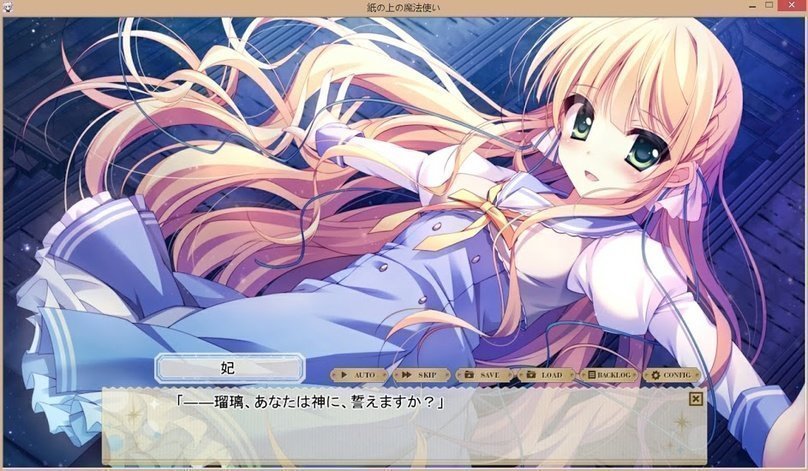
Of course that alone isn’t enough. What makes this game fight is the plot. 紙の上の魔法使い pulls off multiple reversals.
What’s a reversal? It’s when a character is the protagonist in one chapter, then a moment later, in the next chapter, they’re not — and then another turn, and two chapters later they’re back in the protagonist seat. The game has no clear-cut heroes and villains, but the excavation of the instigator and the mastermind, and the exploration of the story framework’s truth, is genuinely full of ups and downs. Most importantly, this kind of breathless rollercoaster rarely sticks the landing — but here it does.
That’s already rare. Sure, the game has some bugs and no standalone OP or ED, but the art, story, and BGM are already worth the price of admission. Most importantly, it left an indelible impression on me. Look — when I think back on the games I’ve played, it’s always the first one that comes to mind, and that says enough…
Some people call works with “cute, beautiful art but no real main plot, just tea-drinking and idle chatter” moege. Same goes for both anime and games. Honestly, I used to think so too, until I discovered Frontwing’s take on “moege” — this one, ゆきこいめると.
At the end of the year a phrase was going around: “Be elegant, not filthy.” What “filthy” means here is really hard to pin down, but the genuinely filthy people understand its deep meaning immediately. ゆきこいめると is a moege, but it also carries strong 18+ game DNA, and the developers milk this delightful dual identity for all it’s worth. A cute moe work should be “elegant,” but an 18+ porn game is inherently “filthy,” so ゆきこいめると loudly presents to you what “elegant filth” looks like.
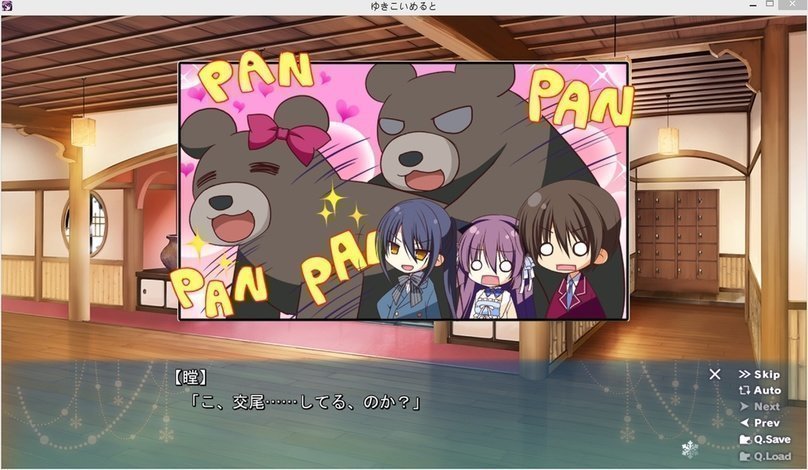
ゆきこいめると’s story structure is dead simple, no different from your average tea-drinking anime: girls and the protagonist gather, form a club, and the game depicts their daily lives. But this game props up the entire structure with sheer force of its slice-of-life content. Why is the daily life so good? Because it’s all gags — packed with gags, packed with dirty jokes… The cute girls open their mouths and out come dirty jokes, and the fun part is they’re subtle. Often after delivering the punchline, just as you catch the dirty part, the game suddenly turns dead serious, giving you the illusion of “you’re just imagining dirty things, get your mind out of the gutter.” If you watch Gintama regularly you’ll get what I mean.
The daily segments are long, but miraculously I never got bored. The little stories are just too entertaining — read it as a four-panel comic and you’ll find plenty of laughs. Gag after gag, you can’t stop, and by the time the daily life ends and you reach the ending, you’re left wanting more.
This game overturned my view of slice-of-life games. So daily life can be this fun — provided you have a strong gag writer… oh, I mean a scenario writer.
I imagine a lot of people know this one, so recommending it might make me look basic. But some of you probably also know my brain works differently from a lot of VN players. I’m recommending this one not for its philosophy, not for its culture, not for its metaphors…
Just because its story is good. That’s all.
サクラノ詩 may contain a lot of philosophy, a lot of mappings between art and mathematics, homosexuality and art, genius and mediocrity — but ultimately, none of that has any real impact on the story itself. You might see someone quoting some artist’s sayings from サクラノ詩, some line of poetry, dissecting it word by word trying to extract the author’s hidden meaning, calling it “analysis” and enjoying themselves. I just want to say I’m not that kind of guy.
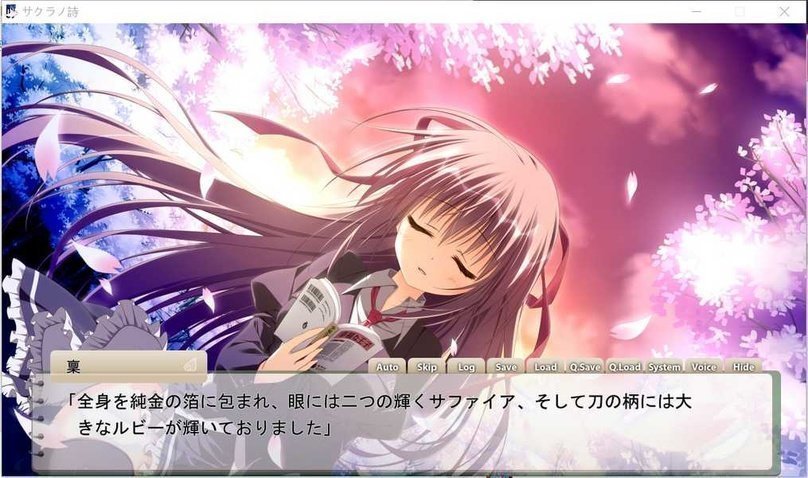
サクラノ詩’s story is complete. I personally don’t recommend, and wouldn’t advise, diving too deep into the game’s hidden contents from the start. Honestly I think the various elements in サクラノ詩 are just there to raise the prestige — they don’t do much else. A lot of it is personal indulgence, some of it wishful nonsense. But that doesn’t mean the story itself is bad. Apart from the first two chapters being too boring, from chapter three onward the plot hits its stride, and by chapters four and five the whole framework comes together, pulling you deep into the protagonists’ legendary journey. By the time you finish, even if you didn’t understand the obscure philosophical dialogue, you’ll still understand the ins and outs, know what the protagonists went through in their fate, and maybe think of yourself, or of people around you.
Seeing the story, relating it to life, gaining new feelings — I think that’s more meaningful than what those idiots nitpicking the game’s wording get. For a game like サクラノ詩, it has a legendary story that gives you an exhilarating experience. That alone makes it worth recommending.
I have a hobby: I like games with combat, games with hot-blooded elements and fast pacing. It’s Duang, it’s hype, it’s satisfying, it’s cathartic.
11月のアルカディア is that kind of game. Its biggest strength is tight structure, and thoughtfully there are no route locks — you can go straight through to the True End smoothly. The story pacing is very fast; apart from a slow bit before the OP, the game’s time limit means it has to pick up the pace. The acceleration lets you overlook a lot — “speed hides all ugliness,” as they say. Fast-paced plot makes it easy for players to miss holes and inconsistencies in the setting and details, since you don’t have time to scrutinize. The great battle is at hand, the enemy is at the gates — no time for detailed analysis.
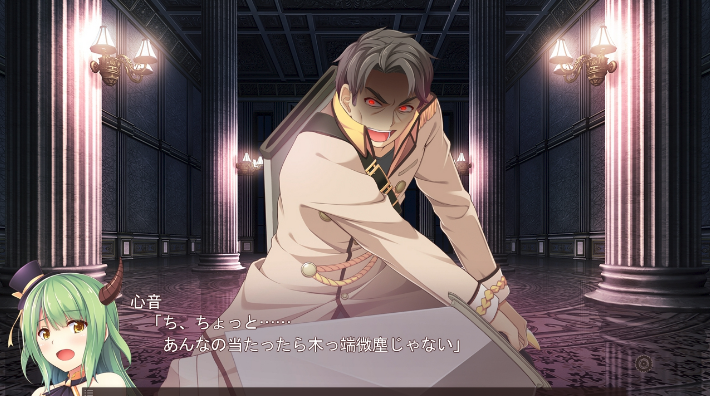
The game has plenty of unreasonable setting elements, but the fast pace covers them well. If you go straight to the True End, there’s a good chance you’ll be swept up by the atmosphere and get that brain-feverish illusion of “this game is so hype.” But once you cool down and look back, you’ll think “eh, that’s all it was.” Then again, that “brain fever” feeling is genuinely satisfying, and it’s a unique sensation no other game gives me. That’s probably 11月のアルカディア’s charm.
By the way, the OP and several EDs are all great listens. Worth recommending for those too.
A work from a subsidiary of Earo Ring. It was marketed as “cooking beauties,” but in reality… it’s a warm little sister-con work. The game has many routes, locked into a rural setting, but the routes don’t feel too boring. I think the game’s two biggest highlights are character writing and the soundtrack.
I always thought of なついろレシピ as a single-route game, because the other side characters feel frankly optional compared to the heroine. However the game develops, it feels more like a simple brother-sister romance. The sister’s characterization is very solid, feelings slowly budding bit by bit — this is a rare quality in VN romance writing. Most games are still on the old crude path of memory-flashback confessions and starting affection at 100%.
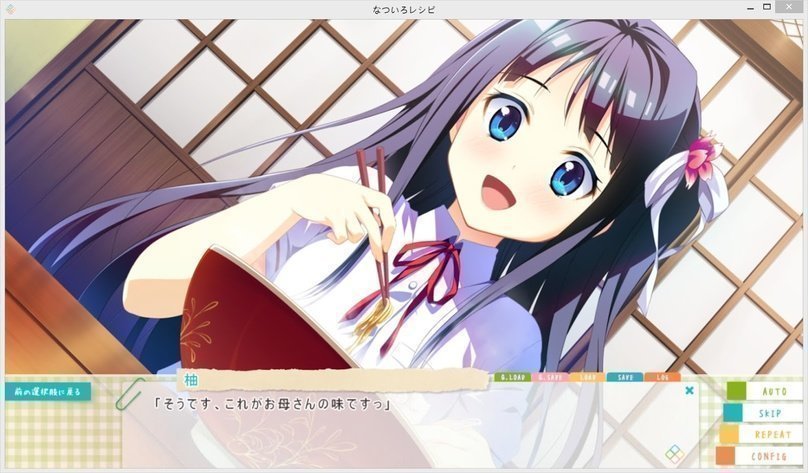
The soundtrack is one of the year’s rare highlights. Since the marketing theme was cooking, the music heavily uses sounds of microwaves, cutting boards, spoons, bowls, and other kitchen utensils colliding to form rhythms. It sounds incredibly lived-in, and like the heroine, it left a deep impression on me.
Most visual novels are set in schools, mostly about school events, but very few actually tell a proper story about youth. A youth story is about doing things you only do when young, things you can only do when young — you only get one life, and without youth something is missing.
空色イノセント captures that youthful air well. Its strength is that it’s short — yes, genuinely short. You can quickly follow a group of boys and girls through their grand plan. No crazy twists, no messy love triangles, just a steady progression to the end, giving a very reassuring feeling.
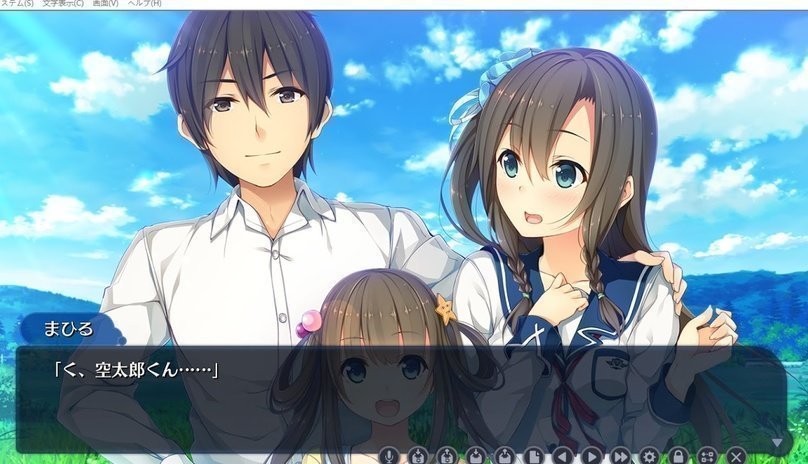
Japanese players rate this game very low, and many of those reviews are baffling. But I think it’s one of the rare works that made me feel the breath of youth — the same feeling I had watching TARI TARI back in the day.
I’m recommending this one not for its plot but for its music and presentation.
Most visual novels never achieve the “cinema-grade” presentation this game reaches. Simply put, playing most visual novels doesn’t feel like watching a TV drama or movie — this one does, and it leans more on the soundtrack and sound effects.
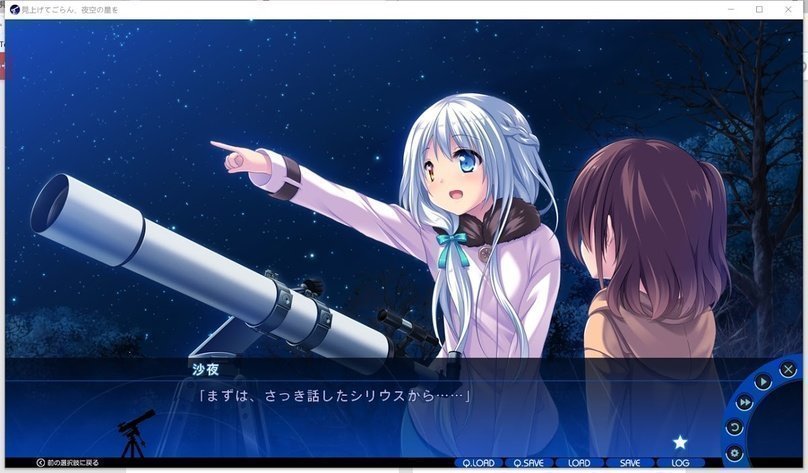
The game is nominally about stargazing, but only part of it is actually about that; mostly it’s stories that revolve around stargazing. Set at night most of the time, the game makes excellent use of night scenery and night-sky staging, combined with immersive music and sound effects, creating an experience that pulls you in.
Some parts drag too long, but thanks to the sound design it doesn’t hurt too much. There are always a few VNs that get a big boost from outstanding music and sound — last year it was はつゆきさくら, and this year the one that gave me that feeling is 見上げてごらん、夜空の星を.
A great visual novel might be famous for its plot, for its art, or for its systems or music — always some strength. All-around excellent works barely exist. But we don’t need perfection — if all-around excellent doesn’t exist, all-around good does. Games like that seem unremarkable but leave some recoil, like 花咲ワークスプリング!.
花咲ワークスプリング! is theoretically a moege, but it has gags, plot, and suspense. Art-wise I’d say it doesn’t match Yuzusoft, but it has its own flavor. Gags aren’t as good as ゆきこいめると but are still funny. The plot isn’t exactly full of twists but has meaning and value. Music isn’t outstanding but is reliably good. The system has no special gimmicks but is efficient.
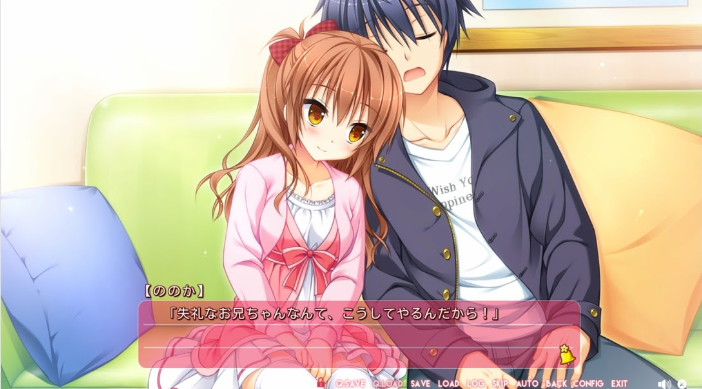
Simply put, for 花咲ワークスプリング!, the unflattering description is “no highlights,” the flattering one is “no flaws.” I lean toward the latter. Looking across the whole year, a game like 花咲ワークスプリング! that gives you nothing obvious to hate is genuinely one of a kind. I wouldn’t say it suits everyone, but it has broad appeal — everyone can find something they want in it. It’s a well-balanced game, and unless someone is an absolute fanatic about one particular element, recommending it should never produce that “this is trash” illusion — at worst some aspects just won’t click.
So 花咲ワークスプリング! has nothing absolutely outstanding, but also nothing bad. If you pit it against the year’s other games in terms of combat power, its rating probably isn’t low…
Of course these are just my personal recommendations. Not many games got translated this year, but a few did. Among translated works, the only one I’d recommend is 恋がさくころ桜どき — a very complete story. キミへ贈る、ソラの花 also got translated, but its plot isn’t for everyone… if you’ve got a strong heart, give it a try.
Below is a list of all the games I played this year, as an index of sorts:
紙の上の魔法使い /archives/809/
翠の海 /archives/817/
SINCLIENT /archives/846/
星織ユメミライ /archives/855/
はるかかなた /archives/856/
キミへ贈る、ソラの花 /archives/894/
恋がさくころ桜どき /archives/973/
恋する彼女の不器用な舞台 /archives/903/
樱花庄的宠物女孩PSP https://plumz.me/archives/911/
变态王子与不笑猫PSP /archives/916/
聖娼女 ~性奴育成学園~ /archives/978/
命运线上的φ /archives/986/
fortissimo EXS//Akkord:nächsten Phase /archives/1002/
SPPL /archives/1004/
十六夜のフォルトゥーナ /archives/1023/
サノバウィッチ /archives/1075/
ぼくの一人戦争 /archives/1115/
鯨神のティアスティラ /archives/1140/
11月のアルカディア /archives/1147/
花咲ワークスプリング! /archives/1165/
灰色的迷宫 灰色的乐园 /archives/1171/
花の野に咲くうたかたの /archives/1181/
1/7の魔法使い /archives/1219/
晴のちきっと菜の花びより /archives/1206/
プラマイウォーズ /archives/1258/
Clover Heart’s /archives/1283/
11eyes: Resona Forma /archives/1294/
いますぐお兄ちゃんに妹だっていいたい /archives/1336/
DEVILS DEVEL CONCEPT /archives/1334/
ゆきこいめると /archives/1312/
アイドル魔法少女ちるちるみちる 前篇/后篇 /archives/1416/
恋想リレーション /archives/1398/
なついろレシピ /archives/1377/
すみれ /archives/1445/
ピュア X コネクト /archives/1461/
Secret Game:Code Revise 2nd Stage Boosted Edition /archives/1468/
LoveRec. /archives/1482/
できない私が、くり返す /archives/1513/
箱庭ロジック /archives/1531/
幼なじみは大統領 /archives/1608/
Areas ~空に映すキミとのセカイ~ /archives/1576/
双子座のパラドクス /archives/1575/
ソーサリージョーカーズ /archives/1669/
ティンクル☆くるせいだ /archives/1640/
幻のディストピア /archives/1653/
さくらにかげつ /archives/1684/
ひとつ飛ばし恋愛 /archives/1768/
フレラバ /archives/1822/
少女アクティビティ /archives/1860/
妹のセイイキ /archives/1839/
恋する夏のラストリゾート /archives/1946/
いろとりどりのセカイ いろとりどりのヒカリ 紅い瞳に映るセカイ /archives/2094/
お兄ちゃん 右手の使用を禁止します /archives/2043/
妹ぱらだいす /archives/2053/
妹ぱらだいす 2 /archives/2065/
時計仕掛けのレイライン 黄昏時の境界線 時計仕掛けのレイライン 残影の夜が明ける時 時計仕掛けのレイライン 朝霧に散る花 /archives/1989/
円交少女 ~陸上部ゆっきーの場合~ /archives/2324/
恋×シンアイ彼女 /archives/2289/
しずくのおと -fall into poison- /archives/2270/
こころリスタ /archives/2247/
サクラノ詩 - 桜の森の上を舞う /archives/2191/
恋する気持ちのかさねかた /archives/2363/
天ノ空レトロスペクト /archives/2339/
箱庭の学園 /archives/2512/
空色イノセント /archives/2490/
空飛ぶ羊と真夏の花 /archives/2452/
コドモノアソビ /archives/2469/
僕はキミだけを見つめる ~I gaze at only you~ /archives/2522/
乱れ雪月華 ~儚く散る細雪~ /archives/2541/
見上げてごらん、夜空の星を /archives/2580/
お兄ちゃんティーチャー ~秘密の授業を希望します /archives/2595/
QUINTUPLE☆SPLASH! /archives/2602/
ソラコイ /archives/2615/
因为是清明节所以鬼很萌 /archives/2627/
Comments are hosted on the Chinese main site. This mirror is read-only.