Clover Toshokan no Juunintachi (クローバー図書館の住人たち/クローバー図書館の住人たち II) Review
The Girl in the Miniature Garden Dreams of a Prince
When we were little, we all read fairy tales.
The funny thing is, in fairy tales the protagonist is almost always a little girl. And the story is almost always about a frail girl and the prince who protects her.
Boys read them and want to be the prince, protecting their princess.
Girls read them and want to be the princess, finding a prince who’ll protect them.
I tried to recall the fairy tales I knew as a kid, and was surprised to find they don’t really skew by gender. Boys and girls read the same tales — explorations of strange worlds, the same prince-and-princess stories passed down for generations.
But time passes, boys and girls grow up, and maybe they’ve all quietly accepted that the fairy tales they heard were lies. Most boys no longer believe in a princess worth protecting, and most girls don’t really dream of a prince coming to save them anymore.
Thinking back on those old tales brings a wry smile. I can’t tell if it’s nostalgia, or the feeling that the kid who believed this stuff was kind of ridiculous.
Still, the fairy tales never stopped. They keep telling the story of prince and princess, for whoever’s willing to listen.

Clover Toshokan no Juunin-tachi (The Residents of the Clover Library) is an otome romance game developed by MIO. Being otome, the romanceable characters are all men — but the story itself is still about boys and girls falling in love, so it doesn’t feel off. If anything, the game is full of a fairy-tale romance you rarely see in your average visual novel.
Clover Toshokan no Juunin-tachi begins with the lone heroine, Aikawa Chihiro, job hunting. She spots a posting for a librarian, and since she’s loved books since childhood, she applies with that passion and lands the job managing the place called the Clover Library.
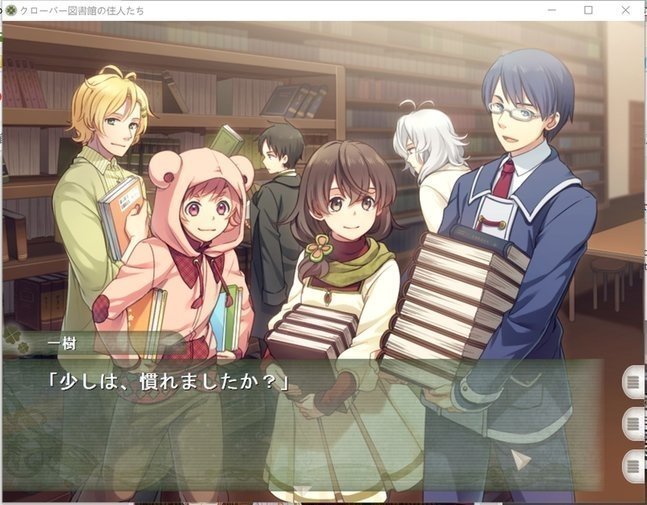
Right from the start of the job, she finds all sorts of people in the library — all men, of course. One can draw, one can cook, one knows a lot, one’s very romantic. They’re romance targets, after all. But soon she notices these library residents can’t be seen during the day, and only move around indoors at night.
She also learns that previous librarians never lasted long. Then one night, the “residents” come clean: they aren’t human. They’re the books in this library, turned into human form.
Which explains why the handsome guys all have different talents — the artist is an art book, the cook is a cookbook.
Chihiro doesn’t mind much when she hears this. She figures these books-turned-people are good folks, and keeps looking after them. Various things happen — a budget crisis, a crisis of damaged books — and with her warm help they pull through.
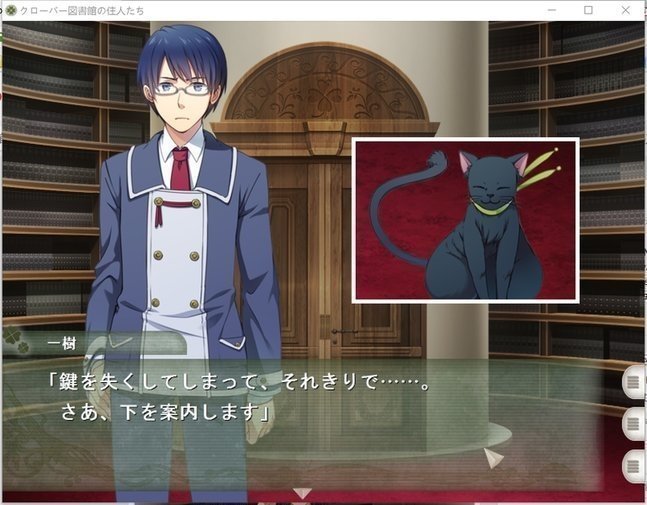
The Clover Library has some mysterious spots. For one, the room on the third floor won’t open. There’s also a black cat said to be an old resident; Chihiro doesn’t know why it’s here, but it isn’t causing trouble, so she leaves it alone. As for the third-floor room, she isn’t curious either — she just does her job honestly.
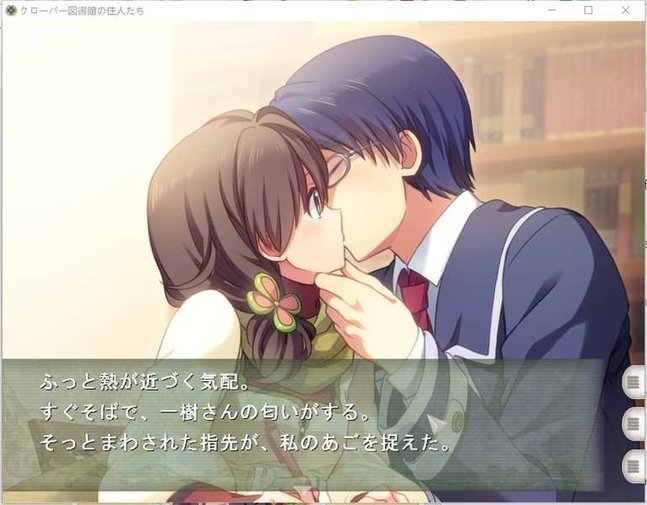
This is where you pick which guy to pursue. The formula is simple: they’re all books, so just meet the one you want more often. The endings are just dating and a kiss. Some choices are landmines — pick wrong and the heroine leaves the library, takes a job at another company, and forgets all about this place.
Worth noting: Clover Toshokan no Juunin-tachi is a split game. The first title only lets you pursue the first three characters; the second lets you pursue the last three and unlocks the final True End.
The two games don’t change the system or much else. I’d rather believe it’s really one game that got pointlessly chopped in half.
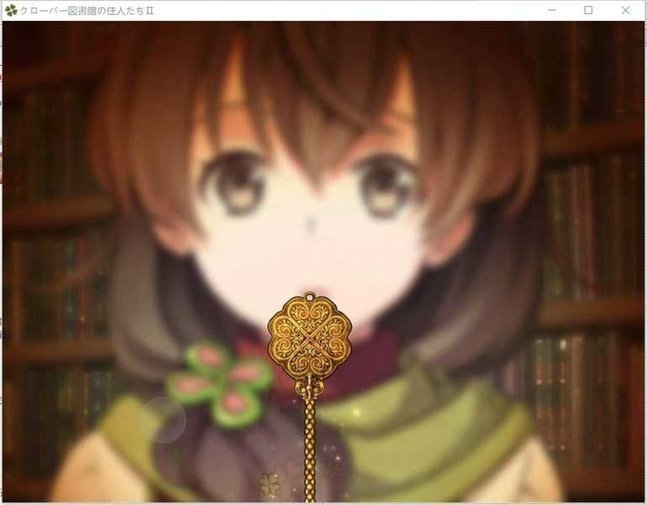
The moment OP2 of the second game starts, the story shifts from “librarian and handsome guys” slice-of-life to “unraveling the library’s secret.” After OP2, Chihiro receives a key from the black cat — apparently a key that opens the third-floor room.
Curious, and figuring the cat might be telling her to check it out, she goes to the third-floor room. There she finds a white book with no writing in it. This book can also take human form — a little girl named Sachiha. Sachiha says she’s the master of this library, but she’s fundamentally a book too — the Book of Beginnings. The library began with her. As a child she stayed indoors, sickly and frail, so her parents gave her books to read, and she holed up in the library. Until she died, Sachiha herself became a book, hiding on the third floor, reading whatever she wanted.
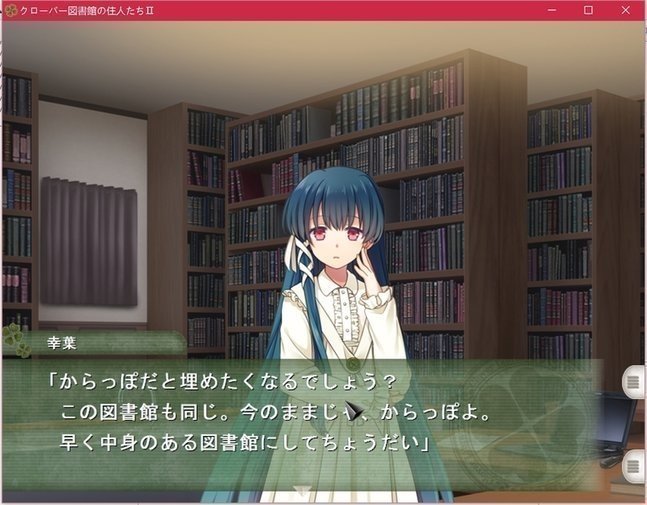
Sachiha meets Chihiro with open disdain. Since Chihiro’s the librarian, she should hurry up and collect books to fill the place — Sachiha needs to keep reading, you know. Her tone is full of dissatisfaction. Chihiro swallows it and keeps organizing, keeps collecting, even though it’s still a bit slow. Soon Sachiha grows more and more unhappy with her sluggish pace. One day Chihiro overhears Sachiha talking with one of the art-book guys — Sachiha wants to do something to Chihiro, and the art book refuses. Sachiha is furious:
“Why are you speaking up for her? You weren’t like this before!”
Chihiro feels oddly hurt hearing this. She’s actually quite fond of the art book, and he’s a little fond of her too. She’s touched he protected her, but seeing how familiar he is with Sachiha makes her a bit jealous.
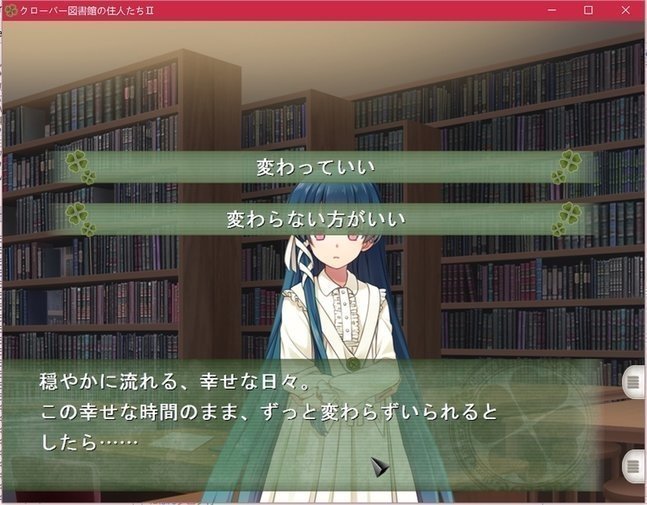
Eventually she notices the art book protecting her more and more, warning her to stay away from Sachiha because Sachiha is dangerous. The two of them start to have something like a romance.
Sachiha finally gives Chihiro an ultimatum. She lays it out: she’s a blank white book, and she needs to keep reading others’ books to broaden her view. That’s what hiring a librarian was for. But Chihiro’s pace no longer satisfies her, so she’s going to turn Chihiro into a book.
Chihiro is startled. “Turn me into a book?”
“Yes. Like I did to the librarians before you.” Sachiha says something shocking.
So all the previous librarians were turned into books by Sachiha and left here forever. Just as Sachiha is about to act, the art book appears again to protect Chihiro.
“You helped me when I turned the others into books! Why are you helping someone else now!” Sachiha is even angrier.
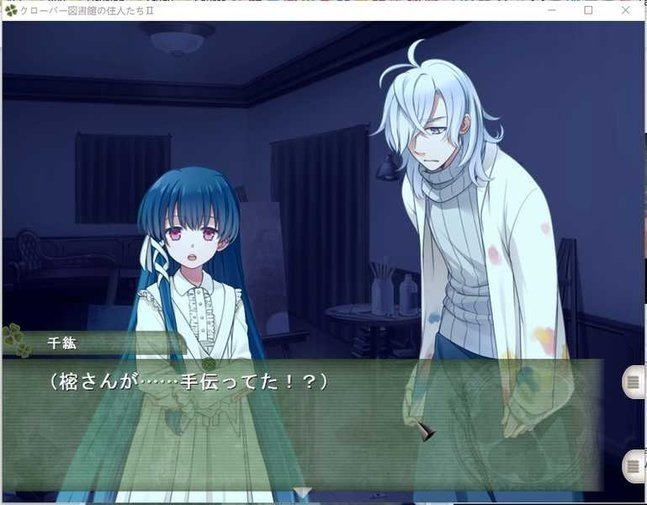
“Anyway, I won’t let you touch her.” The art book keeps protecting Chihiro. (No shit — it’s his route.)
After a few harsh words, Sachiha suddenly gives up. She says that’s just how it is — Chihiro can stay if she wants, leave if she wants.
Chihiro finds it strange, but senses Sachiha isn’t purely malicious, so she stays.
There’s a story lock here: on the first playthrough, it’s Chihiro’s romance with the art book guy to an ending. On the second, the True End opens.
In the True End, Sachiha comes to Chihiro one day and asks if she wants to know more.
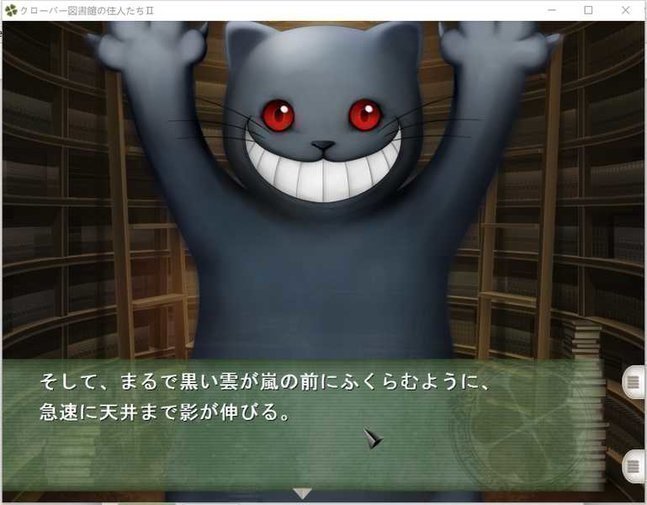
Then comes a pretty wild turn. Sachiha and Chihiro go to the third floor, and after some fuss, the black cat in the library suddenly starts talking.
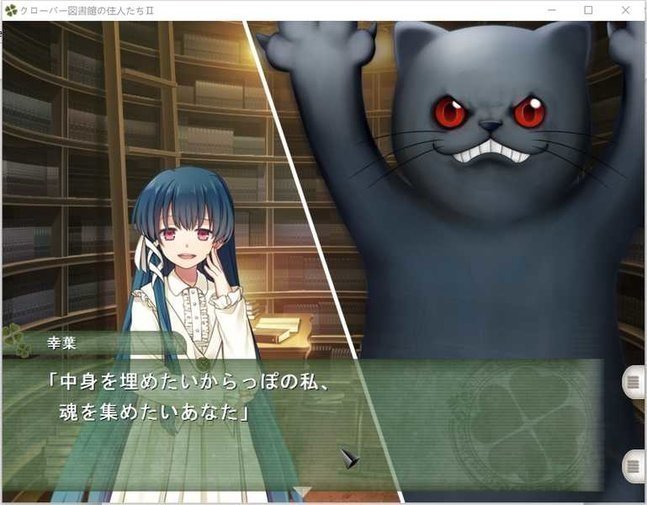
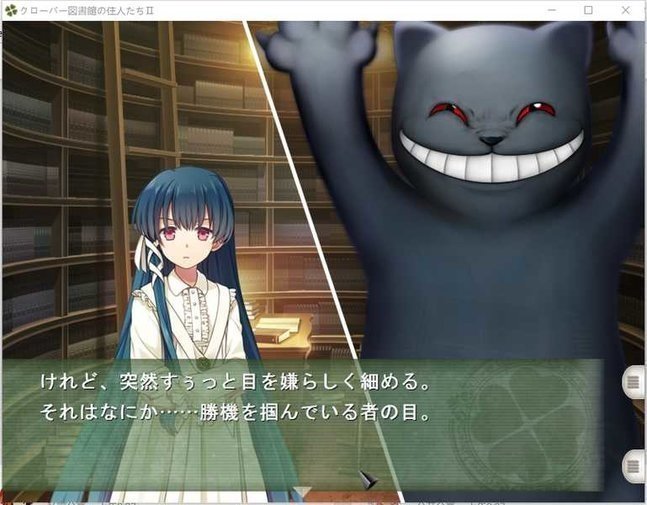
The cat suddenly grows huge and terrifying. The black cat explains it was behind Sachiha’s endless need to read — or rather, it was using Sachiha’s reading to collect human souls, blah blah blah.
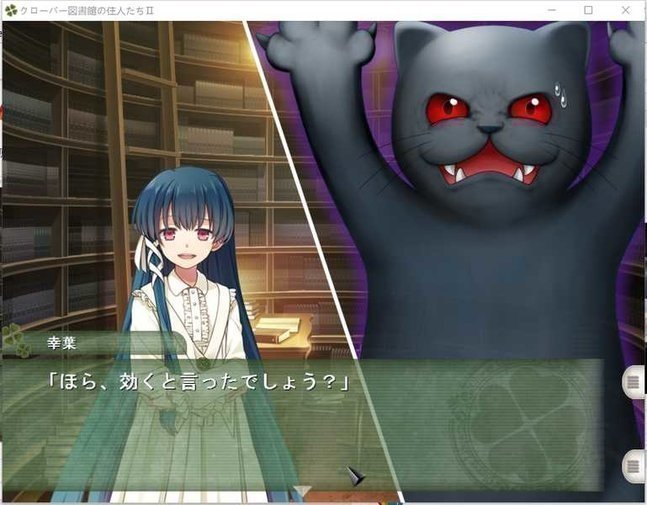
Naturally, Chihiro and the guys unite, and with Sachiha’s verbal beatdown they take down the troublemaking cat.
Freed, Sachiha hugs the black cat and chooses to be reborn, leaving the library. Chihiro is left with the books that turn into boys.
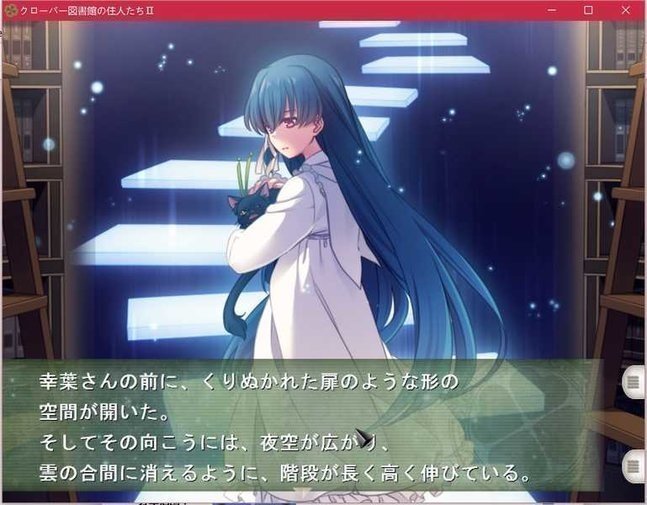
The game reaches its ending.
Clover Toshokan no Juunin-tachi gives 80% of its content to romance and 20% to the final chapter. At least it hands you a mystery hook at the start, so it has to wrap it up — and the plot mostly exists to serve the romance. Sachiha’s appearance, the final boss black cat, all of it is just an answer to the mysterious library setup. No big waves, no real crazy twist, and the ending’s selling point is the heroine being saved.
I’ve played otome games before — yuri and BL too — but Clover Toshokan no Juunin-tachi felt different. First, the art is genuinely good, with no obvious bias: men and women are drawn equally cute, and the heroine’s outfits and hairstyle hit my strike zone dead-on. Maybe because it’s otome, the wording and dialogue are very refined. The heroine’s way of speaking is incredibly, incredibly, incredibly, incredibly, incredibly prim, quiet, and cute — a shame there’s no CV. I could read her lines aloud and mentally supply a soft girl’s voice. The men’s wording is gentle too, mostly the “world’s best boyfriend” type girls dream of: always speaking softly, stepping in front of you when you’re in danger, rushing to save you no matter what, getting tsundere and unable to finish a confession, and so on. It also made me realize that the male-oriented eroge protagonist who casually reads porn and talks about panties nonstop just doesn’t exist in otome games. That’s the huge gulf between them.
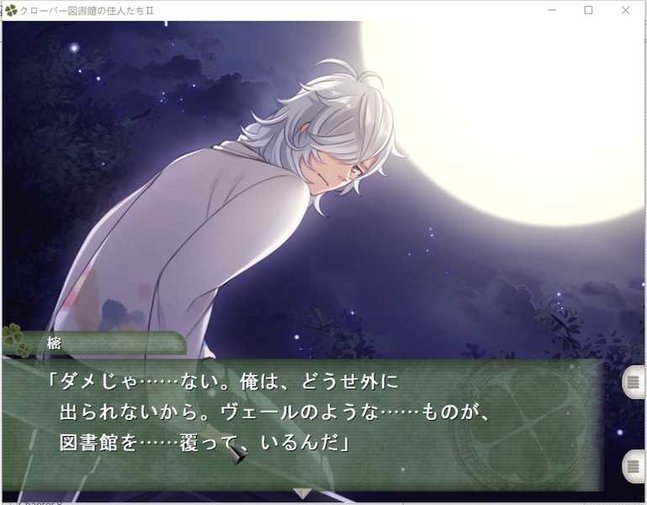
Most of the game is Chihiro dealing with various handsome guys. Since they’re all books in-setting and she’s the librarian, plenty of choices are about how to “treat each book kindly.” There are lots of choices; being kind to the books should raise affection. The dialogue with the guys is full of girlish hearts. I have to marvel that girls facing love really are filthy… oh, I mean subtle. Should you hide behind a man when it thunders? When being carried princess-style, should you lean into his chest? When a man is about to confess but hesitates, should you follow his words and guide him to say it? Should you clean up the room after the men have been there? Should you show your best appearance to the men? And so on. As the true protagonist, the game’s male CV lineup is solid too — Namikawa Daisuke, Hanazawa Kana… wait, no, Hanazawa Kana is female. The cast includes Namikawa Daisuke, Hanazawa Natsuki, Konishi Katsuyuki and others, and the performances are all good. Namikawa Daisuke is an old hand; his voice is close to Persona 4’s protagonist, which gives a strong sense of déjà vu.
The game has many endings: each character has a Normal End, True End, and Bad End, plus the worst End where the heroine leaves the library and nothing remains, and a harem End where she’s surrounded by all the men. As mentioned, the game is split into two parts, really just a rough story division. The interesting bit is that the second game changes to a new OP, announcing the final boss and the key character Sachiha — but the system, UI, and everything else are basically identical.
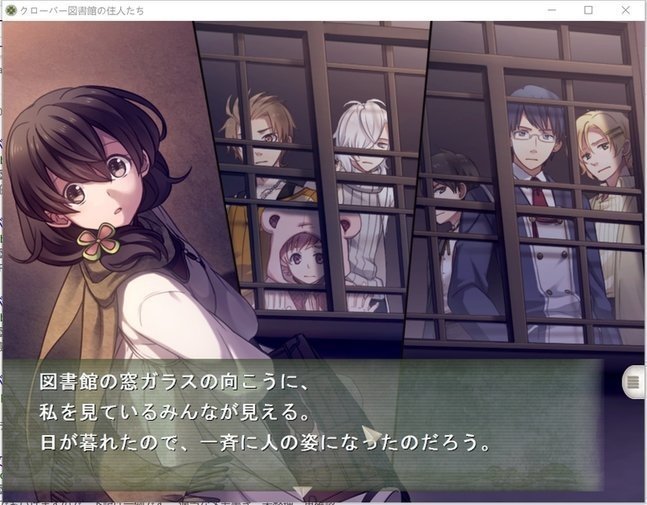
The music is a highlight. OP1 and OP2 are both really good — especially OP2. With the animation, it absolutely blows some male-oriented eroge OPs out of the water. Of course, I mean the music, not the BGM. This game’s BGM is something else — in a disgusting way.
Here’s why: if it’s your first time playing and you haven’t played Tokage no Shippo Kiri, it won’t affect you. But if you’ve played that grotesque game, you’ll notice that at least half of Clover Toshokan no Juunin-tachi’s BGM is identical to Tokage no Shippo Kiri’s.
Yes, identical. One is a pure otome game, the other a bloody grotesque game. They use the same BGM.
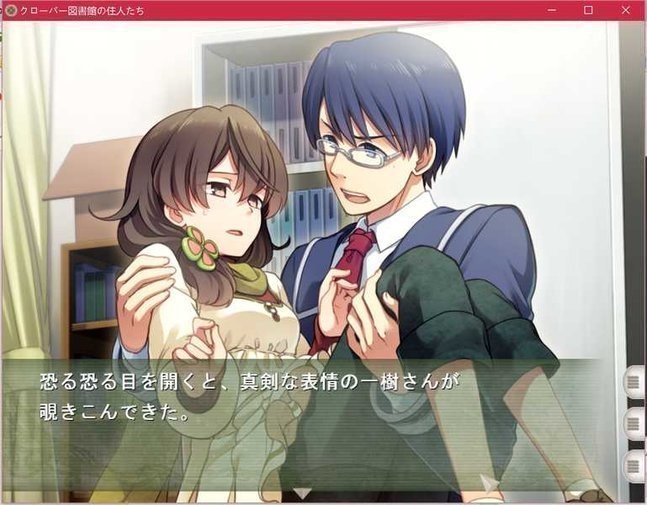
Hearing the daily-life BGM, my reaction was “what the fuck” — my head full of severed hands.
I looked it up later: Tokage no Shippo Kiri’s developer cyclet and Clover Toshokan no Juunin-tachi’s developer MIO both belong to cyc-soft. This cyc-soft is something else — it makes male-oriented and female-oriented games, even yuri… so both games come from the same company, and reusing BGM is kind of normal…
But you can’t reuse BGM this sloppily, right?
Oh well. Maybe they figured people who play grotesque games wouldn’t play otome games. They just happened to run into me.
Anyway, as an otome game, Clover Toshokan no Juunin-tachi doesn’t seem to be well-received by actual veteran female players. They find it too bland.
Fair enough. Compared to real female-oriented BL blockbusters, its romance is too pure, the wording too clean, the style too fairy-tale. I admit it’s like a cup of clear tea — the game isn’t long, the wording is simple, suited to slow savoring. Even the final ending is unhurried, without too much shock. As for the “between male lead and male lead” stuff most veteran fujoshi want, the game doesn’t show it. Overall it’s more like an adventure story about a girl who stumbles into a magical library.
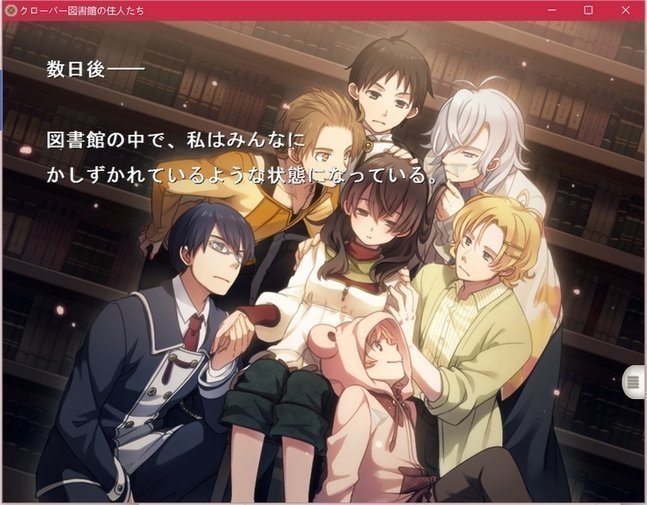
Thinking about it, that’s right. Not only does the title have a fairy-tale style, the game itself follows a fairy-tale style. Even while serving the female audience, the heroine is kind and hardworking, with no “arrogant princess whining in bed all day” nonsense — it’s exactly a “perfect princess meets perfect prince” kind of story.
But in today’s society, neither adult men nor adult women want to believe in fairy tales anymore.
Men jerk off to frozen eroge and get horny over girls; women get horny over BL and squeal over handsome guys.
Both sides are full of human instinct. We filthy people sometimes need to see something pure — maybe it brings a little romance, maybe we find a bit of ourselves.
“Every girl wandering in a closed space dreams of a prince coming to rescue her.”
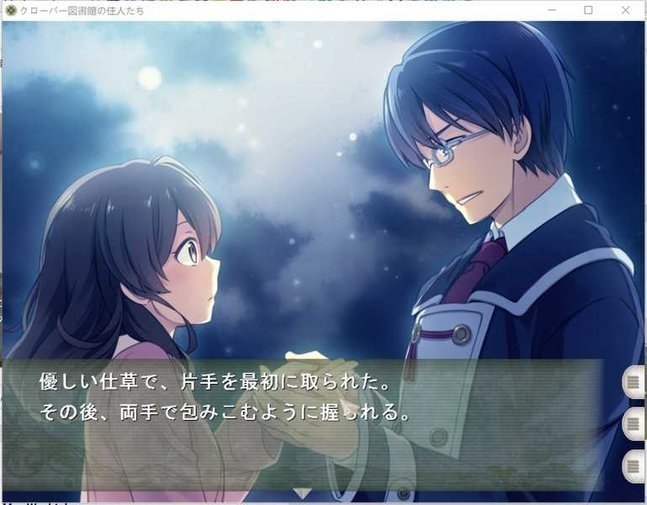
As my title says: The Girl in the Miniature Garden Dreams of a Prince. The girl in the box garden dreamed of a prince.
It has nothing to do with gender. Sometimes we need to be a little more innocent and romantic — whether you’re the girl waiting for a prince, or the prince who wants to save her.
At the very least, I think being willing to listen to fairy tales and believe in them isn’t a bad thing.
Comments are hosted on the Chinese main site. This mirror is read-only.