Toki wo Tsumugu Yakusoku (時を紡ぐ約束) Review
Toki wo Tsumugu Yakusoku: A Textbook Mediocre VN
“Unfortunately, this just wasn’t the dish I was hoping for.”
“I’m writing this not long after finishing the game, so my impressions are probably still colored by that post-clear high. As usual, there’ll be some spoilers about the game’s ideas and setting, but nothing much beyond what the trial version already tells you. Just a heads-up about where this is coming from.”
When I write up a game, I usually treat it as closing the book on it — a way of settling accounts with myself. With Toki wo Tsumugu Yakusoku, I only did the common route, and I skimmed the remaining heroine routes here and there. By “here and there” I mean I skipped through huge chunks and only stopped once the story got rolling enough to show its core beats. I did it because I felt there was no need — and no point — in finishing the rest. There are a lot of reasons… so let me list them one by one:
I went into this expecting something from the story. The VNDB blurb makes it sound like there’s some kind of twist lurking underneath — the classic “false surface, hidden truth” thing. Nope. It’s not that kind of game. Sure, there’s some time-travel-adjacent magic in there, but it’s about as meaningful as the time-travel stuff in ChronoClock last year (i.e., not at all). The protagonist has a superpower for reasons that never get explained: he can freeze time for 10 seconds and do whatever he wants in that window. There’s no strict limit on it, though you do learn he gets tired if he spams it. From what I could tell, the game basically never bothers explaining where the ability came from. It does come in handy during a few plot conflicts, but the ability is never the core of the story — and honestly, given how flimsy the setup and explanation are, it doesn’t matter much anyway.
In the common route, the protagonist tells one heroine he has magic powers. She immediately writes him off as an idiot and doesn’t give him the time of day. So to prove it, he makes a coin vanish in front of her. She assumes it’s just a magic trick or some sleight of hand. To convince her, he busts out his “teleportation” and only then does she have to admit he really does have powers. Her reaction? A completely flat “Wow, so cool, you can use magic~.” Basically the same attitude as treating it as a party trick. That part confused me. My guess is the world of Toki wo Tsumugu Yakusoku is more or less like the real world — magic and powers aren’t acknowledged and nobody believes in them. And that’s how the game plays it. There’s no “espers” or “mages” organization, no other power user ever shows up, so the heroines’ reactions make sense. Throughout the whole story, their attitude toward the protagonist’s power is just going through the motions of “wow, amazing” with zero actual interest.
Like I said at the start, the protagonist’s ability does matter in a few conflict scenes, but most of the “using the power” setups are laughable. The protagonist works in a small town called Yunohara, billed as a “long-established hot spring town.” The game describes this onsen town as crawling with thugs and sex offenders, lurking on every corner. In every route some shadowy figure shows up to put the hero and heroine in danger. I don’t know if it’s meant to be his chance to shine, but the writer, Shimatora, apparently felt the need to send the protagonist out to beat up ruffians and thugs to assert his justice and cement his protagonist status. That’s a standard formula, sure, but I found it laughable and boring for a few reasons. The big one: the heroines are constantly, endlessly being saved by the protagonist. And on the other side, he keeps framing them as “partners who complement and support each other.” These two beats cover the entire game — on and on, so formulaic it wears you out. Another thing I hate: Japan is, relatively speaking, a much safer country than most, yet it’s painted as the opposite here. Yeah, Japan has its underworld and shady organizations on the fringes, but you don’t need to write what feels like “a moe game set in a totally bankrupt Detroit.” There was no need to build this “dangerous Japan” into the setting and plot at all. It’s a straight-up minus for the whole game.

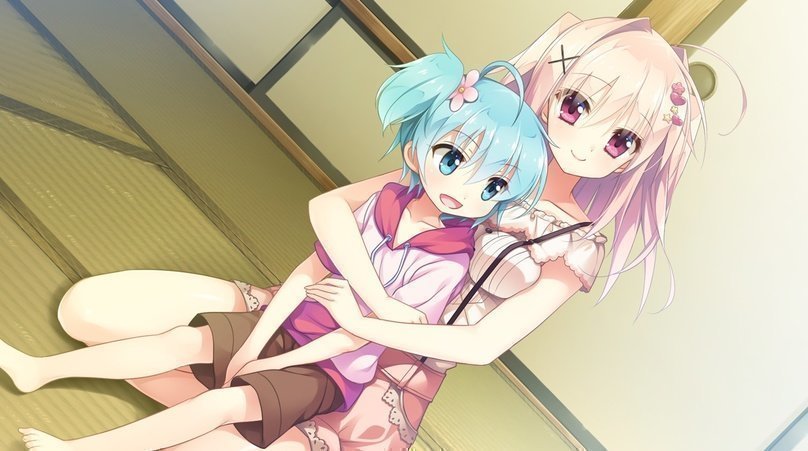
To add that “wounds of the past” flavor, our protagonist — the story’s pillar — is written as an insufferable guy. First off, he has zero negative attitude about anything, and his setup and personality are full of contradictions. He’s supposedly raised in a violent institution (orphanage-ish place) where he was tormented daily. I know this so clearly because he never shuts up about it in the common route. Maybe it’s meant as growth from his past, or a dark-history hint? No idea why the writer made such an “unreliable” protagonist — the guy’s emotions aren’t even stable. But beyond that, he’s also the usual “perfect protagonist”: diligent and eager to learn at the inn, and way too trusting. Those two traits are presumably tied to his upbringing, so fine, character writing. But in the other heroine routes he acts noticeably different from the common route and the other routes — like a different person. Making it worse is his adopted daughter, Miria. At first all you’re told is that he took her in, no details. She seems innocent and cheerful, no different from the random kids in any visual novel, and she follows a standard side-heroine arc — except she’s not a romanceable character. And she’s tied to the True End, of all things.
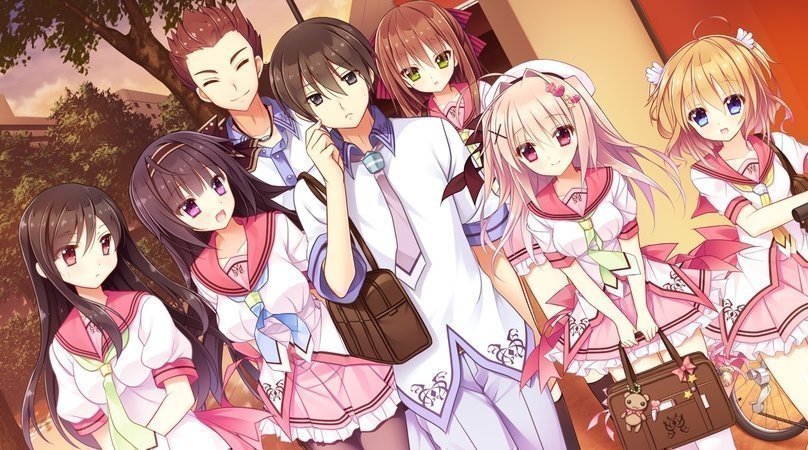
The heroine routes feel more like symbolic drama with a lot of emotional description — literally just drama. They’re pretty negligible within the whole game and hard to remember. Two of the heroines have almost the same hair color, and for the first four hours I couldn’t tell them apart. As the game went on, I quickly forgot the black-haired heroine even existed — her presence is that thin, and she only gets enough screen time in her own route. The common route clearly leans toward the True End heroine, but her route is kind of whatever. What actually holds your attention is Miria, which makes the True End heroine feel like just another bland, uninteresting character.
So, given all the flaws and baffling bits I’ve mentioned, I’m kind of glad I could never get invested in this game. Why? Because I haven’t even mentioned the length. If a story’s length is right, even the unreasonable parts at least won’t make you suffer. But here there’s constant “running around in circles, nothing happens, nothing changes, the plot doesn’t move” content. No matter how many pretty, lovely elements you stuff in — magic, powers, character relationships, no matter how many “lovely slice-of-life moments” you build — with that much padding between plot points, the game can barely make me feel “interested.” I do think the warm atmosphere it builds is decent, and the BGM is good, but the story structure is so mediocre that the whole game ends up mediocre. The production style and content are even trendy in some ways, but they don’t land and feel superfluous — like one heroine being some nameless idol singer, whose performance is worse than the game’s BGM. Oh, and the art and backgrounds are fine, but they’re dragged down by that lukewarm story structure.
Overall, I doubt I’ll be trying new releases to “sweep for landmines” anymore. Normally I’d pick games with good ratings on ErogameScape and VNDB. This one sits around 80 on VNDB, but the sample size is tiny, so it’s not worth much. As visual novels evolve, I think only the ones that don’t put you to sleep — even from some unknown small studio — are worth calling good, and mediocre ones aren’t worth playing at all. If I have to praise Toki wo Tsumugu Yakusoku for something, the music is probably the best part. It’s also one of the rare games that shipped its OST and a piano-arrangement CD as a preorder bonus.
Original author: mdz http://mdzanime.me/2016/04/17/toki-o-tsumugu-yakusoku-mediocrity-had-a-poster-child/
Don’t ask me if the game’s good. I only bought it for the OST.
Comments are hosted on the Chinese main site. This mirror is read-only.