ISLAND Review
ISLAND: A Journey Across 200,000 Years
The reason ISLAND caught my eye was that the other games releasing around the same time were just too easy to read.
I was going to use the word “boring” for the others, but Wagamama doesn’t seem quite that boring — it’s just that most titles, from their introductions alone, clearly aren’t going to pull any surprises.
So ISLAND came charging out with tags like “all-ages,” “story-driven,” and “highbrow foreshadowing payoff,” and announced an anime adaptation almost immediately.
For someone who enjoys plot developments, this seemed like a can’t-miss. But after a long and painful playthrough, I found it wasn’t quite the kind of game I’d imagined.
Not that it’s bad — in fact, its narrative rigor is pushed to an extreme. It’s just not for me. Maybe the kind of people who love EVER17 or Steins;Gate and its time-loop ilk will eat this up.
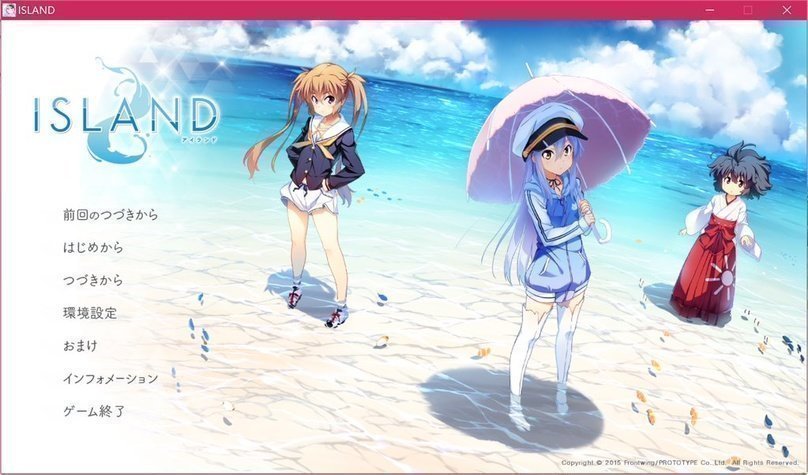
In other words, there aren’t many game types I hate, but one on my hate list is exactly the kind of development ISLAND has. So there’s no helping it — this game gave me zero pleasure and nothing but pain.
Frankly, ISLAND’s premise, its marketing, even its art style and every piece of material are drenched in deception. And not just that — the story itself is full of deception, and not just once.
Usually I’d summarize a game’s plot, but with ISLAND the story defies summary. You could say it has no ending; everything is still ongoing. Not to mention all the deliberate hooks the writer left in for readers to speculate and argue over.
Set up: a memory-less protagonist, Setsuna, washes up on an almost entirely closed-off little island. He knows nothing, but meets a few girls there — the shrine maiden Sara, the young lady Rinne, and Karen, daughter of the island’s administrator. Rinne takes him in as a servant, and he stays on the island, called Urashima. The islanders are xenophobic; anyone not from the island gets deported. If Rinne hadn’t taken him in, he’d have been kicked out.
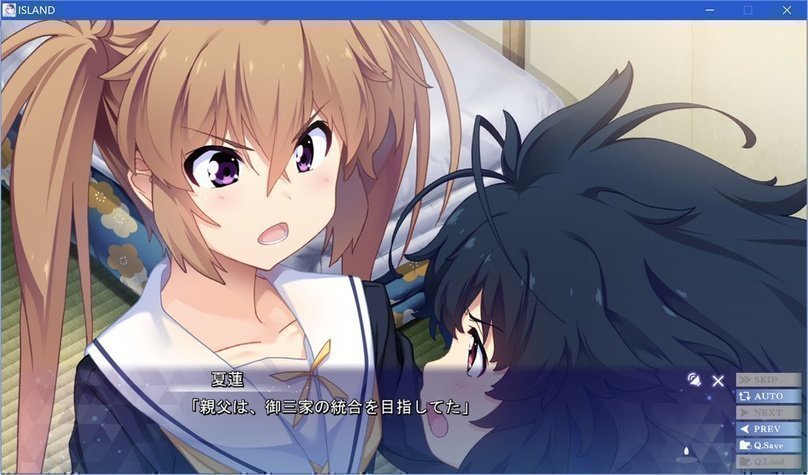
The common route begins. It’s neither long nor short, centered on Setsuna’s daily life on the island, and it plants several mysteries:
1. The Time Traveler
When Rinne first meets Setsuna, she says she’s a time traveler, but it’s a passing remark never really brought up again. Meanwhile, Setsuna insists from the start that he’s from the future, that he came to save someone important, but he can’t for the life of him remember why. The person he’s saving seems to be named Rinne — same as the young lady. Yet he has no idea of his own origins. Similarly, the islanders have some vague recognition of the name Setsuna as he says it, but they don’t pay him much mind and just call him by the kanji “Setsuna.” The common route brings up time travel and crossing over more than once, but every clue gets forcefully cut off by later revelations that tell you it was all a joke. Setsuna dreams repeatedly of the future, of disasters, of fire, but upon waking his IQ conveniently drops and he plays the fool until it’s all forgotten.
In short, in the common route you might notice time travel, you know the protagonist is a time traveler, maybe not from the first playthrough, but otherwise you have almost no leads. That’s it.
2. The Urashima Legend
In daily life, the shrine maiden tells you of an ancient tradition on Urashima — a legend. Long, long ago, a man named Setsuna fell in love with his sister Rinne. A girl named Karen also loved Setsuna, but the sibling love was forbidden. Karen, out of jealousy, went to the gods and demanded punishment for the couple. Rinne was struck by a divine curse, an incurable disease that would soon kill her. To save his beloved, Setsuna went to the nearby island of Tyrannosaurus (yes, really) to beg a witch (or fairy or whatever) for forgiveness. The witch reluctantly agreed but demanded a price: Rinne would lose her life and fall into a cycle of reincarnation, while Setsuna would sleep forever beneath the sea. If, when Setsuna next awakens and meets the reincarnated Rinne, the two fall in love again, the curse would be broken.
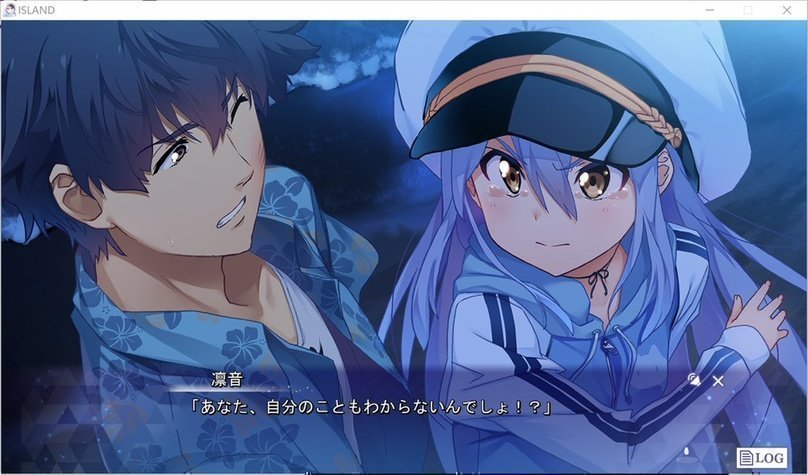
This legend is brought up multiple times in the common route, and throughout the game it has several versions, but the core is always the same: Setsuna sleeps, Rinne reincarnates. As for why the legend’s characters map so neatly onto the common route’s heroines, the initial explanation is “coincidence,” though one heroine calls it fate.
3. Coal Mark Disease
Considered incurable, existing only on Urashima. Once, one of the island’s three noble families, the shrine maidens, dealt with this disease — not by curing it, since it’s terminal, but by cremating the afflicted alive to stamp out infection. The origin of coal mark disease is tied to the Urashima legend: the incurable disease Rinne got from the divine curse is coal mark disease, passed down all this time and never eradicated.
The shrine where Sara serves once burned down, and her mother died in that disaster. Sara was the only survivor. The fire was five years ago, but Sara’s memory of the details is fuzzy.
Rinne is suspected of having coal mark disease. One property of the disease is that sunlight worsens it, so Rinne takes walks late at night all year round.
Next come the individual routes. The recommended order is Karen/Sara → Rinne → True End. But I have to say, following that order, I went from anger to calm.
Roughly: at first, “what the hell is this garbage plot”; mid-game, “wait, they can do that?”; late game, “sure, whatever you say.”
Karen Route
Karen’s route has almost nothing of value. Mostly it’s about Karen, as the administrator’s daughter, being forbidden from leaving the island by her father. She hates it here, wants freedom, keeps trying to sneak out and failing. Her mother ran away long ago and vanished; Karen envies her and wants to meet her.
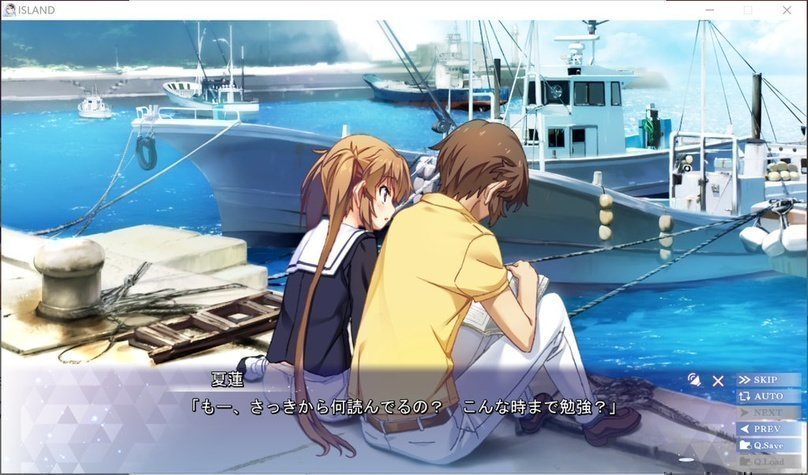
Eventually Setsuna and Karen fall in love, he helps her escape and gain freedom, and at the very end the game drops a key late-game clue: the ocean observation station near Urashima, and the fact that Karen’s mother was a marine scientist studying the island. But it’s all in passing, because the station gets demolished…
So from Karen’s route, all you need to remember is that scientists are studying the island. That’s enough.
Sara Route
Sara’s route is a bit more interesting than Karen’s. Mostly it’s Sara recalling her mother, not understanding why her mother burned to death while she survived, and feeling like she’s forgotten something important from when her mother was alive.
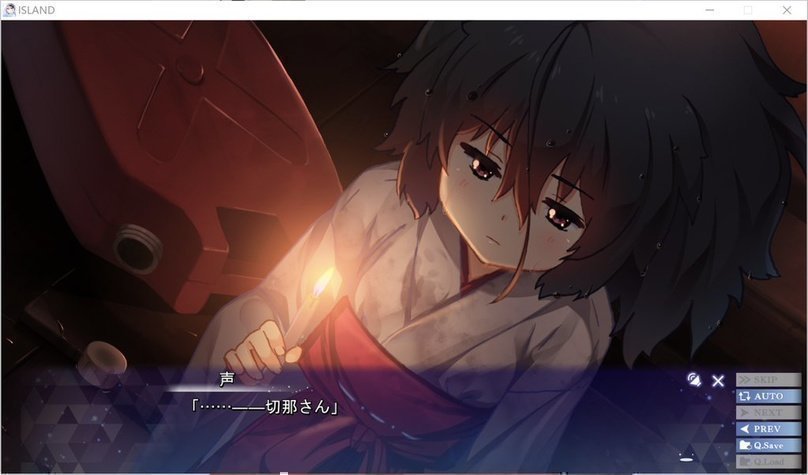
Then the reveal hits like a truck: Sara, through a photo her mother left, discovers a shocking fact — her mother had a mole, and Sara has the same mole in the same place. And she has no memories of certain past events. Putting it together, Sara concludes…
She might be her own mother.
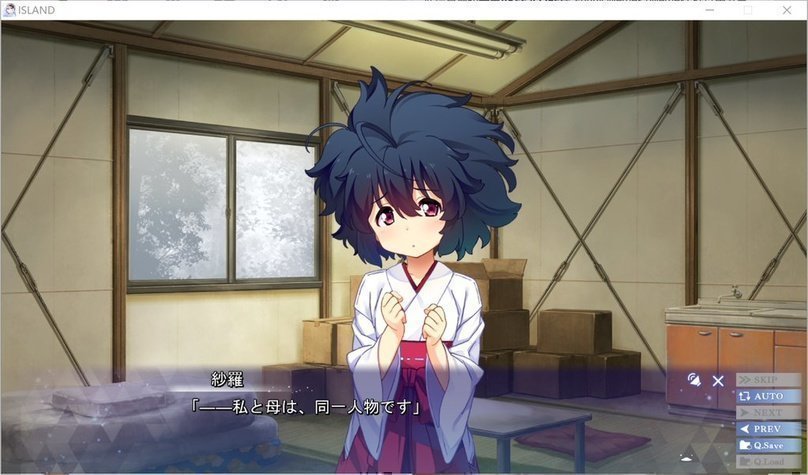
At some point she’ll travel back in time due to some event, become her own mother under the name Maria, give birth to herself, and then Maria (the mother) commits suicide. The daughter Sara grows up and arrives at the present — a closed loop. So at the end of Sara’s route, Sara, refusing to accept the truth, does set the shrine on fire, and Setsuna arrives too late to save her. The flames are unstoppable; he can’t get out either. Then he has a flash of inspiration: a treasure chest enshrined in the shrine seems to have legendary power. He grabs Sara and dives into the chest. After some struggle, Sara is saved. Setsuna thinks the chest might have time-travel power — Sara and he hid in it to escape the fire, went back five years, married, had Sara, and the five-year cycle repeats. That would explain the legend…
But after the ED, the game slaps you in the face: Setsuna didn’t go back in time. Sara just survived with burns. There was no time travel at all.
After finishing Karen and Sara’s routes, the game can no longer be described in a straight line…
Combining the common route and the Karen/Sara clues, most people can probably guess where Rinne’s route is headed: the protagonist, during some past disaster, travels through time to the future to save his past self and his lover, or something like that. The clue to saving them is coal mark disease, the legend might be connected to the protagonist, etc., etc.
Stories built on “legend” and “time travel” usually go like that. Most of them, anyway. Right?
Wrong. All wrong.
The first playthrough of Rinne’s route is still Setsuna and Rinne falling in love, then discovering many oddities about Rinne. Including that Rinne was “spirited away” for five years — she vanished into thin air for five years and reappeared with no memory of that time, not believing she was gone. Also, Rinne says she seems to have met Setsuna as a child — at least someone by that name — and they got along well. But then a disaster struck, and when they fled to Tyrannosaurus Island, that person sacrificed himself to save Rinne. Rinne survived, and the childhood friend named SETSUNA vanished completely.
Then more revelations, and Rinne realizes: the protagonist is the childhood SETSUNA from the past who traveled through time. He went back to save Rinne,修正 the world line to “Rinne is saved, SETSUNA dies.” In other words, the protagonist caused his own past self’s death, and since his past self died, the current him shouldn’t exist — hence the memory loss.
Etc., etc. The game launches into a long timeline explanation. I even drew a sketch to sort out the relationships, and then at Rinne’s ED1 I realized how stupid I’d been.
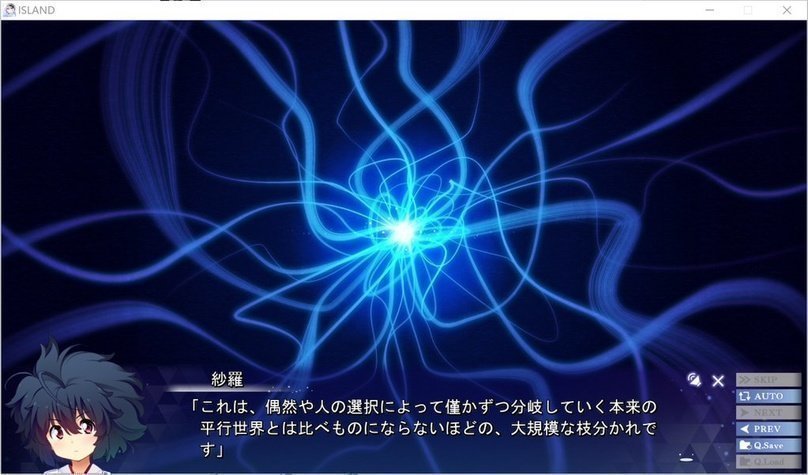
Rinne’s ED1: Rinne chooses to die to save Setsuna. Rinne dies. In the chapter after the ED, Setsuna meets a researcher from off the island. The researcher says the ocean research station is about to be demolished, a shame, but there’s still plenty of good stuff inside. The researcher also says Urashima is excellent research material, that it holds mysterious powers, and rumors even say there’s a “Dragon Palace” on Urashima.
Everyone knows the tale of Urashima Taro, but nobody believes there’s really a Dragon Palace. The game mentions this more than once, and I dismissed it too — who’d think a legend was real?
Setsuna visits the research station and finds something incredible: the station is full of black-tech devices, one of which is a “life-freezing装置” that can freeze a person’s life, making them immortal, to awaken ages later…
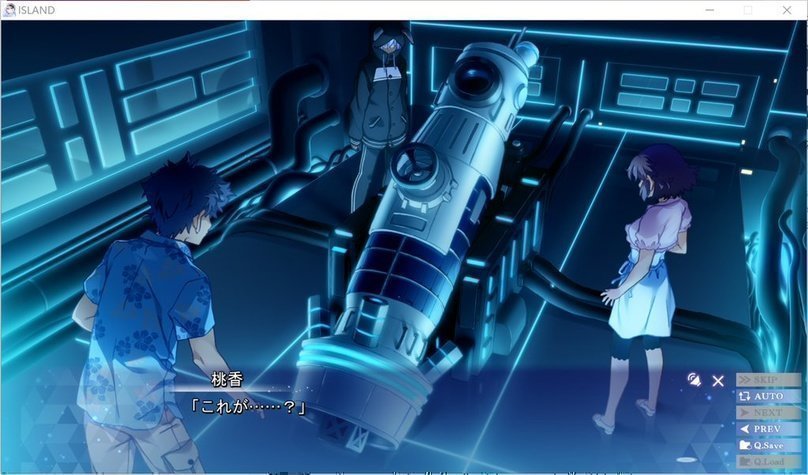
The researcher also reveals that Rinne’s five-year disappearance was because someone found this device in a cave on Tyrannosaurus Island outside Urashima, and inside it was the sleeping Rinne. How the device got there is still under study.
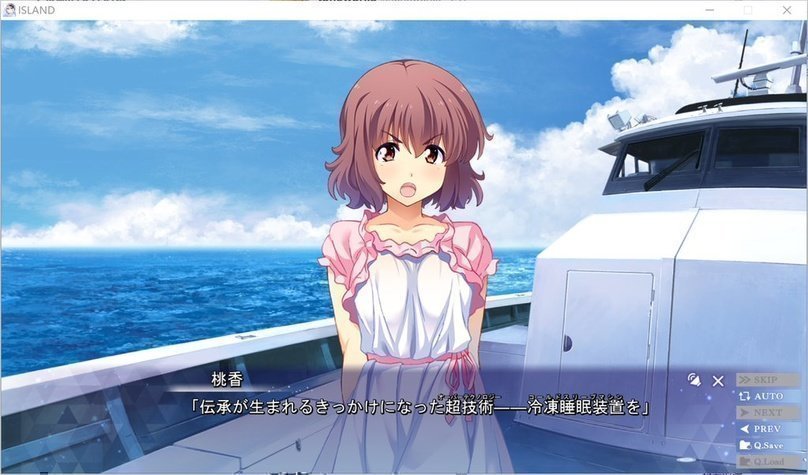
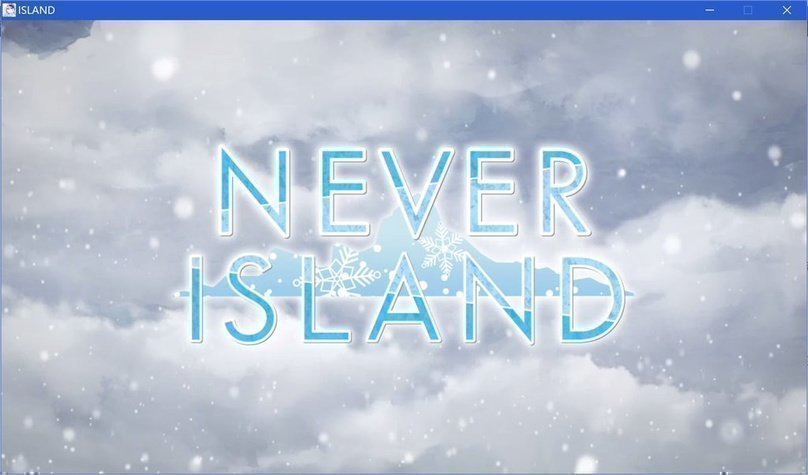
Finally, at the end of Rinne’s route, Setsuna falls into crisis, and the game displays “To Be Continued.” The title screen instantly changes from ISLAND to NEVERISLAND.
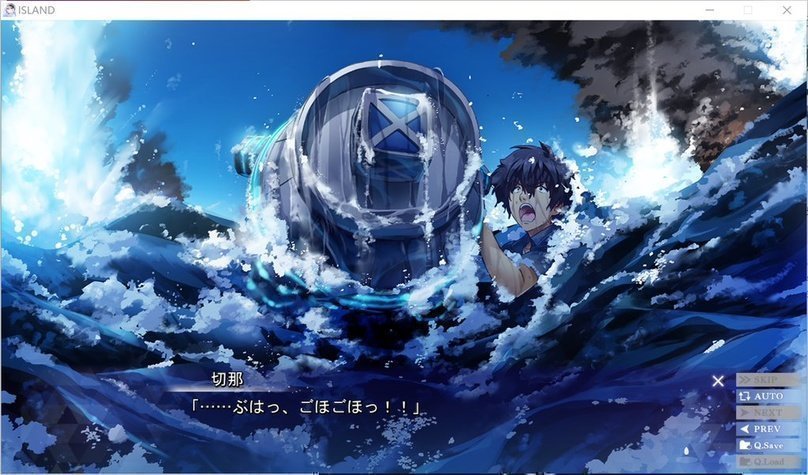
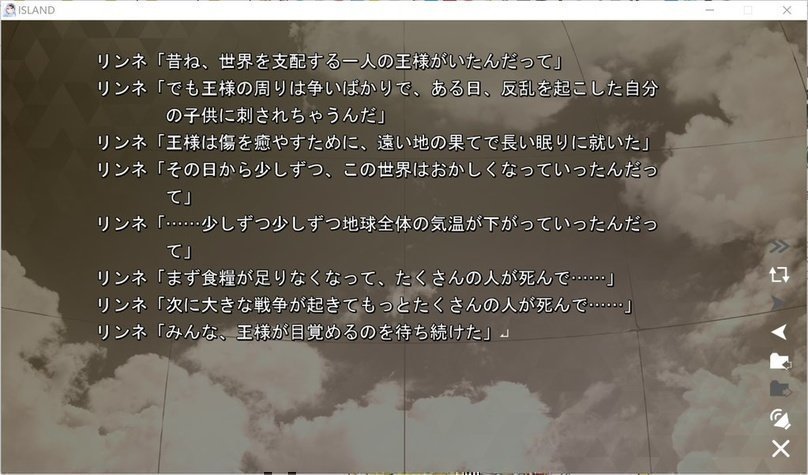
As a low-IQ individual, I can’t even begin to explain the NEVERISLAND chapter, because the story has little to do with the original content anymore — it’s a full-on alternate-world setup. Setsuna finds himself in the year 22016 — yes, 22016. He says his name is Setsuna, and a little girl named Rinne finds him while scavenging garbage in the wilderness and takes him home. Then he inexplicably discovers that in 22016, humanity lives inside a walled world called “Ailand,” food is limited and rationed by something like an ID card. With Rinne’s help, Setsuna gets food rations, and they start their daily life. Soon he finds that this 22016 world still has all kinds of class conflicts, a church as spiritual leader, and underground rebels without IDs who can’t get food. Interestingly, the rebel leader is Karen, and the church’s head nun is Sara (basically the same people in different outfits). Over a long daily life, Setsuna and Rinne develop a deep bond, and the contradictions of this small society become more obvious — food isn’t enough. Rinne tells Setsuna she wants to save this hopeless world, sneaks out of Ailand’s living zone to explore the outside, and finds nothing but a snowy wasteland.
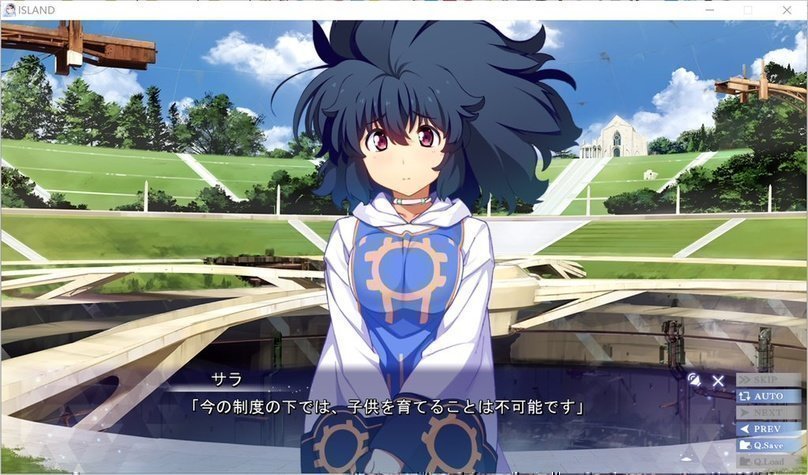
After a long build-up, the NEVERISLAND chapter ends with a riot in Ailand. The saint or bishop or whatever — Sara — gets hanged by the starving mob. Setsuna is exiled from Ailand. Rinne wants to save him but can’t. Others who snuck out of Ailand facilities, like Karen, start coming down with coal mark disease. Everything looks doomed. Setsuna and Rinne work together and finally find a “life-freezing device.” Setsuna goes in and chooses to freeze himself, achieving time travel.
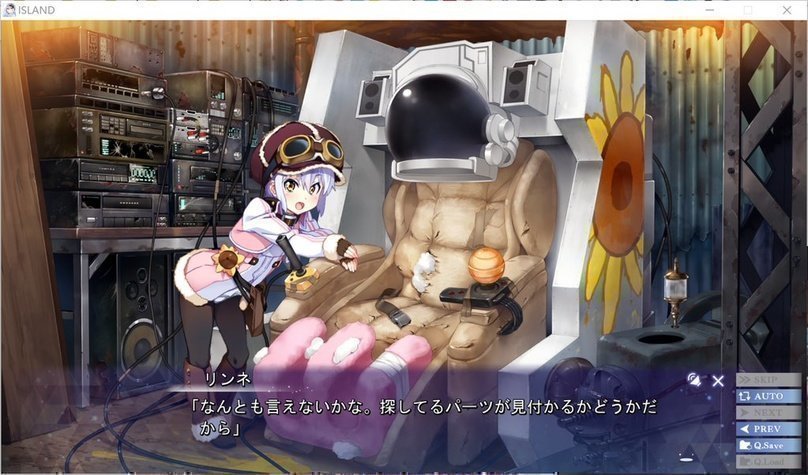
The NEVERISLAND ending is probably a tragedy, but I roughly understood one story: how Setsuna and Rinne fell in love. And the life-freezing device at the end — I thought it sent him back in time, but actually it didn’t…
After NEVERISLAND, the game hints there’s a HAPPY END. You need to start again and enter the Midsummer chapter — the TRUE END.
The prerequisites for this END are nothing new — same common route and Rinne route, except this time the protagonist has his memories. With memories, it’s easy: he confronts everyone, can immediately talk to the hidden time travelers, helps who he can, solves what he can. Most importantly, he discovers the secret of Rinne’s mother. Finally there’s a choice: accept fate and be with the current Rinne on Urashima, or defy fate and save Rinne — the first love he met in the past.
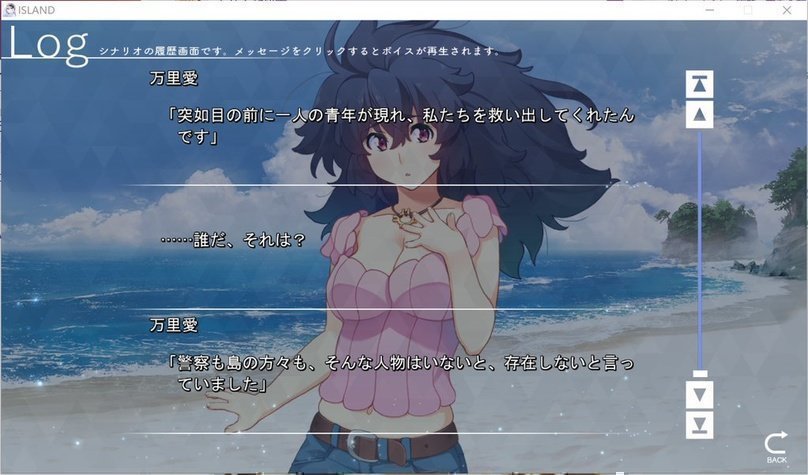
Choose Rinne and they marry quickly, the end. Choose Rinne (the original) and the story continues.
Oh right, here you learn another fact: the so-called year 22016 is actually 20,000 years ago. Humans existed during the Ice Age or even earlier, but for various reasons that era’s humans went extinct, then dinosaurs, then the current new generation of humans. The humans back then had black tech; current humans haven’t reached that level. The salvation lies in the researcher discovering an underground “Dragon Palace” near Urashima. It’s not really a Dragon Palace — it’s the underground fortress the humans of NEVERISLAND built.
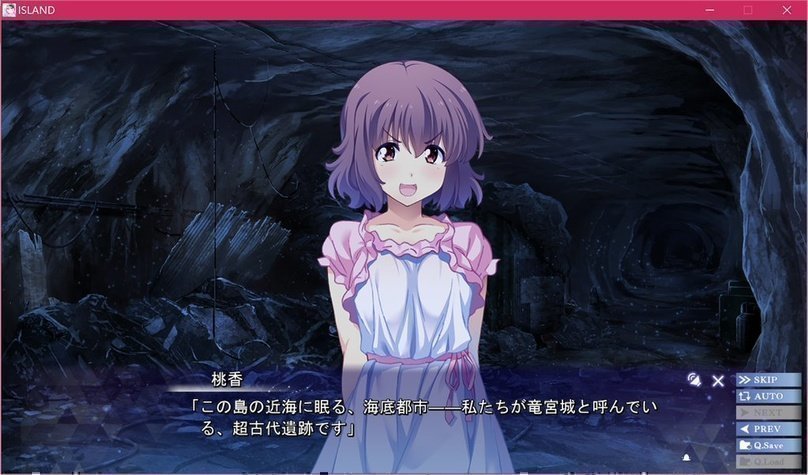
In other words, 20,000 years ago, Setsuna crawled into the life-freezing machine, woke up 20,000 years later, and met the reincarnated Rinne — the current Rinne. And the protagonist seems to have gone through this cycle more than once: from 20,000 years ago to 1999 (20,000 years later), then sleeping another 20,000 years, human civilization rising again to the same height, shuttling back and forth, all to keep the promise to Rinne — to save the world, to save Rinne.
So saving Rinne is the right path. Rinne is the woman the protagonist first fell in love with; everyone after, the 1999 ones, are just reincarnations of Rinne. As for the Urashima legend, it’s just another retelling of the earliest love between Rinne and Setsuna. In the common route someone even tells you the legend might be a remnant of an ancient time travel event.
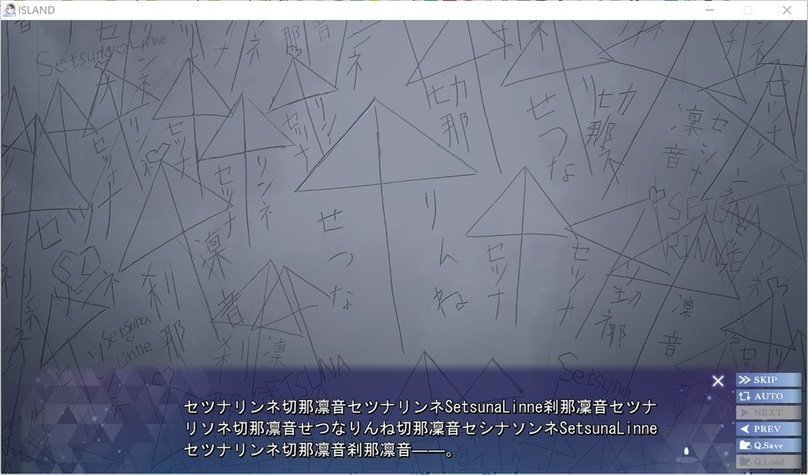
The final ending: the protagonist realizes his mission, chooses to enter another cycle to save Rinne. Time travel causes memory loss, so to avoid forgetting, he fills the inside of the machine with the names of himself and Rinne from every different world line.
After the game ends, the protagonist’s story isn’t over. He’s still cycling, still shuttling between these 20,000 years.
Based on the protagonist’s age in the game, he’s traveled at least 10 times, roughly completing a 200,000-year journey.
You could probably draw a rigorous diagram of this game’s time-travel timeline. But I’m dumb, and by the late game I’d given up thinking about it. All I know is the game never clearly states whether there’s a time machine — only a life-freezing device. Freeze once, sleep 20,000 years. Consecutive 20,000-year sleeps, the rise and fall of human civilization, can achieve a cycle effect like time travel… I gave up on the details.
Yes, I gave up. Remember what I said at the beginning? I absolutely hate this type of game.
Before expressing my hatred, let me praise it first. ISLAND has many strong points.
First, the voice acting. Choosing all-ages over 18+ was the right call, because this is a genuine “story-driven” work, and the cast includes big names from the mainstream seiyuu world — Tamura Yukari and Asumi Kana are both veterans. I’ve noticed these two doing all-ages galge more than once. Murakawa Rie as a newcomer also shines; not to be underestimated. In many scenes that need dramatic tension, Tamura Yukari completely holds it together. With anyone else, those scenes would have no ups and downs at all.
The music comes from the very familiar name Peak A Soul+. Quality is a given — maybe lacking a standout track, but never jarring. You might not even notice the BGM, which is probably exactly what BGM should be. The art is solid. It might look like a typical moe game, but there’s nothing to complain about. I keep using the phrase “no complaints though X” — maybe that’s just my way of saying “middle-of-the-road.”
The story, I think, is highly controversial and the part I personally dislike.
ISLAND’s marketing gives the impression of an island, a legend, reincarnation, time travel, and fate. Nobody would guess it’s actually a slightly sci-fi work spanning 20,000 years.
In fact, the game’s early development is small-scale — at most, a disappearance five years ago, a disaster five years ago. I kept thinking the protagonist would time-travel, discover some ruins on the island, or gain mysterious divine power to travel through time and save the person he wants to save again.
But all that is destroyed at the end of Rinne’s route when the researcher earnestly says “life-freezing device.” It feels like watching a horror movie where all the mystery should have an explanation, but ISLAND is like a horror movie that seems to be about human mischief, then suddenly tells you everything really was ghosts, and they brought in a ghost hunter to kill the ghost.
I always thought a big twist should make you go “oh shit, so that’s how it was, how did I miss that.”
Not “what the hell is this, you can’t just do that.”
The most unpleasant part of ISLAND is how the writer toys with the reader early on — setting up all kinds of foreshadowing and hints, then personally destroying them one by one, telling you it was all a joke. And when you’ve finally lost faith, they hit you with the 20,000-year high-tech twist. For me, that’s just unpleasant. Worse, the writer seems completely incapable of writing romance or slice-of-life. In the common route, the protagonist’s stupidity is unbearable — his random hyperactive running around and streaking don’t make me laugh. The only amusing joke is him saying his dick is under 8 cm. Everything else is forced tickling. And he constantly spews dirty jokes for no reason. Fine, you can say he has amnesia, but when the plot gets serious, our protagonist seems like a different person — infinitely reliable and upright. I doubt it’s the same idiot. ISLAND’s daily life is never “fun” to read.
Of course, I’m talking about “daily life and romance.” The game’s logic and foreshadowing are another matter.
While the writer is bad at slice-of-life, he’s great at plot logic and connections. Every foreshadowing in the game, if you care to look, has a corresponding description — the legendary “foreshadowing payoff.”
The degree of payoff in ISLAND makes me suspect the writer drew a flowchart first, then strictly built the entire structure point by point along it. For a game where the protagonist time-travels dozens of times, precision is necessary; one slip and the whole flow breaks. ISLAND does this perfectly. If you enjoy tracing the timelines the game describes and piecing together the puzzle, you’ll probably have a great time.
Yeah — the fun in ISLAND’s script comes from decrypting and arguing over what happened between the protagonist’s repeated jumps and loops. The writer is clearly having a blast with it (666% flex), leaving tons of things deliberately vague: either he’s planting seeds or he’s trolling you on purpose, all so you’ll let your imagination run wild. Either way, that route to having fun does not include the game’s emotional beats or its slice-of-life scenes.
I’d argue it’s a puzzle game. Honestly they should’ve just made ISLAND a fill-in-the-blank exercise: finish the main route, then have the player assemble the timeline out of Lego bricks. Could’ve been a decent new-genre AVG.
I don’t have anything against time-travel stories, or against stories that bury foreshadowing deep and then hoover it all up at the end. But when a work that had one style suddenly does a hard 180 mid-way — surprise, there are actually multiple dimensions, blah blah blah — that disgusts me. Once a game pulls that kind of reveal, it’s basically abandoned the actual telling of a story and thrown everything into justifying the twist. A plot you were feeling along with suddenly becomes something impossibly far away. That’s the feeling.
Which is why, when ISLAND hit the NEVERISLAND chapter, I sat there with a dead face, staring at the screen in full “sure, whatever you say” mode, eyes glazed, watching the plot go by. Class conflict this, human re-origin project that, cryogenic freezing machines — sure, fine, whatever. The little island in my head, the inheritance, that whole story soaked in summer and ocean air — completely dead.
If ISLAND had advertised this twist from the start, I never would’ve played it. My acceptance limit for this kind of reveal is EVER 17. Push it any further open and I feel like I’m reading a manual, not a novel. Manuals are rigorous and precise but stale and joyless; novels are maybe full of shit in places but actually interesting. I think the time-travel and loop setup should support the plot and characters, not steal the show — not flatten the daily-life scenes into nothing and turn “so how did it actually come to this” into the entire point of the story. Hakuchuumu is the same deal, except it’s fast-paced and doesn’t have as many mind-game elements. The follow-up, Gemini Paradox, fell into the exact same hole as ISLAND: the looping is passable, but man, the slice-of-life is crushingly boring, genuinely hard to get through, and the terrible character designs make it worse.
Sometimes I wonder if my hatred of ISLAND’s late-game twist is actually because the protagonist is so goddamn stupid early on. The second he started acting crazy I wanted to smash my monitor, and the anger kept me from ever settling into the plot.
So, in summary: ISLAND is tightly constructed, and its sci-fi escalation is handled really well. Great for hardcore STEM brainiacs who love sci-fi time travel and spend their free time thinking about time and space while not caring much about emotional writing. For a humanities kid like me who hangs out with the STEM crowd and wants emotional writing and slice-of-life detail — utterly the wrong dish. I can’t say the game’s bad, because it does properly explain the before-and-after of every bit of foreshadowing. Even though I think the explanations are strained — but saying they’re strained has no real-world basis either, since no real world would ever do this. The story is sci-fi now; that’s that.
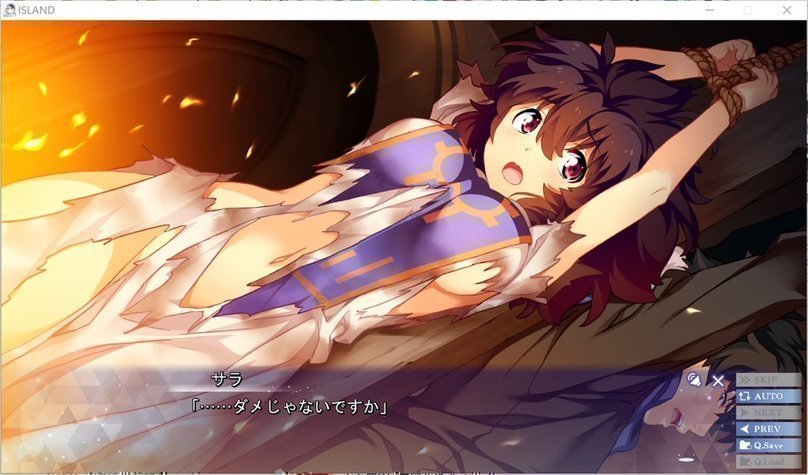
ISLAND also shamelessly leaves several holes unfilled. Himawari has a write-up on ISLAND too, and the author even put out a novel decrypting other elements of the game. Go look if you’re curious.
One last bit of awe: the writer really went there. I’ve seen thousand-year time leaps, but this is my first two-ten-thousand-year one. Ten-ish of them, carrying human cultural heritage across the gaps — probably 200,000 years total. Like the game’s description of the protagonist: always “the traveler.” The poor guy really doesn’t get a break. 200,000 years of journeying, and still no clear endpoint.
But for me, this game’s already reached its endpoint.
Comments are hosted on the Chinese main site. This mirror is read-only.