Harumade, Kururu (はるまで、くるる) Review
Harumade, Kururu
One of the writers on Harumade, Kururu is a guy named Watanabe Ryoichi. His latest work is Ao no Kanata no Four Rhythm, but before that he and his buddy Kio Nachi worked on a bunch of eroge, including some with seriously weird premises. I looked into it way back, and eventually noticed these works tend to share one thing:
They love a mindfuck twist. Right at the end they tell you the protagonists were living in a dream, or that the world wasn’t the real one.
One of the better-known Watanabe Ryoichi and Kio Nachi collaborations is Sukima Sakura to Uso no Machi. No prizes for guessing, that game ends with exactly that kind of reveal. Though the two weren’t the planners on that one, so who knows if it’s their fault.
Anyway, Harumade, Kururu is one of these two madmen’s joint projects. Why’d I play it?
Because the OP hooked me again, obviously.
Harumade, Kururu… the art’s got those twisted faces again, but it’s not the full NekoNeko Soft crew so it’s not a total disaster. According to the reviews on Chuuni Space, the game wins on story, and I’m a story guy, so I figured I’d give it a run.
That run took half a year. More precisely, I did the pre-OP and a chunk of the post-OP stuff first, then only recently finished the rest.
How do I put this… the story is genuinely insane, tons of imagination. But this game should not be… this long.
The game opens by telling you the protagonist and a few girls live on a solitary island. They go to school, but it’s all self-study. Summer break hits not long after. None of them know how they got to the island, or who else might be there. There’s enough food for now, so no immediate worries. The only oddity they notice is an absurdly tall chimney on the island. Every night a bugle-like tune plays—the nursery rhyme “Haru yo Koi.” The music is creepy, but nobody explains why. Everything else is a blank, so they just roll with it and start living.
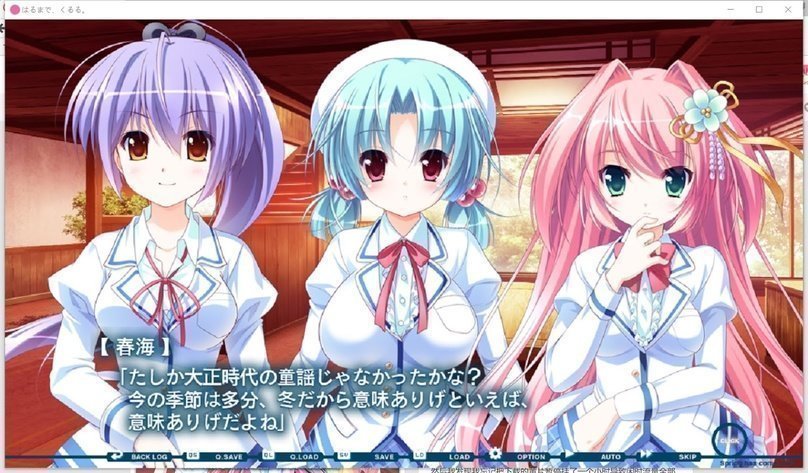
Then the game slaps me in the face. It all starts with the main heroine’s line: “Self-study suspended, commence the orgy!” Everything collapses from there.
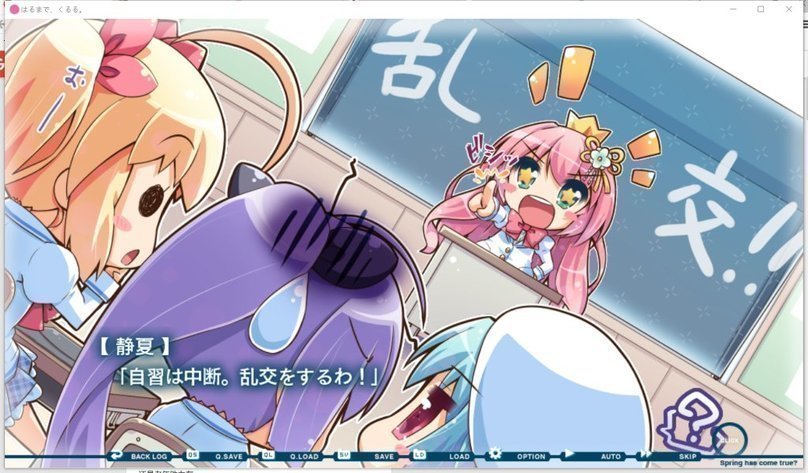
The game kicks off an atrocious harem fuckfest. Fucking and fucking, all kinds of fucking, all kinds of hype. About three months pass in-game, then suddenly time rewinds. The protagonist is back three months earlier, and everything starts over.
Worth noting: right before the rewind, the camera cuts to a lab. Across from a tank of jellyfish-like creatures, someone muses, “Maybe this experiment was a bit of a failure… let’s try a different approach next time.”
So you get the picture. The story enters an endless loop of those three months. Every time the protagonist finishes the three-month run, it loops back. It feels like these people are being kept and experimented on, but why, what experiment, whether it’s even an experiment—nobody ever tells you. The game just loops and loops and loops, with occasional small scenes of heroines losing control: one has a murder urge, another keeps thinking about suicide… Someone tells the protagonist that the island shows a night moon but has no tides, which is unnatural.
As for that giant chimney, the protagonist tries to explore it once but can’t get close. Anyway, the plot spins through these endless three months until one day a heroine drags the protagonist off and straight-up reveals the secret of the world.
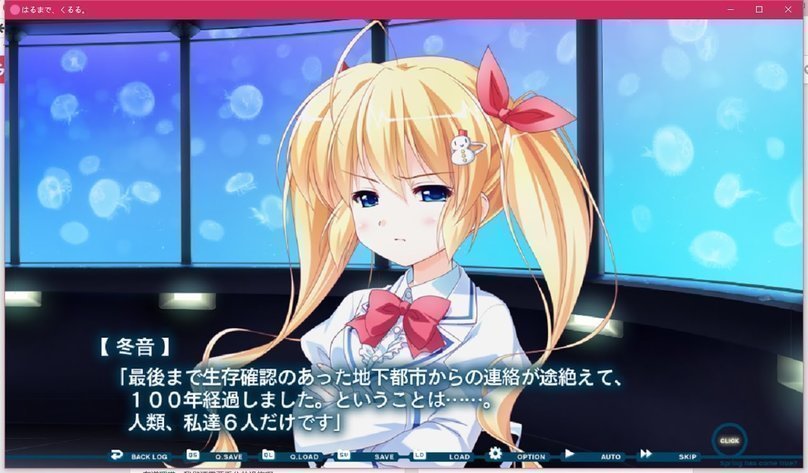
Gotta say, the reveal is brutally simple. It just throws the truth in your face: the so-called island is an underground world.
And the actual time isn’t around 2000 AD like the protagonist believes—it’s past 10000 AD.
Supposedly, starting around 3000 AD, humanity discovered a jellyfish with rejuvenation properties. Scientists wanted to extract it for human use, but every test failed. Eventually, after much research, they found the jellyfish’s rejuvenation requires a specific environment and specific sound stimuli to activate cells and reverse aging. The limit of their research was three months of cellular reactivation—going back three months—but since it’s cellular activation, memories are lost too.
So the researchers built a massive underground space simulating a year-2000 island environment, creating everything needed to activate the jellyfish cells: ecological balance, food supply, and that bugle-like broadcast of “Haru yo Koi.” Those are the conditions for the three-month rejuvenation. Then they gathered several volunteers from around the world—the protagonist and the heroines—who entered this artificial space, abandoning their original names and memories, and joined the experiment. Just like the game’s opening: endlessly repeating those three months.
The experiment began in 3000 AD. Who’d have thought that soon after, Earth entered a new ice age, and with food shortages and war, humanity neared extinction. The people running the project mostly vanished, leaving only the protagonist and heroines, clueless, looping those three months in the virtual space. Only one girl retains memories of every loop—she’s the administrator, with a paired “liquid computer” storing each playthrough’s memories for her. She lives those three months over and over until she’s finally sick of it and wants to die—that’s the suicide incident in the common route.

The girl says she can’t take it anymore and tries to strangle herself for real. But even if she dies, she won’t truly die—three months later, cellular reactivation brings her back. Only after that she’s no longer the “administrator”; the role passes to the protagonist as second priority. Eventually the protagonist becomes the administrator and sees that outside the virtual world things are far worse than imagined. Humanity is extinct, the ice age shows no sign of ending, and the sun is starting to die. At this rate, the only humans left are the protagonist and his group, and they’ll keep looping three months forever. As someone with stacked loop memories, the protagonist starts going mad in the infinite loop…
Of course, being the game’s ending, it’s not going to be all bad. The protagonist finds hope, decides to stop the experiment himself, and steps out to see the outside world. He cuts the experiment equipment and takes the elevator to the surface, where a brand-new Earth and true spring await—that’s the meaning of the title Harumade, Kururu.
So what is this game actually saying…
The main plot: the protagonist and friends live in a virtual world as experimental subjects. Outside, the human world has gone through massive changes. And they’re still looping infinitely in here.
In other words, the game’s big payoff should be when the truth comes out.
But aside from that main plot, Harumade, Kururu is painfully thin.
Meaning: apart from the reveal that gets you excited, most of the time you’re just watching slice-of-life. And the slice-of-life isn’t even well-written. The heroines have zero charm—within five lines someone’s dropping a dirty joke, and they’re direct, blatantly filthy, not the clever subtle kind that makes you go “damn.” From the first playthrough’s orgies to the later random rambling, because it’s not near the “truth,” everything’s just messing around. It’s a loop, so write whatever, right…
So the common route wore down my patience. I could barely find any explanation approaching the main plot. I could only infer this “world” was fake. But who the hell couldn’t? When your OP mentions Alice and the Mirror Country, I already guessed it was fake. Yet the truth never gets explained, and when it does, it suddenly dumps “10000 years later” on you and leaves you drowning in confusion. Though compared to that one a while back with 20000 years later, it’s a bit easier to swallow.
All in all, Harumade, Kururu has very little “substantive content.” I think you can just check out the world setting, play the first playthrough, then skip to the end—it won’t hurt your understanding. You might miss the murder incident in the middle, but the game never brings it up again later so don’t worry.
The music isn’t good, the art isn’t good at all, the system is weird and occasionally crashes, the font is ugly. The only selling point is the story, and it turns out to be just a standard bait-and-switch twist game. Except other games have character designs, music, slice-of-life, jokes, and other factors to keep you reading the daily stuff. For Harumade, Kururu, the daily stuff is just straightforward dirty jokes and fucking. Oh right, and some chuunibyou and various highbrow discussions—totally useless, just bait and smoke.
Thinking about it more, the common route isn’t completely without hints. The bugle, the various longing for spring, the visions of the future—when the group finally sees spring on the surface, you might understand the title’s meaning.
Lastly, worth mentioning: Harumade, Kururu has a spiritual successor, Natsukumo Yururu. From reviews, the writer seems to have learned his lesson and adopted a “slowly unfolding, layer-by-layer” approach, but people still joke it reads like a middle schooler’s chuuni dark-history novel…
Whatever. If I feel like torturing myself, I’ll check out that spiritual successor someday.
Comments are hosted on the Chinese main site. This mirror is read-only.