Building an OpenMediaVault NAS
My HP N40L kicked the bucket, and of course it was just past warranty. The case is some bizarre proprietary thing too, so there’s no repairing it. Nothing to do but sigh at the 10 hard drives left behind. Figured I’d just build one myself. Bought an absurdly cheap H61 board off eBay, an equally cheap Celeron 1610, and a cheap industrial-style full tower — 400 yuan total. Along with the sketchy SSD and HBA card I already had, plus a leftover OC3 Red Sea cooler and a pile of random case fans, that was basically everything.
I’ll skip the assembly. The industrial case gives you 10 drive bays and room for more. It POSTed on the first try, naturally — and of course after it booted I found two of the 10 drives were dead. That left four 500GB WD Blue drives and four 1TB Seagate 7200 drives.
At first I wanted to do RAID, because if you don’t do RAID the big shots sneer and call you a clown. But I asked some veterans on Reddit (r/visualnovels) and they all said: you’re just a home download box, you’re not storing state secrets, you download porn and delete it after watching, why the hell do you need RAID. Then I got lectured that RAID without a full high-end setup is a trap — one drive drops and you’re in for a world of pain. If you do it at all, RAID1 is enough, blah blah blah. Felt like a revelation. Laptops and desktops have no RAID and their data is still fine. Without the proper hardware there’s no point flexing. So I decided to just pool the drives together plain.
Then one day, bored, I saw someone build a RAID10 out of nested RAIDs and thought that was fun — I’d only known RAID10 as two layers, didn’t realize you could stack more. I eyeballed my four 500GB and four 1TB drives and thought, why not pair the 500s into mirrors, then build a RAID10 out of them. It’s just for fun anyway; downloaded data gets sorted and burned to Blu-ray, so if it dies, it dies.
That said, don’t do this for anything serious or with important data — use a more proper method.
I agonized between FreeNAS and OpenMediaVault. On the N40L the OMV install image had too old a kernel and couldn’t even recognize the NIC. Then I checked the Wiki and found the developers don’t even use the install image — they manually install Debian and add the OMV repo. With OMV you can install to that sketchy SSD; with FreeNAS you can only write the system to a USB stick and use the SSD for ZFS cache. In practice the two are about the same speed, and the former lets you manually expand the cache. More importantly, OMV is Debian-based, so you can do more with it — even spinning up a VirtualBox VM is far easier than FreeNAS. FreeNAS’s Jail-based VM setup is a pain in the ass to connect to even once.
I tinkered on and off for a few days and got it basically working. The Wiki covers the process, so I’ll just list the problems I hit.
You must install with Debian 7.5, not Unstable or Sid — the OMV repo doesn’t support them.
For installing OMV on Debian 7.5 you can follow the Wiki, but remember to change the version string to kralizec, which the Wiki doesn’t mention.
OMV’s RAID management is based on mdadm. The web GUI makes creating RAID easy, but occasionally it won’t refresh the list of created arrays — either reboot, or SSH in and create it from the command line. I recommend the latter; if you’re not comfortable, do the former.
After OMV installs you need to reboot. On the first reboot SSH is off. Don’t try adding SSH startup stuff to Linux’s boot files, and don’t try enabling SSH from the command line. The correct move is to log into the web admin page and enable SSH under services, because OMV has fully taken over.
OMV has an Extras.org additional repo — look it up. It bundles a bunch of plugins, and someone has compiled a NAS-specific 3.14 kernel. Recommended.
Installing plugins in OMV is just apt-get install, and the web page often stops responding, so I think it’s more reliable to SSH in and install things yourself.
Creating RAID10 with mdadm didn’t take long. I made two mirrors out of the two 500GB drives, then striped those two mirrors, then striped that stripe with two more mirrors built from the four 1TB drives. Usable size ends up 3TB (2.7T).
After installing the VirtualBox plugin, headers aren’t installed by default — SSH in and install them manually.
After the first OMV setup I hit a weird issue: not only did the gigabit LAN copy speed stabilize at only 40MB/s, but two days after boot it dropped to 500KB/s. More amusingly, writes were only 20MB/s regardless. SSHing into the box locally showed no problem. After thinking it over I zeroed in on the 20-yuan dual-port Intel gigabit NIC in the machine. Recalling that this card couldn’t remember DNS under FreeNAS either and needed manual IP config in OMV, I bought a 50-yuan domestic Intel 82574L card, swapped it in, and speeds were normal — peaks around 90MB/s. Fine for a NAS.
After the first setup I had serious drive-drop issues. Discussed it with Kaya on G+ and we guessed it was the PSU. Bought a cheap single-rail-12V FSP 400W unit, installed it, problem solved. Another 200+ yuan over budget.
Worth noting: even drives need cooling. The industrial case has a fan slot at the drive bay, so I stuffed a fan in, and added a dust filter over the vent holes in front of it. I also put damping tape on the case seams and anywhere else that might resonate. Overall the NAS isn’t loud.
The NAS is running fine now, and there’s plenty to play with among the plugins, but I haven’t tested them. I’ve only used VirtualBox to spin up a few VMs for remote access. I skipped DAAP and DLNA since there are too many games to push and I couldn’t be bothered. Finding DLNA video and playing it directly from the Win8 tablet works fine, of course.
Overall, if you install on Debian 7.5, OMV is more usable than FreeNAS. I need to upgrade the file server at work soon, and I’m thinking of building an OMV box there too — all it needs is simple Samba sharing, and OMV is plenty. I’ll add more if problems come up.
Final advice for anyone wanting a NAS: build it yourself, or buy a Synology or a ready-made unit. The HP N40L or N54L aren’t reliable. Worse, once one dies you’re stuck with a brick — you can’t find parts, the board is proprietary, basically unrepairable. Not worth it.
Shanzhai RAID10. Probably won’t die. (Probably.)
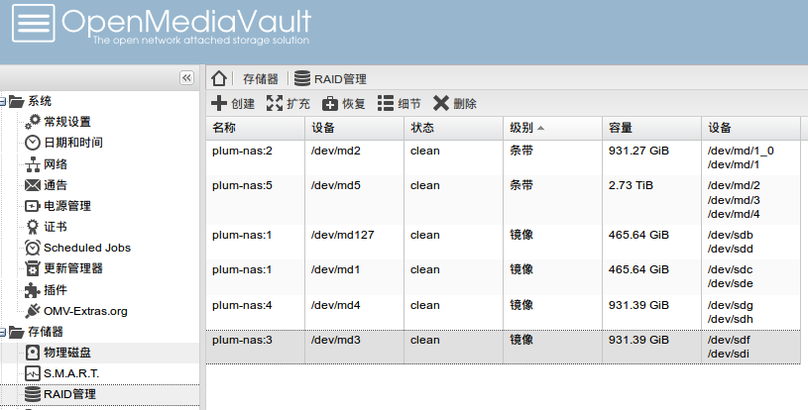
Running the in-development OMV 1.0, but no stability issues.
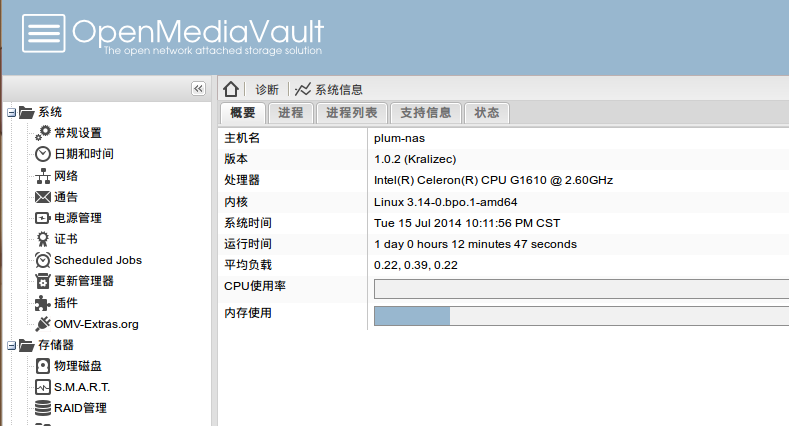
Comments are hosted on the Chinese main site. This mirror is read-only.