The Cute and Extreme Side of Petty Girls
Some people say girls in the real world are impossible to reason with, that most of them only think about themselves, self-centered, never considering anyone else. But everything is relative. There are also women who get so lost in love they can’t pull themselves out—possessive, jealous, but also kind-hearted and carrying a huge guilt complex, especially when they’ve stolen their best friend’s love interest.
Put plainly, what we commonly call “petty.”
This kind of story isn’t common in visual novels, because whenever we hear “petty,” we think of some dark turn or yandere. It seems like a petty, possessive woman has to either go full dark or use violence to snatch her man.
That’s fake, and unrealistic. It’s also cowardly. A strong petty girl would handle things more forcefully, like… confrontation.
Looking back at the few visual novels I’ve played, the ones that fit this “steals friend’s love interest while torn between guilt and jealousy” plot are the Kiba Mifuyu route in Koi to Senkyo to Chocolate, and this one—the Hinata Ibuki route in Hoshizora e Kakaru Hashi.
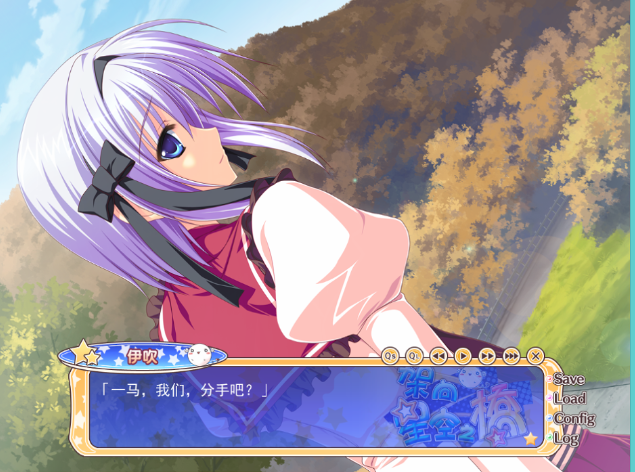
Hinata Ibuki is set up as a typical tsundere, the best friend of the main heroine Nakatsugawa Ui. The first heroine and the protagonist meet in a normal, cliché romance development, but after you woo the tsundere and enter her personal route, Ibuki’s behavior gets stranger and stranger. First, when she accepts the protagonist’s confession, she says “I don’t know if I like him myself, so might as well accept and see how it goes,” and the game even shows her internal perspective, proving this isn’t just her tsundere side—it’s her real thought.
When they start dating, Ibuki won’t let the protagonist reveal their relationship in public, repeatedly rejects his advances, and gives him the cold shoulder to any emotional communication—completely acting like a bitch stringing him along. She’s also indecisive about whether she likes him, constantly playing with his feelings. Then one day, the protagonist goes out alone with Nakatsugawa Ui, and Ibuki suddenly flares up with jealousy and realizes—oh, she really does like him…
Feels a bit far-fetched? It gets worse…
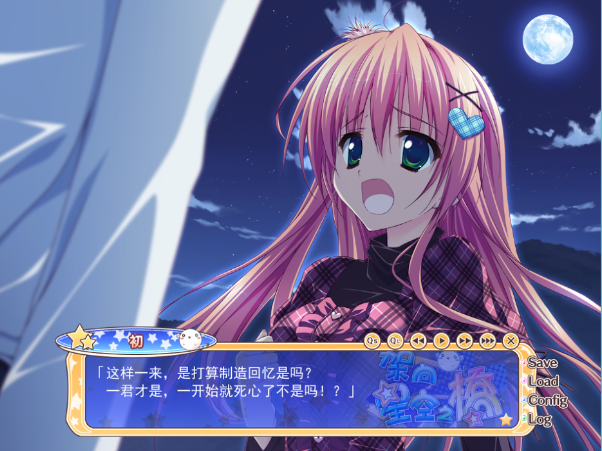
After confirming she likes him, Ibuki instantly becomes very proactive, constantly clinging to the protagonist, turning into a jealous mess whenever he interacts with other women, and she even starts treating her former good friend Nakatsugawa Ui as an enemy. She knows it’s jealousy but can’t control it, and an inner conflict emerges.
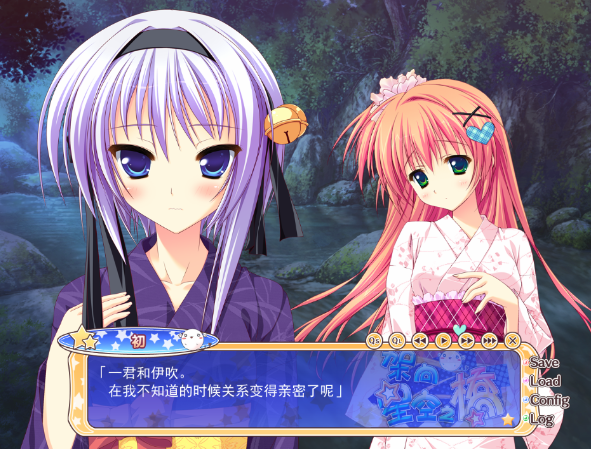
Ibuki’s feelings break down amid this growing jealousy and pettiness. She offends all her friends and everyone around her to monopolize the protagonist, eventually realizes she’s wrong, and in her heartbreak runs away again, asking to break up…
The ending is naturally predictable: the protagonist and her friends prove through their actions that Ibuki isn’t despised by everyone. Ibuki resolves her inner conflict, stops obsessing over guilt and whether the protagonist will betray her, chooses to trust him, and reaches the ending.
Honestly, from the start of this route to the breakup proposal, my affection for Ibuki kept dropping… because I thought, how can such a whiny woman exist?
Then I thought about it more carefully. There probably are such people—quite a few, actually. At least it proves one thing: Ibuki loves the protagonist, but she lacks confidence, lacks the confidence that he’ll definitely like her. So she can only care more about what others think, which only brings more harm to herself and those around her, and a loss of control in her heart.
The Kiba Mifuyu route in Koi to Senkyo to Chocolate is the same. Mifuyu agonizes over her huge scar and frail body, and Sumiyoshi Kiri’s one-sided love for the protagonist. She chooses to run from his confession and hides her own feelings. Later she’s forced to dump him, but in the end she chooses to face it. She still gets jealous seeing him with others, but confronting that jealousy and overcoming it with trust is the only way to be free.
Worth mentioning: Sumiyoshi Kiri and Nakatsugawa Ui share the same CV, Nakamura Eriko… orz
Why do I understand this pettiness so well? Because I’m that kind of person. Anyone who knows me well enough can probably see it. If I ever get married or become a normie, I might constantly worry about my partner and get jealous of others… but the prerequisite is… first…
Okay, enough about that. I just want to say: petty or princess syndrome, it’s mostly just trust and dependence on one person—dependence and the insecurity the other person brings. For these petty people, what they need isn’t something exhausting, just a promise, an action, a smile. That’s all. So I never dislike yandere or petty women, because I think—compared to those bitches who can get along with any guy—these devoted, sensitive girls seem more delicate and cute… or rather, that’s a kind of extreme cuteness.
Now about the game…
I only played through four routes in Hoshizora e Kakaru Hashi: Nakatsugawa Ui, Hinata Ibuki, Koumoto Madoka, and Toudou Koyori. The most interesting and moving one for me was Hinata Ibuki. The others were decent—typical visual novel developments, no big surprises. Though I did unexpectedly find that Toudou Koyori’s energetic loli type is pretty good too. The game’s big gimmick is the feminine little brother, but there’s no route for him. Ah, actually there is—if you go for a bad end…
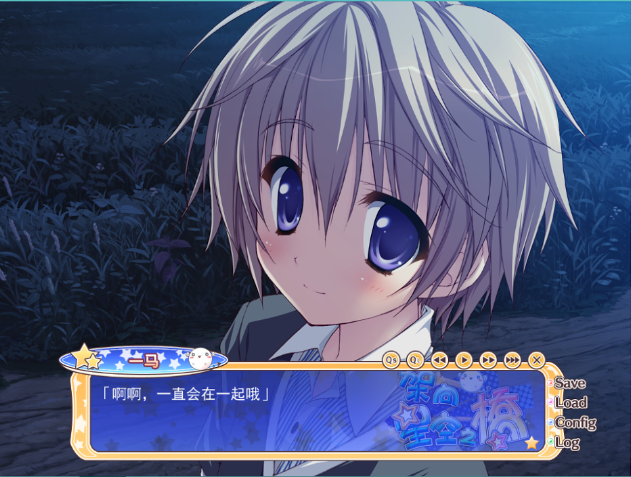
The game’s art is average. Among the character designs, only Ui, Koyori, and Madoka, who had Ryoka involved, are free of崩坏; the others all have some degree of character崩坏. The music is very budget—just a few tracks looping. The H scenes, I don’t know if it’s budget-saving or not, use ASMR-like 3D audio effects, which sound pretty realistic, but the CG art is just one image.
The game system, on top of the basic visual novel system, uses an anime-like presentation—each story segment is Episode 1, Episode 2, Episode 3…, and each episode ends with a next-episode preview. If you like, you can watch the OP again at the start of each episode, giving a real anime-watching feel. Though I think that’s not very meaningful for a visual novel; it’s more of an anti-addiction effect. Like, playing one episode before bed each day, treating it like watching anime, isn’t bad.
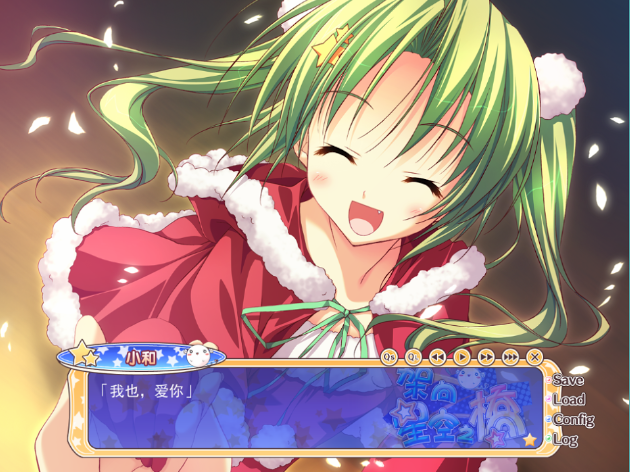
Hoshizora e Kakaru Hashi has an anime adaptation. I played the game first, then watched the anime. The anime differs quite a bit from the game—many characters changed, settings changed, especially Nakatsugawa Ui, who was completely turned into a tsundere instead of a natural airhead. Toudou Koyori’s screen time increased a lot, and that’s where I started to crush on her. The protagonist’s good buddy Daigo’s death-seeking level also dropped greatly in the anime. Overall, it’s not as fun as the game. The anime did follow Nakatsugawa Ui’s route, but it maliciously强化 her sad past with her brother, which the game didn’t detail this much.
Lastly… I have to say, Nakamura Eriko’s voice really doesn’t suit the natural airhead type. She’s better with standard voices like Sumiyoshi Kiri, or the type in Walkure Romanze, and the loli voice in Sakura no Uta and Lies of the City…
Ui’s voice… really doesn’t sound good. Even Miru-mama’s airhead in Natsuzora no Kanata sounded better.
Comments are hosted on the Chinese main site. This mirror is read-only.