Akiyume Kukuru (あきゆめくくる) Review
How to Properly Consume the "Season Kana ABB" Series
Some eroge studios, to make their games’ themes clear, put together projects tied to the seasons.
But sometimes those projects get a little ambitious, and they do a “four seasons series”… meaning four games, each set in a different season, each telling a different story.
Wake up. Put away that kitchen knife and those razor blades you were about to mail to Japan—they didn’t even make it through customs. I’m not talking about Shinji Nii, I’m not talking about Natsuyume Nagisa, and I’m not talking about Hatsuyuki Sakura. I’m talking about the “Season Kana ABB” series put together by Watanabe Ryoichi and Kio Nachi.
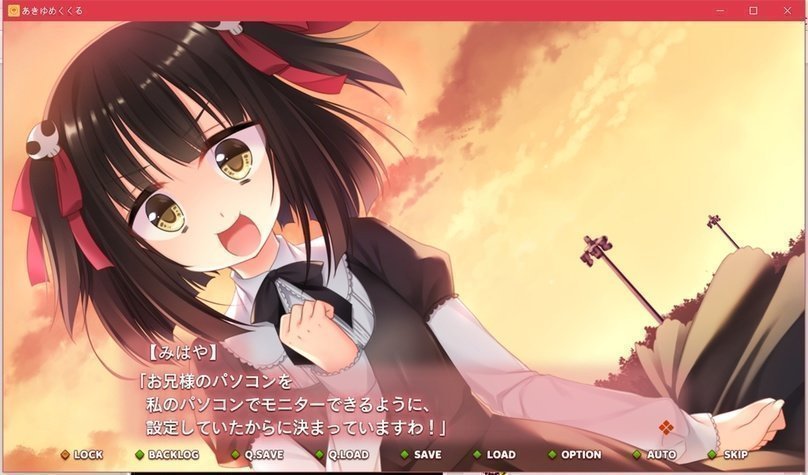
The reason I call it that is the naming pattern. I played a game called Harumade, Kururu before—that’s the first entry in this series—and later came Natsukumo Yururu, plus the autumn edition Akiyume Kukuru that just came out last month.
See it? The titles are all “season” + (one kana word) + (an ABB or AAB pattern with る in it). That’s the only name I can come up with for this series. Kio Nachi seemed to have his own kana abbreviation for it on Twitter, but I forgot it, so this’ll do.
I played Harumade, Kururu before, and my verdict was: this story didn’t need to be this long… because as far as the main plot goes, the beginning and the ending are all you need. But looking back, I was naive… After getting a rough idea of the summer entry Natsukumo Yururu and skimming the newly released autumn entry Akiyume Kukuru, I more or less understand what this series is going for.

The series doesn’t score badly on ErogameScape—anyone who’s played it gives it 80 or above. A lot of people say things like “the content is insane, the ideas are wild, but it’s still fun, and there are tons of references.”
After playing it, though, I lean more toward a Japanese reviewer’s take on Natsukumo Yururu:
中学生の書いた出来の悪い黒歴史な小説を読んでいるよう
I’m not saying the game is bad. I’m saying it needs the right wavelength. I’ve actually seen the kind of people this game is for on Twitter and Google Plus, and I think in their eyes this might be a “masterpiece.”
Before we talk about wavelengths, let’s look at a question on Quora:
How high is the average skill level of Japanese anime screenwriters?
We’ve all seen Japanese ACG works like this: the premise is sci-fi, grounded in science, a high schooler stumbles into some world-ending cutting-edge technology in the middle of daily life, gradually uncovers the world’s secrets, and meanwhile the protagonist (or the protagonist’s friend) is actually a genius who can casually solve the latest scientific problems. In the end they sort everything out, beat the mastermind, and save humanity.
The dialogue in these works is usually stuffed with physics, biology, chemistry, math, computer science, and all sorts of random trivia. To make sure you get it, they explain it to you—games give you a glossary, manga has margin notes, anime has someone narrate an explanation (and the pretentious fansub groups will plaster a whole screen of annotations on you). Watching it, you get that “whoa, this is deep” future-tech vibe, as if you’d walk away having learned a bunch of knowledge…
Yeah, I know what you’re thinking. I’m not aiming this at Naotaka Hayashi, and I’ve got nothing against Chiyomaru Shikura. It’s just that this kind of work is the most common one you see in the Gal space. What I’m saying is, if you actually know a little about those terms, or you actually look them up…
“You could delete all the fancy vocabulary from this game and it’d still make sense!”
In other words, the fancy words and references are just seasoning in the dialogue, not the main dish. The story itself is just people interacting with people. All that science is there to look cool… Think about it—aren’t all the well-received “science fiction works” in this scene ones where the plot holds up on its own and the sci-fi elements just add shine? If the story itself is bad, dumping in more science won’t save it. You’d honestly have more fun reading Wikipedia.
So my take on this stuff leans toward this:
Back to the series: frankly, the “Season Kana ABB” series is not a series that tells stories.
This series is a framework, a formula. The formula goes like this: first, build a closed world where the protagonist and several heroines go to school together. This closed world has a LOOP element (where the る in the title comes from?), plus all sorts of strange things that never get explained. Not until the very end of the game does it force out a conclusion with a wild, sci-fi finale, and then the game ends.
Think back to the plot of Harumade, Kururu: the protagonist and a bunch of heroines are on an uninhabited island, going to school every day. Nobody knows where anything comes from, nobody knows what’s going on with the environment, school is just self-study with no teacher, and after three months everything loops. It’s never explained until the very end, when you’re told this is an underground test field, the protagonist and friends are test subjects, ten thousand years have passed outside, etc. etc… and once that’s explained, it wraps up hastily.
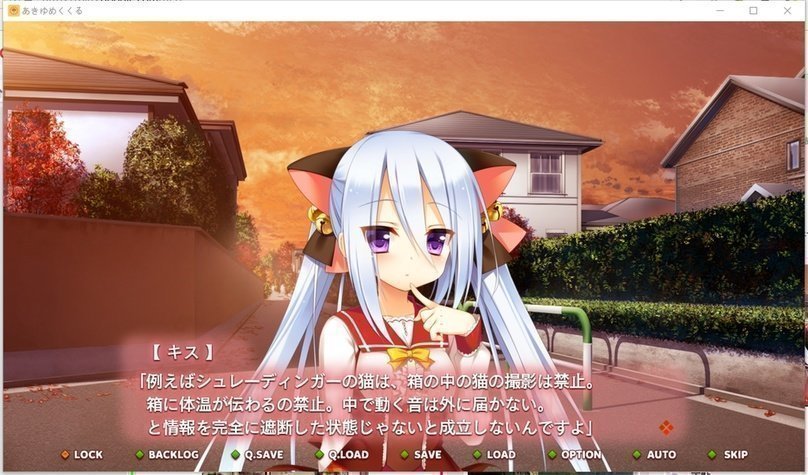
Akiyume Kukuru is the same… From the start the game proudly throws around “quantum mechanics,” and from the very first conversation the heroine is talking your ear off about quantum computers and world simulation and the possibilities of future scientific research. But what’s the point? None. Zero. Other than letting a sensitive chuuni see a familiar word from their textbook, get excited, and screenshot it for Twitter to show off that they know this, it’s completely useless.
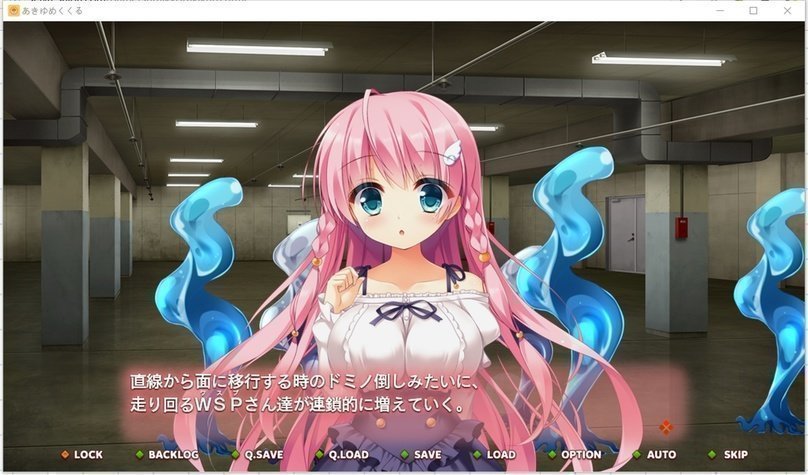
All you know is that the protagonist and the heroines aren’t normal people, that the heroines seem to be test subjects—XNA or some kind of genetic mutation—kept locked up here so they won’t be let out to destroy the world. And there are WSP people (sort of like gel people) walking around the streets. So who are these WSP? Why are the heroines kept here? Someone tells the protagonist that if he performs a “romantic comedy” here, he’ll be let out. Why? Still no explanation. You only get the gist at the very end…
And knowing it doesn’t help. By the end I was just staring blankly… I can’t be bothered to spoil it, because it’s so stupid. Genuinely stupid. Stupid enough that I felt playing this game was a worse use of time than going back to Honor of Kings.
So if, as always, “watch the beginning, watch the ending” tells you the whole story, what’s in the middle?
The middle is the actual game…
The protagonist’s day-to-day with the heroines is shameless and bottomless. Every conversation is filthy—three sentences in and it’s back to the crotch. One girl keeps threatening to castrate you, one keeps telling you to fuck her ass, one keeps saying she’s in heat. It’s a mess. It feels like you can’t have a normal conversation with anyone, because the moment you start talking they launch into dirty jokes, like they’ve got no serious bone in their body.
Aside from the shameless, disgusting dirty jokes, the dialogue also has two people bullshitting each other dead serious, and the rhythm of that bullshit is close to the Monogatari series. Now, I couldn’t get through “Black Monogatari” (or was it Nekomonogatari Black?)—two people chattering on and on like idiots about the most trivial shit. If you call that a comedy routine, fine, I’ll accept it. But some idiots insist they see “Araragi-kun’s tangled, delicate feelings with his harem” in those conversations, and keep calling it “fucking amazing” (牛逼炸了). I can’t understand it. It’s like how I can’t see the bromance between Guo Degang and Yu Qian in their crosstalk—though if you told me Feng Gong and Niu Qun were a ship, I’d give you 1% agreement.
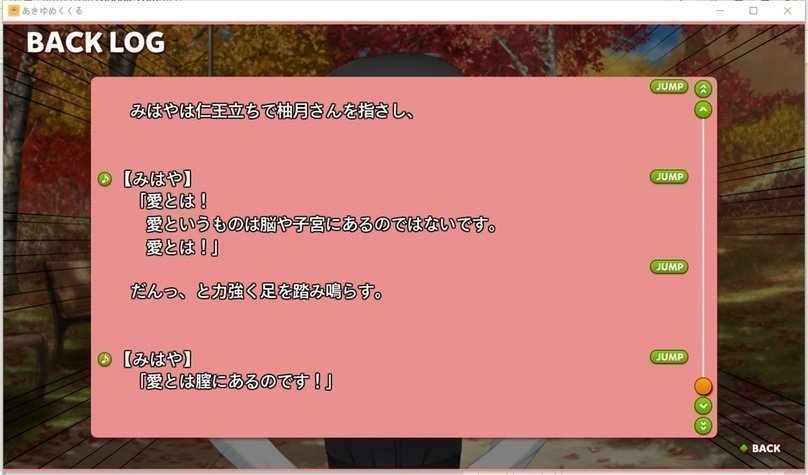
So Akiyume Kukuru is best suited for the kind of people who spend every day on Twitter and Google Plus getting off on their own high-tech-but-not-actually-funny gags and so-called Hi-Tech references, plus the socially awkward types who devour sci-fi novels but can’t tell a story or express themselves to save their lives. If you just want an ordinary “story,” this series isn’t for you. Maybe you can do what I did—read the beginning, skim the middle, read the end, and get a rough idea of what this fucked-up story is. But it won’t give you any satisfaction or pleasure; it’ll just leave you a little disgusted and feeling like you wasted your time.
Of course, if it matches your wavelength, this game might be like a thick four-panel comic you can lose yourself in for hours. The ErogameScape score probably tells you normal people won’t play this—only real fans of the series will buy it, and naturally they’ll be satisfied with it.
For me, though, it really is more like a sci-fi novel written by a middle schooler in the terminal stage of chuunibyou. But who hasn’t been through a chuuni phase? I’ve graduated, so I look at this and think it’s dumb, but the types who never graduated and go around yelling “fucking amazing” (牛逼炸了) every day are probably exactly the target audience.
Final advice: before consuming the “Season Kana ABB” series, make sure your wavelength matches. Otherwise it’ll make you sick. Or you can check out the story of Harumade, Kururu first to get a feel for it.
Comments are hosted on the Chinese main site. This mirror is read-only.