Hoshikoi Twinkle (星恋*ティンクル) Review
Twinkle ni Hoshi Koi no Eien
Sometimes I think about this: so many scenario writers in Japan do original drafts for anime and games — are they just mass-producing the same thing over and over?
…………I mean, whatever a given writer puts out, doesn’t it always follow one pattern no matter how you look at it?
Code Geass, Guilty Crown, Valvrave, and the latest one — what was it called? Kabaneri?
I’m not saying Ichiro Okouchi is bad; the man won a best screenplay award, didn’t he? I’m talking about visual novels — whether some writers end up reusing the same套路 across multiple games.
I noticed this pretty early on. For example, the Shiiba route in Yuzusoft’s Sanoba Witch overlaps heavily with the Riru route in Kujira Kami no Tiastila, which came out not long after. I don’t know if that’s Tota’s doing or just coincidence. But a “competent scenario” shouldn’t have the problem of “can’t adapt, only ever writes one path” — otherwise you’re just showing how tapped out you are.
But man… for Hoshi Koi * Twinkle… I don’t even know what to say anymore…
Let me start by saying I do like Korie Riko’s art. In Gaku ☆ Ou and Magical Charming! I thought her girls looked great — especially how tiny and slender they are. So I was following Hoshi Koi * Twinkle from early on; the promo started early too. I checked the writer Nakahiro’s past work — there’s the Imouto no Seiiki and Gakkou no Seiiki series, plus Hoshizora no Memoria and Astraea no Shiroki Eien, all well-received. Even his nukige aren’t that bad… so my expectations were high. The art was guaranteed fine, and as long as the scenario didn’t shit the bed and just followed Astraea no Shiroki Eien, it should at least get decent word of mouth…
Then the trial came out and slapped me right in the face. Then the full version dropped, and after I hit the True End, it slapped me again.
Never in a million years did I think this company would take a winning hand and play it this badly.
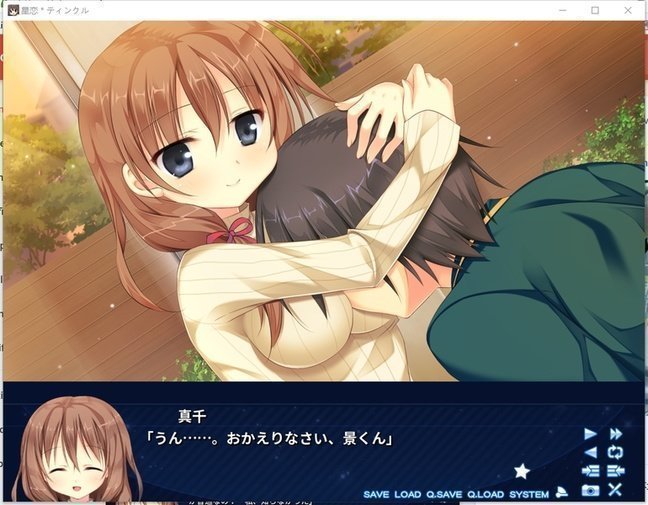
First, the art. Everyone knows moe-consuming otaku pursue “moe” with a kind of tsundere-ish “pseudo-erotic borderline” approach — I don’t know if I’m putting this accurately, but none of the popular “moe works” are made to sell you meat.
A nerd can look at a cute girl, get absolutely wrecked by the moe, and imagine her spreading her legs for him or getting trained into a cumdump in some doujin — but in the official work, she has to be fully clothed, no random panty shots; occasionally showing a bit of panties is already the limit.
In other words, the nerd can mentally rape his fantasy girl ten thousand times, but on the surface she must be pure and flawless. Only then can he, when asked “what are you watching,” solemnly say he’s watching “love and friendship” instead of “porn,” even though his head is full of porn…
So you see, how does Yuzusoft do it? Normal dialogue is dead serious; even when selling meat they don’t do it crudely, and the overall pacing follows a very normal pattern. The one that pushed it a bit further was Amatsutsumi * Airnocts, and sure enough that one’s reputation isn’t great…
But what did Hoshi Koi * Twinkle do? The planner must have gotten kicked in the head by Sendai-baba — they simply and crudely assumed “the more meat we sell, the more excited players will be.”
So in the trial I felt extremely awkward: the little sister’s clothes are practically transparent, nipples clearly visible. Normally that kind of thing comes as a bonus patch, but this game has it by default — during dialogue it feels like she’s completely naked. And at home she really does run around topless all the time…
Awkward. Fucking awkward!
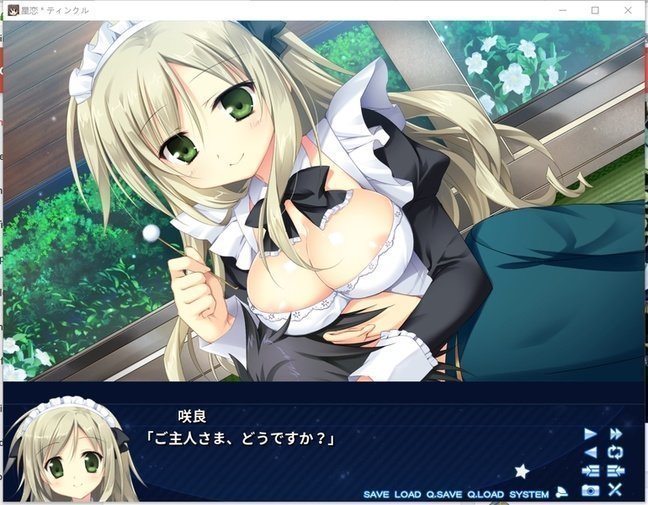
In the full version, the devs apparently saw the trial feedback saying the sister was like an exhibitionist and unbearable, so they added a toggle option, off by default. But even so, the sister’s exhibitionist setting didn’t change, and later the protagonist’s aunt shows up, lives at his house, and she’s a fucking exhibitionist too… In the game, wearing a maid outfit shows nipples, practically any CG shows the pubic mound, panty shots are actually the most normal CGs, and even the shrine maiden outfit has fucking hard nipples…
Every CG I saw in this game made me cringe. I don’t know how this game positions itself — is it a moe work labeled “love and friendship,” or a big-tits-fucking moe nukige? Honestly, for a moe work, as long as the regular story is fun, you can sell your 18+ tapestries on the side. Do you really think you can have it both ways? Impossible. What’s a moe nukige? At the very least it needs a harem setup, right? Look at Imouto Tenkoku — that’s the benchmark. A game that at least “still wants to tell a story” shouldn’t force itself toward meat-selling; the result is that playing it is awkward, everyone acts like an exhibitionist, and the poor little sister especially is completely un-moe — she’s three GFWs behind Sora-chan. If you really want otaku money, first draw the characters cute, instead of drawing bigger tits and fewer clothes. Do you even know the market?!
The awkwardness in the art completely wasted Korie Riko’s name. And the story? What about Nakahiro, who’d written plenty of decent stuff? How’s this game’s story?
Honestly, the framework is okay, but even if it’s okay it’s useless.
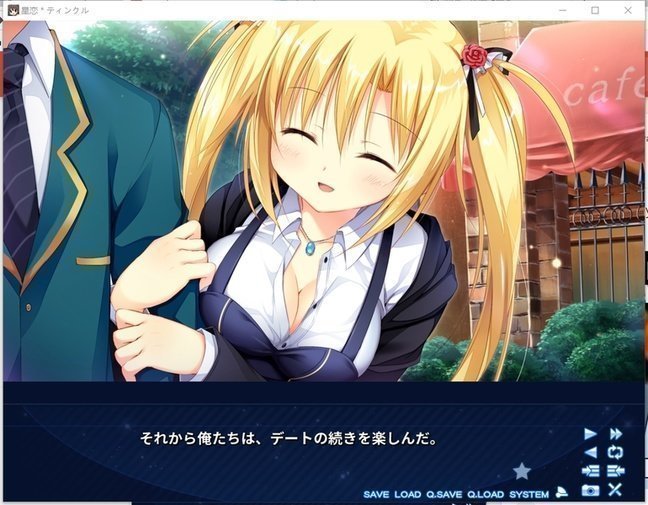
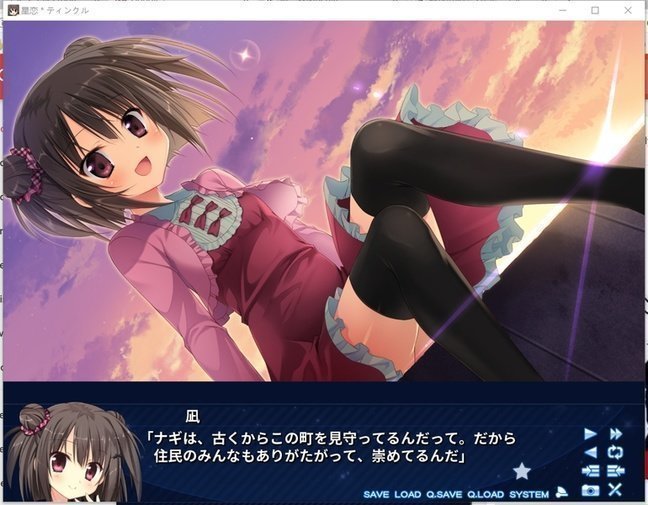
The game starts with the protagonist, Muragumo Kei, and his little sister Muragumo Sora moving to a small town — the opening is a lot like Yosuga no Sora, they even arrive by train. After moving in, he meets some townspeople: the shrine maiden and student council president, Orikami Tamaki; the school nurse’s sister, Hanamimi Sakura; and the daughter of the island research institute director, Narusegawa Nagi.
Then he learns that the town has three great families with inherited “divine powers” — one is “Yu,” one is “Jin,” one is “Chi” — roughly courage, mind-reading, healing, that kind of superpower. The individual routes tie into these abilities: Hanamimi Sakura has healing, Orikami Tamaki has mind-reading, the protagonist has courage… His sister has a power too, but doesn’t use it much.
Now for the protagonist’s background: his grandmother was from this town, from one of the three families. Families couldn’t intermarry (because two ability users together supposedly bring misfortune), but she broke the rule and eloped with someone from another family, got exiled from the village, and had to change her surname — which became the protagonist’s surname. As descendants, he and his sister naturally have powers too.
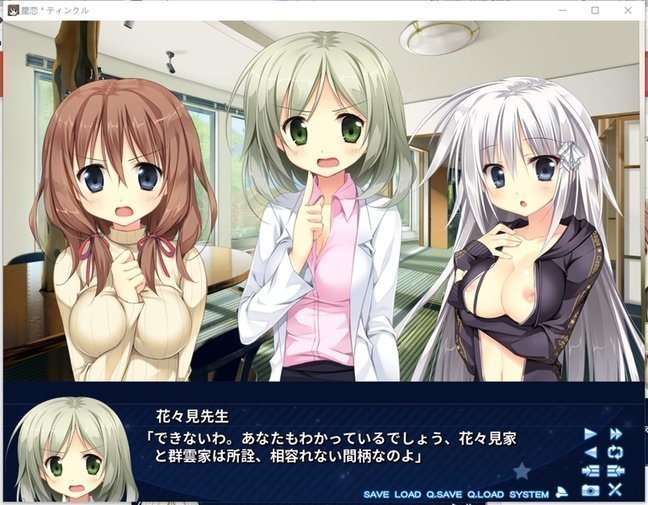
What’s the point of all this? None, really. It’s just to explain that the three families worship a star in the sky called Nagi, and every year they hold a festival to celebrate and bless it. They believe the star brought them blessings and gave them superpowers…
But the blessing festival has rules: it must be done by the village itself, no outsiders, no publicity. One of the heroines, Narusegawa Nagi, thinks that’s bad — if you’re celebrating, celebrate big, let more people know about the festival. Naturally she gets opposed.
Then after you finish the other routes, Nagi’s route unlocks. In it, Nagi forces through an activities club to plan the festival and get more people involved, and she also says her mother researches that star — the star is dying, and if they don’t celebrate now it’ll be too late. The event seems to succeed: they put on a play, and the play’s content satirizes the town’s “closed-off celebration that doesn’t want outsiders.” Nagi’s mother first opposes the play, then agrees.
The play is a big hit, but it’s still useless. Nagi keeps dreaming of looking down at Earth as if she’s in space. After the play, Nagi confesses to the protagonist, and after confessing she says she’s going to disappear. Then one night, by the sea, in the blink of an eye, Nagi is gone…
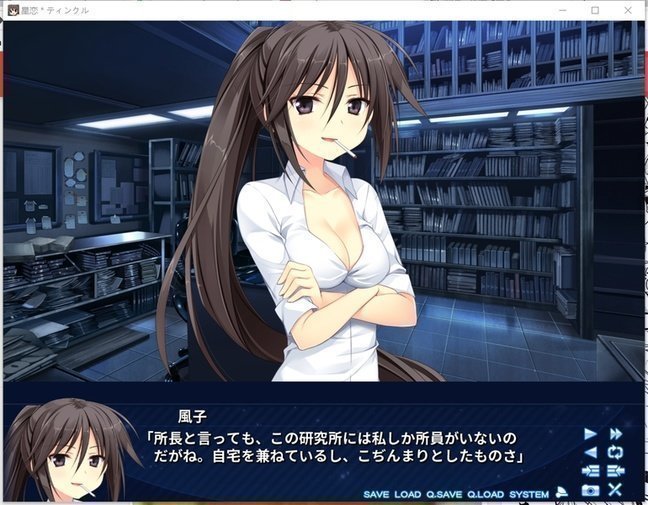
She vanishes entirely, as if she’d never been there.
Then Nagi’s mother reveals the truth: Nagi isn’t her biological daughter — someone gave her the child to raise one day. Shortly after Nagi’s mother had a miscarriage, a mysterious person who looked like they came from the sky brought a baby girl, saying her name was Nagi, the same as the constellation the town worships, so she named her with the Japanese character for “Nagi.”
So the story keeps going, and the more it goes the more it explodes.
It turns out Narusegawa Nagi is an alien. Her alien planet was destroyed, and some refugees boarded a ship to seek refuge on Earth, but on approach the ship malfunctioned and the alien couple were about to die. With no other choice, they entrusted their infant daughter to a spaceship with an AI. The ship took human form, projected the daughter inside the ship onto Earth — specifically that Japanese town — and projected itself as a phantom, handing the phantom baby to a female scientist on Earth to raise: Nagi’s mother.
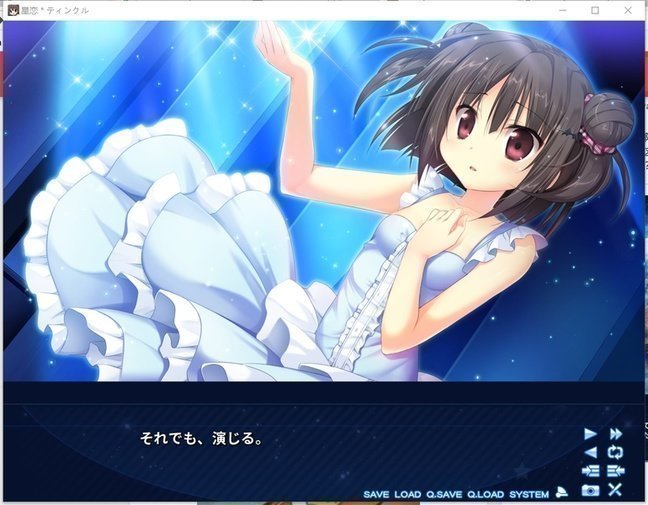
So the especially bright star called Nagi that the town watches every day is the spaceship’s light. It flickers because the ship has to keep projecting onto Earth — otherwise Nagi wouldn’t exist.
Why does the town have superpowers? Because the ship’s projection also irradiated certain people. The phantom loli who keeps appearing in the game is actually the spaceship itself, occasionally appearing to protect Nagi.
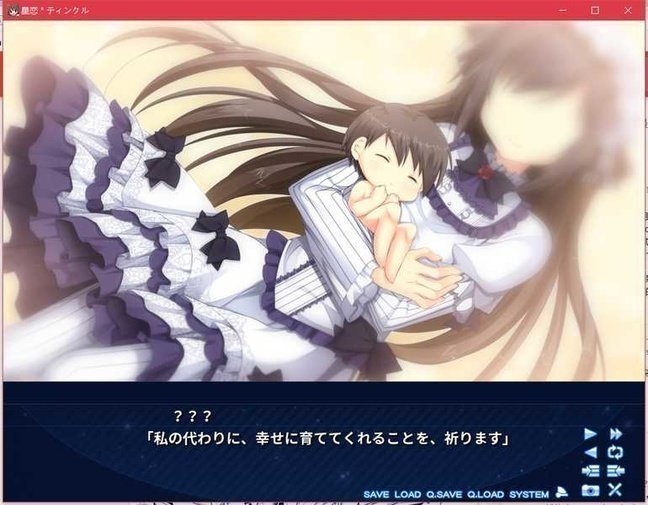
Why did Nagi disappear at the end? Because the spaceship broke (or ran out of power, I forget). Nagi’s real body is still lying inside the ship — the one on the ground was only a projection all along.
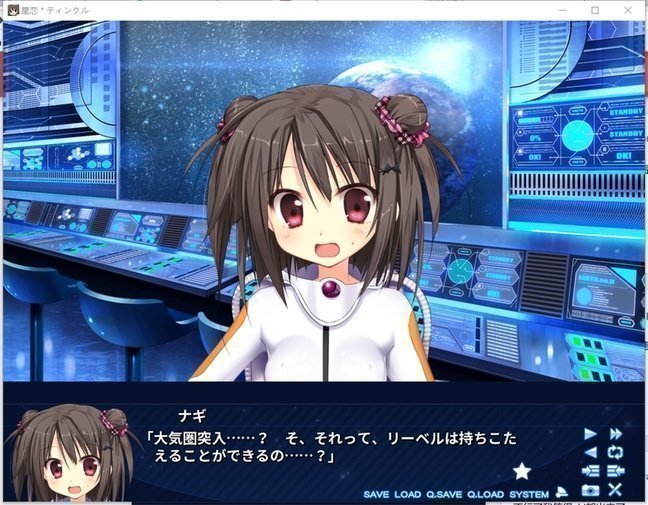
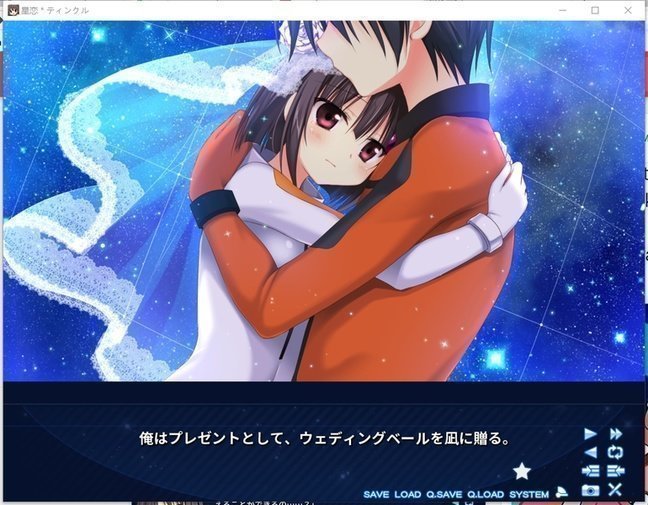
Final ending: the protagonist flies into space, saves the real Narusegawa Nagi, and they break through the atmosphere back to Earth and live as a married couple.
The star (spaceship) is gone too, and the town loses its superpowers.
So the game’s “offer blessings to Nagi” — Nagi is the heroine herself. She is the representative of that star in the sky. In a way the title didn’t lie to you.
So look, is this framework passable? It’s just that while playing… I kept feeling like I’d seen it before.
Ability users, alien phantoms, space exploration, power contagion… plus the town’s science institute, and the institute mother’s ability-user daughter…
What did I remember?
This is literally a degraded version of Astraea no Shiroki Eien. Yukiyuki was formed from a Martian stone, and Narusegawa Nagi is an alien; Tsukizaki got powers from the snow, and this town got powers from spaceship radiation. The individual route characters are set up similarly to Astraea too — the sister also keeps muttering and throwing herself at him, Orikami Tamaki’s tsundere is like Tachibana Ochiba, Hanamimi Sakura’s role is like Corona… It’s hard to explain in detail, but if you’ve played both and compare, you’ll find tons of similarities in setting, characters, and atmosphere — basically one pattern.
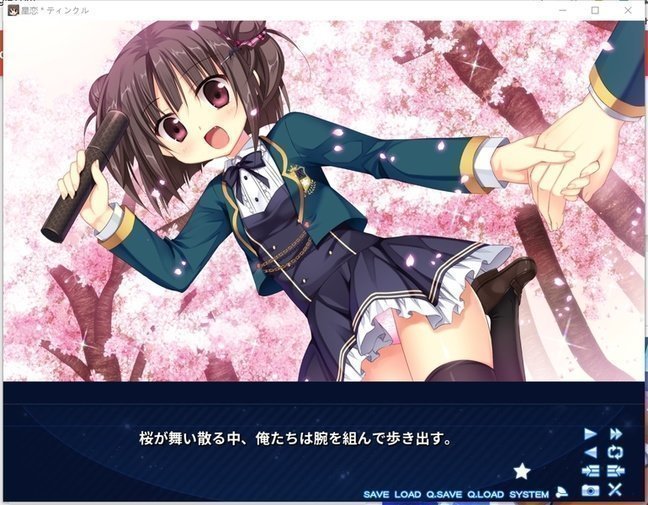
Of course, not entirely — the game’s slice-of-life is worse than Astraea’s, mostly on the level of the Seiiki series. I’m not saying the Seiiki series is bad; it’s just that Seiiki is positioned as a nukige, and when a nukige tells a slightly decent story you’re pleasantly surprised. But for Hoshi Koi * Twinkle, which is labeled “non-nukige,” writing at the Seiiki level plus the forced fanservice in the sprites and CGs always gave me the illusion that I might be playing a fake game.
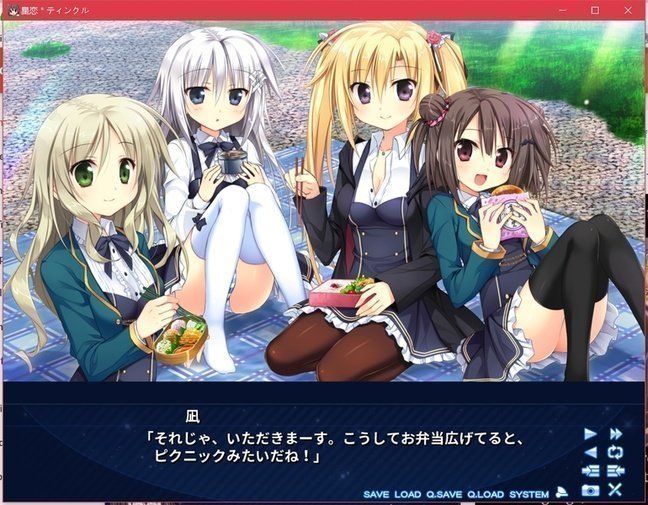
Also, most of the individual routes are really dumb. The student council president’s route: the protagonist, as an ability user, combining with her ability brings misfortune, so the plot quickly turns into “Final Destination.” The sister’s route drags hard, while Hanamimi Sakura’s route is very short and baffling — the protagonist’s childhood phantom shows up out of nowhere…
The music is nothing special, standard eroge background music, and the direction is weak compared to Astraea. What’s most worth mentioning is the Normal ED.
Even listening through your armpit you can tell the Normal ED is sung by Niita Emi, but the game credits the composer, arranger, guitar, keyboard, and drums — just not the vocalist. Looks like Ippon no Zukan 07 ruined Niita Emi so badly she’s not even famous anymore… my heart aches for 0.5 seconds, because I need to save the rest for tomorrow.
All in all… Hoshi Koi * Twinkle has a first-rate artist, a not-bad scenario framework, a not-bad CV lineup — truly the right time, place, and people…
And then they went and fucked it all up into this state. I don’t even know how to rate it. Maybe it’s 2017’s opening landmine. Speaking of which, the first game I played last year was also a landmine… also featuring Akino Hana, Sendai-baba, Gotou Mai and the rest.
Sigh. Is it fate?
In the end, Hoshi Koi * Twinkle is itself a clumsy rehash of Astraea no Shiroki Eien’s pattern, and not even a good one — a degraded version. At some point I think this game might as well change its name to “Twinkle ni Hoshi Koi no Eien.”
Comments are hosted on the Chinese main site. This mirror is read-only.