I Was a Spinner Back in School, and I Found a Fun Little Gadget
I figure a lot of people spun pens back in school.
I mean you at least imitated it, or tried it. In middle school I happened to see someone holding a ballpoint in his hand, gave it a flick with two fingers, and the barrel went dancing between his fingers. Looked sick. So I copied him. And of course the result was predictable: the useless thing spun less than 180 degrees across the web of my thumb before plummeting out of my hand.
But I wasn’t discouraged. Practice makes perfect, and spinning badly doesn’t get anyone pregnant, doesn’t hurt you either. Idle hands, so why not.
Over time my right hand, whenever it wasn’t writing, kept endlessly messing with the pen between the web of the thumb and the index finger. They say persist at something long enough and it becomes a habit. So one day in class I suddenly noticed my pen had dropped to the floor from a failed spin, and realized I’d been spinning for over 40 minutes without noticing. That was when it hit me: I’d picked up a bad habit called pen spinning.
There’s a lot of debate about pen spinning… several kinds, in fact:
Some say fiddling around like that keeps your fingers nimble and boosts your IQ; some say it prevents Parkinson’s; some say it’s a wanton act of destroying ballpoints and fountain pens, a conspiracy by the people who sell gel pens and fountain pens; and there’s another group who swear up and down that it’s a dick move…
The IQ thing is obviously bullshit. I spun for years and my grades slid from middle school through high school. Boosted what, exactly. The Parkinson’s bit has some logic, but starting Parkinson’s prevention in your school years is like handing out condoms to elementary schoolers — it convinces nobody. The destroy-pens-to-boost-sales theory is even shakier, pure WeChat-moments conspiracy vibes. As for the last group, the ones who call it a dick move… that came from a teacher, and from where he’s standing I’d say he had a point.
That was my high school physics teacher. Slightly chubby, tiny eyes, looked like Garfield. One day mid-class he suddenly stopped lecturing, wore the expression of a man thoroughly sick of something, and let out a long breath…
“Class…” The whole room froze, figuring a pop quiz was coming… “Please, stop spinning your pens… pen spinning is just a dick move… I look out and the whole classroom is full of spinning pens, I’m getting dizzy…”
Only then did it occur to me that pen spinning could, collectively, deliver a devastating visual assault on a teacher. Not that it helps — unless you get someone to call a count and have everyone spin to the beat, you can’t maximize the effect. And obviously that’s not happening. Pen spinning isn’t aimed at teachers anyway. It’s just students being bored in class.
Right — pen spinning isn’t anything special. It’s just that holding a pen while you’re not writing is too dull, so you spin it to pass the time. Basically the same tier as people who jiggle their legs, pick at their hands, or stare around the room. Killing time with idle body parts. A tiny behavioral tic, nothing more.
But the sheer ubiquity of pen spinning shows that most people need some channel — something to do with their hands when they’re bored — to release stress and kill idleness. In college I wondered: could someone make a pen purpose-built for spinning, one that improves success rate and comfort? Might sell well?
And sure, someone did. It didn’t go great. In the pen spinning world, pros sneer at that stuff. It only fools beginners. Real spinners’ weapons are always hand-tuned by the spinner himself — otherwise it doesn’t feel right.
So a dedicated pen might not work, but a small team overseas took a different route and came up with a fun little thing called the fidget cube.
The design is dead simple and kind of boring: a few gears, a joystick, some switches, a little steel ball you press for a click-click sound.
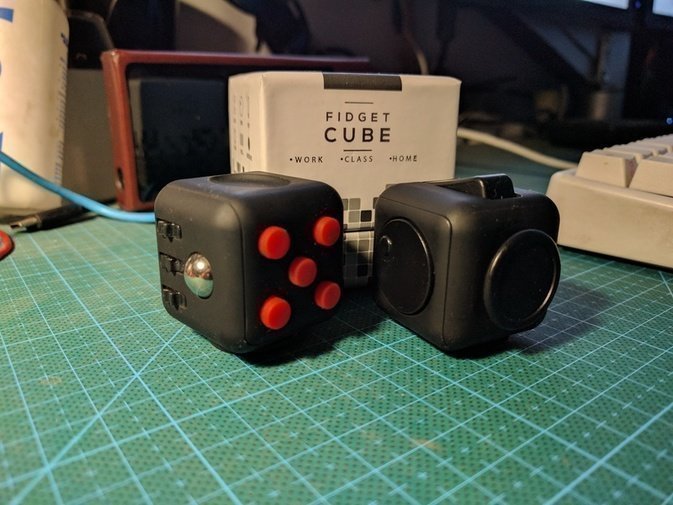
It started as a Kickstarter campaign and got chased after by people worldwide almost immediately. The crowdfunding phase is over now, orders are still coming in, and plenty of backers are still pestering them about when their units ship… you can’t call them patient.
What’s it good for? Nothing, really. It’s a little cube with almost every “thing you might idly press for no reason” crammed onto it. Hold it and fidget, listen to the click-click and kill some boredom.
So why did it blow up? Think about it — it’s exactly like pen spinning back then. It’s just something to keep your idle hands busy. It can’t do anything, can’t achieve anything, but it means a lot.
I got one too. Not from the official site — it’s not expensive, but the shipping costs as much as the product. So I went to good old eBay.
Plenty of sellers had it, lots of them knockoffs. I found one claiming a unique channel; the shopkeeper swore the Kickstarter product was made in his factory, that something this dumb and low-tech could be cloned 100% identical, and that what he sold was exactly that — plus more colors than the Kickstarter original.
When it arrived it was indeed pretty much identical. After using it for a few days I found I’d gradually adapted to it.
Not “can’t live without it,” not “use it every day.” It just feels like it’s been adapted into me.
Same kind of adaptation as pen spinning back then. Without noticing, you’re pressing it in your hand. It’s small, easy to carry, takes up no pocket space, and the moment it’s in your hand you start pressing. Which fits its stated purpose: stress relief, killing boredom.
Sometimes while squeezing it I wonder — is this thing the modern equivalent of those two health balls old men roll around in their palms?
Maybe when we’re old, what we hold won’t be two big iron balls. A little cube like this might suit us better.
Comments are hosted on the Chinese main site. This mirror is read-only.