Amanatsu Adolescence (甘夏アドゥレセンス) Review
Amanatsu Adolescence
Last year — no, the year before that — I played a game called Ten no Sora Retrospect (天ノ空レトロスペクト). I actually thought it was pretty good at the time. It fizzles out late and gets muddled in the middle, but the opening was solid, it made clever use of the infinite monkey theorem for a genuinely fun premise, and a lot of the scene transitions in the prologue had a bit of a cinematic feel.
But Japanese players didn’t really click with it, apparently. The reasons were the same as for a lot of games I think are good but Japan doesn’t: most of them said “what the hell is this, how could the world be made by monkeys, how could some monkey bang out Shakespeare on a typewriter, why would a god in the sky have anything to do with monkeys, it’s a mess, bad review.” So yeah, I really don’t get these Japanese players sometimes. It’s like how I thought that game about raising a Canadian goose and flying with it was good too, but they gave it bad reviews because “raising Canadian geese is a crime.” Under the infinite monkey theorem, there could be infinitely many possible worlds that monkeys banged out by pure chance. They refuse to accept that setup, but they’ll happily accept something even dumber like the world ending tens of thousands of years ago. A lot of Japanese called Ten no Sora Retrospect a “denpa game.” Honestly, go call the “Kisetsu Kururu” series a denpa game first. What I really can’t wrap my head around is that the latter outdoes the former by about 20 Chaos;Childs in both chuuni and sheer insanity, and yet it got tons of praise. Some people say Ten no Sora Retrospect reads like a chuuni kid’s embarrassing old novel. If that’s a chuuni’s embarrassing old novel, then the “Kisetsu Kururu” series is toilet paper from a psych ward.
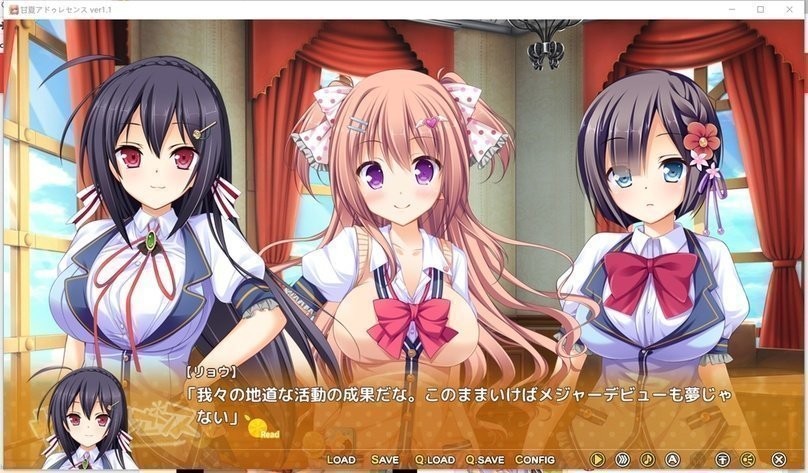
A game came out this month called Amanatsu Adolescence. The moment I saw the premise I knew it was about a band, so I was puzzled: how many years has it been since K-On! made that trend go stale? Waking up to this setup now, kinda dumb… But while bored-scanning reviews I found something interesting. The game is from a new company called “Confiture Soft.” It’s their first title, but basically the entire staff — the artist, the writer, the music, all of it — is the same as Ten no Sora Retrospect. It really looks like those guys just put on a new company name and started making a new game. Digging further, I found something even better: one Japanese reviewer flat-out said this was the old landmine company GLace changing its name to fool people because they couldn’t sell under the old one.
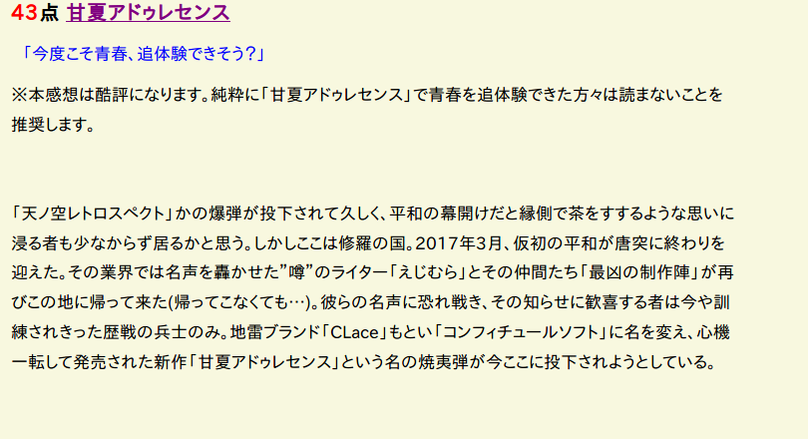
What? You say GLace is a landmine company? At first glance that seems about right — I played GLace’s Timepiece Ensemble, and it was stupid to an extreme. But thinking about it more, that’s off: every GLace game had a different writer, so how could they possibly have found someone who writes landmines every single time? The saddest case is a game called 1/2 Summer, which got decent reviews and was made by the same people as GLace, but it was published under Alcot. It’s back under GLace now, but nobody thinks of it as a GLace game anymore.
So how does Amanatsu Adolescence actually turn out? Is it a landmine? Hard to say…
The basic premise of Amanatsu Adolescence could not be simpler: they start a band to enjoy their youth. At first glance there’s nothing wrong with that, and the prologue is refreshingly straightforward. Structurally, I’d split the game into three parts: the prologue, the main story, and the heroine routes.
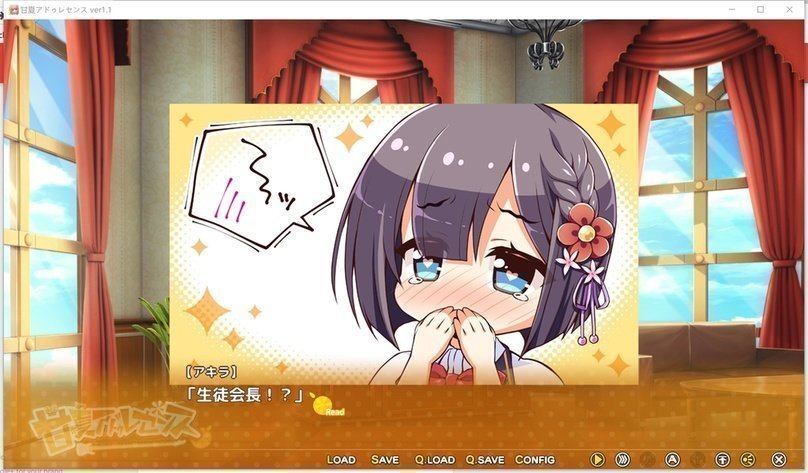
The first part is the fun, traditional part. The protagonist starts out in the school’s music club, which has a band and puts on shows. At one of those early shows, to show off, he uses a guitar that shoots fire. The fire trick goes wrong and the guitar burns down the school. The damage isn’t huge because they put it out fast, but the school decides to shut down the protagonist’s club and scatter everyone into other clubs — baseball, choir, science, whatever. natu, the club president, and the protagonist refuse to accept it, and go plead with the student council to get the school to show some leniency. No dice, of course.
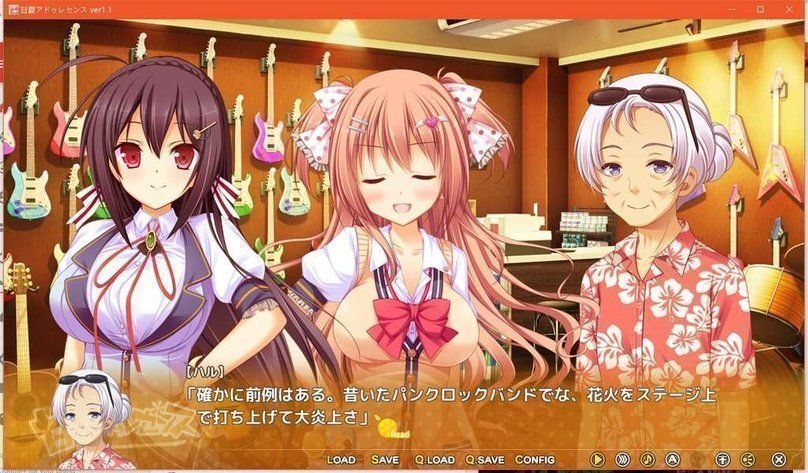
So the club is gone and the band has nowhere to play, and natu suggests performing at her grandma’s instrument shop. The old lady says they can practice there, but first they have to clean the place up. Cue another round of busywork. When they’re ready to perform, they realize they’re short a member. Conveniently, the protagonist’s parents work in publishing in Russia, and a Russian transfer student shows up saying she’ll stay at the protagonist’s house. She has huge boobs and loves music. At first she’s tsundere and looks down on the protagonist’s band, but eventually they talk her into joining. Then the protagonist drags in Amane, the science club president and resident loli scientist, on the grounds that she’s good at playing drums.
The band is assembled, so they get to work. The protagonist and company figure things can’t go on like this — the real point is getting the school to let their club come back. Then the chance arrives. The school says if they can sell out their performance and put on a good show, they’ll allow the club to return.
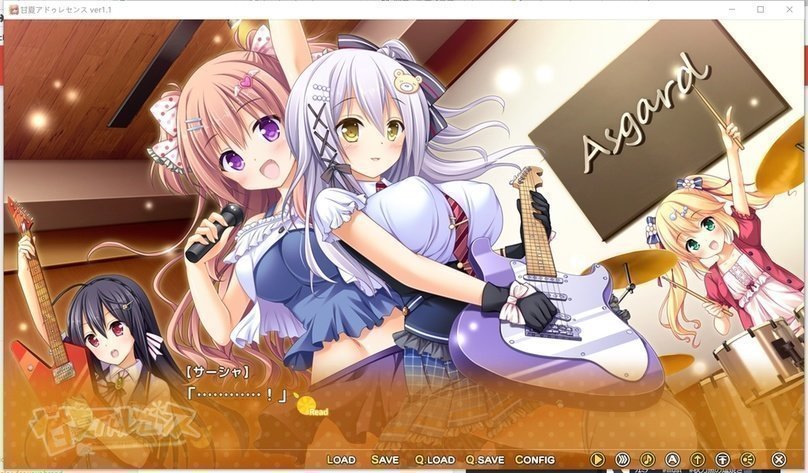
And you already know how this goes — of course they pull it off, and the club comes back.
That’s where the first part ends, and so far it’s all pretty normal. You might think the story’s over here. Nonono, too naive — it’s only just getting started.
The second part veers into fantasy. The Russian girl staying at the protagonist’s house one day spots an acquaintance on the street, also from Russia. The next day that acquaintance drops into the protagonist’s school out of nowhere and declares she’s the new principal. The protagonist is bewildered, and after asking around learns the school has been bought out by a major Russian conglomerate, so the new blonde Russian teacher is now the principal.
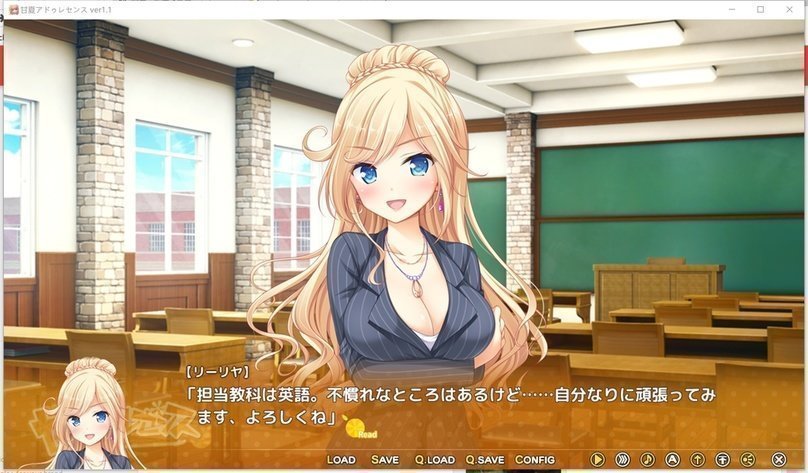
The principal announces that from now on the school will run on strict discipline, and all clubs are canceled. The schoolyard is now Red Square, everyone marches in formation every day, actively recites socialist scientific values, and enforces strict discipline. The protagonist and friends are screwed — the band just got together and now it’s doomed again. And there’s something even bigger to uncover: the Russian girl staying at the protagonist’s house is the Russian president’s daughter. She came to Japan to study music because she loves it so much (what kind of logic is that). Even weirder, the Russian principal who dropped in from nowhere, as a person from Russia, came all the way to a Japanese school to teach English. I honestly don’t know if that’s just going to ruin the students.
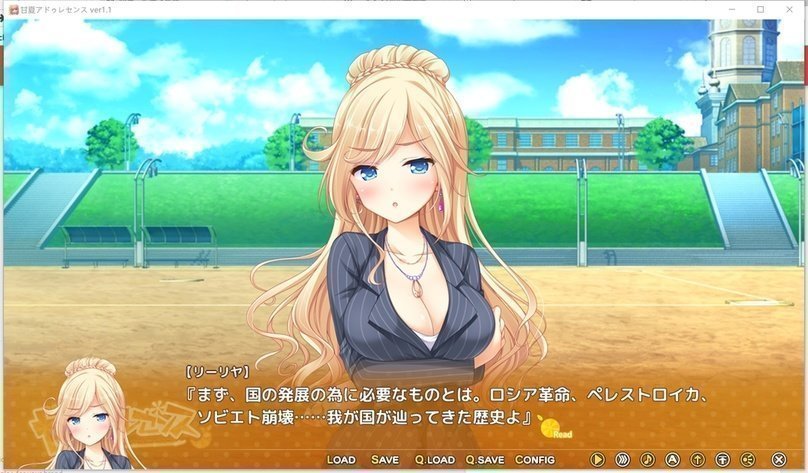
Then the game keeps going, and it turns out there’s a bigger conspiracy. The Russian conglomerate that bought the school is backed by Russia’s largest anti-government organization. The teacher who dropped in is actually a spy, out to bring down the current Russian government. She also discovers that the Russian president’s daughter is living at the protagonist’s house, so she threatens him: hand her over quietly, and in exchange your club comes back.
Naturally he refuses flat out. Then he actually makes a bet with the spy: if he can place in the upcoming whatever FES (who cares, just think of it as some competition), the spy will give up on her plans…
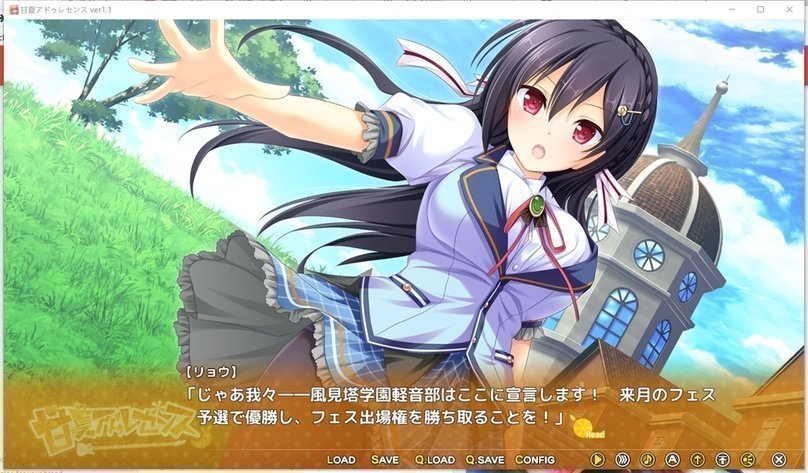
Then there’s a bunch of nonsense, and the protagonist wins over the spy with his mighty speeches and performance, saving his school and club.
Think that’s absurd? We’re not done yet.
Next is the third part, the heroine routes. I did Amane’s route, so I’ll focus on that one, and it’s a wild ride too. Amane is the school science club’s loli scientist who does all kinds of research every day, including building the protagonist’s fire-shooting guitar. Her route is simple and blunt: pick her twice and she confesses out of nowhere. Then it’s the traditional romance development, until the very end of her route, when the game goes off the rails again.
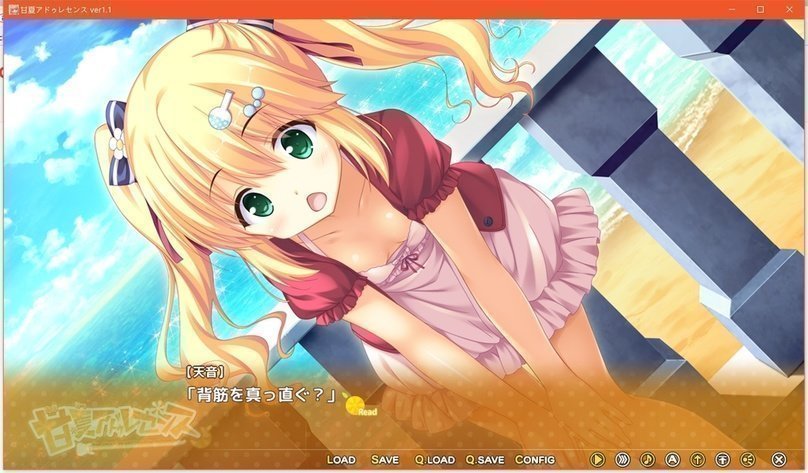
The protagonist and Amane get kidnapped. They wake up surrounded by Russian experts, who say they have a reason for the abduction. Amane immediately understands and says she’ll cooperate. The protagonist is confused, so the Russians explain: Amane is actually a brilliant genius scientist with the power to destroy the world. If she cooperates, they’ll give her the best research environment and the best equipment. Bottom line: money is no object, do whatever you want, just produce results.
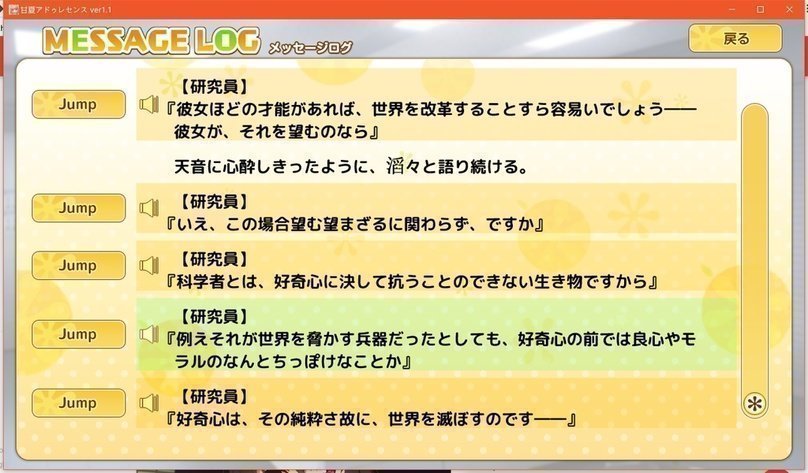
Amane is thrilled and says she’ll do it. The protagonist sinks into thought. Then, after they go at it a few times in the lab, the two of them think it over in the afterglow: should they really do research here? Amane says the environment is so great, she could bury herself in research and not have to worry about anything. But the protagonist says, “Is that really what you want? Do you want me, or do you want the research?” Amane freezes at that and says, “Then I want you.”
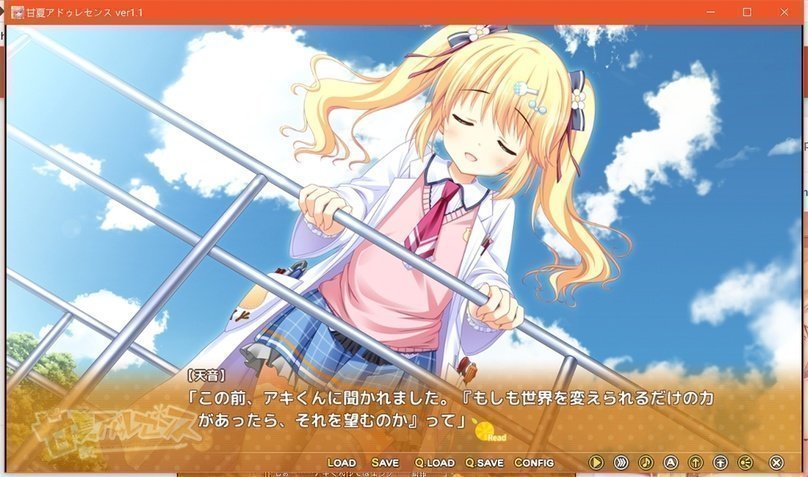
So Amane tells the experts she’s not going to do research, she’s going back to play in a band with her boyfriend. The experts are dumbfounded, but then they say they understand — if Amane kept going, she’d probably soon invent some black technology that could quickly destroy the world, and the world would be done for. Better she doesn’t.
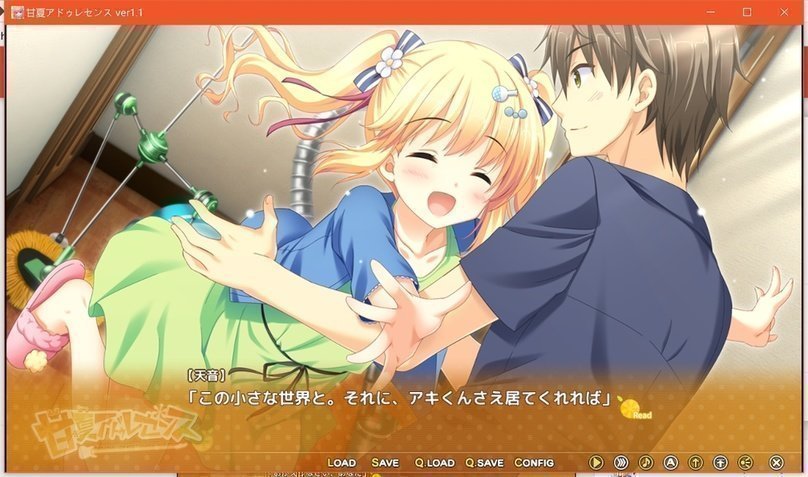
And so a genius scientist with the power to destroy the world gives up research and goes back to a small Japanese village to live with her boyfriend and play in a band. The end…
Jokes aside, by around the 30% mark I thought the game was passable. At least the everyday dialogue was more interesting than the several games I’d played earlier that month. The characters are distinct: the optimist acts like an optimist, the schemer acts like a schemer, the tsundere acts like a tsundere, the airhead acts like an airhead. The first 30%, the plot about putting on a show to get the club back, actually fits the game’s marketing — youth, fighting once for your youth, fine.
But after that 30%… I don’t know what to say. Honestly, I was laughing the whole time.
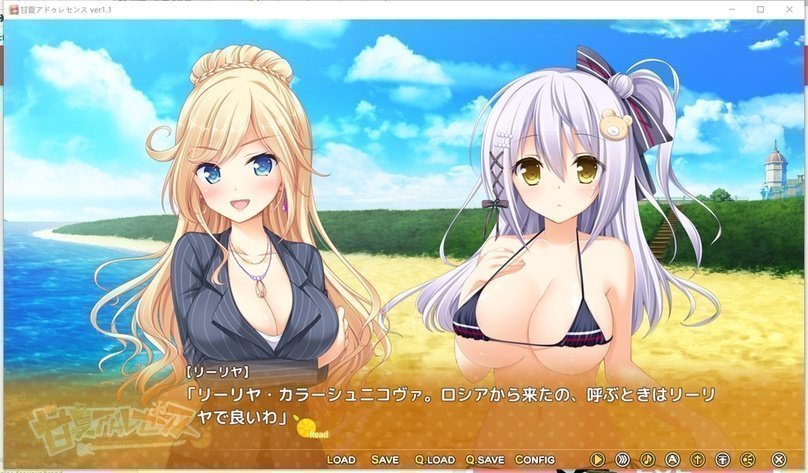
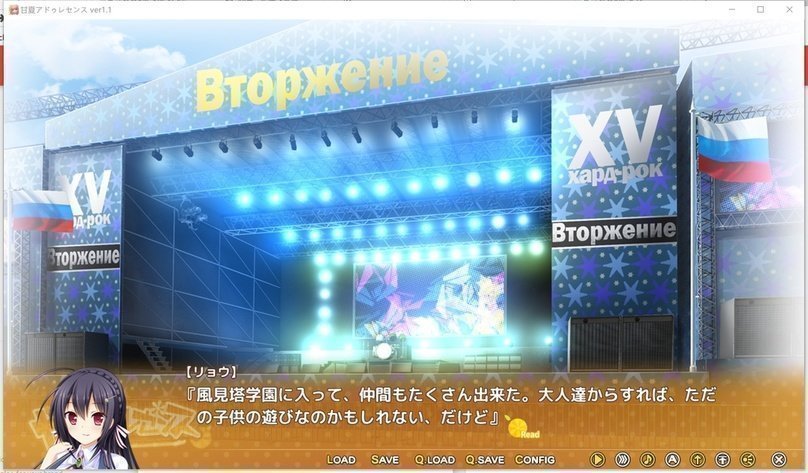
Did the writer watch something Russian recently? Why the obsession with Russia? And his understanding of Russia seems stuck in the Soviet era — it’s all Gorbachev this and Gorbachev that. The game also has a ton of Russian in it, untranslated. I asked some people who know Russian, and apparently it’s all very stupid vocabulary (thank you, I don’t know, sorry, okay), but not explaining it is genuinely obnoxious. You know how Russian is — I can’t even type it, let alone look it up…
The second half’s level of fantasy defies description. Sometimes I watched it like I was watching an anime like Valvrave, because the story is pure nonsense, and it’s nonsense delivered with a completely straight face. Honestly, if you call it comedy it’s pretty good — a parody, like Gintama. It’s just that it also seems to be seriously telling a story. When the school is about to be taken over by Russian spies, the soundtrack switches to some track that sounds like someone’s mom died, and instead of feeling sad, it’s hilarious. And from the second half on, the game has almost nothing to do with music anymore. Or rather, it has nothing to do with the original premise at all — only Russia, anti-government organizations, grand conspiracies, and world destruction are left…
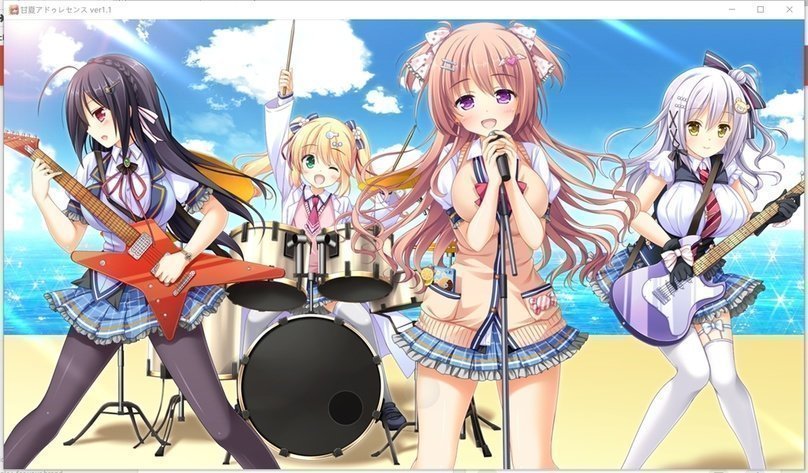
Calling it a landmine feels unfair. The everyday dialogue is still funny, the characters are well drawn, and the music is good — I mean, the music fits the second half’s atmosphere.
What atmosphere? Comedy. Because the second half is a mess but combined with a straight-faced bullshit story and music that flips faster than a book, it accidentally — like a blind cat finding a dead mouse — creates a comedy-film style. I was laughing the whole time, laughing so hard I got hard, then laughed until I went soft again. Maybe I’m the weird one, but story-wise the second half has completely lost control. Youth? Band? Passion? Bullshit. Eat Russian shit!
Another flaw: for a game that bills itself as being about music, it never describes the music in any detail. Or rather, not at all. Even Yuzusoft’s Sanoba Witch, which has a band, has a crappy edited MV. This game doesn’t even have a proper all-out band performance. I honestly suspect the game originally wanted to be about Russian anti-government agents dropping into a Japanese school to destroy the world, and only slapped on music and youth as a skin at the last minute before shipping.
Another funny thing I noticed: the writer has an almost fanatical fixation on “old ladies.” The previous game, Ten no Sora Retrospect, had an old lady named Orikado who was a historian, discovered that the world was made by the monkey theorem, and could talk to God. This game has an old lady too — natu’s grandma, a rock grandma, very hip. She helps the protagonist several times early on, and then apparently gets sick and dies… or does she? I forget. Either way, she suddenly stops appearing altogether… I wonder if the writer lived with his grandma as a kid, which would explain this weird fixation.
The game got terrible reviews in Japan, which seems fair. The second half’s nonsense is more than enough for people to call it bullshit: the main story is a mess, and the first and second halves feel like two different games. Some people went straight for the writer himself, Ejimura, calling him a total idiot and a professional landmine-maker whose games are all garbage. Sorry, though — his next job is writing for Alcot.

By the way, is GLace connected to Alcot somehow? Looking at the styles and collaborations, I’ve always had this feeling that the two companies have some kind of partnership or other relationship. And the everyday-scene quality of GLace’s much-criticized “landmine” games is on the same level as Alcot proper’s everyday scenes. Just a guess, though.
So personally, I wouldn’t call Amanatsu Adolescence a landmine, but it’s also true that the second half spins out of control. For most people there’s no real reason to play it. Takamori’s voice work is decent, and the character songs included with the game are nice, though they’re not full versions. That’s about all there is to this awkward game.
The game seems to want one big emotional crescendo at the end, like that line from the loli scientist Amane: rather than do research and destroy the world, I’d rather be with the person I love — the person I love is my world.
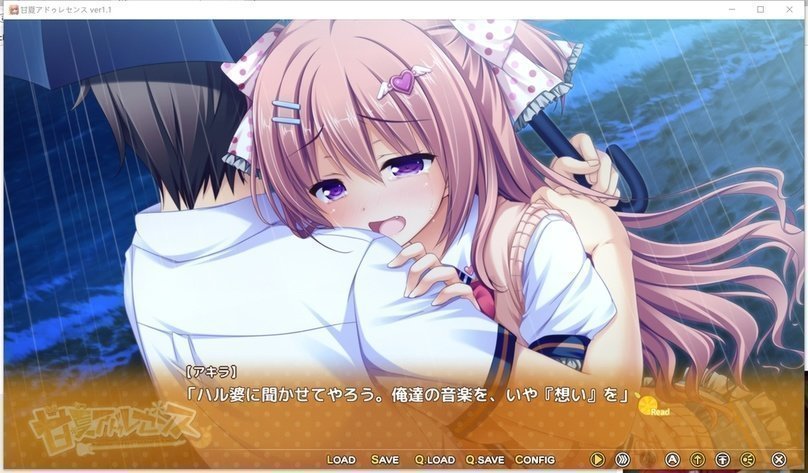
But that crescendo is just too awkward. Other characters in the game say Amane’s work might change the whole world — maybe destroy it, maybe make it better — and she just gives it up to go play rock with the protagonist. And the game barely ever says what rock even is; it just keeps saying they want to rock. Rock my ass…
If you ask me, the writer should have gone all out: just have Amane destroy the world. Rip off that one anime title: What Do You Do at the End of the World? Are You Busy? Will You Rock with Me?
Who knows, that might actually have turned it into a masterpiece (lol).
Comments are hosted on the Chinese main site. This mirror is read-only.