The Fruit of Grisaia: Potentially a Masterpiece
Everyone’s got their own personal masterpiece. Of course, the word is cheap — partly because people yell it too much, partly because you never know if you’ll run into something better later on. Strictly speaking, you can’t be sure what your life’s masterpiece is until you kick the bucket. I’ve still got a long way to go before that, so I’m just talking out of my ass here.
Before I played The Fruit of Grisaia, my masterpiece was Eustia of the Tarnished Wings (Aiyoku no Eustia). The writing there is tight and coherent in a way that’s genuinely top-tier. Though that kind of fictional setting is a bit too far removed from us.
As Frontwing’s 10th anniversary title, you can tell they poured a lot into The Fruit of Grisaia — especially the story and script. The game has weak spots, sure, but even those weak spots would pass as strengths in most other games. Frontwing has put out a fair number of titles, but almost none are translated, probably because the studio doesn’t have much of a fanbase. The Fruit of Grisaia did get an English release, though, and it has a pretty huge fanbase in overseas discussion threads. I’ve seen it talked about on r/anime more than once.
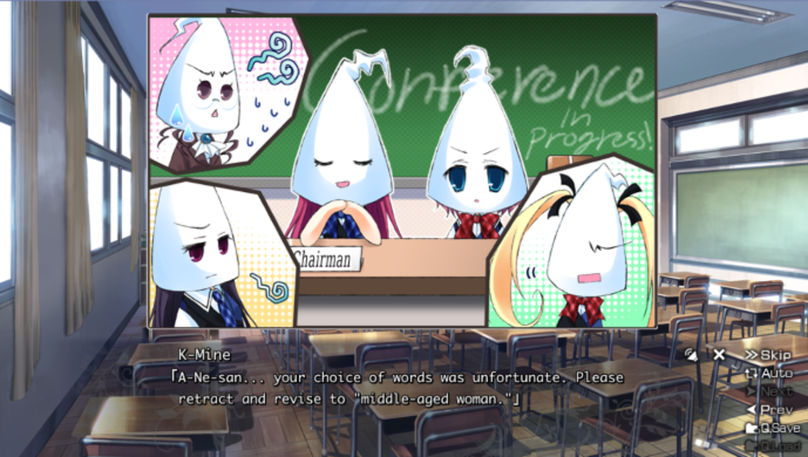
With the anime about to air, here come the spoilers. Turn back now if you don’t want them…
Common Route
The premise sounds cliché at first: protagonist Kazami Yuuji transfers into a school with only five students including himself, saying he wants to experience “a normal school life.” There he meets Komine Sachi, Suou Amane, Sakaki Yumiko, Matsushima Michiru, Irisu Makina, and the headmistress, Tachibana Chizuru. And so the long school life begins.
When I started, I’d already heard that every heroine has a dark past, so I didn’t think much of the common route — figured it was just filler. Boy, was I wrong. I never expected the game to put this much effort into the common route.
The common route has close to 60 events, each one a series of conversations in a single scene, running from 10 minutes to half an hour. You know what that means? The common route alone is at least 10 hours, up to 30. It took me nearly 20 hours to get through it. That doesn’t mean it’s boring or pointless, though — the common route exists mostly to establish each heroine’s personality, which matters a lot for the individual routes later. Every heroine has her quirks:
Class rep Komine Sachi never refuses anyone’s request and sees it through with stubborn dedication.
Amane treats the protagonist like a gentle older sister from the moment they meet, constantly trying to throw herself at him and become his girlfriend.
Yumiko avoids crowds at all times — you can barely find her.
Matsushima Michiru is dumb as rocks and gets teased by everyone, but sometimes she turns strangely gloomy.
Makina is a foul-mouthed loli whose family seems rich but who refuses to talk about them.
Everyone has their problems, more or less, and those problems only get resolved in the individual routes after the long common route.
Komine Sachi: The Guilt of Killing Her Parents
Sachi’s route runs through the whole game, because from the moment you meet her you feel her personality problem — she’s too obedient. She never says no to anything, and she’ll come up with all sorts of things to do it perfectly, down to the smallest detail. Michiru demands Sachi call her “Michiru-sama,” and Sachi does it the entire time. And after fulfilling a request, she looks relieved and satisfied, not tired.
So at the start of her route, the protagonist and several others wonder: “Has Sachi ever agreed to something she couldn’t do?”
Conclusion: no.
Yuuji asks around, and many people doubt whether anyone could accept every request without complaint, do it perfectly, and enjoy it. That’s just not normal. Yuuji tries asking Sachi if there’s anything she wants to ask of others, since she’s always doing things for others and never cares about herself. After much hemming and hawing, Sachi says:
“I want Yuuji to praise me and pat my head.”
Yuuji does it, and is surprised she’d ask for something like that. Curiosity drives him to give her a little self-awareness. He proposes she be his girlfriend, and she agrees without hesitation. Yuuji is surprised and confused — who knows if she agreed because she didn’t want to disobey or because she genuinely wanted to.
Later, Yuuji and Sachi agree to meet at “the usual place” at night. Sachi says she’ll be there at 4, maybe a little late. A day and a night pass, and Sachi is missing. Yuuji remembers Sachi once said she liked the playground in the residential district, and goes to check on a hunch — and there she is.

Yuuji’s confusion peaks. He finally goes to his boss for Sachi’s past records and the file on how she ended up at this strange school, and sees her dark history.
Sachi was a model student as a child, with parents who doted on her. She loved being with them and loved being praised and patted on the head. She worked hard and got first place on every test — not for the learning, but so her parents would look at her and praise her more. But as she grew up, her parents got busier with work, took her good grades for granted, and gradually stopped being as close to her. On one birthday, Sachi waited for her parents to come home and eat together, but they were busy with work and ignored her. When they apologized, Sachi exploded:
“I don’t want any presents! I just want the family to eat curry together!”
After that, Sachi decided on her own that her parents had abandoned her and ran out of the house. At the nearby playground she met a young Yuuji — Kazami Yuuji — and they quickly became friends, promising to meet at the playground every day.
“See you tomorrow, same place!” That’s what Sachi told Yuuji.
Then one day, Yuuji tells Sachi he can’t play with her anymore.
“Why?”
“My sister died. Things are a mess at home. We’re moving.”
“Then I’ll keep waiting here tomorrow.”
“We might move tomorrow. I might not come.”
“That’s fine. I’ll wait for you at the usual place.”
The next day happens to be Sachi’s birthday. Early in the morning her parents tell her they have a surprise for her, and that they won’t neglect her for work ever again. But Sachi has already decided her parents abandoned her — sudden kindness must be fake.
“Why… why are you suddenly being nice to me now?”
Sachi gets inexplicably angry and runs out, hiding at the usual spot by the playground to wait for Yuuji. Of course, even by dusk, Yuuji doesn’t come.
In the evening, her parents, who’ve been searching for her all day, finally find her there. Just as they see her and start running over, a drunk driver’s truck plows through and sends them flying.
Her father dies on the spot. Her mother becomes a vegetable. Both lie in front of Sachi.
Her mother’s last words to Sachi are: “Sachi, why…”
She falls into deep shock and self-blame. She knew her parents were busy, that she shouldn’t have been selfish. She’d always been obedient, but on her birthday she disobeyed, got angry, and ran out. She thinks it’s all her fault, and her mother’s final “why…” feels like a rebuke for her disobedience. Every night Sachi has nightmares of her mother saying “why.”
“Sachi, why didn’t you listen? Why did you run off? Do you know how hard your mom and dad looked for you? Do you know how much it hurt when the truck hit us? You really are a bad girl.”
Sachi can’t bring herself to visit her mother in the hospital — one look and she remembers the blood and gore. Diagnosed with PTSD, a condition that also shows up in A/Z. After that, Sachi resolves to be an obedient person. As long as she’s obedient, she’s a good girl.
“Good girls are obedient. As long as I’m obedient, I’m still a good girl… and as long as I’m a good girl, Mom… will forgive me.”
So Sachi becomes a truly “obedient good girl.” In school, delinquent girls use her — tell her to wipe every window in the school and she does it, tell her to cheat and she does it. Whatever it is, if someone asks, she never asks why, she just does it. In the end, the delinquents say, “Next week’s school-wide exam is such a pain. Go make them cancel it.”
Sachi thinks it over and sets the school on fire in the middle of the night… Even when people try to stop her, she can’t stop herself — as if failing a request means she’s no longer a good girl.
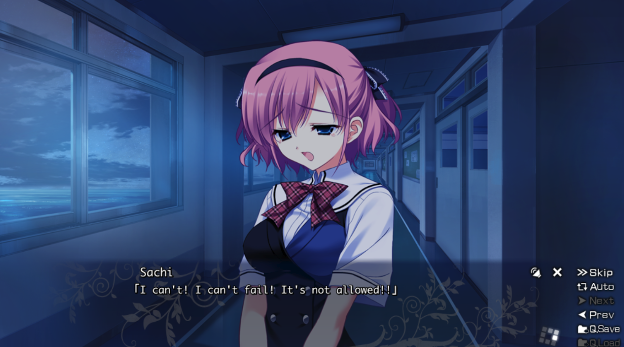
The school burns, the exam is obviously canceled… and Sachi is expelled as a problem child and sent to this strange school.
After reading Sachi’s past, Yuuji understands why she asked to be patted on the head and praised. She’s lived in the shadow of her parents’ death, believing their deaths were her fault for disobeying. To atone, she chooses to be a good girl who obeys everything, to ease her guilt. She can’t face her mother, afraid her mother hates her.
Yuuji decides to save her. He takes her to see her mother, encourages her, and even blows up the whole school to make Sachi understand: “Obeying everything people say is wrong. You have things you want to protect too.” At the end, Yuuji brings Sachi, now brave enough to face her mother, to her childhood home.
In the room she hasn’t visited since, there’s the surprise her parents had prepared for her birthday — a carefully wrapped present and a wall covered in words of encouragement.
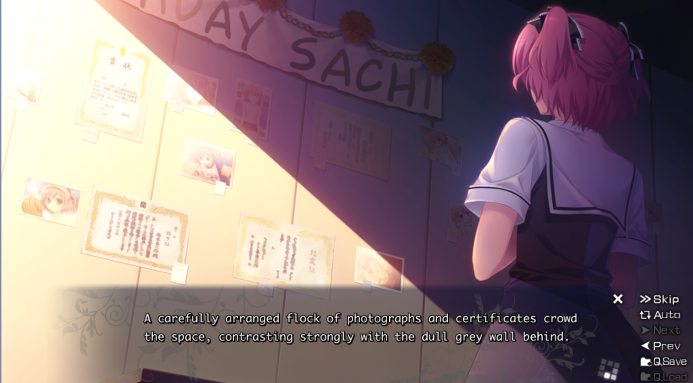
Her parents hadn’t forgotten her. They’d just kept those things. Sachi reads the birthday letter her parents left her and understands: her parents quit their jobs and sold their machines, just to be with her and happily eat curry…
What should have been a happy birthday turned out like this. Sachi cries.
The last thing is the birthday present her parents left her — a music box:
“I hear Sachi’s been playing with a boy named Yuuji at the park lately. He must be a very nice boy. If you end up together someday, listen to this music box with him. Mom and Dad fell in love that way too.”
Then the ED plays, and the route ends.
Honestly, Sachi’s route is perfect on every level. It’s tightly connected front to back, cause and effect line up perfectly, and all the little foreshadowing from earlier events pays off. It’s the most perfect route I’ve ever seen. The story feels close to everyone, too — no parent hates their child. Sachi’s childhood birthday was supposed to be a surprise from her parents, with a celebration prepared in the workshop, but her momentary doubt and selfishness led to her parents dying in an accident. All along Sachi believed her parents didn’t love her, that that day they were just humoring or mocking her. She loved her parents, but her selfishness caused the accident — she’s a guilty murderer, haunted for nearly ten years by nightmares of her mother blaming her. So she keeps obeying everyone’s orders, trying to be a good girl, losing herself…
The whole story is just a heartbreaking tragedy.
Suou Amane: The Guilt of Surviving Alone
Amane’s route carries enormous weight in the game, because it involves the death of Yuuji’s sister, Kazami Kazuki. Getting into this route is also confusing, because from the start Amane throws herself at the protagonist — fanservice, wanting to be his girlfriend, and after he refuses, persistently trying to be his older sister.
The choice to enter her route is just agreeing to date her. That’s it. After dating, they live shamelessly, three rounds a day, all sorts of positions — no wonder Makina keeps calling Amane a slut. Then at a local festival, Yuuji overhears some gossip about Amane.
“So Suou Amane ended up here…” “Ahaha yeah, that cockroach woman, hahaha.” “Bet nobody here knows about that thing she did. That cockroach thing.”
Yuuji feels uneasy and curious. He realizes Amane is hiding something and asks her directly that night. Amane silently pulls out a diary, and through it Yuuji uncovers her past.

Amane once attended the same school as Yuuji’s sister Kazami Kazuki. On a basketball team training trip, their bus crashed in a remote mountain valley. Fourteen people survived the crash, including Amane and Kazuki. Only Amane made it out.
The valley was surrounded by forest, no cell signal, no contact with the outside, too dense to escape. After discussing it, they decide to wait for rescue in place.
At first the days are rough. The leader says the food will only last three days. Soon three days pass, no rescue, food runs short, and the wounds of the injured start to fester and infect. No medicine, nothing to be done.
Amane and Kazuki share a tent. She discovers Kazuki has incredible foresight and a sharp mind. When Amane despairs, Kazuki says:
“Don’t worry, we’ll get out. At the very least, I’ll make sure you survive.”
Days go on — 12, 13 — with constant rain and food shortages driving many to the edge. Some eat strange mushrooms and go insane. Some drink dirty water and get brain parasites. Some are too sick to move. The first injured have died.
Someone says to a dead companion’s corpse: “Hey… why don’t we eat her too?”
On day 20, the leader sadly announces that a student committed suicide… and in the afternoon he brings out some meat for everyone, saying he caught an animal.
“Don’t eat it,” Kazuki tells Amane.
That night, Kazuki drags Amane to follow the leader into the forest, where they see him having sex with a female student — and the body of the student who supposedly killed herself, part of her flesh missing. So the meat the leader gave them that afternoon was the female student’s human flesh.
“They’re not human anymore. They’re beasts.”
Amane screams in shock, alerting the “beasts.” She and Kazuki, who won’t eat human flesh, are treated as outsiders. They’re surrounded, the beasts want to kill Amane and eat her flesh.
Kazuki tells Amane to leave first, gives her a map, and says she has a plan.
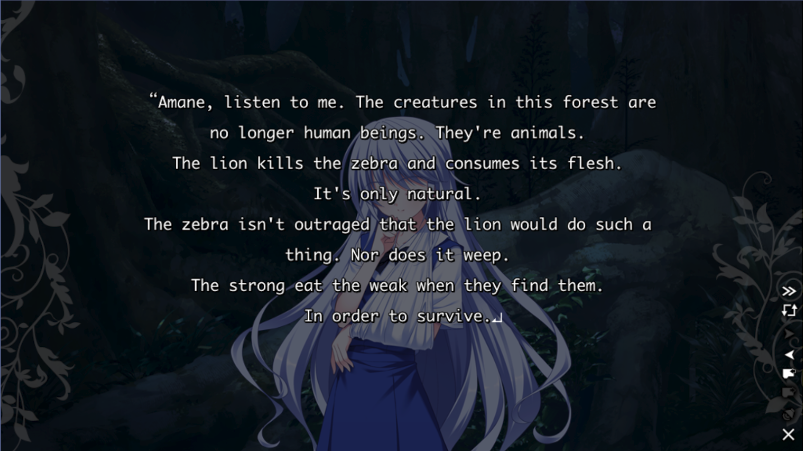
Amane fumbles her way along the map and finally escapes the forest. When the police later find the place, only body parts remain, and Kazami Kazuki is presumed dead.
Amane, the sole survivor of the accident, is seen as just like the beasts — a human-eating monster. Some call her a cockroach, some a zombie. Everyone looks at her strangely, and she herself thinks countless times that she shouldn’t have survived — that Kazami Kazuki should have been the one to live. So when she meets Kazuki’s younger brother Yuuji, she throws herself at him, wanting to take his sister’s place and comfort this brother who lost his sister.
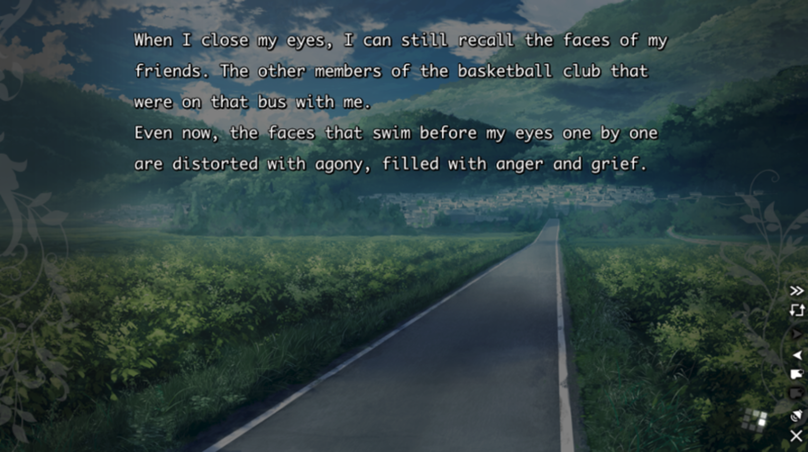
Because Amane is the only survivor of that disaster, and because she sacrificed Kazami Kazuki, she carries guilt her whole life. She wants to atone, wants someone to punish her, to kill her, quickly. So she throws herself at the protagonist, hoping for his forgiveness. In the end he does forgive her, but he can only speak for himself and his sister, not for the other 13 who died. Suou Amane lives her whole life in guilt. At the end, the game deliberately stretches the timeline — to marriage, to Amane growing old. Amane always wanted to die, but she’s the one who lives longest. In the end, her granddaughter asks Amane, now a grandmother:
“Grandma, are you afraid of dying?” “No. If anything, I long to die peacefully.” “Why?” “Because I’m lonely. In heaven, Grandma’s friends are waiting for her.” “Then I’ll make you a ticket to heaven, Grandma, so you can go.”

With a smile, Amane’s life finally ends.
“Hey, Yuuji. I’ve come to see you. When we meet again, will you still scold me for being clumsy like before?”
Then the ED plays, and the game ends.
This route ranks just below Sachi’s for me. The flashback cuts in too abruptly, and Amane’s characterization doesn’t hold together — in the flashback she’s a pure young girl, and now she’s a slut. I can’t reconcile the two. But the 20-day survival flashback is described in impressive detail — you really feel the despair. The final boss is a bit inexplicable and could be cut. It’s also the first time I’ve seen a galgame stretch the timeline until both the man and woman grow old and die, but it fits Amane’s past — she carries guilt and wants release.
Amane’s ED is called “Home.” Maybe that represents her greatest wish during those 20 days of nightmare, and the greatest wish of her dead classmates.
“I want to go home.” That was the one thing each of them wanted most in life.
Matsushima Michiru: The Failed Genius and the Timid Girl
Michiru shows something off in the common route — the Michiru looking at the sea seems like a completely different person from her usual goofy self. At first I thought she had a dual personality, but it doesn’t seem that way.

Michiru’s childhood was miserable. Her father was a social climber who wanted her to be a genius, hiring a huge number of tutors and calling them the best teachers.
But not everyone is a genius. Michiru quickly can’t keep up, and when his daughter makes no progress, her father takes his anger out on the tutors, blaming their incompetence.
Soon disaster strikes Michiru.
One day a tutor comes to teach:
“Repeat after me: ‘I’m a big idiot. I can’t learn anything. I’m a moron.’”
“…” Michiru doesn’t understand why the teacher is doing this. She gets a loud slap.
“Say it! Your father says it’s my fault I can’t teach you, haha. I think it’s because you’re a moron!”
Another slap.
After several slaps, Michiru can only obey.
“I’m a big idiot. I can’t learn anything. I’m a moron.”
“There, that’s right, you big idiot. Now you’d better learn what I teach you, and if you can’t learn it you’ll memorize it — don’t you dare think it’s my fault!”
Soon bullying Michiru becomes a required course for every tutor, and her grades naturally plummet. Michiru’s father gives up on her completely, letting her do as she pleases. With her grades at the bottom and self-abandonment, Michiru has no friends and even wants to die. While trying to kill herself, she meets another girl who’s also given up…
She and that girl quickly become friends. But soon the girl says she’s met a man who loves her and is going to run away with him.

A month later, the girl comes back, saying the man doesn’t love her, just abuses her, and even got people to gang-rape her… She despairs completely of the world.
“Goodbye.”
Michiru’s only friend jumps to her death in front of her…
Losing her only friend, Michiru despairs, picks up a knife, and stabs herself in the chest.
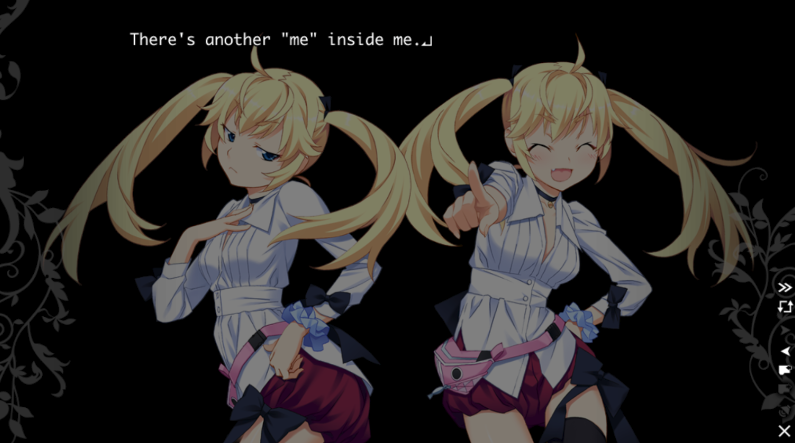
Of course, she doesn’t die. Michiru receives a heart transplant — the heart of another girl, a vegetative patient with a terminal illness, who had given up hope and wanted to die. Soon two personalities appear inside Michiru: her own and the other girl’s. When the other girl surfaces, Michiru has no memory.
Michiru notices her memory loss. She was always timid and scared, so she hides, avoids people, ignores others, and despairs — and she doesn’t want to live.

Yuuji saves her, of course. The method is simple: romance, dates. Even that doesn’t calm Michiru’s anxiety, so Yuuji does something extreme — he pretends to strangle her and holds a funeral for her, where Michiru hears how her roommates will miss her. She realizes her survival still has meaning and chooses to live on…
In the end, Michiru chooses to be friends with the other self inside her, and helps the other self fulfill her wish to see her mother — a happy end, more or less.
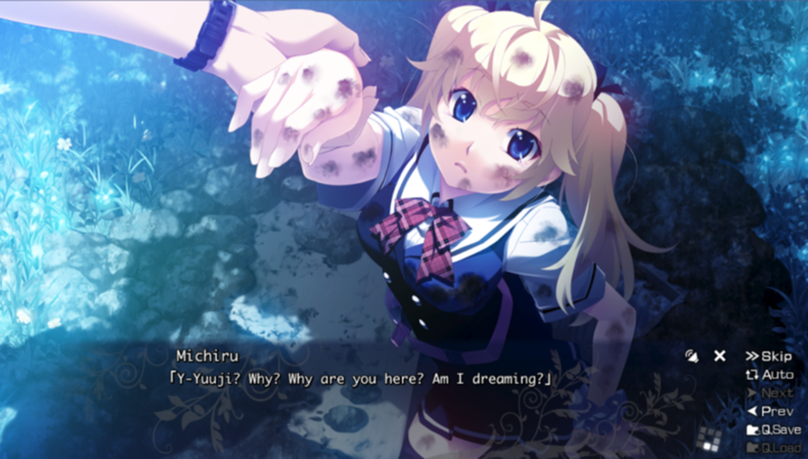
Overall the story is okay, but Watanabe Akio’s art ruins this route. It’s a little shorter than the others, only a little. The route isn’t weak, but compared to Amane’s and Sachi’s, it falls short. Honestly, if you dropped this route’s story into any moe game as a True End, it would raise the whole game’s level. But this is The Fruit of Grisaia, and this route has too many illogical holes.
Another thing: I personally really dislike Watanabe Akio’s character designs and art style. The color is too saturated, and Michiru’s route should be cuter. Instead, Watanabe Akio drew several CGs with an off-putting vibe, and made faces look fierce, lowering the player’s impression of Michiru. Michiru should be a cute, timid, kind, fragile girl, but she got drawn as Kanbaru Suruga’s face on Hachikuji Mayoi. Mizuhashi-san tries her best, but it’s still too distracting.
Sakaki Yumiko: Guilty of Being Born
Yumiko’s birth itself is a tragedy. Her mother’s family business was declining, so her grandparents married her mother off to the president of another big company — a business marriage. That president, Yumiko’s father, didn’t love her mother. If anything, he was a cold man with no feelings at all. Soon Yumiko was born — a girl. Seeing his child wasn’t a boy who could inherit his business, her father threw Yumiko and her mother out. Soon her mother got sick, the man didn’t care, and kicked them out. They returned to the mother’s family, where Yumiko was despised too — just because she wasn’t a boy, a useless girl.
“If only… you had been a boy. None of this would have happened.” That’s what her mother, lying in her sickbed, says to Yumiko.
Only then did Yumiko realize that no matter how hard she tried, no matter how much she tried to please her parents, it was all pointless — simply because she was a girl. Half out of her mind, she grabbed a box cutter and hacked off her own hair, trying to become a boy, and was mocked by everyone for it.
In class too, everyone laughed at her, because she was the daughter of a wealthy family, a discarded young lady. She hadn’t done anything wrong, yet people never stopped whispering about her. Driven past reason, Yumiko started cutting the people who looked down on her with that box cutter, and she came to be seen as a problem child.

Soon after, Yumiko’s mother recovered and apologized to her. Just as the two were about to go home and make peace, word came that Yumiko’s father had a bastard son with his mistress — a boy — and the very day he got that boy, he sent a lawyer to discuss divorce with her mother.
That cold-blooded man drove Yumiko’s mother insane outright, and she never got better.
Having lost her mother, Yumiko was utterly devastated. But soon her father came to acknowledge her again, took her back home, treated her to good food and comfort, and said he’d been wrong before.
Just as Yumiko was about to forgive the old man, she found out he only wanted her because his bastard son had died — he meant to use her for something like a business marriage.
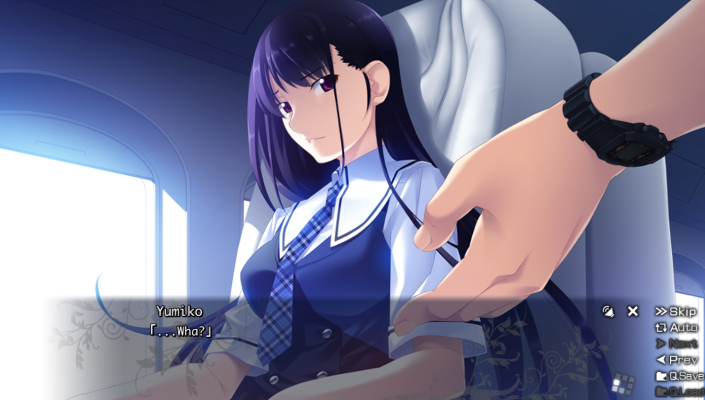
Yumiko saw her father for what he was and cut ties with him. So her father personally founded a school and imprisoned her inside it. That school is the one Yuuji attends, the one with only five students. It sits under her father’s surveillance, which is why Yumiko doesn’t want to associate with the other students — she knows what the school is for and doesn’t want to drag anyone else into it.

At first, the protagonist was ordered to approach her as Yumiko’s bodyguard. Naturally, the whole thing was a play directed by Yumiko’s father, just to make her understand she was in danger and to keep her obedient. Later the protagonist saw through the act and started protecting her for real — including taking on eight guys at once.
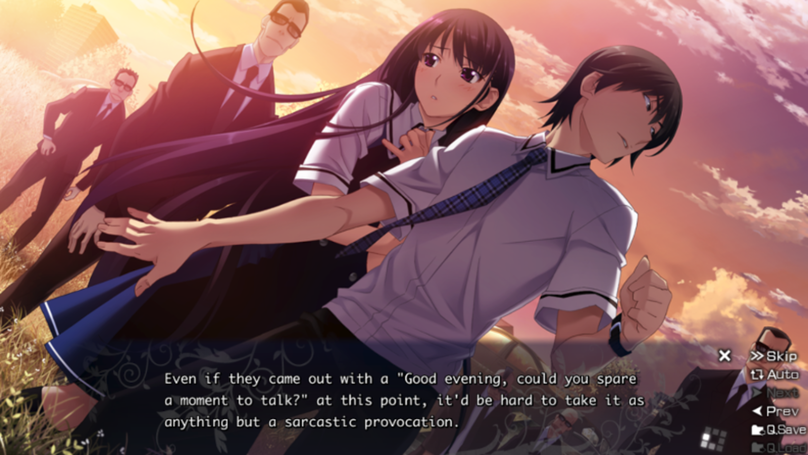
In the end, the protagonist resolves to save Yumiko, snatches her off the plane where she’s being held, and carries her out of that cage; the two of them run far away. Of course it isn’t that easy — the old man’s claws are everywhere — but after a series of confrontations, Yumiko uses business tactics to turn the tables, defeats her father, and lives happily with the protagonist.
At the finish, Yumiko’s father has lost everything and realizes his mistake. He says he was raised as a tool since childhood and never knew what feelings were; now he does, and he’ll change his ways, and his relationship with his daughter gradually softens. Yumiko eventually marries Yuuji and has a child, and that’s the end.

Honestly I rushed this route a bit — I skipped a lot of the slice-of-life stuff, though I did watch the important flashback scenes. Later on there’s a lot of business-war vocabulary I didn’t quite follow, but it didn’t get in the way of the gist.
The girl introduced at the start as “guilty from birth” — I always assumed that was Makina, but it was Yumiko. This route’s plot is very Hong Kong drama… and mainland period drama, with the son-preference stuff mixed with corporate warfare. Maybe 11区 rarely puts that in a Galgame. And yeah, the plot has its holes: a company leader wouldn’t be swayed by one kid’s tantrum. Too formulaic.
Yumiko’s route is apparently set up as the game’s true end, but honestly it’s clearly less exciting than Amane’s and Yuki’s routes — only a bit better than Michiru’s. If the anime adapts this route, well, there’s plenty of content, car chases and plane chases and all, but people will still call out the plot holes at the end.
Irisu Makina: The Sin of Being Sacrificed
Makina, honestly, I didn’t like her at first — her voice acting grated on me, and she was foul-mouthed, two-faced, and dark inside. But her route is comparatively easy to follow.
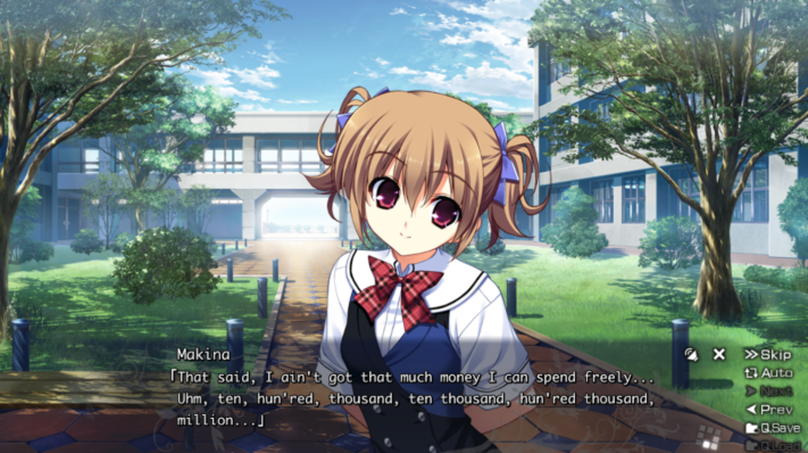
First off, she’s a rich girl — the kind who can casually throw around 7 million in pocket money. As a child Makina was the family prodigy, seen as the family’s hope, and precisely because of that she caught the attention of every rival faction. Soon enough, one day, she was kidnapped. Her father spared no expense to save her, but even so, her father was killed by the kidnappers right in front of her — because the money still wasn’t enough.

So the captive Makina sat watching her father’s corpse in front of her for seven whole days, until it rotted, before she was finally rescued. After that her mind started to go. And because her father had compromised with the kidnappers, Makina became the family’s shame, so the succession naturally passed to her younger sister.
But soon her sister became a target too, and was killed by a bomb in some incident. By then Makina had recovered her sanity and was attending this five-student academy.
Soon her grandfather announced that Makina would be named heir again.

And so Makina became a target once more — every gang and every corporate enemy had their eyes on her. Her mother knew all this and did nothing.
Yuuji steps up to help Makina — or rather, at the start Makina buys Yuuji for 7 million to be her “daddy,” and once Yuuji learns about her past he sees how much of it mirrors his own, and chooses to protect her of his own will.
At the end, the mercenary group Yuuji belongs to also takes a contract to assassinate Makina, and Yuuji is assigned to carry it out. Faced with the organization and Makina, Yuuji chooses to betray the organization and protect her.
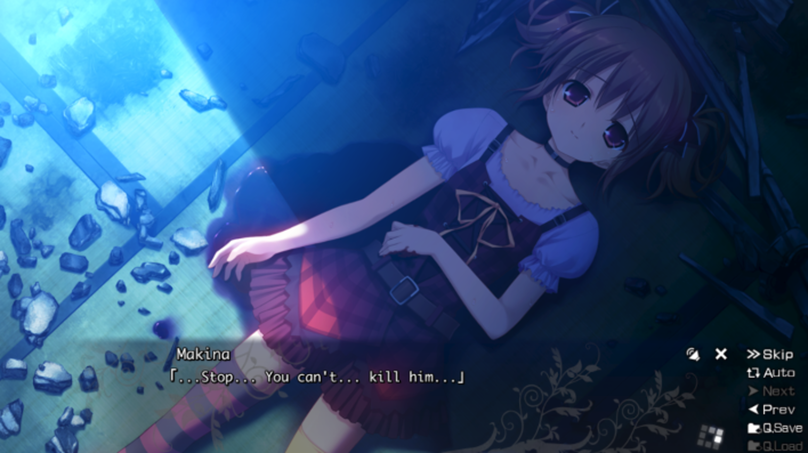
Makina is wounded in an assassination attempt; she doesn’t die, but because of it she can no longer be heir, and her life is spared. Yuuji realizes this won’t solve anything, goes to Makina’s mother, learns that this cold-blooded woman has been pulling strings behind the scenes too, and in a rage points his gun at her.
In the end Yuuji doesn’t pull the trigger, but the threat is enough. He helps Makina break free of the family, and the two of them open a bakery and live happily.
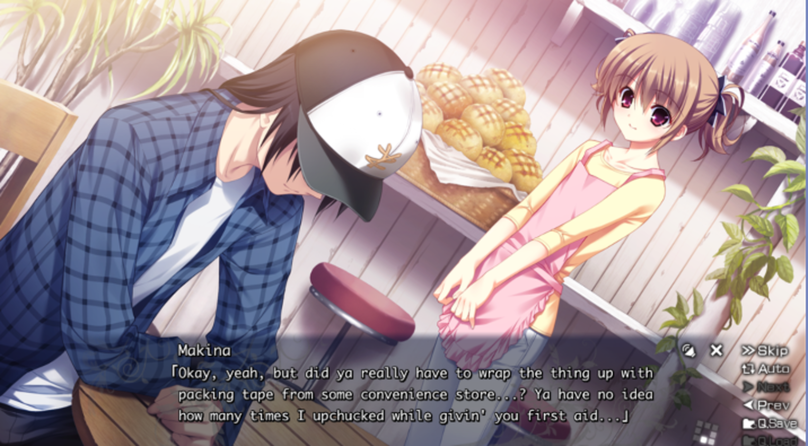
Honestly Makina’s route didn’t leave much of an impression. It’s mostly about infighting inside a rich family’s conglomerate, and not everyone is a young lady. The plot does have its ups and downs, and there’s plenty of fighting that makes the protagonist look like a real man, but it’s too high-class, too far from ordinary life, and hard to relate to. The bad end is pure malice: I thought I’d picked the right options, and then the game tells me the protagonist is a corpse and Makina is talking to it…
Here’s the bad end CG. The game even has fly-buzzing sounds.

Other Stuff
There are two character designers: one is Watanabe Akio, the other is Fumio. The former is known for Bakemonogatari, the latter for Tomoyo After (so you can see how Kazama Kazuki looks a lot like that version of Sakagami Tomoyo). On character design — I personally, very very very much do not like Watanabe Akio’s art style. Yumiko’s fine, but on Matsushima Michiru it looks downright creepy; a lot of the profile shots are drawn hideously, and where it should be cute he gives you grotesque expressions, where it should be pure he gives you a massive complexion problem. Sure, in the H-scene art Watanabe Akio hits Misaki Kurehito levels (muscles! muscles! more muscles!), but in non-H scenes, especially with characters who aren’t mature women, it just doesn’t satisfy. By contrast, Fumio’s designs are far more varied — lolis and onee-sans both come out well, and the facial detail work is better. Watanabe Akio’s art has lots of distinctive poses… like Araragi’s stance in Bakemonogatari, and Senjougahara’s signature head-turn pose shows up in the Grisaia CGs too. Well, some people might like it. I don’t.
The music has no big highlights but nothing to complain about either; it fits the story, and some of the melodies are actually pretty. Worth mentioning: every route has a big-name indie ED, and my favorites are Yuki’s and Amane’s — they fit the themes perfectly, and listening to them too much makes me tear up.
The English version’s quality deserves praise. I don’t know which group did the localization, but the wording is really on point, lots of fine word choices, including consistently writing pants as underwear and toilet as bathroom, and converting Japanese style to American style — sometimes I even wonder if the game was originally in English. It’s worth reading just as English practice.
The Anime
Hearing about the anime was exciting. Selfishly, it means I can flex that I’ve played the original — but mostly I wanted to see if the anime had any surprises. The animation director and the game OP staff are almost identical, the Grisaia OP was fully animated, and the animation director is Watanabe Akio again. But after seeing the character designs on the official site, I felt a huge unease.
I have a thing about Watanabe Akio’s designs, specifically from The World God Only Knows. Wakaki Tamiki himself likes to draw rounder faces and bigger eyes when he draws characters; the upside is they look cute, the downside is they have no complexion.
So when The World God Only Knows was animated, I heard Wakaki Tamiki personally asked Watanabe Akio to do the designs, and well, you can see how that turned out…
Here’s Wakaki Tamiki’s version:

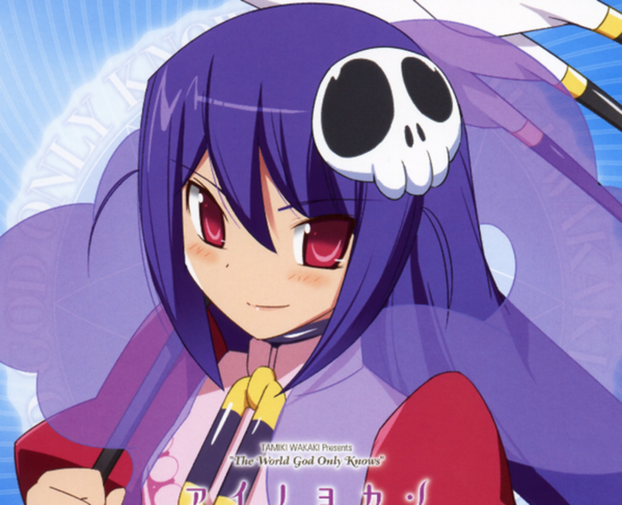
And here’s Watanabe-sensei’s designs:


Then Wakaki Tamiki’s Nagase Jun:

And then Watanabe-sensei’s:

In the Goddess arc it gets even more insane.
 Loli turns into a floozy~

So when the anime designs were announced I rushed to look.
Here’s the game version:
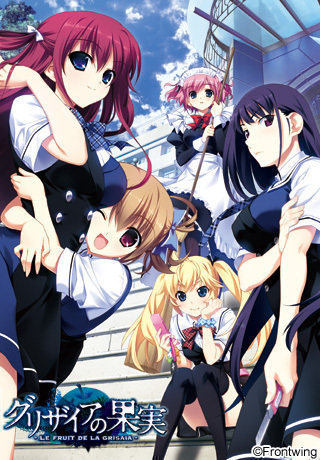 And here’s the anime version:
 That unique complexion-boosting art style and face instantly filled me with dread.
The little mouth is upturned, the cheeks are oily, the mouth has gone V-shaped — and these poses are still copied from the game. I can only pray the designs don’t dump a whole heap of Michiru’s grotesque expressions onto Yuki’s face…
Everyone has their own masterpiece. The Fruit of Grisaia has its flaws, but in how it tells its story it fully lives up to my personal masterpiece ranking. Follow-ups The Labyrinth of Grisaia and The Eden of Grisaia came out — one’s a fan disc, one tells the protagonist’s past. I hear the foreigners are working hard on the English version too; no idea when we’ll get to play it.
The Fruit of Grisaia’s story is very, very long, but if you have the time, or don’t mind English, I’d still recommend playing it. No idea what the October anime will do to the plot, or whether the faces will hold up, but either way the original is the safer bet.
Comments are hosted on the Chinese main site. This mirror is read-only.