Pure Song Garden! (ピュアソングガーデン!) Review
My Girlfriend from 50 Years Later
Someone once left a comment on one of my blog posts expressing contempt for PULLTOP. Honestly, my own feelings about PULLTOP are fine — they’ve put out some games I like, what with the plane-making one, the country romance, and the stargazing one. But PULLTOP has definitely also released some mediocre and even mind-numbingly sleep-inducing games. Most of those were the work of their sub-brand, though. PULLTOP LATTE was literally built as a nukige label, so if it’s boring, whatever — at least the main brand is fine, right?
Like the guy in the comments said, he thinks PULLTOP itself is stupid, and sometimes I agree. Take the plane-making game — it was probably one of the first Japanese eroge to make the jump to STEAM. The publisher was a company called MoeNovel. I looked into MoeNovel, and the registered asset info lists it as a sub-brand of willplus. And willplus is the parent company of the PULLTOP brand.
willplus is actually pretty big, with a bunch of labels under it — plenty of nukige, some normal stuff too. The old Propeller, PULLTOP, ensemble, all of them were willplus labels. I know guilty too — they do NTR. A company that big should be doing well, right? Yet I keep watching them make one dumb move after another. Some of their decisions are just braindead.
How braindead, specifically? Back to the earlier topic. Since PULLTOP = MoeNovel, that means PULLTOP chose to publish its own games overseas itself — no licensing agent involved. Should be fine, right? The plane-making game had a great reputation, plenty of Western otaku wanted to play it, a fan translation was already finished, and lots of people said they’d buy it the moment it hit STEAM.
Heaven and earth and man were all aligned. PULLTOP probably didn’t even need to translate anything — just grab the English translation license and lie back collecting STEAM money…
And PULLTOP still managed to botch it. First, they went and made their own English version. Fine, translating it themselves — the fan team has rights too, and maybe official is better. But the official translation team’s English was terrible, errors everywhere, and Westerners roasted it nonstop. Worse, MoeNovel made massive changes to the game content. First, self-censorship: not only did they cut the 18+ content, they also removed the tsundere bits, the light yuri, some of the siscon stuff, and the dirty jokes that are standard in Japanese eroge. Some changes were so drastic the thing was unrecognizable — an entire route was rewritten. Western players couldn’t take it; they felt trampled on. I mean, Westerners playing your Japanese eroge are there to hear cute girls be tsundere at them in Japanese, calling them oniichan. That’s literally one of your selling points. And you castrated yourself before STEAM even said anything. That’s suicide.
The stark contrast here is Frontwing. Frontwing was the eroge maker that followed PULLTOP into the overseas market, and they played the game way more maturely. The Grisaia series opened up sales successfully, then they ran crowdfunding campaigns to sell games, and most importantly their translations were on point — you could tell the English team was professional. Not only did they not censor content, they released a mosaic-free version to comply with US law. Explosive. So Frontwing sold like crazy on STEAM and basically stopped caring about the tiny Japanese domestic market. The natural contrast to Frontwing taking off on STEAM is, of course, stupid PULLTOP, still putting out old games like LoveGami, with content that’s completely moronic. Rehashing old stuff is one thing, but Japanese idols? Do they think Westerners will scream as long as they see a cute Japanese girl and she’s an idol? That’s insulting weeaboos.
All that said about how stupid PULLTOP is, I still have hopes for them. They did make Stargazing and Country Romance. Both are well-written games — the former’s love triangle, interwoven timelines, and nighttime presentation, the latter’s perfect soundtrack and rustic atmosphere. Both were genuinely surprising. But my unease about PULLTOP started when the Stargazing FD came out. That’s when I realized Stargazing worked because it had a confession story belonging to Saya, built up across years of experiences that made it precious. Take that main line out for the FD and it’s completely unwatchable…
Yeah, unwatchable. Stargazing isn’t great because of star observation, telescopes, galaxies, or astronomy themes. It’s great because of that line in the OP — “破れたページ” — representing the stargazing diary Saya tore up after confessing to the protagonist. That emotional line was the real highlight. But the game’s planning team completely missed that and kept hammering on stargazing and astronomical observation.
So I’ve long suspected something: did PULLTOP make the plane-making game and Stargazing because of blind luck — because those two games happened to succeed through other main-line elements that drew players in, not because of whatever theme the planning team came up with? Their planning frequently has shit for brains.
And the chance to prove whether PULLTOP’s planning has shit for brains arrived quickly. PULLTOP’s new game this year, Pure Song Garden!, is out!

As for why I played it… it’s because cracking Harune Alice*Gram needs 300 mystery points!
I already thought the planning was braindead when Pure Song Garden! was announced. The game chose a future society, VR virtual reality, plus idols and music. The whole thing doesn’t feel like “music” at all — it’s just awkward. The title itself isn’t great either. Pure Song Garden. The game’s description was also unclear about what it was even about — just that the protagonist is a composer hobbyist, the heroine is a VR idol, and a bunch of people are in an experimental special zone with cutting-edge VR tech. Only after finishing the whole game did I realize: it’s a simple story. Actually, kind of like Doraemon. And unsurprisingly, the game made this halfway-decent story stupid.
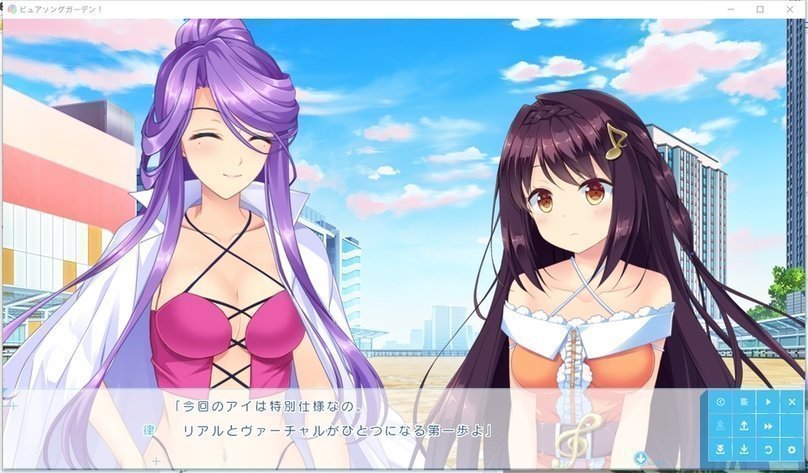
As the description says, the protagonist’s area is a special zone for cutting-edge tech development experiments. The scientists there are researching VR — virtual reality. They’ve got a project called Pure Song Garden: they want their VR idol, Ai-chan (not the YouTube idiot), to descend into reality. The method is simple — build a body, a doll-like thing (made by an inflatable doll manufacturer, no less), then inject the VR idol Ai-chan’s program into the doll to bring the virtual character to life. The Pure Song Garden project runs for one week, ending with Ai-chan’s concert.
The protagonist is a composer. He’s invited by VR researcher Yanagisawa Ritsu to watch Ai-chan’s descent. But after the descent, everyone realizes something’s off. Ai-chan is alive, the body moves, but it’s not Ai-chan at all… it’s someone else. She calls herself Hoshino Iroha, says she’s from 50 years in the future, and came to 50 years ago on a one-week time-travel vacation. Somehow she got transported and ended up possessing this doll…

Everyone’s baffled. We’re doing a virtual idol descending into reality, crossing the dimensional wall, and you brought us a time traveler? Eventually Hoshino Iroha says she’s caused trouble, and if it comes down to it, let her take Ai-chan’s place at the concert. Just needs training. Her body is a doll from an inflatable-doll manufacturer, but Iroha has a future AI assistant named Suzu who can coordinate her body…
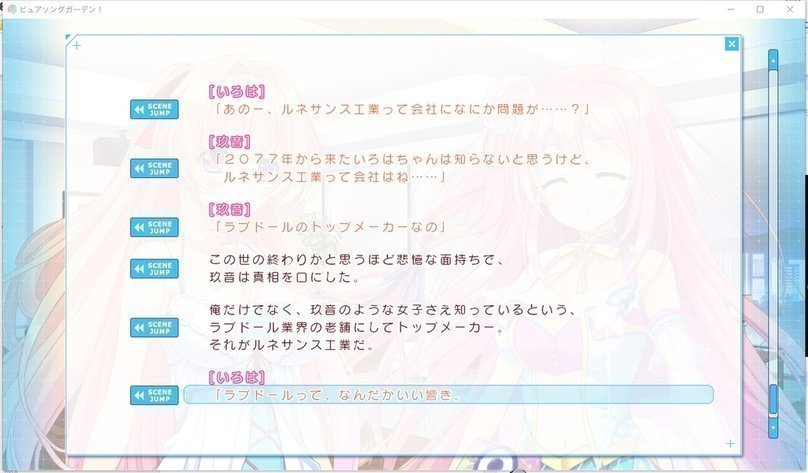
Concert day arrives, and Iroha’s scheduled time travel also ends that day. Just as the concert’s getting going and everyone’s silently counting down to Iroha’s teleport back to the future, the city’s entire VR system collapses. Basically the system got overloaded, went haywire, VR characters start running amok in the city and can’t be calmed. And Iroha doesn’t make it back to the future either.
The original Pure Song Garden VR project is finished, leaving a mess behind — people call it the VR Hazard. The future girl Iroha can’t go back, and everyone’s at a loss. VR characters running through the streets panic the residents. The government gives them 30 days or it shuts down all VR research.

After discussion, and analysis from the scientists and Suzu, they figure Iroha’s time-travel visit here disrupted the original AI project — indirectly changing the future. Iroha says VR tech in her future is mature and tied to time machines. If the current VR project gets shut down… the future changes. And if the future changes, there’s no Iroha traveling back in time via VR tech… so this can’t be allowed to happen.
The protagonist says they have to save the VR Hazard, restore public confidence in VR, and get the government to let VR keep developing. Iroha says she’ll do her best — and her best includes establishing a romantic relationship with the protagonist, and the two of them banging several times… oh wait, I mean, going out on the streets every day being cute to reassure the public, and also… holding concerts…

With the scientists’ help, the protagonist calculates future possibilities. The chance of public confidence in VR recovering is 1%. But as Iroha does more cute stuff on the streets (and does more f*cking with the protagonist), the chance rises. At the final concert, Iroha sings with several other heroines and the percentage hits 100%. The VR Hazard repair script gets written, problem solved, Iroha travels back to the future, and the time-travel vacation ends.

Is the game over? No. Before Iroha leaves, her AI assistant Suzu tells the protagonist: after Iroha leaves, leave clues for the future Iroha, telling her she must come to 50 years ago on a certain day to travel. That makes the whole thing complete.
Thinking about it, this story is extremely by-the-numbers. A future person travels to the past, accidentally changes the future, causing her own nonexistence in that future, so she has to help fix the future to get back. After returning, she has to ask someone to tell her future self to definitely return to the past on a certain day to keep things complete. That’s the formula. I remember Doraemon: Nobita’s Great Adventure in the Underworld used this setup. Except this game… has two majorly stupid things story-wise.
First stupid thing: the common route is way too goddamn long!!!!
And this “long” is meaningless long. Sleep-inducing long. “You watch for a bit and can’t stand it” long. The game’s pacing is awful, character writing has no personality. I forced myself through about 3 days of the common route, couldn’t take it, decided to skip. But even skipping, it’s too slow. Barely any plot progress. The game says 7 days, and I swear it’d take 7 actual days to play. Every day is: protagonist wakes up, chats with people, endless back-and-forth over a few lines, incredibly boring. And the voice acting isn’t good either, making it worse. Iroha’s VA is Madoka Yonezawa — i.e., Setsuna. Her Japanese pronunciation is the most standard, but standard to the point of no emotion is unbearable. Other characters don’t inject much feeling either — just reading lines off a page…
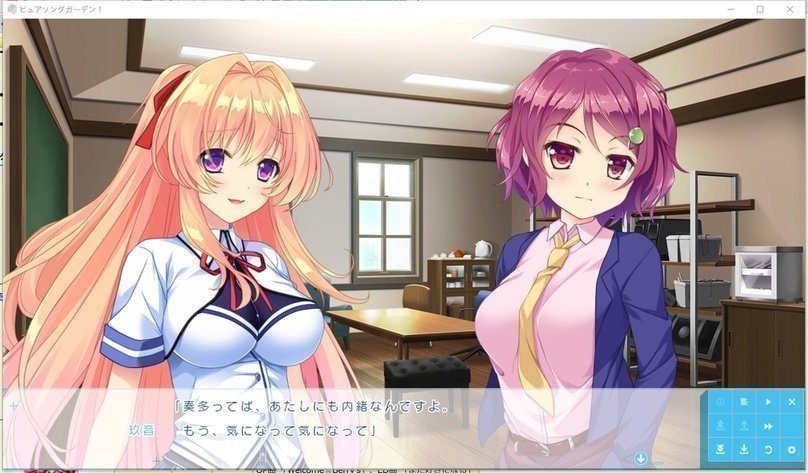
Then when the common route ends, right before Iroha’s final Live, the plot suddenly surges and becomes watchable — the main line emerges. The final Live is actually kind of interesting, looks like they spent money on it. The bonus character song included has this Live’s song, sung by several people, matching the final Live chorus.
Still, the Live’s effects are just “good,” not “badass.” Oh right, in Japanese I should say “yabai.”

The other stupid thing: the True End takes a good hand and plays the final rescue formula into the ground.
This game has a True End. After finishing Iroha’s route, you can pursue her AI assistant Suzu, then the main menu unlocks the final ending, encore.
In my mind, this ending could’ve been genuinely moving. The protagonist leaves a message for his girlfriend 50 years later, telling her to come to 50 years ago, save the VR crisis of 50 years ago, fall in love with him during the rescue, and successfully return to the future.

If I were writing this, here’s how I’d do it:
Iroha digs up a box buried 50 years ago, sees the message inside telling her to go back in time for the trip, then meets an old man. The old man looks at her strangely, lecherously. Iroha thinks she’s met a pervert, but the old man insists he’ll help her get back in time, and Iroha agrees. She goes to the past, goes through the VR Hazard events, finishes the concert, returns to the future, and realizes who the old man was — her past boyfriend. The two embrace, reunited after 50 years. At that moment, age doesn’t matter anymore.
Ah, what great love. A love that crosses 50 years and doesn’t care. That’s real love. And the structure’s complete, with suspense, bookends. At least a good game.
But you know how the game actually does it? Encore starts with Iroha digging up a chip from a box buried 50 years ago. Then, with Suzu’s help, Iroha travels to 50 years ago. The chip gets brought to the past. Past scientists get the future chip and start developing VR and AI, creating Suzu. In other words, this AI was actually developed in the past and sent to the future, and Suzu’s mission is to trick Iroha into going on the 50-years-ago time trip.

Then it gets stupid. A year after the protagonist sends Iroha to the future, Iroha f*cking travels back again — in person this time. Iroha says she traveled back 3 years later, when time-travel tech is more mature and stable. So why’d she come? To see the protagonist, and to bang.
After banging, Iroha invites everyone to the future, and the whole group f*cking goes 50 years ahead. Future Iroha is an idol, holding a concert. At the concert, Iroha loudly announces that the protagonist and friends are guests from 50 years ago. Concert ends, game’s True End ends.

Holy shit. Holy shit. I won’t even get into the sloppy time-travel logic — what the hell is this stupid development? Time travel’s this fun? This casual? Come and go as you please? Didn’t you just brag about not being able to casually change history and the future? Why’s she loudly announcing it at the end? What the hell is this? If time travel’s this easy, what was the point of the protagonist busting his ass over the stupid VR Hazard? I mean, for server and system damage, what good is an idol? Future tech can be lent to the past freely? The past can run to the future freely? Doraemon doesn’t run around this much! What is this game even trying to say? Did they just think throwing VR, idols, music, and the future together would max out the coolness stat?
Max out my ass! A time-travel story could’ve ended perfectly with loops and bookends, and they still had to throw in another goddamn concert. Do you Japanese love idols and concerts this much?

The story’s stupidity already has me furious, but the game’s stupidity goes way beyond that.
Because the visuals are even stupider.
The game uses Emote tech — the thing where character sprites move. But this is probably the stupidest Emote I’ve ever seen.
How stupid? Go watch a YouTube playthrough. Most characters, 90% of the time, only their face moves. The body doesn’t. Hair doesn’t move, like Medusa. Occasionally the body moves a bit, with some breast physics, and that’s it. The face also warps, and the warping is as stiff as the breast physics, plus the warping deforms the face. Plenty of characters look like idiots.
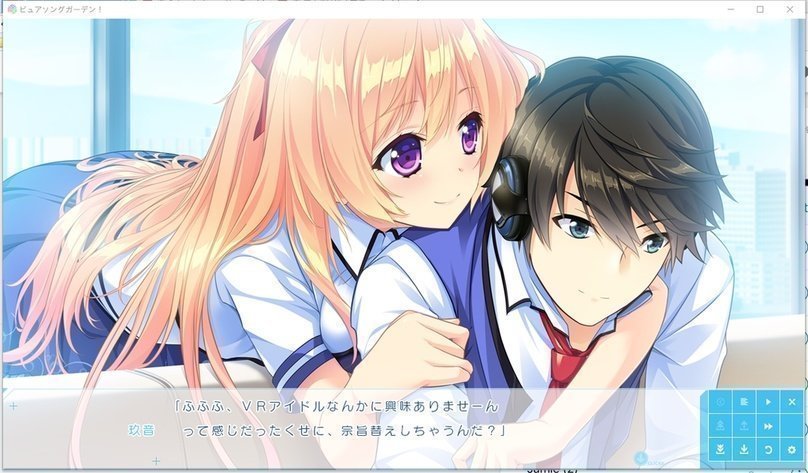
Like this

This

And this

Sometimes it scares you

Pairs nicely with the native expression packs
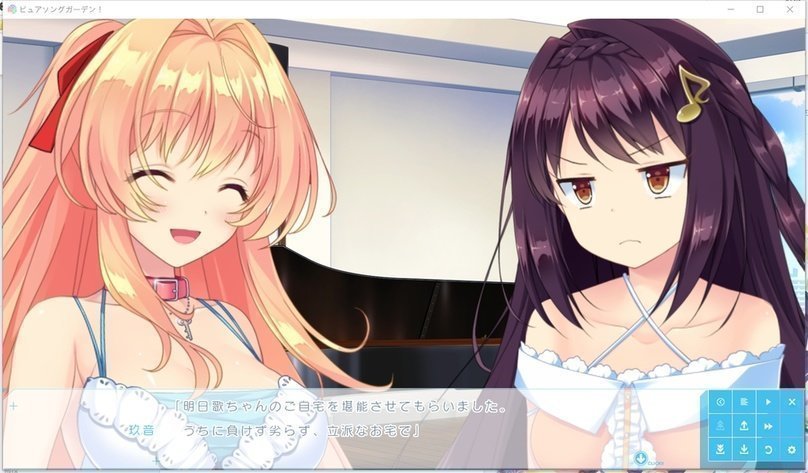
Besides idiocy, sometimes it’s genuinely creepy, since only the face moves. Like some heroine’s father here.
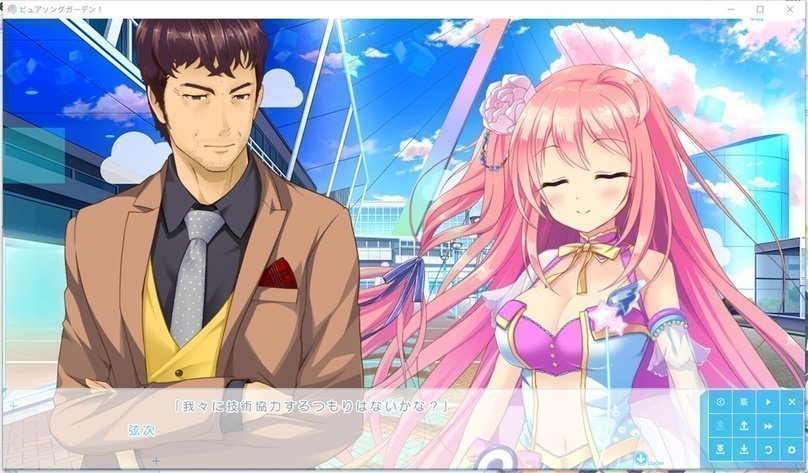
Imagine: an endless common route, emotionless voice acting, several idiot and creepy faces, plus an utterly stupid development…
Just… just… seriously, just…
Oh, I haven’t mentioned the music. Setsuna’s electronic song is okay, but the BGM is really plain. Lots of cheap electronic music, plus harsh sound effects that drift left and right and make you uneasy, making the game even worse.

Honestly, I don’t think PULLTOP should’ve made this game like this. Even as a moe-ge, at least get the stupid Emote right. I don’t know if PULLTOP has some special fixation on “the future.” There was Kokoro@Function! with a similar setup, and now this with a similar setup again. Do the planners love this kind of theme? If you love it, why make it like this? Are you secretly trolling?

Maybe PULLTOP’s planning really is stupid. Stargazing and the plane-making game’s success had little to do with the planning’s themes — more to do with the scenario writer, voice acting, and music. Pure Song Garden! really exposes PULLTOP’s true level. The game even has a slogan for emotional effect: あなたのみらいはしあわせですか? (Is your future happy?)
Actually, thinking about it, if my girlfriend were 50 years in the future and kept time-traveling over to bang me, I guess that counts as happy?
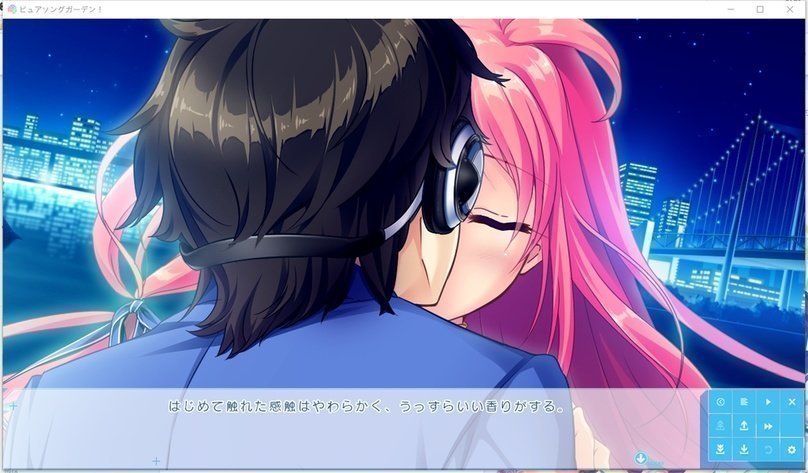
Of course, I feel like my actual fate would be like this: wearing a VR headset and kissing an inflatable doll…
Comments are hosted on the Chinese main site. This mirror is read-only.