Ouchi ni Kaeru made ga Mashimaro Desu (お家に帰るまでがましまろです) Review
お家に帰るまでがましまろです
Back when I played World of Warcraft, I’d always run into these “casual guilds.”
They didn’t have any strict raid schedule. Anyone could join, and the guild leader would help out the newbies a bit, and the atmosphere was relaxed. Every now and then they’d run a raid, but most of the time there were no rules at all — just people screwing around.
A lot of the hardcore players wanted the kind of guild with a rigid hierarchy and harsh rules that could push into better raids for better gear. They had nothing but contempt for the “casual guild” type. Most of them couldn’t wrap their heads around what the point of such a lazy, ambitionless guild even was. But the members of those casual guilds didn’t care. They just quietly lived their lives.
I’ve had my own hardcore phase too. I used to not get casual guilds either — until I got old, until I no longer had the time to dump into a game as a hardcore gamer, and I joined a casual guild, because no other guild would take me.
Once I was in, I understood. The guild looked like it was just “a tag for people who don’t have a guild,” but it wasn’t that simple. The core of a guild like that is almost always the leader. The leader is very likely a middle-aged guy — good-tempered, easygoing, doesn’t get angry. Because the guild takes all comers, the leader is constantly playing peacemaker.
Members might rub each other the wrong way, but most of them have no complaints about the leader.
Plenty of members leave when they find a new guild, and the leader wishes them well. Some people complain that the guild has no events, can’t down bosses, can’t get gear, and all the leader can do is apologize and say he’s useless.
For a casual guild like this, lose the leader and it’s done for in a heartbeat. But these leaders have a hell of a lot of willpower, and they always manage to keep the guild alive.
Once I was chatting with a guild leader and asked him out of curiosity: “Why do you pour so much energy into keeping a guild like this running?”
“A game is like society,” he answered. “There are always people out there who don’t belong anywhere, who have no home. They need something like a family to take them in, to give them a harbor that feels like home.”
I still think about that line a lot. It makes a lot of sense. Whether our parents are around or not, we always feel lonely — that loneliness of “nobody is here with me” — so we need something like a “family” to let us escape and rest for a while, a harbor for the heart.
That’s why you see people trying to do this in real life too — adopting orphans and whatnot. In fiction there are even more of these characters: the ones who take in lost children, the “hopeless good guy” setup, that’s everywhere. Like this game, Ouchi ni Kaeru made ga Mashimaro desu (お家に帰るまでがましまろです).

Ouchi ni Kaeru made ga Mashimaro desu is the new release from Marmalade (ま~まれぇど). I’d never actually touched a Marmalade game before — I heard Primal X Hearts had a good reputation but I couldn’t be bothered to play it. What got my attention about Ouchi ni Kaeru made ga Mashimaro desu was the premise: a sweets shop making cakes. That piqued my interest, since I’ve been making cookies and cakes myself lately. Beyond the sweets-shop setting I knew basically nothing about the game, and the endless delays only whetted my appetite more. So when it finally came out this month, I discovered… huh. It’s really not what I expected.
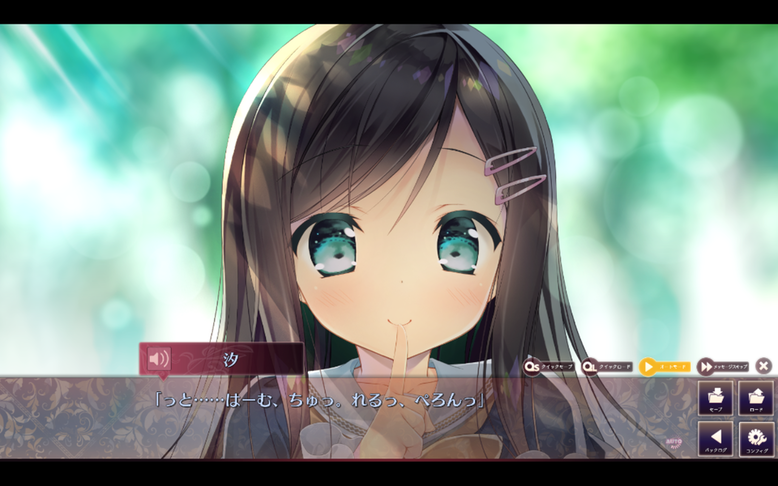
At first I figured Ouchi ni Kaeru made ga Mashimaro desu might be somewhat story-driven. In the trial version, the main heroine, Kasukabe Kanon, is the manager of a sweets shop called Mashimaro Tree (ましまろツーイー), and to carry on her elder’s wishes she decides to keep the shop going. So at the start she finds the protagonist by the side of the road, learns he has no home, and drags him back to the shop to work. The shop already has two people: the petite but ridiculously adorable senpai Asaka Shio, who you want to scoop up and hug the moment you see her, and a stubbly, dialect-speaking person with no name, known only by the initials “JC.”
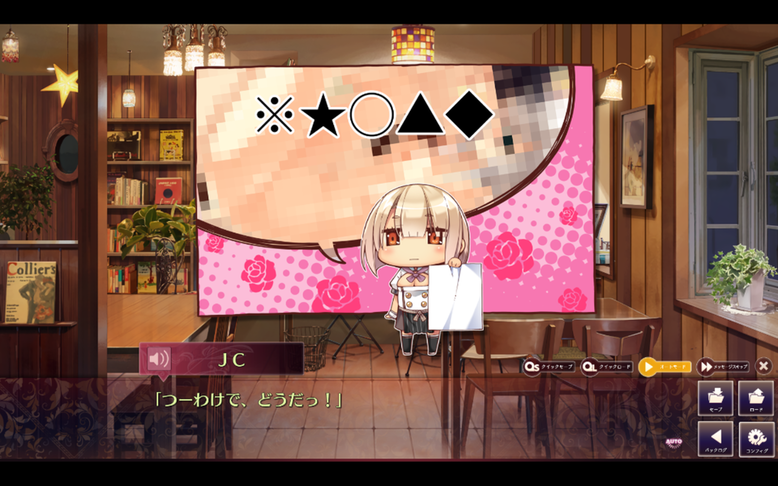
The story after that is dead simple. The protagonist works at the shop, every day figuring out how to keep it afloat, while manager Kanon is a hopeless softie — she tries to help anyone she sees, wanders off doing good deeds, and wouldn’t know a business trick if it bit her. And even though her own shop is on the verge of going under, she keeps dragging new people in: the genius half-blood pastry chef from the big corporate sweets chain, Reiha Raikonen, and the painter Sumire Sasa.
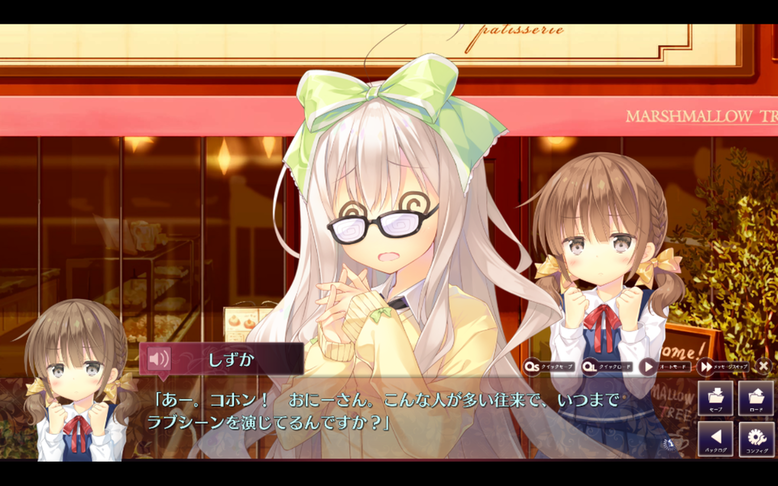
Painter girl Sumire Sasa has a bad case of low self-esteem and no confidence in herself, but she drops by the shop now and then. Kanon helps her a lot with communicating with people, and more than that, gets the protagonist and the shop’s crew to become friends with the somewhat withdrawn Sasa. So she decides to work there too.
Reiha Raikonen’s story is a bit more complicated. She’s mixed-race and came to Japan alone for certain reasons, having cut ties with her mother. A lot of her pastry skill was taught by her mother, but now she’s literally an orphan. There’s a scene where Reiha’s mother happens to come to the shop, eats a cake her daughter made, and says, moved, “There’s a nostalgic taste in this.” Reiha is overwhelmed — but facing her own flesh and blood, she doesn’t reveal herself. She says just that much is enough. All of this happens thanks to manager Kanon’s help, so afterward Reiha Raikonen also decides to work at the shop.
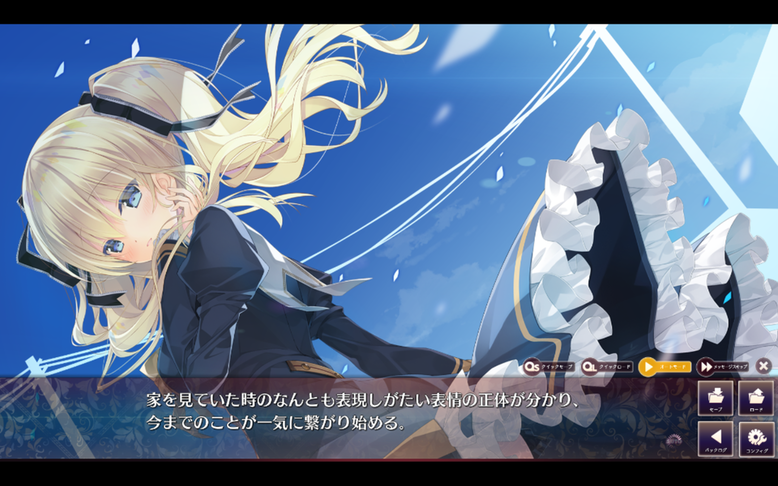
So the plot of Ouchi ni Kaeru made ga Mashimaro desu is very pure and simple: the manager tries to fix up a sweets shop on the brink of closing, recruits help everywhere, and keeps taking in those “kids who feel lonely, in life or in their hearts,” letting them join her, giving them happiness and joy, and making them members of Mashimaro Tree.
In the end Mashimaro Tree reopens and gets off to a good start. Manager Kanon, kind-hearted softie that she is, has helped so many people, and it comes back to her — for example, once when they ran out of ingredients, the whole neighborhood brought materials from their own homes. Everyone said Kanon is a good kid, and if she needs help they’ll always come.
Overall the game feels more like a typical “slice-of-life tea time” anime, or the atmosphere of a 4-koma manga. It sets up a big story framework, and from there the story can unfold at its own pace, maybe with progress along the way — say, the shop continuously gaining staff, at a rate and feel not unlike a long-running serialized manga. Manager Kanon is always the protagonist, and as a kind-hearted softie she defines the whole game’s style: “sweet,” “calm,” and “heartwarming.”

“Sweet” means the game does a good job shaping each character through the daily scenes, even if the shaping is heavily typecast: JC is dirty jokes and bluntness, Asaka Shio keeps insisting she’s the older-sister type, Kanon is airheaded and soft-hearted, Sasa apologizes before anything else, and Reiha is forever cold outside and warm inside. Worth mentioning too is the little sister figure on the side, Kawagoe Shizuka — small body, big attitude, always wanting to be the protagonist’s wife, and hilarious when she opens her mouth.
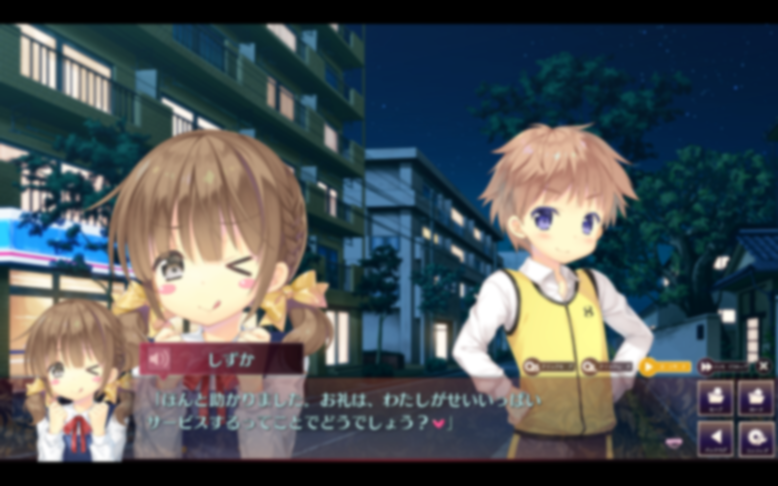
“Calm” means the story unfolds without much turbulence — just day after day of daily life passing peacefully. Occasionally the game throws in some forced dramatic twist, like the protagonist being suspected of drug trafficking, but it passes quickly once it turns out to be a misunderstanding. The whole thing feels more like… a sitcom? Or more like a 4-koma manga. If you’ve read that kind of work, you know what I mean. There are even transitions separating story from story, which makes the point even clearer.
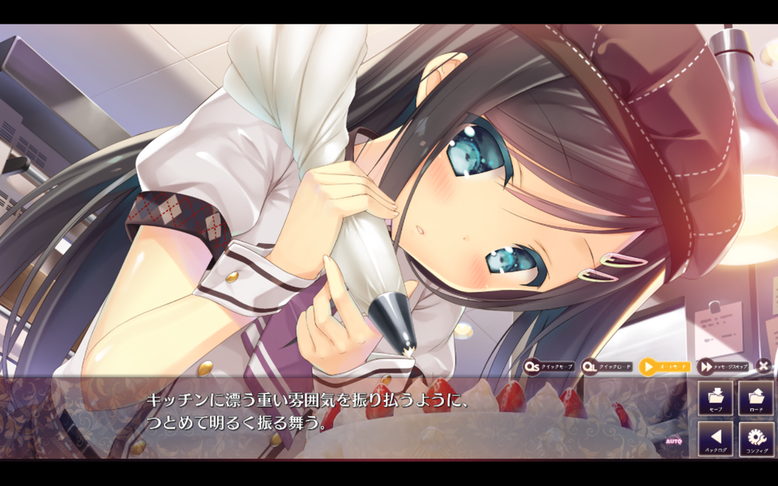
“Heartwarming” means that although this is a visual novel, it doesn’t blindly charge into “romance” territory. It’s more about shaping relationships between people, mostly on the themes of “friends” and “family” — Kanon’s account of her elder’s wish to open the shop, her sense of responsibility toward everyone in the store, and of course Reiha and her mother. Those are the parts that warm your heart.
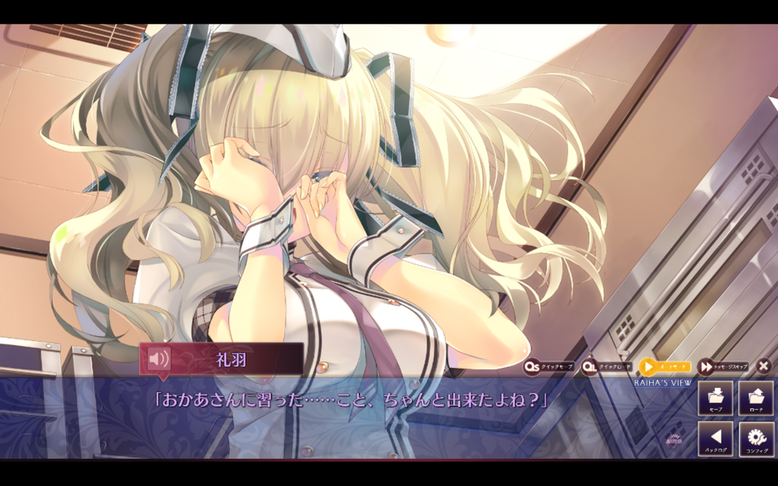
I said the game doesn’t focus on “romance,” but that doesn’t mean there’s no romance in it. The “lover” relationship only gets described once you pick a specific route. And the way it’s described is light and fun — for instance, the protagonist deliberately tells his senpai “Don’t leave me, don’t go anywhere, stay by my side,” when he actually means to plead on the manager’s behalf for the soon-to-graduate senpai to keep working there. The senpai of course misunderstands, takes it as a confession, and that spins off into another amusing little story. The stories in the game are separate, but some of them are connected, making it feel even more like a 4-koma manga. The unhurried pace is genuinely pleasant to read — that’s a skill in itself. And once you’re in a character route, the sweetness of the romance goes without saying. If the daily stuff is already this good, how could the dating be anything but sweet?
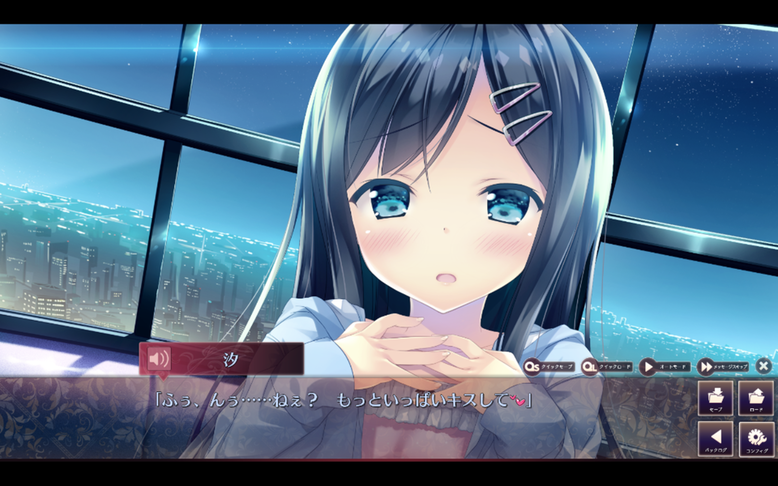
Ouchi ni Kaeru made ga Mashimaro desu is a game that’s at least 85% slice-of-life content, and it puts all its effort into shaping that daily life. Chapter-based segmentation, theme music transposed, various atmosphere-building tracks cutting in quickly — all very well done. What matches that is the sheer volume of story: tons of daily scenes, terrifyingly many, and a very long story, scarily long. Because the story itself is simple, there’s no absolute beginning or ending — that’s the nature of slice-of-life works. Some people on Reddit complained the scenario was boring to write, but maybe they were just comparing it to other plot-driven works. Plot-driven works are the kind that suck you in and won’t let you stop until you’ve read it all in one sitting. A slice-of-life work like Ouchi ni Kaeru made ga Mashimaro desu is more like a thick manga volume: flip through a few pages in your spare time, watch the people in the story joke and bicker and laze around, and you feel happy and warm too.
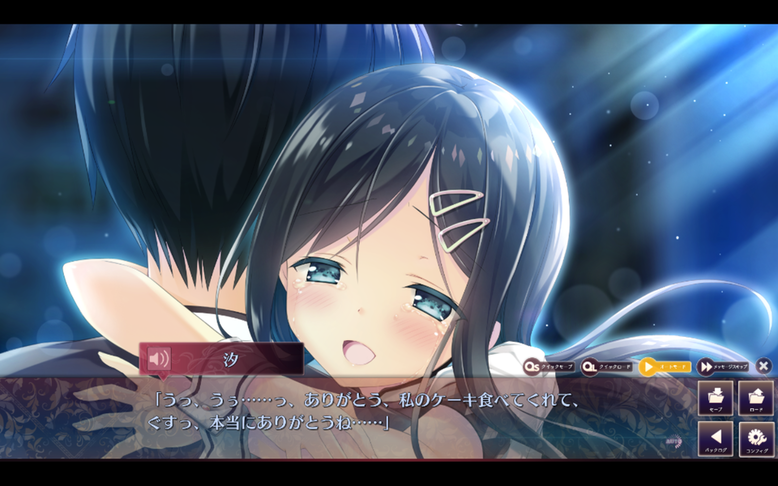
One obvious flaw of Ouchi ni Kaeru made ga Mashimaro desu is that the art’s coloring is a bit odd — too white, washed-out white, I think. And the system hogs way too many resources; the CPU spikes constantly. There aren’t even any real effects, so it’s probably just poor optimization. Another thing is that the game’s style may not sit well with most people. Especially the hardcore galgamers who “grab the game the day it drops and grind through it in two nights” — they’ll be exhausted by this one, because the entire main plot can be summed up in two sentences and everything else is daily life. Daily life is like dessert: once in a while it’s a treat, but eat a whole plate at once and you’re heading for diabetes.
Thinking back to the game: manager Kasukabe Kanon, when the protagonist asks why she’s so dead set on running this sweets shop, and why she keeps helping people left and right when the shop will never turn a profit at this rate.
Kanon says the shop came from her elder’s wish. Opening it wasn’t about making money — it was about having a place where busy, lonely, unhappy people could have something to lean on, and treat it as a “home” and a harbor for the heart. That’s the meaning of Mashimaro Tree’s existence.

Which brings to mind those “casual guild” leaders I met in World of Warcraft. They probably all think the same way — more like a rest stop for the soul, or a Catcher in the Rye kind of existence.
The shop Kanon runs in the game is called “ましまろツーイー” — in English, marshmallow tree. A thing that doesn’t exist, and yet it neatly captures the meaning of the game’s title.
お家に帰るまでがましまろです
If you can’t find your way home, come to the Marshmallow Tree (ましまろツーイー).
By the way, the game’s OP is really good: http://music.163.com/#/song?id=494410414 https://www.youtube.com/watch?v=165aKFeYdTA
Comments are hosted on the Chinese main site. This mirror is read-only.