Chi Yin (赤印) Review
Akane印: It Didn't Have to Be This Bad
Most of the culture that’s popular in Japan right now, as I see it, is stuff China was already playing with centuries ago.
Crossdressing boys go way back in Chinese opera — crowds of opera fans clapping and cheering for the cute boys on stage, striking poses no different from a bunch of otaku today wanking it to a girl with a dick on screen. Opera has scripts, staging, singing, acting. A pack of opera enthusiasts obsessed with one particular performer, addicted to his voice — isn’t that just the early ancestor of the CV fanatic? You pass an old man on the street holding a radio listening to opera — you gonna tell me he’s not listening to an audio drama?
At the bottom of it all, the otaku type has always existed. It just keeps changing shape as history rolls on.
I’m saying all this to make one point: China has its own style and culture, and in most respects there’s really no need to deliberately imitate someone else. Clumsy imitation only earns you a sigh and a “what the hell is this.”
Which is exactly what I’m talking about with a visual novel called Akane印 (赤印)…
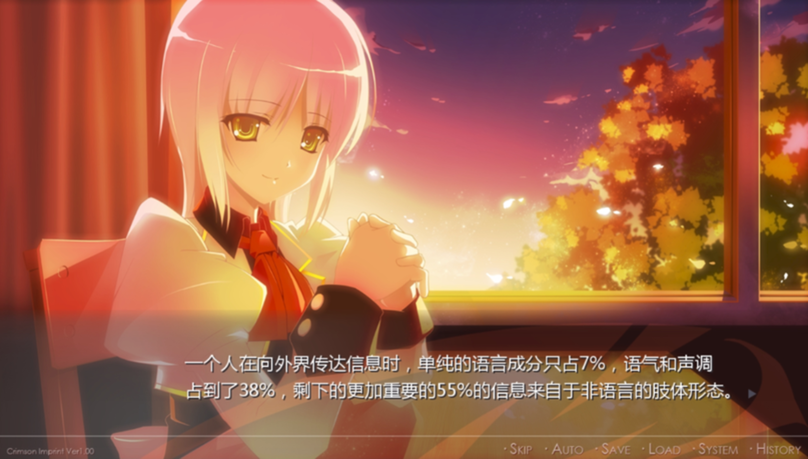
As a Chinese-made visual novel, Akane印 is actually not bad outside of the story. And that “not bad” comes with a lot of encouragement baked in — this is the most “proper-looking” one I’ve seen, and it’s miles better than the baffling nonsense I’d run into before… But for a visual novel, the story is the core driving force, especially in Chinese works, where that whole special field of fanservice doesn’t exist.
Akane印’s plot is a bit complicated, but the main line is dead simple: the male lead is hired to kill the female lead. Turns out she’s got a tragic past too. After a bit of romance with her, he flips and kills his employer. Sound familiar? This setup’s shown up in plenty of games — the most famous being Sharin no Kuni and G-senjou no Maou — but the writing here is far worse than either.
Where’s it worse? First, the setting.
The male lead is a jujutsu sorcerer, and the rules for how his sorcery activates are absurdly overcomplicated — yet after all that complexity, none of it has anything to do with the plot. Basically, all you need to know is that he’s insanely strong. The game also introduces something called “里相” — literally some kind of ability to see into people’s hearts — but the narration deliberately wraps it in so much fog that I’ve got Chinese text filling the whole screen and I’m having a harder time than chewing through raw Japanese. And of course, this “里相” thing doesn’t matter much to the story either.
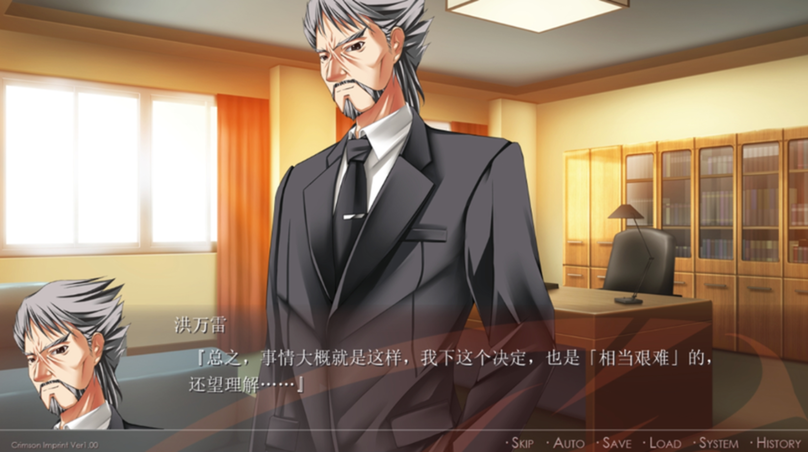
All you need to know is that the protagonist can cast spells and he’s goated. Everything else is pointless.
Sure, every dark visual novel has an OP protagonist, but I’ve never seen one this bloated. Grisaia already set the perfect example: sometimes everyone knows the hero is a beast, but you show it through action and plot, not pages upon pages of description.
Second, the conflict.
I already said the guy is strong. But the heroine is written even stronger. She doesn’t trust him at all — hell, she’s described as having given up on life entirely. That’s standard. So our badass protagonist should win her over, earn her trust. And how does he do it?
“Since you won’t believe anything I say, I’ll just tell you the truth.”
So he tells her the whole truth — including that he’s here to kill her, that he belongs to some organization, all of it… Looks like he’s breaking the rules of the genre, but what does it actually mean? It means the loss of the “conflict” itself.
It’s like you’re playing basketball and you tell your opponent, “I’m going left next, get ready.” Is that cool? Does he think you’re sincere? No, it’s stupid. He just thinks the guy he’s playing against is a total dumbass.
Sometimes backstabbing and deceit are the whole point of plot collision — and this game just throws it away. Even if you’d first shown the protagonist lying to her, getting caught, and only then coming clean during the seduction — that would’ve been better than opening with this.
Last, the backstory.
This is where Akane印 drew the most controversy. To make the heroine’s suffering feel bigger, the game shoves her into an enormous dark past: gang-raped, toyed with in every way. For a Chinese visual novel, that’s a bombshell — even in Japanese eroge, a heroine’s past rarely goes full bitch; usually it’s just bullying. This game goes straight for the hard stuff: not only is she violated, she’s also written as HIV-positive, and she uses her own HIV as a weapon for revenge.

Hey — didn’t we just say she doesn’t want to live anymore? How’d she turn into an angel of vengeance?
The protagonist’s job is to kill her cleanly, so it looks normal and leaves no questions. Fine. By the later plot, all he’d have to do is use his sorcery to cure the HIV (oh my god, our goated hero has conquered AIDS!) and then kill her. Of course, being a visual novel, it can’t go that way — he’s supposed to fall for her over time.
And you’ll never guess what he tells her: “I’ll fall in love with you, then kill you.”
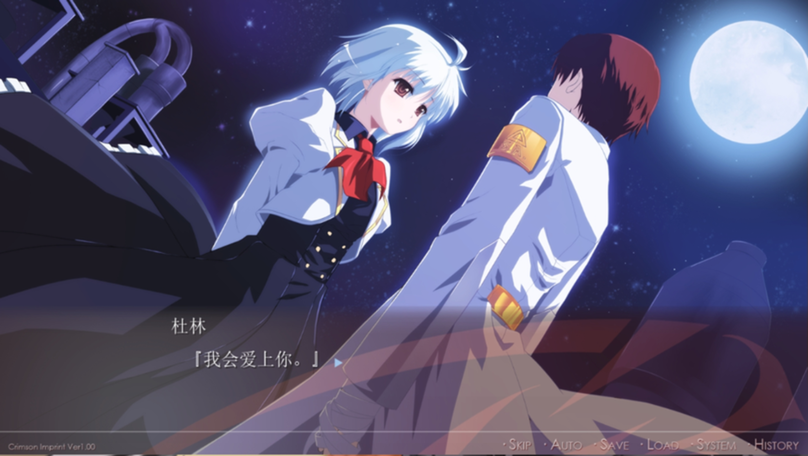
What is this, a second-rate Chinese school novel? Sounds cool, actually cringe. I think the better move would’ve been keeping the protagonist deceiving her, having him discover she isn’t so bad while lying to her, then mutual feelings developing. But this blunt declaration — what the hell was that?
Then the prologue ends. That’s where the whole internet uproar stopped. After the prologue, the game drops the dark conflict stuff entirely and switches to the protagonist and heroine living together, being lovey-dovey every day. Honestly, it threw me off — and I think it threw the writer off too, because starting from that chapter the plot has a distinct “I have nothing left to write” smell. It’s just endless flirting and showing off their love, and not even professionally done… compared to Japanese slice-of-life moege, it’s a chasm apart. The lovey-dovey doesn’t last long before the story rushes to its ending: the enraged protagonist, facing the cold indifference around him after the heroine’s death, goes berserk, kills his employer, and gets thrown into solitary by the organization.
Then? There is no then.
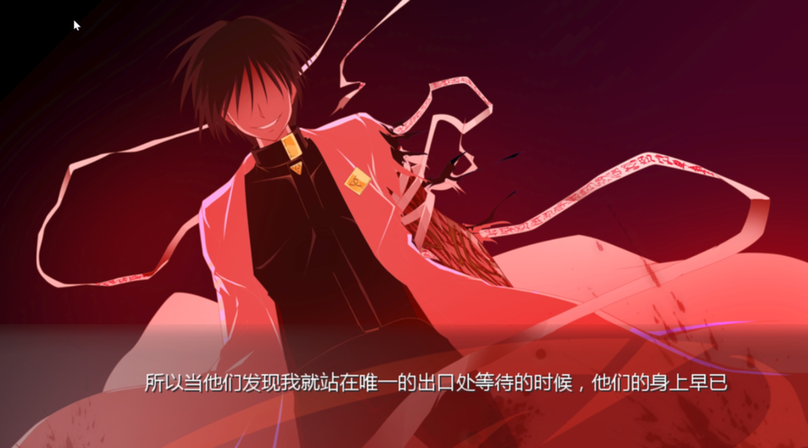
The story seems to want to paint a dark world where nobody can be saved, with the protagonist rescuing the despairing heroine from it.
But the plot leans too hard on shock-value material, and that never actually hits you in the gut. Think of horror movies: fear built purely from visuals can’t leave a deep impression. It’s the low-budget stuff that creeps into your soul that truly scares you.
And frankly, at China’s current level, we don’t even have the chops to pull off pure visual horror anyway.
I don’t know how many people have already ragged on Chinese wuxia RPGs for their brutal graphics and animation — but at least those RPGs have good stories and their own wuxia atmosphere and setting going for them.
Akane印 clearly didn’t play to that strength. It just blindly imitates Japanese visual novels — including the endless “呐……” in dialogue. “ねぇ” is perfectly normal in Japanese, but having it pop up constantly in Chinese conversation is weird. Same with “kōhai,” “senpai,” “XXXX了呢” and the rest. If you’d set the game in Japan, fine, no problem. But the protagonist and everyone around him are Chinese — none of this Japanese-style dialogue belongs in the game. The scriptwriter should’ve paid closer attention to how the people around him actually talk instead of pasting in whatever he’d seen. It’s not just weird, it loses the soul.
And finally, the CVs, which you can’t not complain about. The voice acting is all amateur, but you can hear the effort. The one bright spot is the villain Hong Wanlei — the last bit of conscience in the game’s voice work, genuinely professional-level. If every CV in every game were at Hong Wanlei’s level, homegrown Chinese visual novels wouldn’t be a problem at all.
The engine is KiriKiri, and the config files aren’t hidden properly — you can find the conf file right in the game directory and unlock whatever you want in the settings. The chapter system is also kind of user-hostile: after unlocking a chapter, you have to go back to the main menu and start over. Completely unnecessary, if you ask me.
Sometimes I feel for games like this. I think about how they “didn’t have to be this bad” — that’s me mourning the work, because it already had the ingredients for success and still ended up a loser for one reason or another. That’s Akane印. If it hadn’t deliberately force-fed the dark backstory, if it hadn’t deliberately edged into borderline content for attention, if it had paid more attention to psychological writing, if the CVs were just a bit more professional, if… if…
But the world doesn’t have that many ifs. Akane印 has done its job: it showed us China can make a game that’s watchable. But it’s also like a wave that died on the beach, waiting for the next one to step over its body — and the next one just hasn’t come…
By the way, the latest Chinese visual novel is apparently one called Nijiiro Melody (虹色旋律). The setup is trite and dumb, but the music is by Manabu Miwa, and it seems to be getting exported to Japan with Japanese CVs too — details in a Reddit thread.
Guess I might pick it up if I get the chance.
Comments are hosted on the Chinese main site. This mirror is read-only.