Sakura Hitohira Koi Moyou (桜ひとひら恋もよう) Review
Maybe Only Chinese Players Really Get This Game
Parasol has put out another new game. Honestly I don’t expect much from Parasol anymore — their games have lost any real identity or selling point. The last one with actual buzz was Hare nochi Kitto Nanohana Biyori, a.k.a. “Haru na Hana.” That game had serious problems with its narrative logic; calling it a landmine isn’t unfair. After that Parasol felt like it never recovered. Everything since has been a minor throwaway title, made half-heartedly, with painfully generic premises and nothing that stands out. Take last time’s “swimming club” thing, or that one from the start of the year, “My Everyday Romance With My Girlfriend” or whatever — they just slap together a school setting, add a harem with every girl type imaginable, you pick whoever you want, fuck her once, and it’s over.
How do I put this… it doesn’t feel like romance. It feels like hiring a prostitute.
So this time Parasol is back with Sakura Hitohira Koi Moyou (桜ひとひら恋もよう). No idea how to translate the title well. A single cherry petal has the shape of love? Sakura Hitohira Koi Moyou? Whatever, you get the idea. But the premise of this new one didn’t interest me at first glance either… except I noticed there’s a nine-year-old loli elementary schooler in the game, and you can’t even get on her route.

The setup is that the protagonist is going to school as usual when suddenly the school is going to be merged into another one, due to enrollment rates or bad management or whatever. He refuses to accept it and leads a bunch of classmates in protest. That’s the story.
Japan’s declining birthrate is getting worse, so school mergers are a dime a dozen. This premise is just taking the old “a girls’ school gets merged in” setup and flipping it to “we refuse the merger, and it’s not a girls’ school.” What’s the difference? Same soup, different bowl…
That’s what I thought at first. Then I found out the game has a lot more going on inside.
The opening is utterly by-the-numbers. The protagonist is a student, gets woken up every morning by his busty childhood-friend onee-san, gets to school and has a mysterious pure-hearted beauty dragging him into starting a “Romance Research Club,” and most importantly, he meets a girl who claims to be his little sister: Kamikawa Saya. Though the meeting is a little awkward.
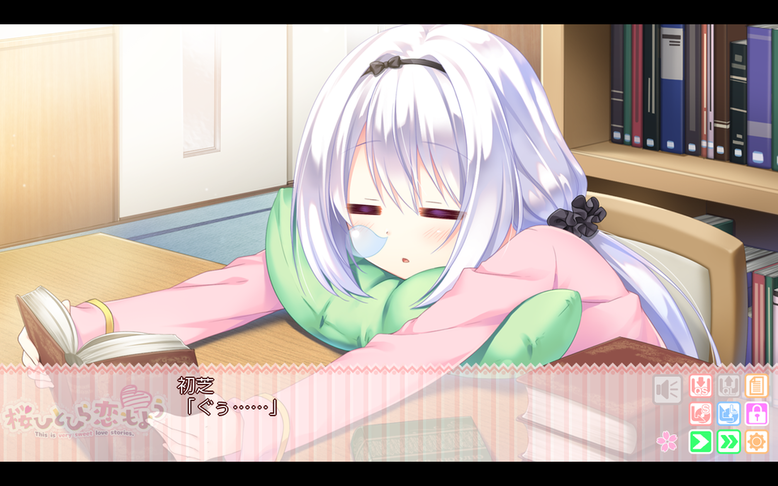
This girl who calls herself his sister is inexplicably cold to him, and seeing her fills him with inexplicable sadness.
Why? Two reasons. First, this self-proclaimed sister, Kamikawa Saya, has a father — Kamikawa Michinori — who is the principal of Houjou Gakuen, the school that’s absorbing his. And Houjou Gakuen doesn’t have a good reputation; rumor has it they treat students like demons, roughly like the Linyi Internet Addiction Center back in China…

And the second reason is the more important one. Kamikawa Saya used to date the protagonist… Back then he’d just happened to meet her, and they fell for each other. The reason was pretty interesting:
“The two of us are really alike, aren’t we?”
Just when things were heating up, Saya’s father found out. And what he said shocked the protagonist even more:
“Kamikawa Saya is your half-sister. I won’t allow you two to be together.”
The protagonist’s first love turns out to be his own sister. Well, that explains why they were so alike. So they had to part painfully. (I’m honestly surprised he wasn’t overjoyed.)
The protagonist’s mother was named “Yukiko.” She gave birth to the protagonist with Kamikawa Michinori, then died of illness. Michinori then found another woman, and that’s how Saya and her older sister Kamikawa Wakana came to be. Actually Wakana is older than the protagonist, which means the protagonist was born from Michinori’s illicit affair with his own mother Yukiko — in other words, he’s an illegitimate child.
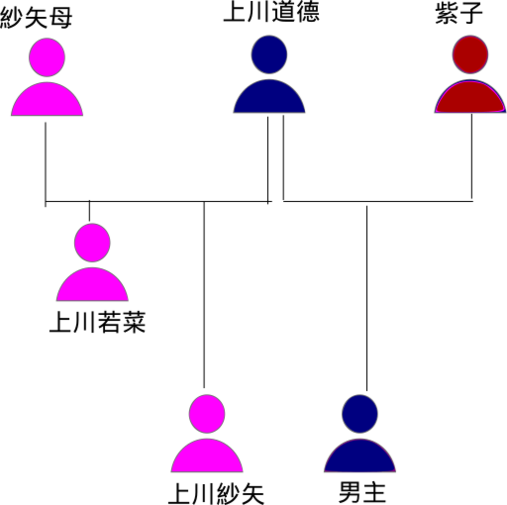
Let’s set the protagonist’s parentage aside for now. His school falls into turmoil: the principal dies of illness, and the new acting principal is the former principal’s granddaughter, who is only nine years old. Since the little girl can’t keep the school running, it’s about to be absorbed by Kamikawa Michinori’s Houjou Gakuen.
The protagonist’s school’s philosophy is freedom and openness. Michinori’s school’s philosophy is dogma, coercion, and standardization.
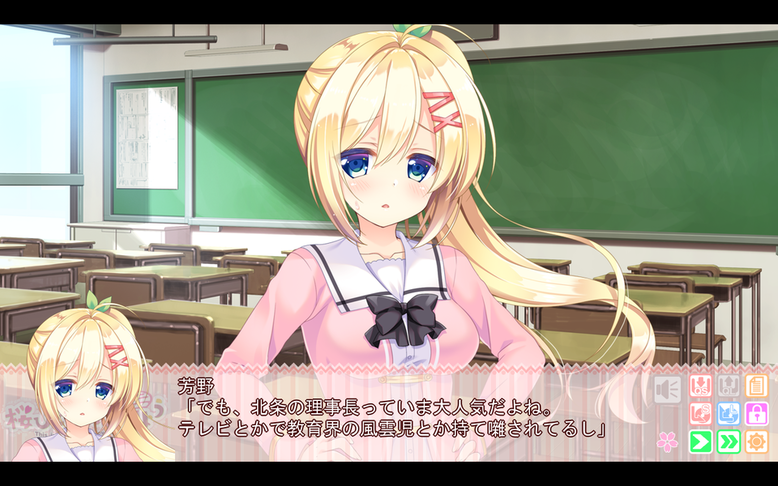
What does “standardization” mean? High-pressure management of students, forcing them to study hard. Compared to the protagonist’s school’s somewhat lax approach, Michinori’s method might actually be more effective for exam-oriented education.
But the current principal opposes it, and she starts rallying the students to resist the merger.

The girls around the protagonist all decide to resist the merger. Michinori even has the nerve to come to the school and declare, “The merger is only a matter of time. You brats who don’t study can just wait.” Which only fuels public outrage.
While everyone is discussing how to resist, Kamikawa Saya appears and proposes a viable plan.
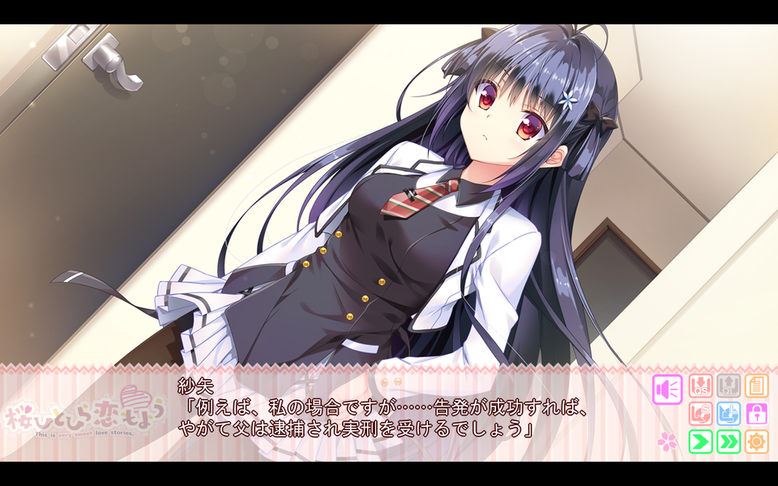
Saya points out that from what she knows of her father, for the merger to succeed he’d have to bribe local officials. Once he’s stuffed enough money and they nod, the merger goes through. If they can expose the bribery, Michinori’s reputation will be ruined and the merger will be shelved.
So how to expose it? Saya says her father is going to meet someone in the reception room at a baseball game on a certain day, and that’s probably when the bribery will happen. One of the protagonist’s classmates, Mizutani Yoshino, works there. The group asks Yoshino to wear a small camera and try to capture evidence.
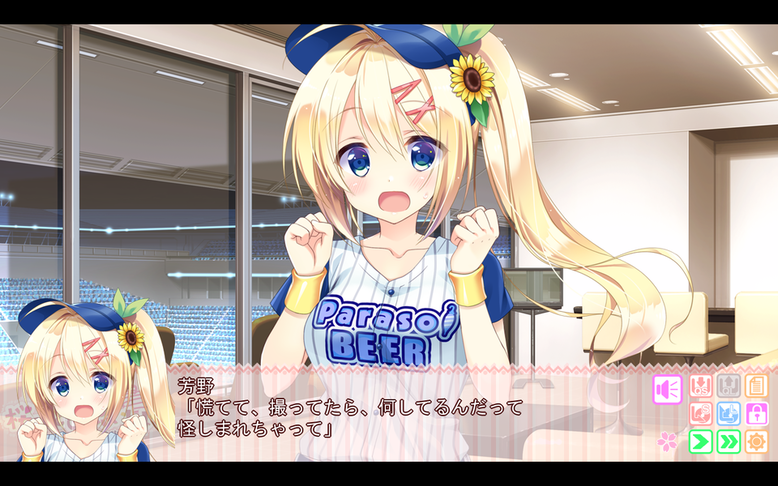
Actually the sting doesn’t go smoothly and nearly goes wrong, but they get some blurry footage. The evidence gets delivered through certain channels, but there’s no big reaction. What’s more effective is Saya’s older sister, Kamikawa Wakana, taking a hard stance against her father.
It turns out Wakana ran away from home long ago and cut ties with her father — Saya’s father too — Kamikawa Michinori. She hates that man’s money-grubbing ways, and hates even more that he betrayed her mother. Through her own efforts she came to this school as a teacher, and seeing her father reach his claws in here again, she naturally resists.
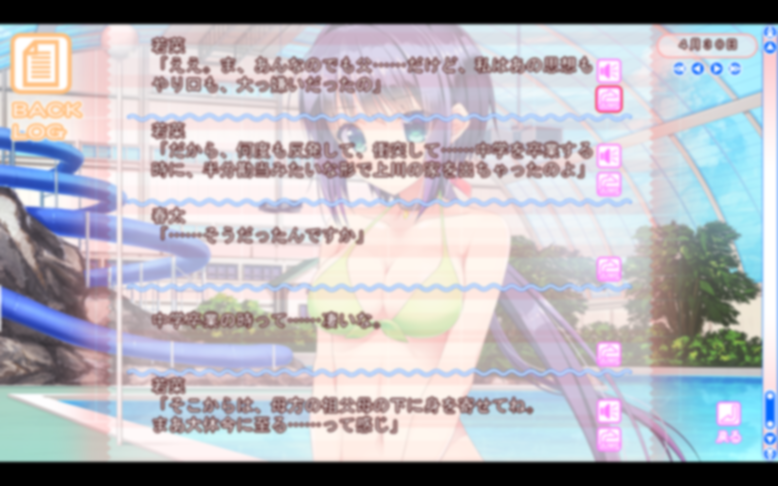
Saya hasn’t yet turned her back on her father, but she hates him inside too, which is why she secretly helps the protagonist oppose his merger plan.
But the earlier sting didn’t accomplish much, so Saya comes to the protagonist again asking for help. This time she wants to completely destroy her father’s merger plan.
Saya tells the protagonist and the others that her father Kamikawa Michinori’s school, Houjou Gakuen, has severe corporal punishment. It abuses any disobedient student, brainwashes them, and forces them to police each other like they’ve lost their humanity. But because of Houjou Gakuen’s high-pressure policies and political bribery, few outsiders know what goes on inside. All they know is the students have high advancement rates — not the truth. Saya wants the protagonist to get into that school and secretly record evidence with a camera or whatever, then expose it, so Michinori’s school can never operate again.
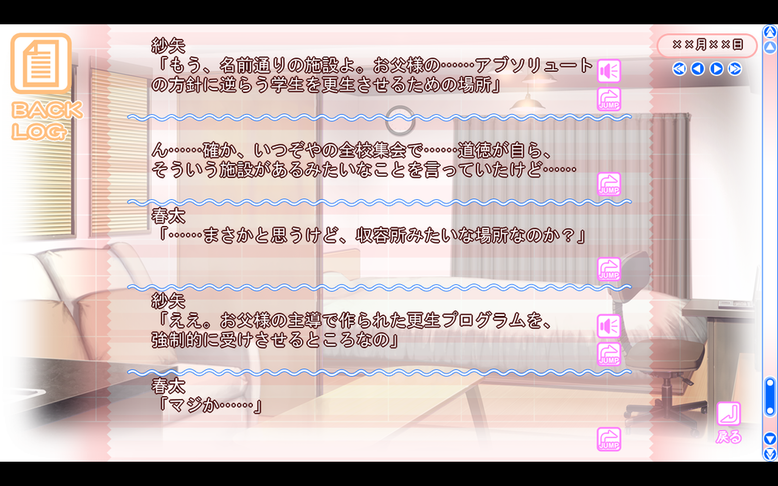
Saya is the daughter of the school’s director, so getting the protagonist in is easy. She then sneaks into the school and gives him a camera.
The protagonist spends two weeks in that school like a nightmare. Every day he’s forcibly woken up. Loudspeakers broadcast Principal Kamikawa Michinori’s speeches. Everyone must obey, must read, has no freedom, can’t have any thoughts, is surrounded by informants — let alone leave.
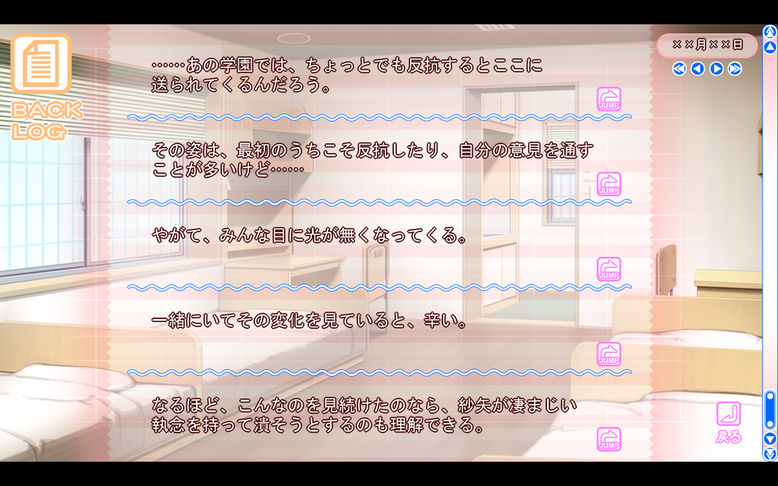
The protagonist sees all the students inside with vacant, expressionless faces, like they’ve been brainwashed. Just when he can’t take it anymore, Saya appears, takes the camera with the evidence, and tells him to wait — she’ll come rescue him soon.
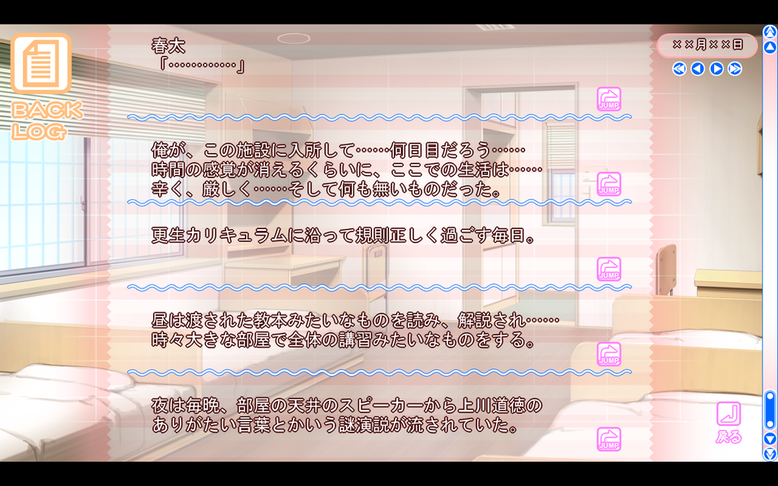
With the evidence in hand, Saya doesn’t simply hand it to local media. She gives it to a foreign journalist, because she knows local media would be handled by her father.
The foreign journalist is confused:
“If this gets out, your father could face prison.”
Saya doesn’t hesitate. She’s long hated that inhuman father of hers.

Soon the story breaks. The protagonist is rescued, Michinori’s school is temporarily shut down, and Michinori appears on TV every day apologizing and issuing statements, his fake-sincere tone making Saya sick:
“Houjou Gakuen has always put students first. We have never used corporal punishment. We always emphasize students’ quality education…”
It does little good, though. Saya knows her father Kamikawa Michinori has no credibility left — the exposed evidence is enough to destroy him.
But Michinori isn’t stupid. He soon finds out who did it, confines Saya, and starts threatening her.
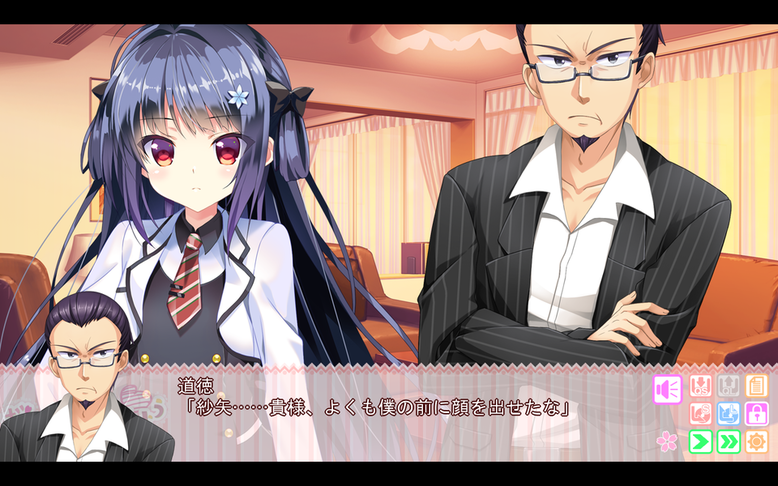
“You’re my daughter. You were in that school too. Stand up and tell the media I’m not that kind of person, that I never used corporal punishment, and reduce my sentence!”
Saya refuses. Michinori goes mad.
“How dare you refuse! I brought you into this world so you could be a tool for me to use! You have no right to refuse!”
And Saya understands. Michinori has no humanity. To say such things to his own daughter — his children were never people he loved, only tools.
Just then the protagonist learns Saya is confined and sneaks in to save her. Wakana helps him find the secret passage into the house.
The protagonist enters and sees Saya, only to be cornered in the room by Michinori.
“I knew you two were behind those photos and videos! Unless you both go out and clarify to everyone that you fabricated them, neither of you is leaving today.”
The protagonist starts arguing with Michinori, asking how he could treat Saya like that, and says he loves Saya. And then Michinori drops an even more shocking truth.
“Why do you think Yukiko and I separated? Why didn’t we end up together?” “Because Saya and you are both children of Yukiko and me.” “And Yukiko was my sister.” “Isn’t it ironic? I had children with my sister, and now my son has fallen in love with his own sister.”
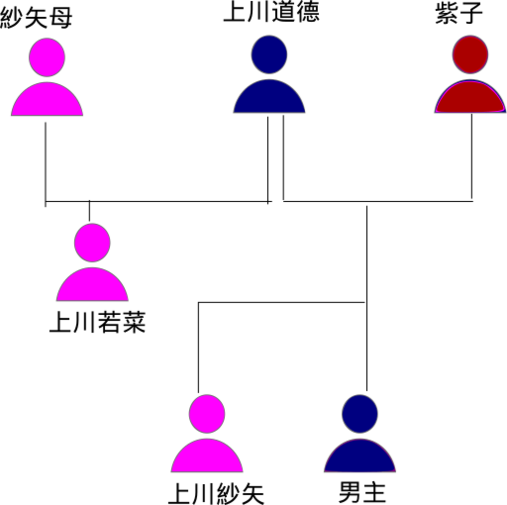
The protagonist is stunned… and Saya understands too — why she always dreamed of being with the protagonist and his mother as a child, why she had no impression of her own mother, and why her mother had so little feeling for her. And she and the protagonist share a birthday. Twins after all, huh?
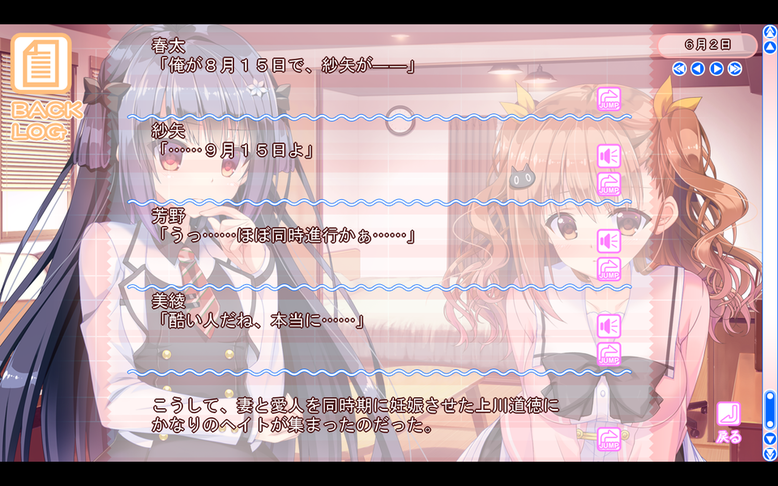
The protagonist has no time to think. Just then Wakana appears, stands in front of Michinori, and pulls Saya out of that house.
Seeing Wakana, Michinori switches his tune again. He says he doesn’t want the disobedient Saya anymore, that Wakana is his favorite, and asks her to help her daddy testify that he isn’t that kind of person.
Wakana says nothing. She’d already called the police in advance, and Michinori is taken away.
Saya has nowhere to go, so she lives at the protagonist’s house. During this time, their relationship grows complicated.
Saya loves the protagonist, and he loves her. But they’re now… full siblings.
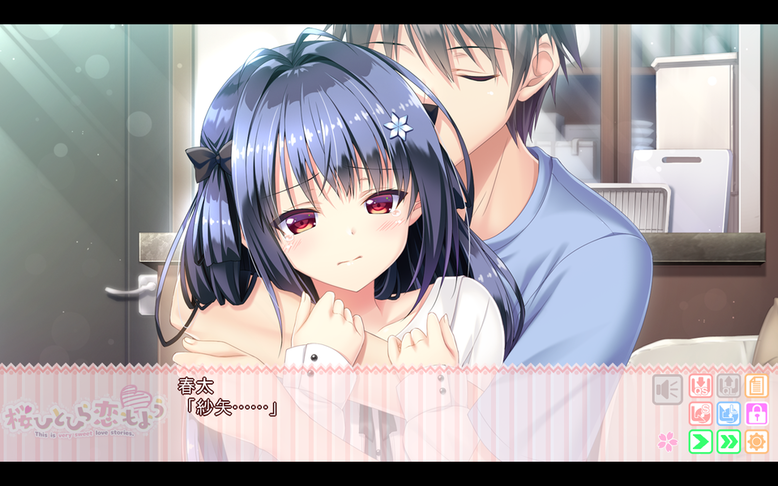
Saya doesn’t even remember her own birth mother, because Michinori took her away as a child. She didn’t even know the protagonist’s mother was her mother, and calls her “onee-san.”
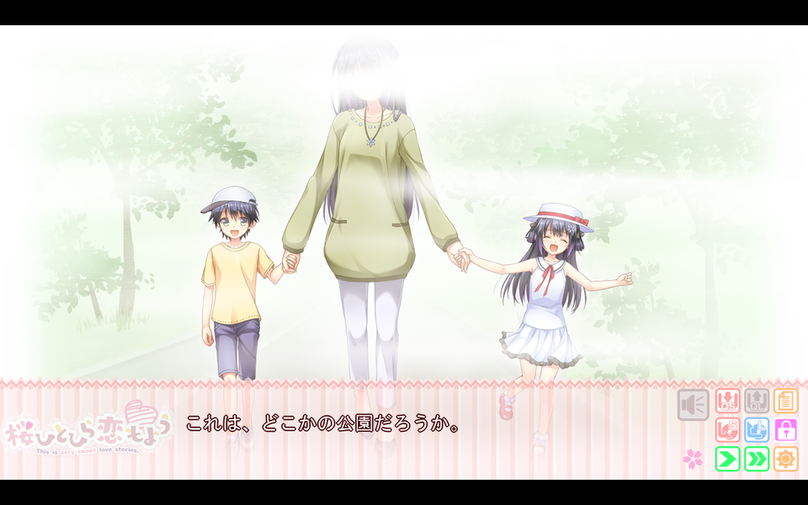
The protagonist takes out a photo of his mother, and Saya finds a line of writing on the back: harta saya. Saya is puzzled — she assumes it’s haruta and saya, their two names. But why is it written harta and saya? The protagonist’s mother worked as a translator; she wouldn’t make a mistake like dropping a “u.”
Saya searches on her phone, and her whole hand trembles.
harta saya: in Indonesian, it means “my treasure,” my precious one. So their mother knew about the relationship between the two, and loved them both deeply.

Saya decides to stop wavering and be with her brother. In the end she doesn’t care what their relationship is — lovers, siblings, whatever. She just wants to be together forever. They may never be able to marry, but so what. As long as they’re always together, that’s enough.

And the game reaches its ending.
The “resist the merger” main plot of Sakura Hitohira Koi Moyou roughly splits into two parts: exposing Houjou’s corporal punishment abuses, and the sibling love between the protagonist and heroine, who turn out to be twins.
On the former, my feelings are complicated, to say the least. This isn’t the kind of thing I’d expect Parasol to write — it’s too heavy, and Parasol’s scenario writing is only so-so to begin with, so it doesn’t dig deep. In fact, the game’s depiction of the inhumane abuse at “Ikusei Academy” is too childish, not vicious or dark enough. Some Japanese players even thought after playing: “What the hell is this? How could a school like this exist?”
Japanese players might think that. But as a Chinese person, I can’t laugh.
Let’s go over the key descriptions of the abusive “Houjou Gakuen” in the game:
- The school has severe corporal punishment and confinement, forcing students to study.
- The school aims to break students’ will, demanding only obedience.
- The school frequently brainwashes students into boundless worship of the principal.
- The school’s actions are protected by local government, because the principal bribes them and it serves both their interests.
- Outsiders only see improved student grades, not the dark reality of abuse inside.
What does this remind you of? Does it remind you of some recent news from mainland China?
Let me list two:
“Comparable to Yang Yongxin? Yuzhang Academy Accused of Abusing Students, Local Government Responds” “Yang Yongxin Still Using Electric Shocks to ‘Treat’ Internet Addiction; No One Accountable After Radical ‘Therapy’ Exposed”
Ironically, the game’s “principal and local government covering for each other” and “exposing to local media is useless, you have to expose to foreigners” — these things are actually more common in China.
Many Japanese find it fantastical. But is it really?
And the game has some descriptions of the protagonist’s father, Kamikawa Michinori, that seem exaggerated:
- Using gold bars as desk decorations for good luck
- Government officials taking bribes in restaurants, then getting exposed
- Private schools using corporal punishment that drives students to suicide
These are all real, you know. China aside — too common. Even in Japan these are common. Someone on ErogameScape even provided links:
For example, this gold bar for improving feng shui:
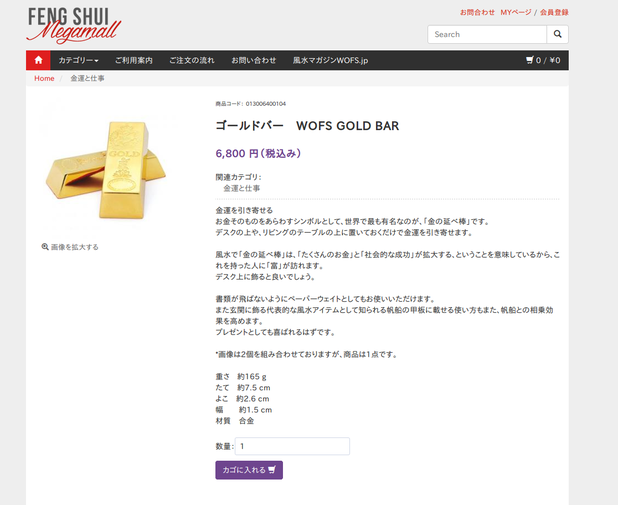
https://www.fsmegamall.jp/products/detail.php?product_id=1351
A school where corporal punishment drove students to suicide:
As for bribery and corruption, that’s even more common, so I won’t list examples.
When the game deals with “exposing an inhumane school,” many things seem exaggerated, but they’re actually facts — facts in China, and facts that exist in Japan too. It creates a strange kind of irony.
The script writing throughout the game isn’t high-level, but reading it always gives me a peculiar ache in my chest.
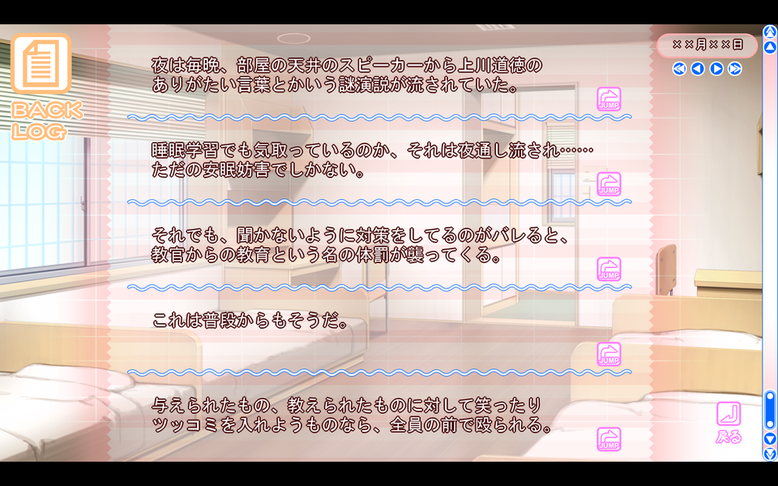
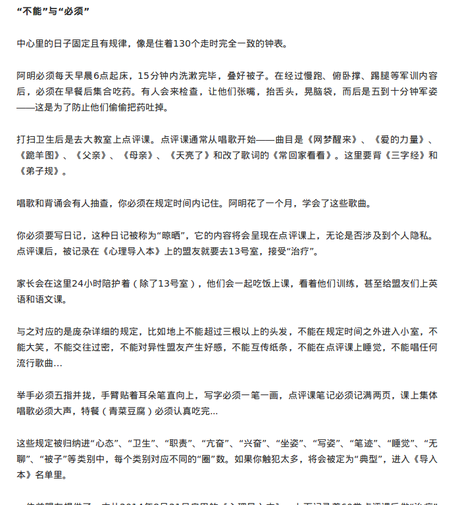
“The Terrifying Escalation of Yang Yongxin’s Internet Addiction Center: Electric Shocks, Brainwashing, Nationwide Capture” http://news.ifeng.com/a/20160822/49820472_0.shtml
When something that looks childish and fake is presented to you, and you realize it’s “real,” a feeling of “what on earth is wrong with this world” rises up in you.
I can’t say the game handles this content well, but it really does write things that make you sigh after reading. Even if many Japanese think it’s “childish.”
Sometimes I can hardly believe this is a game made by Parasol. The same Parasol that made the melodramatic Haru na Hana and the loli swimming club.
As for the sibling love in the latter half, I found it a bit average. There isn’t much transition or depiction of the heroine and protagonist’s hesitation and conflict over their forbidden love — they just naturally get together, with no explanation, no discussion of the future. They’re just together, and that’s it.

Personally I’d rather over-interpret this game’s plot. Or maybe siblings who’ve been through such complicated circumstances just need to live peacefully, and wouldn’t ask for more.
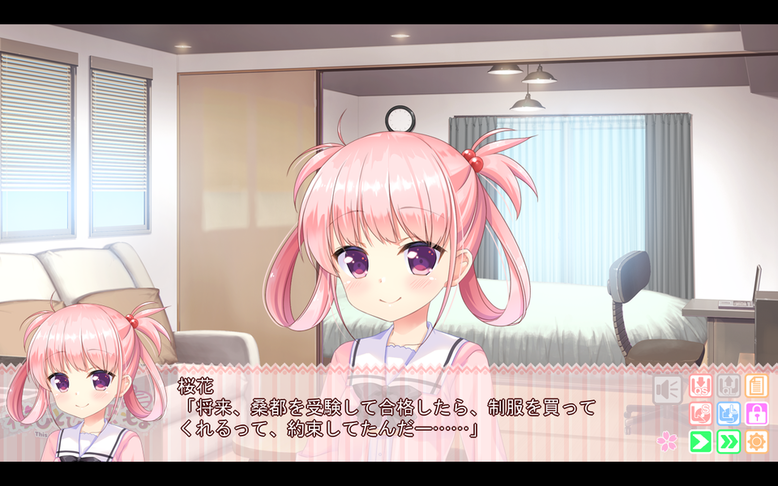
The game’s CV performances are average, the art is acceptable. The other heroines’ routes have nothing to do with the main story, and I hear they’re pretty much nukige. Interestingly, that nine-year-old acting principal seems to be conquerable — you just say a few words and it’s over… They even put out a patch where she grows up and can finally date you.
Whatever, whatever. For this game, just the main story is enough to make me sigh.
The bigger sigh is that in the game, Kamikawa Michinori is finally sent to prison because of his daughter’s betrayal — and it took a foreign journalist’s exposé to do it.
Meanwhile China’s Yang Yongxin is still at large. After all those exposés, the Linyi Internet Addiction Center still exists. Not only that, Yuzhang Academy popped up too. China has plenty more Yang Yongxins, and what’s more despairing is that China has plenty of irresponsible parents who think “Yang Yongxin is right.”
Japanese players say this game is too heavy and far-fetched. Some even say, dick in hand, that they can’t jack off to it.

I can’t jack off to it either. But my feelings are different from theirs. Maybe only Chinese players will really understand this game.
Comments are hosted on the Chinese main site. This mirror is read-only.