The World is Ending and It's My Birthday
《终わる世界とバースデイ》 is a visual novel put out by Wataame-sha, and good luck finding anything about it — even in Chinese-language circles the info is scarce, and basically nobody seems to have reviewed it. I played it partly because Kiritani Hana is in it, and partly out of curiosity about the story setup. Played it raw, too — so thanks are due to VNR, a Casio Japanese-Chinese dictionary, and the surprisingly useful Baidu Translate.
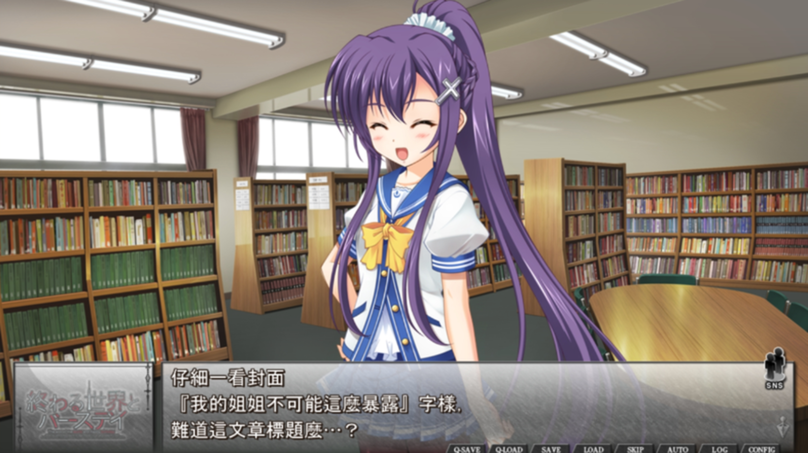
How should I even rate this game? Hmm, let’s just say it’s one of the few recent works I’ve come across that genuinely takes its storytelling seriously.
The game’s premise revolves around the end of the world. When the protagonist shows up, rumors are spreading online that the world will end on the 25th of that month—which happens to be the heroine’s birthday, and also the day her older brother died. The protagonist’s role is to pose as her brother and look after her, convincing her that he didn’t actually die N years ago… Why is it so easy for him to pull off the impersonation? Because the heroine has poor eyesight.
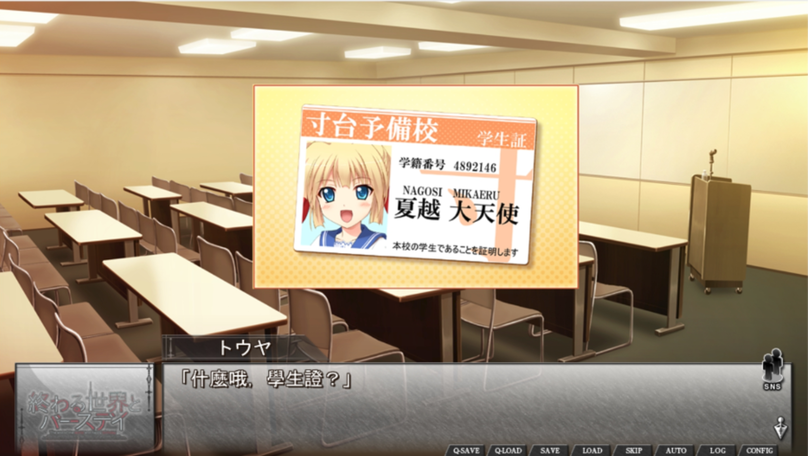
The protagonist and his best friend’s little sister — that’s the whole setup. The first playthrough plays out on the way toward doomsday on the 25th, and the story branches into four character routes plus a final True End. Namely: the sister route’s Cassandra Syndrome, Natsukoshi Daitenshi’s Genocide Virus, Fujishiro Tou’s Glacial Period, and Naruko’s Reverse Start.
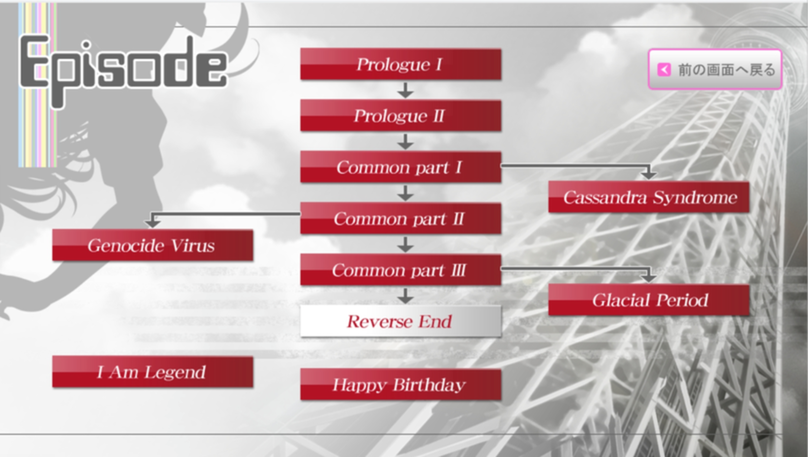
And after all of those are unlocked, you get the bonus scenario “I Am Legend,” followed by the final scenario, “Happy Birthday.”
The game’s overall story is way too complicated for me to describe one by one. All I can say is that each heroine route’s plot is basically a process of world destruction—like parallel worlds, the world gets destroyed four times. So during my playthrough I was completely lost at first. In the little sister route, the protagonist saves his sister, but then the screen suddenly flashes and a mysterious person tells you that your sister has actually been dead for a long time. In the Natsukoshi Archangel route, a zombie virus suddenly spreads across the globe, and the final plot has the protagonist and the Archangel, surrounded by the zombie virus and with nowhere left to run, committing double suicide. The Fujishiro Tou route is even more depressing—the protagonist and Fujishiro Tou get trapped in a mysterious glacier where anything that touches it freezes, and they literally freeze to death. It’s only in the final Naruko route, when Naruko fails to quit being a shut-in and suddenly wants to back out, that I noticed a bit of connection between each heroine route.
In every route, each protagonist is more or less eaten up by regret. In the younger sister Iri route, the protagonist carries his regret toward Orizuka. In the Archangel route, the Archangel is haunted by the time she lost control of her emotions as a child and could never apologize. In the Fujishiro Tou route, it’s the daughter’s regret over her relationship with her father. And in the Naruko route, it’s the shut-in older sister’s regret over the traffic accident that took her brother, the one who had always looked after her so carefully.
So after going through that baffling I Am Legend–ass route, the truth of the world gets laid bare — turns out the whole thing was a scam.
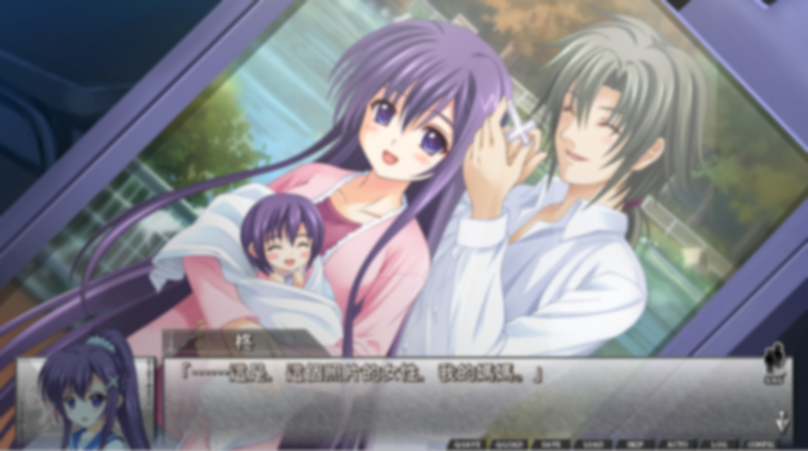
See, Chichizaki Iri — the heroine of the game — actually died years ago in a car crash, caused by the protagonist taking her out for a joyride without permission. The protagonist and Iri’s older brother, Chichizaki Touya, suddenly hit on a way to save their sister: research AI. The body can’t be brought back, but they can build a high-fidelity AI of her. The president of Fujishiro Enterprises backed the proposal, because Touya pitched it to him as a technology that lets you return to the past — experiencing through virtual reality the things you once lived through. The president had been diagnosed with a terminal illness, and his relationship with his daughter, Fujishiro Tou, was terrible; he deeply regretted not treating her better, so out of his own self-interest — wanting to go back and see his daughter as a little girl — he agreed to fund the project. As for Chichizaki Touya, his goal was to bring more living people into this virtual world and use its environment to cultivate the intelligence of the AI named Chichizaki Iri. An AI can’t be raised by shutting itself away and working in isolation — it needs training in a real environment to come closer to being an actual human.
So years later, a virtual reality game event organized by the Fujishiro corporation was held “to go back to the past and do the things you wanted to do.” The participants, each regretting what they’d done in the past, wanted to find a little comfort in VR. The organizers—the protagonist and Momochizaki Touya—instead intended to use those participants to train the AI they’d built, a girl named Momochizaki Iri.
Initially the plan was for the protagonist to log into the game, become a GM, and work with Tōya from the inside — stretching what was supposed to be a one-to-one, single-morning session into several times that length, so the players who had no idea what was going on would live through countless loops of the world’s destruction, boosting the AI’s odds of successful training.
But the truth is, after the protagonist enters the game he loses his memory, forgets he’s inside a virtual reality, and gets completely absorbed in the game—which is exactly what sets up the world-destruction plot of that first playthrough.
In the end, Chichizaki Touya also wanted to save the protagonist, so he went ahead and created a new world on his own, lured the protagonist there, told him that everything he had been through was a dream, and hoped the protagonist would recall his own situation. But after learning the truth, the protagonist instead realized that kidnapping a bunch of people and running experiments on them just to mold an AI was wrong, and turned against Touya. Touya gave up on the protagonist too and chose to keep cultivating the AI. The protagonist is stuck inside the game, Touya is the game’s GM, and all he can do is let himself be pushed around.
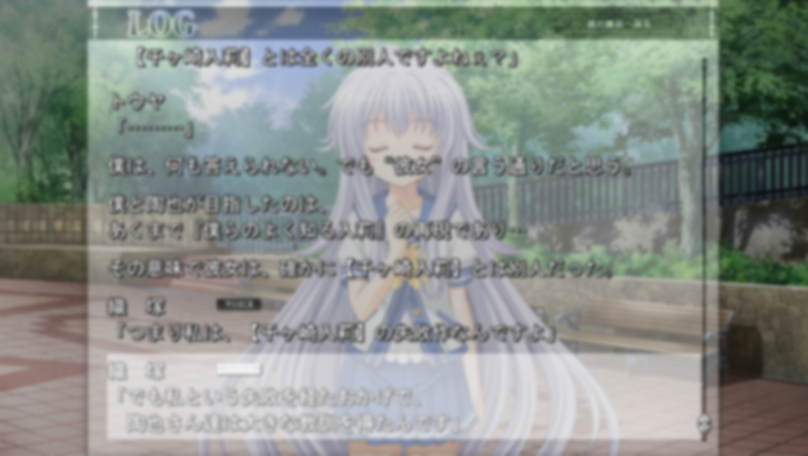
So the game reaches its final playthrough. The protagonist keeps the memories from the previous loop and tells Chichizaki Iri the truth — that she’s actually an AI. Knowing this, she chooses to help him, and together they work from the inside and out to grab root access to the game, bringing the whole thing to an end. The protagonist returns to reality, while the AI named Chichizaki Iri chooses to seal herself away for good, never to appear again.
I tried to roast this game, but after thinking it over, I found that both the cause-and-effect logic and the setting hold up completely:
Why would Oritsuka inexplicably fall for the protagonist? Because Oritsuka is a failed product of Touya’s research into Chichizaki Iri—she inherited her little sister’s setting of being in love with the protagonist.
Why does Chichizaki Iri get root access? Because when Touya created Chichizaki Iri, he worried she’d run into danger in the virtual world, so he gave her a “guardian with root privileges who appears whenever she’s in danger” — Cassandra. At the end of the game, Chichizaki Iri summons Cassandra by jumping off a building, and through the root privileges she gains, she takes control of Touya.
Why does the virtual world always get destroyed on October 25? Because, according to Tōya, the memory computation of the virtual reality can only run for one month — 30 days. That day happens to be Iri’s birthday, so he chooses it as the day to reset the virtual world by destroying it.
Why can’t Touya and the protagonist exist at the same time in Chichizaki Iri’s virtual world? Because this version of Chichizaki Iri has a bug. If the two of them appear at once, it throws off the memories fed into the past, and Chichizaki Iri’s emotional state destabilizes. You can see this play out in Iri’s route.
Why can the protagonist inherit his memories in the final playthrough, when Dou also said he’d reset the entire world? Because Dou cut corners when building the world — he didn’t reset what was underground during the wipe. The time capsule the protagonist buried did its job, and it survived.
So I tried to poke holes in it, and every attempt failed. The game’s setting and descriptions are already airtight—if you really want to nitpick, the only unreasonable thing left is whether AI should exist at all.
The game is just as meticulous in how it lays out its story as it is in its pacing. “Gripping” is the word. The early routes look like they have nothing to do with the main plot, but by the end every one of them ties back into where each character stands. Why does the Archangel care about the protagonist? Why won’t Fujishiro Tou’s father acknowledge him? Why did Naruko end up becoming a police officer? All of it lands as “unexpected, yet entirely reasonable.”
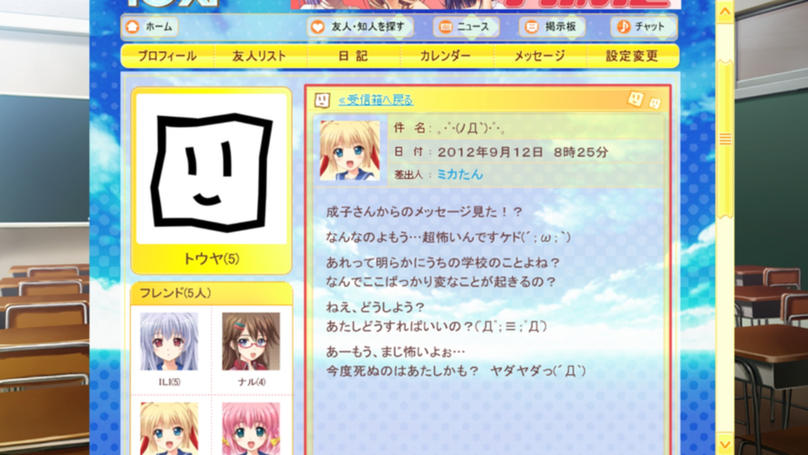
The game also has a pretty neat SNS system: whenever someone updates their Twitter or blog, you get a notification in-game and can browse through it at any time. It’s basically just flavor—nothing in the story hinges on it—but it does a good job of patching up the character writing. The archangel is constantly complaining on Twitter that she can’t finish her homework, Or旧塚 is forever hunting for a ramen shop he likes, and little touches like that make up for the fact that some of the cast don’t get enough screen time.
The game’s biggest weak point is its visuals. The character designs aren’t anything to write home about either—everyone’s drawn with a face like a slab of pork kidney. Some of the CGs actually look a bit better. I think Watahashi-sha should put some work into the art style, because this weird look makes it hard to draw in many people, no matter how good your story is.
The music in the game isn’t anything special, but the OP and ED fit the mood really well. Not many tracks from the OST stick with you—but graduation alone is enough to shake you to the core.
Finishing this game left me with a lot to say. I want to praise it, but I don’t know where to start. I want to snark on it, but I can’t find any obvious flaws. The weird, morbid satisfaction it gave me from the very beginning, the curiosity it later baited out of me, and the inexplicable emotion the ending stirred up — those wild swings give the whole thing a real sense of “adventure.” Maybe that’s an element visual novels are supposed to have in the first place.
If I had to sum up the plot of this game, it’d be this: an insanely siscon guy who, in order to build an AI that’s a perfect copy of his little sister, doesn’t hesitate to deceive a whole group of people into being his test subjects. But in the end, the siscon still fails. An AI isn’t a real person, after all. His actual sister is already dead, and all he gets is an even deeper emptiness and grief.
As the AI named Chichizaki Iri said at the very end: “I’m genuinely happy that you created me. But I’m not Iri — I’m just an AI. And I think, if Iri were still alive, she wouldn’t want to see you do something like this. She’d want to see Kazu-kun and Sueharu keep facing the life ahead of them, instead of living in the past, in guilt over their sister’s death.”
Your little sister is already dead. Even if you live on in grief, she isn’t coming back. So that the protagonist and Touya can face the future properly, Chiisaki Iri’s AI chose to freeze itself and put an end to everything.
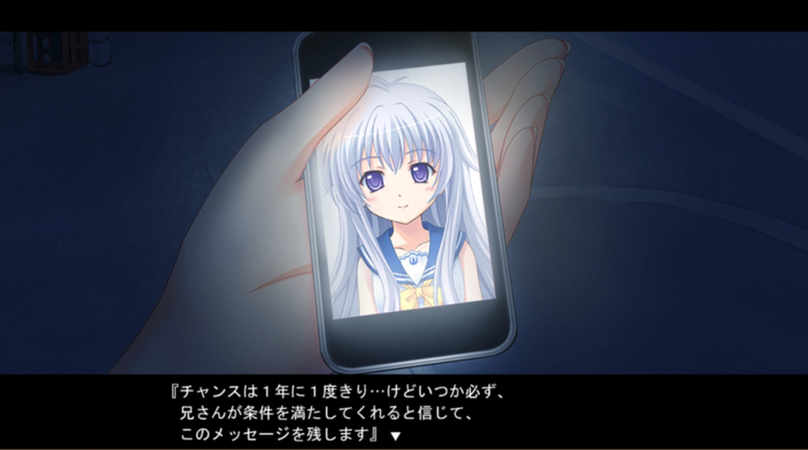
The story always manages to offer hope right when things feel bleak. Just as the protagonist is convinced everything is over, he finds Chichizaki Iri’s figure on his phone.
“Even though I chose to be frozen, I’ll still show up online every year on my brother’s birthday, just to tell you: happy birthday.”
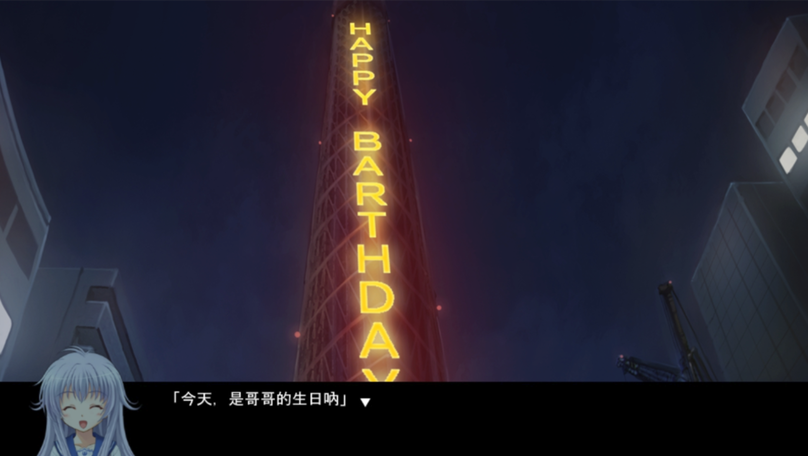
Staring at the final “Happy Barthday”—misspelled the same way Irie did—the protagonist cries. The game’s title feels awfully prominent right then: the old world has already ended, and what arrives instead is a new birthday.
This one may never get a fan translation, but I’d argue it’s one of the visual novels most worth playing.
Comments are hosted on the Chinese main site. This mirror is read-only.