AstralAir no Shiroki Towa (アストラエアの白き永遠) Review
The White Eternity of the Starry Vault
A while back on a forum I saw someone loudly declare that every visual novel’s core has to be porn — softcore, hardcore, hidden, whatever flavor of titillation — and that if a game loses the core of making the player jack off, the whole medium is doomed.
Rare for me, I couldn’t really take a side. Honestly, what I play visual novels for isn’t the format itself; it’s the Japanese flavor of story that leans a little into fantasy and thrill. Anime doesn’t have the runtime to tell a story properly, and manga and light novels mostly get strangled by endless serialization that drags things out. Only a visual novel, with one route and one ending, can more or less scratch that itch — because when a route reaches its end, the story actually ends, instead of dragging on like a bottomless pit the way serialized manga and light novels do.
As for porn, I’ve always figured it doesn’t conflict with plot. When the H-scene comes up you can sell as much meat as you want; when it doesn’t, you can still just tell your story straight. If the H and the plot are inseparable, then at best it’s a nukige, made for a specific audience with specific needs. So in visual novels you get a few different ways of structuring the plot: some play the borderline game hard, some straight-faced hand you a softcore setup, and some rare ones honestly keep H and story separate. Which brings us to… 《アストラエアの白き永遠》 might be one of those.

I had no idea how to translate the title 《アストラエアの白き永遠》. Astral Aria’s White Eternity? After finishing the game I figured “The White Eternity of the Starry Vault” works better — otherwise you’d be doing a disservice to a writer this obsessed with the cosmos and the stars.
Compared to other visual novels I’ve played, The White Eternity of the Starry Vault carries itself with a hell of a lot of restraint. Put simply: not many borderline teases, not much shameless fanservice, and the slice-of-life scenes build gradually, so each character feels like she has a life of her own. On Quora — a site I can’t stand — I saw someone talk about how plots get sold: low-tier works sell setups, mid-tier novels sell plot, high-tier novels sell characters. The highest level of plot writing is making the people you write feel like they actually exist. That’s mostly personality — what would this person do in this situation? What’s her temperament? How would she face this kind of story? Making the plot both logical and emotionally inevitable is brutally hard. But The White Eternity of the Starry Vault pulls it off. In each heroine’s route the character writing reaches a genuinely high level.
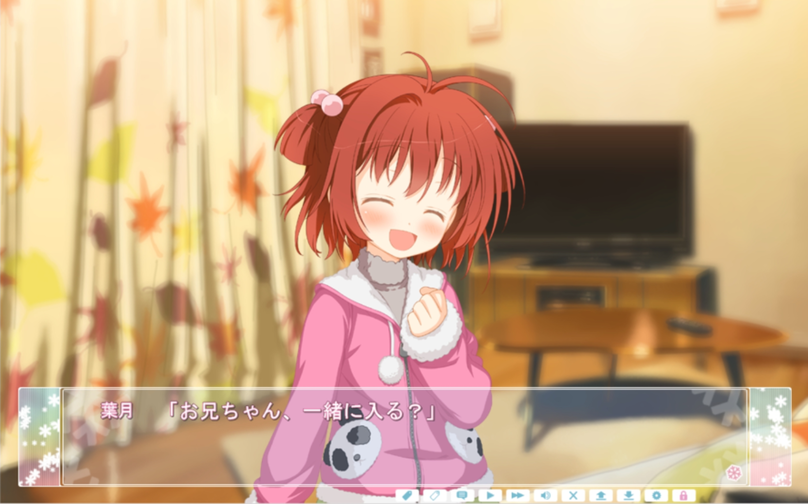
In the Tachibana Ochiba route the game emphasizes warmth and longing for family. In the everyday dialogue between Ochiba and Tachibana Hazuki you feel this thick, cozy warmth, and Ochiba herself is written with real flesh and blood — a girl who, standing in for her mother who died young, holds the whole family together alone. Strong on the outside, anxious and fragile on the inside. It comes through vividly.
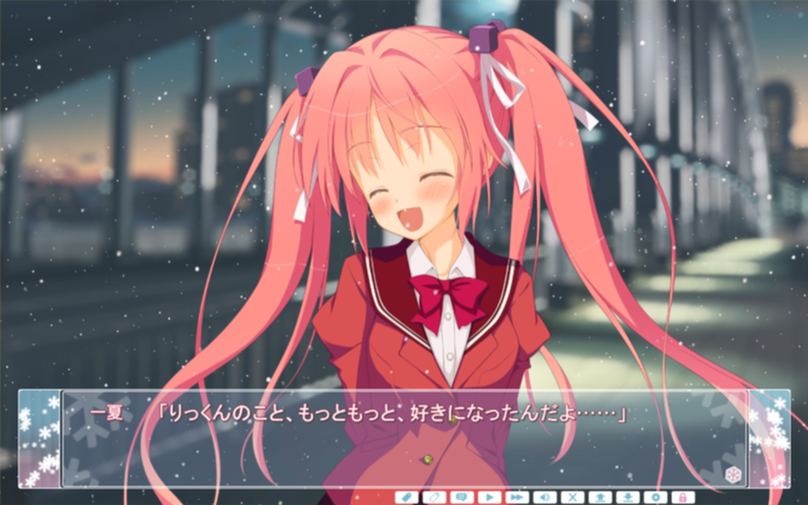
In the Ichika route the story leans on Ichika’s innocent, bubbly personality and her care for her sister, plus the attachment to the protagonist that awakens after she discovers her powers. Especially the part where she realizes the only bond between her and the protagonist is her ability — and the love-hate that comes with that inexplicable thing. Ichika’s everyday pouts and neediness, paired with Kiritsu Hana’s voice work, make the whole route pure sweetness.
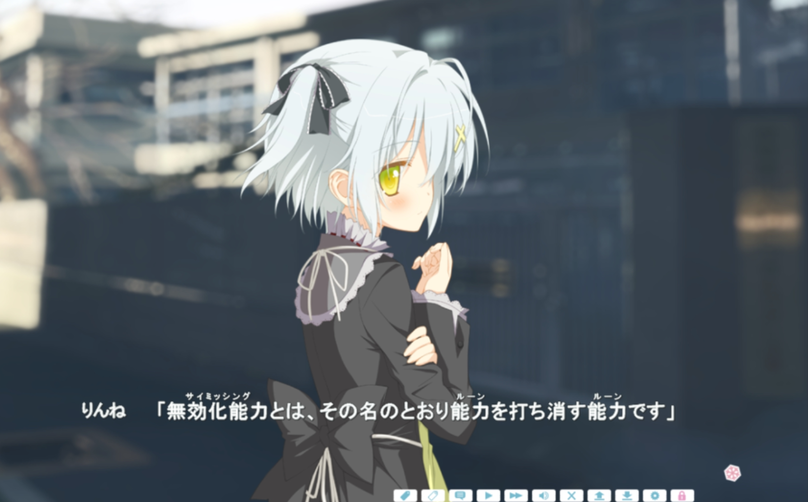
The protagonist’s sister Rinne’s route is a much sadder one. Rinne knows she’s the protagonist’s sister; the protagonist doesn’t. The whole route is full of Rinne muttering to herself about him — she likes her brother but can’t say it, because they’re siblings, and he already has Koyuki, whom he likes. Should she steal him? Should she confess? Rinne’s inner turmoil gets detailed page time here; the protagonist himself gets relatively little, though since it’s a personal route that’s fine.
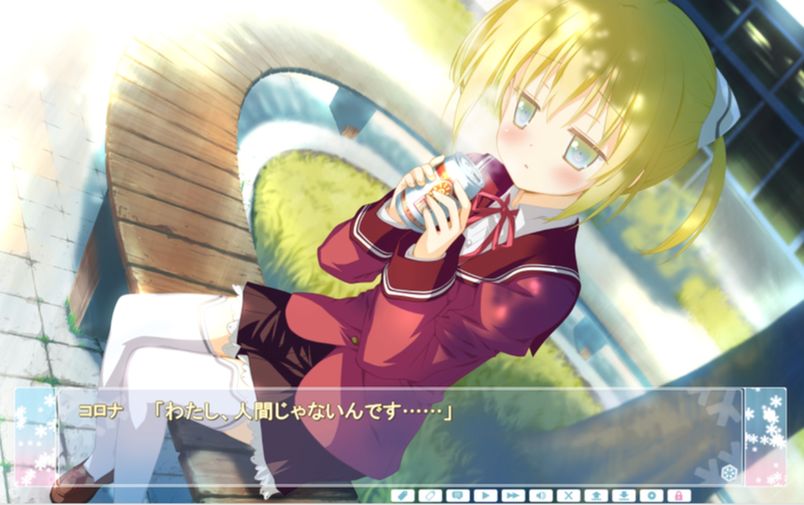
I didn’t go through Korona’s and Kotori’s routes carefully, but the themes are passable. Not as deep as the first three, but serviceable enough.
Worth mentioning is the voice cast. Ochiba is voiced by Takamori Natsumi, who usually does TV anime — and she genuinely surprised me. In TV anime she only ever plays hyperactive girls, like Misaki in Sakurasou, Misaki in Another, and some energetic girl in the electric district bookshop anime this season. It’s hard to imagine she has this other, slightly mature female register. Hands down the best performance in the game. Then there’s Ohashi Ayuru; I’d heard her in Hoshi Ori and Your Diary, but that slow, coquettish, rambling delivery she does here still feels one of a kind. Kiritsu Hana as Ichika is just fine — her voice is too similar to Kotachi’s, so it’s a standard performance with no real highlights. Korona’s VA I wasn’t familiar with, but I found out she’s the older sister from Renai 0 Kilometer. All I can say is: that older-sister voice can go die, just use the Korona voice from now on. Kotori’s Chōba Juri is nothing special — flat, same as Shichimiya Sōko in Chūnibyō. And finally Hazuki’s VA, our great Akizuki Airi… no, Ikaruga Hiromi — absolutely perfect. I never realized she suited loli roles this well. That skill level would steamroll people even in TV anime.
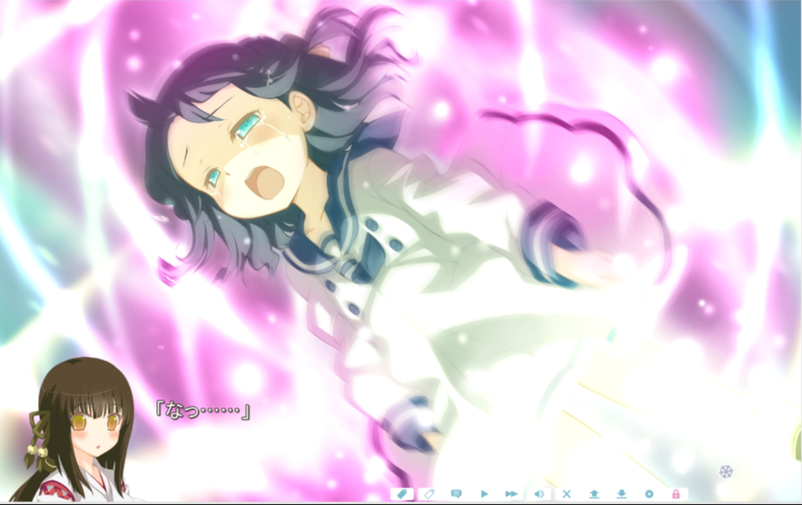
The Ochiba route, the Rinne route, the Ichika route — all good. Warm where it’s supposed to be warm, sweet where it’s sweet, sad where it’s sad. It shows the writer’s real skill with slice-of-life, small details, and character building.
But but but — none of them have a damn thing to do with the main plot.
Don’t forget the game opens with fantasy flavor: Tsukisaki’s town snows year-round, a girl named Koyuki appears and vanishes like a ghost, espers keep going berserk for no reason. That’s obviously the main plot, and the common route spends a lot of time on it — the first berserk, Chisa’s; the second, Ichika’s; the third, the young Yuzu’s; the fourth, Hazuki getting abducted. The questions pile up, the mysteries multiply — and in Ochiba, Ichika, Rinne, Korona, and Kotori’s routes, all of it gets zero. answers.
All you get is: Koyuki showed up, the town snowed, the fight between espers ended for no clear reason, and at the very end of the route a mysterious girl shows up, says something cryptic, and then nothing. Nothing at all…
Want to know why? The route lock exists to teach you a lesson. You have to finish every heroine’s route before the final True End unlocks.
And when I got to the True End, I wanted to kneel before the writer.
The True End’s plotting is a mess. First it recaps the endings of all the other routes. (What the hell, you just made me play all of them, why are you telling me again? Padding?) Then Koyuki shows up mysteriously again, with no interaction with the protagonist that has any actual value each time; instead the side character Hinata’s screen time balloons, and sometimes I wondered whose route this was. After dragging on and on, it suddenly starts going berserk…
What do I mean by berserk? Dumping every setting and so-called truth into your skull all at once — unprocessed, raw, like someone pouring gasoline down your throat with a bucket.
Suddenly a director named Shiraha who was background scenery in the other routes pops out. Suddenly the protagonist is inside the research lab. Suddenly he finds a girl named Shiraha Yuki lying there. Suddenly she tells him Koyuki is something she summoned, and when she explains why, I nearly spat out my drink…
“When I was little I came into contact with a rock from a Mars expedition, and I got psychic powers. I was bedridden then. I wanted a friend. So my power activated, my wish came true, and Koyuki appeared.”
So our great Koyuki is a girl who popped out of a rock from Mars, and the plot rolls on: the so-called psychic powers are contagious. Meaning Koyuki is the source; she infected the protagonist, the protagonist infected Rinne, then Koyuki infected the lab people, the lab people infected Ochiba, Ochiba infected Hazuki — and this thing called psychic power spreads through the whole town like a virus.
How did the protagonist’s father die? The moment Shiraha Yuki got her powers they went out of control, killed him, and infected a bunch of other people too.
Then our Koyuki feels sad about it. She thinks she’s infecting people with powers that might go berserk, that she’s the root of all evil. To avoid spreading it further she hides away and avoids people — except for chatting with the protagonist now and then…
By this point my brain had checked out… It’s like watching a myth: Bai Niangzi and Xu Xian in love, and suddenly Bai Niangzi says, “Husband, actually I’m an alien from Mars.” That exact weird vibe.
I’d assumed Koyuki was some kind of spirit — a spirit and a human falling in love, crossing the species line, touching stuff. And Koyuki is a spirit, technically. Just a spirit from Mars… carrying a virus called psychic power. In the end the protagonist says he doesn’t care who Koyuki is, the two of them have a mindfuck inside Koyuki’s dream, and the plot wraps up hastily for no clear reason.

I can’t understand it. I can’t understand why the writer is so fixated on aliens and Mars expeditions. Is it because Korona’s route has sci-fi elements? But Korona isn’t a robot, which already undercuts that. Is it because the game needs a research lab? Is it because the protagonist’s father died on a Mars expedition, so everything has to be tied together? And to bump up the cool factor the game drags in Norse mythology — which has zero actual effect on the main story…
It would’ve been fine to just focus the writing on the romance between Koyuki and the protagonist. Instead, to patch together that pile of nonsense, it ends up neither fish nor fowl. And the so-called Koyuki route doesn’t even flesh out Koyuki’s personality properly — all I remember is her eating everything in sight. That’s it. Nothing else stuck…
The writer may have a knack for slice-of-life, but he’s clearly bad at psychic powers and broader worldbuilding. Outside the True End, the psychic battle scenes lack tension and any detail about the fighting itself — the protagonist just “tries harder” and the other guy falls down…
Koyuki’s VA is the legendary Nitta Emi, and honestly her performance isn’t great. The voice has no distinct character, doesn’t leave an impression — though that’s partly because the character herself is underwritten. The music is decent, though I couldn’t find an OST download; the bonus was just a song album. The art style is what you see in the screenshots — blindingly white… but the characters are cute enough. Sometimes I even wonder if this artist worked on Alcot’s My Childhood Friend Became President, because the style is so similar…
What can I say… For The White Eternity of the Starry Vault, maybe finishing Ochiba, Ichika, and Rinne’s routes and never touching that so-called True End is the best choice.
Comments are hosted on the Chinese main site. This mirror is read-only.